
Category Archives: Science

Behold: the fantastic star-formation region near the edge of NGC 2174, aka The Monkey’s Head Nebula in the constellation of Orion, about 6,400 light-years away. To wit:

It follows mountainous clouds of gas and dust carved by winds and radiation from the region’s newborn stars, now found scattered in open star clusters embedded around the center of NGC 2174, off the top of the frame. Though star formation continues within these dusty cosmic clouds they will likely be dispersed by the energetic newborn stars within a few million years. Recorded at infrared wavelengths by the Hubble Space Telescope in 2014, the interstellar scene spans about 6 light-years. Scheduled for launch in 2021, the James Webb Space Telescope is optimized for exploring the Universe at infrared wavelengths.

(Image : NASA, ESA, Hubble Heritage Team (STScI/AURA)

apod

Behold: a spectacular view from the International Space Station of an aurora generously slathered like salsa verde onto the Earth’s thermosphere just before midsummer 2017. To wit:

About 400 kilometres (250 miles) above Earth, the orbiting station is itself within the upper realm of the auroral displays. Aurorae have the signature colours of excited molecules and atoms at the low densities found at extreme altitudes. Emission from atomic oxygen dominates this view. The tantalizing glow is green at lower altitudes, but rarer reddish bands extend above the space station’s horizon. The orbital scene was captured while passing over a point south and east of Australia, with stars above the horizon at the right belonging to the constellation Canis Major, Orion’s big dog. Sirius, alpha star of Canis Major, is the brightest star near the Earth’s limb.

(Image: Jack Fischer, Expedition 52, NASA)

apod

The Moon: changing its appearance nightly depending on numerous factors but nonetheless entirely predictable. To wit:

As the Moon orbits the Earth, the half illuminated by the Sun first becomes increasingly visible, then decreasingly visible. The featured video animates images taken by NASA’s Moon-orbiting Lunar Reconnaissance Orbiter to show all 12 lunations that appear this year, 2021. A single lunation describes one full cycle of our Moon, including all of its phases. A full lunation takes about 29.5 days, just under a month (moon-th). As each lunation progresses, sunlight reflects from the Moon at different angles, and so illuminates different features differently. During all of this, of course, the Moon always keeps the same face toward the Earth. What is less apparent night-to-night is that the Moon‘s apparent size changes slightly, and that a slight wobble called a libration occurs as the Moon progresses along its elliptical orbit.

(Video: Data: Lunar Reconnaissance Orbiter ; Animation: NASA‘s Scientific Visualization Studio; Music: Brandenburg Concerto No4-1 BWV1049 (Johann Sebastian Bach), by Kevin MacLeod via Incompetech)

apod

Behold: some of the largest, hottest and most massive stars known to science. To wit:

These stars, known collectively as star cluster R136, part of the Tarantula Nebula, were captured in the featured image in visible light in 2009 through the Hubble Space Telescope. Gas and dust clouds in the Tarantula Nebula, have been sculpted into elongated shapes by powerful winds and ultraviolet radiation from these hot cluster stars. The Tarantula Nebula lies within a neighboring galaxy known as the Large Magellanic Cloud and is located a mere 170,000 light-years away.

(Image: NASA, ESA, & F. Paresce (INAF-IASF), R. O’Connell (U. Virginia) et al.)

apod

Behold: the majestic 200,000 light years wide island universe of NGC 1365, aka the Great Barred Spiral Galaxy. To wit:

Located a mere 60 million light-years away toward the chemical constellation Fornax, NGC 1365 is a dominant member of the well-studied Fornax Cluster of galaxies. This impressively sharp color image shows the intense, reddish star forming regions near the ends of central bar and along the spiral arms, with details of the obscuring dust lanes cutting across the galaxy’s bright core. At the core lies a supermassive black hole. Astronomers think NGC 1365’s prominent bar plays a crucial role in the galaxy’s evolution, drawing gas and dust into a star-forming maelstrom and ultimately feeding material into the central black hole.

(Image: Mike Selby, Leonardo Orazi)

apod

Waddaya mean there wasn’t one?

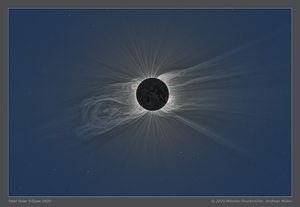
If you were present along a narrow path between Chile and Argentina for the final New Moon of 2020 on December 14th last, you’d have seen the only total solar eclipse of the year. To wit:

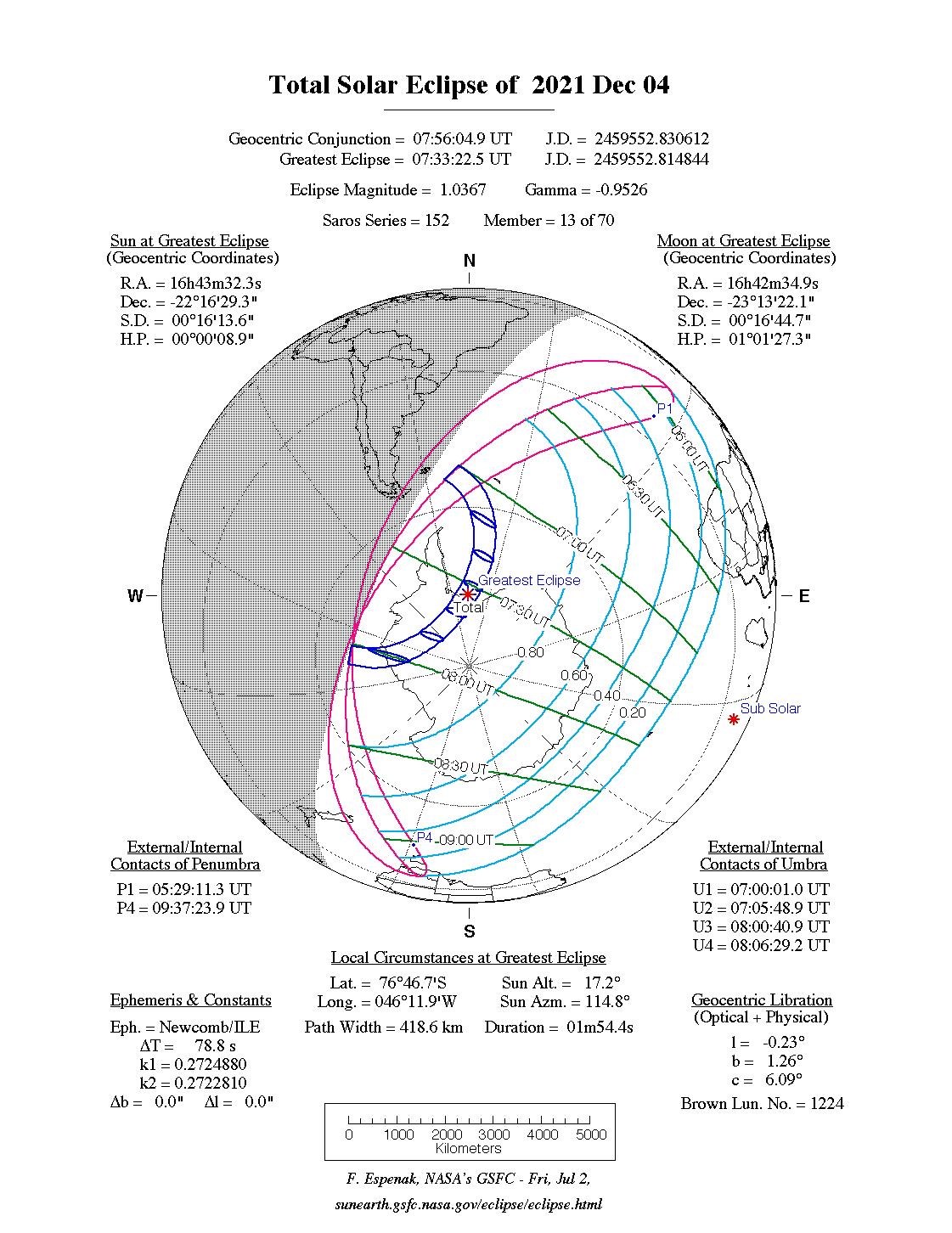
Within about 2 days of perigee, the closest point in its elliptical orbit, the New Moon’s surface is faintly lit by earthshine in this dramatic composite view. The image is a processed composite of 55 calibrated exposures ranging from 1/640 to 3 seconds. Covering a large range in brightness during totality, it reveals the dim lunar surface and faint background stars, along with planet-sized prominences at the Sun’s edge, an enormous coronal mass ejection, and sweeping coronal structures normally hidden in the Sun’s glare. Look closely for an ill-fated sungrazing Kreutz family comet (C/2020 X3 SOHO) approaching from the lower left, at about the 7 o’clock position. In 2021 eclipse chasers will see an annular solar eclipse coming up on June 10. They’ll have to wait until December 4 for the only total solar eclipse in 2021 though. That eclipse will be total along a narrow path crossing the southernmost continent of Antarctica.

(Image: Miloslav Druckmuller, Andreas Moller, (Brno University of Technology)

apod

Behold: the curiously striped dunes of the Kunowsky crater – part of an image captured recently by the Mars Reconnaisance Orbiter’s HiRISE Camera.

But why do they look like that? No one knows. To wit:

Many Martian dunes are known to be covered unevenly with carbon dioxide (dry ice) frost, creating patterns of light and dark areas. Carbon dioxide doesn’t melt, but sublimates, turning directly into a gas. Carbon dioxide is also a greenhouse material even as a solid, so it can trap heat under the ice and sublimate from the bottom up, causing geyser-like eruptions. During Martian spring, these eruptions can cause a pattern of dark defrosting spots, where the darker sand is exposed. The featured image, though, was taken during Martian autumn, when the weather is getting colder – making these stripes particularly puzzling. One hypothesis is that they are caused by cracks in the ice that form from weaker eruptions or thermal stress as part of the day-night cycle, but research continues. Watching these dunes and others through more Martian seasons may give us more clues to solve this mystery.

(Image: HiRISE, MRO, LPL (U. Arizona), NASA; Processing: Włodek Głażewski; Text: Alex R. Howe (NASA/USRA, Reader’s History of SciFi Podcast)

apod

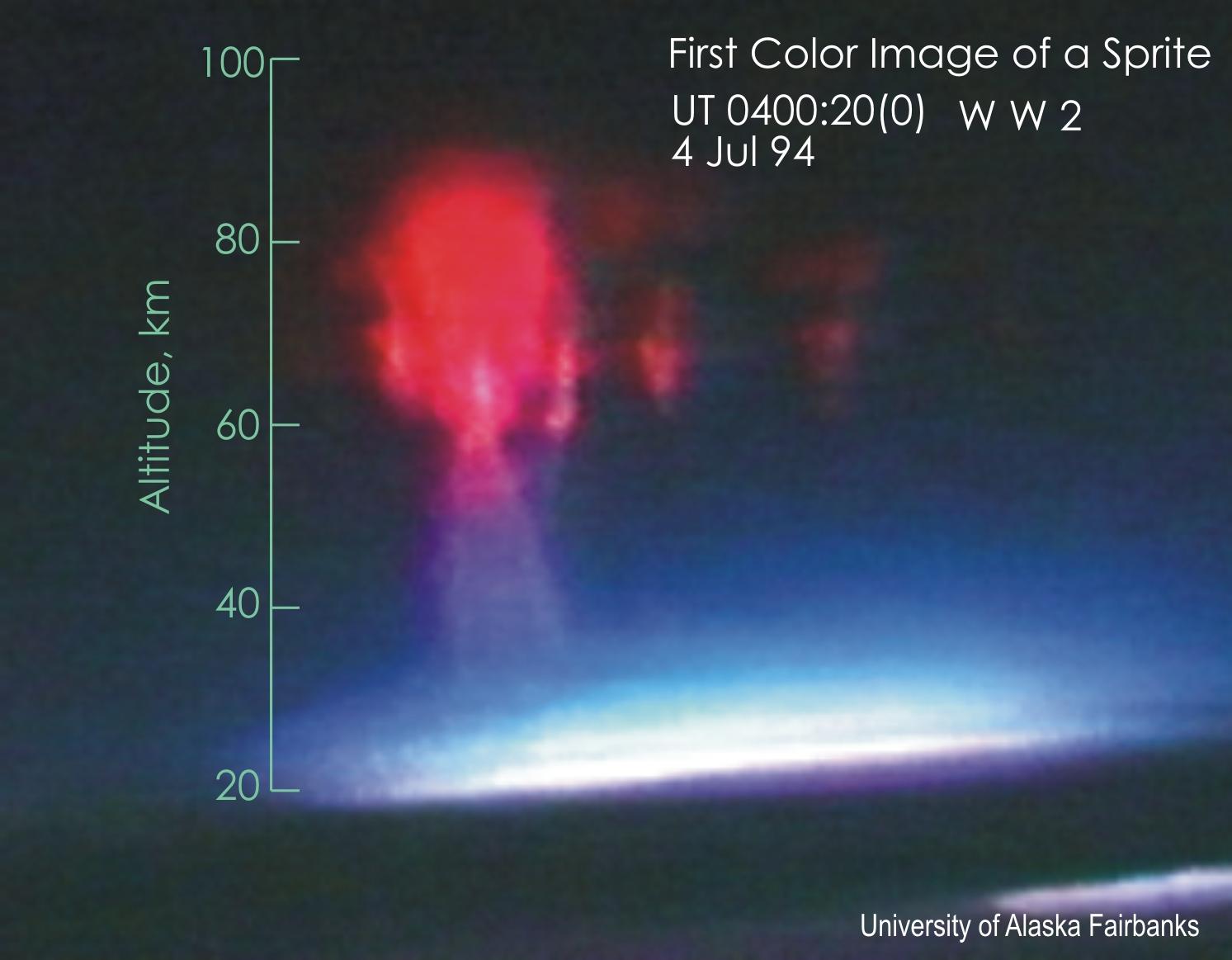
Behold: ghostly sprite lightning at 100,000 frames per second. But what is it?

Mysterious bursts of light in the sky that momentarily resemble gigantic jellyfish have been recorded for over 30 years, but apart from a general association with positive cloud-to-ground lightning, their root cause remains unknown. Some thunderstorms have them — most don’t. Recently, however, high speed videos are better detailing how sprites actually develop. The featured video, captured in mid-2019, is fast enough — at about 100,000 frames per second — to time-resolve several sprite “bombs” dropping and developing into the multi-pronged streamers that appear on still images. Unfortunately, the visual clues provided by videos like these do not fully resolve the sprite origins mystery. High speed vidoes do indicate to some researchers, though, that sprites are more likely to occur when plasma irregularities exist in the upper atmosphere.

(Video: Matthew G McHarg, Jacob L Harley, Thomas Ashcraft, Hans Nielsen)

Previously: No Sprite Is Safe

apod

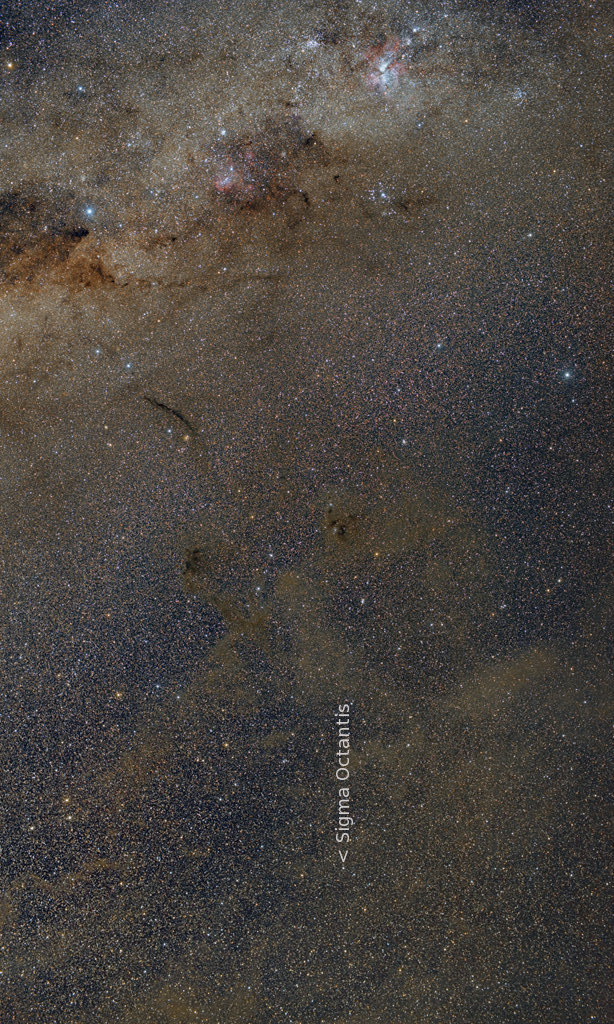
Behold: the South Celestial Pole – the centre of all southern star trail arcs – one of two imaginary points in the sky where the Earth’s axis of rotation indefinitely extended, intersects the celestial sphere. To wit: 

In this starry panorama stretching about 60 degrees across deep southern skies the South Celestial Pole is somewhere near the middle though, flanked by bright galaxies and southern celestial gems. Across the top of the frame are the stars and nebulae along the plane of our own Milky Way Galaxy. Gamma Crucis, a yellowish giant star heads the Southern Cross near top center, with the dark expanse of the Coalsack nebula tucked under the cross arm on the left. Eta Carinae and the reddish glow of the Great Carina Nebula shine along the galactic plane near the right edge. At the bottom are the Large and Small Magellanic clouds, external galaxies in their own right and satellites of the mighty Milky Way. A line from Gamma Crucis through the blue star at the bottom of the southern cross, Alpha Crucis, points toward the South Celestial Pole, but where exactly is it? Just look for south pole star Sigma Octantis. Analog to Polaris the north pole star, Sigma Octantis is little over one degree fom the the South Celestial pole.

(Image: Petr Horalek, Josef Kujal)

apod