
Category Archives: Science

To the unaided eye, meteors – while impressive in speed and suddeness – are usually just white steaks across the sky. The cameras sees more. To wit:

Pictured is a Quadrantids meteor captured by camera over Missouri, USA, early this month that was not only impressively bright, but colourful. The radiant grit, likely cast off by asteroid 2003 EH1, blazed a path across Earth’s atmosphere. Colours in meteors usually originate from ionised elements released as the meteor disintegrates, with blue-green typically originating from magnesium, calcium radiating violet, and nickel glowing green. Red, however, typically originates from energised nitrogen and oxygen in the Earth’s atmosphere. This bright meteoric fireball was gone in a flash — less than a second — but it left a wind-blown ionisation trail that remained visible for several minutes.

(Image: Frank Kuszaj)

apod

Behold: the beautiful spiral galaxy Messier 66 in glorious detail despite being 35 million light years away. To wit:

The gorgeous island universe is about 100 thousand light-years across, similar in size to the Milky Way. This reprocessed Hubble Space Telescope close-up view spans a region about 30,000 light-years wide around the galactic core. It shows the galaxy’s disk dramatically inclined to our line-of-sight. Surrounding its bright core, the likely home of a supermassive black hole, obscuring dust lanes and young, blue star clusters sweep along spiral arms dotted with the tell-tale glow of pinksh star forming regions. Messier 66, also known as NGC 3627, is the brightest of the three galaxies in the gravitationaly interacting Leo Triplet.

(Image: NASA, ESA, Hubble; Processing & Copyright: Leo Shatz)

apod

You’ve seen a lunar halo before. But probably not like this. To wit:

This fairly common sight occurs when high thin clouds containing millions of tiny ice crystals cover much of the sky. Each ice crystal acts like a miniature lens. Because most of the crystals have a similar elongated hexagonal shape, light entering one crystal face and exiting through the opposing face refracts 22 degrees, which corresponds to the radius of the Moon Halo. A similar Sun Halo may be visible during the day. Exactly how ice-crystals form in clouds remains a topic of research. In the featured image taken last week from Östersund, Sweden, a complete lunar halo was captured over snowy trees and rabbit tracks.

(Image: Göran Strand)

apod

Behold: the vertical magnetic field of NGC 5775, a spiral galaxy 70 million light years away in the Virgo Cluster.

Not just attractive, it’s even more attractive than previously thought. To wit:

For decades, astronomers knew only that some spiral galaxies had magnetic fields. However, after NRAO‘s Very Large Array (VLA) radio telescope (popularized in the movie Contact) was upgraded in 2011, it was unexpectedly discovered that these fields could extend vertically away from the disk by several thousand light-years. The featured image of edge-on spiral galaxy NGC 5775, observed in the CHANG-ES (Continuum Halos in Nearby Galaxies) survey, also reveals spurs of magnetic field lines that may be common in spirals. Analogous to iron filings around a bar magnet, radiation from electrons trace galactic magnetic field lines by spiraling around these lines at almost the speed of light. The filaments in this image are constructed from those tracks in VLA data. The visible light image, constructed from Hubble Space Telescope data, shows pink gaseous regions where stars are born. It seems that winds from these regions help form the magnificently extended galactic magnetic fields.

(Image: NRAO, NASA, ESA, Hubble; Processing & Text: Jayanne English (U. Manitoba)

apod

Behold: the expanding debris cloud known as Cassiopeia A – a cosmic memorial to the fate of an ancient star. To wit:

Massive stars in our Milky Way Galaxy live spectacular lives. Collapsing from vast cosmic clouds, their nuclear furnaces ignite and create heavy elements in their cores. After a few million years, the enriched material is blasted back into interstellar space where star formation can begin anew […] Light from the explosion which created this supernova remnant would have been first seen in planet Earth’s sky about 350 years ago, although it took that light about 11,000 years to reach us. This false-colour image, composed of X-ray and optical image data from the Chandra X-ray Observatory and Hubble Space Telescope, shows the still hot filaments and knots in the remnant. It spans about 30 light-years at the estimated distance of Cassiopeia A. High-energy X-ray emission from specific elements has been colour coded, silicon in red, sulphur in yellow, calcium in green and iron in purple, to help astronomers explore the recycling of our galaxy’s star stuff. Still expanding, the outer blast wave is seen in blue hues. The bright speck near the centre is a neutron star, the incredibly dense, collapsed remains of the massive stellar core.

(Image: X-ray – NASA, CXC, SAO; Optical – NASA,STScI)

apod

Behold: the majestic disc of NGC 2841 – one of the most massive known galaxies, a mere 46 million light years away in the constellation of Ursa Major. To wit:

This sharp view of the gorgeous island universe shows off a striking yellow nucleus and galactic disk. Dust lanes, small, pink star-forming regions, and young blue star clusters are embedded in the patchy, tightly wound spiral arms. In contrast, many other spirals exhibit grand, sweeping arms with large star-forming regions. NGC 2841 has a diameter of over 150,000 light-years, even larger than our own Milky Way. The featured composite image merges exposures from the orbiting 2.4-meter Hubble Space Telescope and the ground-based 8.2-meter Subaru Telescope. X-ray images suggest that resulting winds and stellar explosions create plumes of hot gas extending into a halo around NGC 2841.

(Image: NASA, ESA, Hubble, Subaru; Composition & Copyright: Roberto Colombari)

apod

Behold: the many interstellar dust clouds and glowing nebulae of the constellation of Orion. To wit:

One of the brightest, M78, is centred in this colourful, wide field view, covering an area north of Orion’s belt. At a distance of about 1,500 light-years, the bluish reflection nebula is around 5 light-years across. Its tint is due to dust preferentially reflecting the blue light of hot, young stars. Reflection nebula NGC 2071 is just to the left of M78. Flecks of emission from Herbig-Haro objects, energetic jets from stars in the process of formation, stand out against the dark dust lanes. The exposure also brings out the region’s fainter, pervasive reddish glow of atomic hydrogen gas.

(Image: Wes Higgins)

apod

Behold: vast jets emanating from the Centaurus A galaxy, aka Caldwell 77, each one more than a million light years long. To wit:

These jets of streaming plasma, expelled by a giant black hole in the centre of this spiral galaxy, light up this composite image of Cen A. Exactly how the central black hole expels infalling matter remains unknown. After clearing the galaxy, however, the jets inflate large radio bubbles that likely glow for millions of years. If energised by a passing gas cloud, the radio bubbles can even light up again after billions of years. X-ray light is depicted in the featured composite image in blue, while microwave light is coloured orange. The base of the jet in radio light shows details of the innermost light year of the central jet.

(Image: ESO/WFI (visible); MPIfR/ESO/APEX/A. Weiss et al. (microwave); NASA/CXC/CfA/R. Kraft et al. (X-ray)

apod

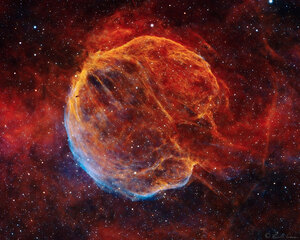
Behold: CTB-1, aka the Medulla Nebula – a mighty supernova remnant, but from where does it draw its brainpower? To wit:

CTB-1 is the expanding gas shell that was left when a massive star toward the constellation of Cassiopeia exploded about 10,000 years ago. The star likely detonated when it ran out of elements, near its core, that could create stabilizing pressure with nuclear fusion. The resulting supernova remnant, nicknamed the Medulla Nebula for its brain-like shape, still glows in visible light by the heat generated by its collision with confining interstellar gas. Why the nebula also glows in X-ray light, though, remains a mystery. One hypothesis holds that an energetic pulsar was co-created that powers the nebula with a fast outwardly moving wind. Following this lead, a pulsar has recently been found in radio waves that appears to have been expelled by the supernova explosion at over 1000 kilometers per second. Although the Medulla Nebula appears as large as a full moon, it is so faint that it took 130-hours of exposure with two small telescopes in New Mexico, USA, to create the featured image.

(Image: Russell Croman)

apod