
Category Archives: Science

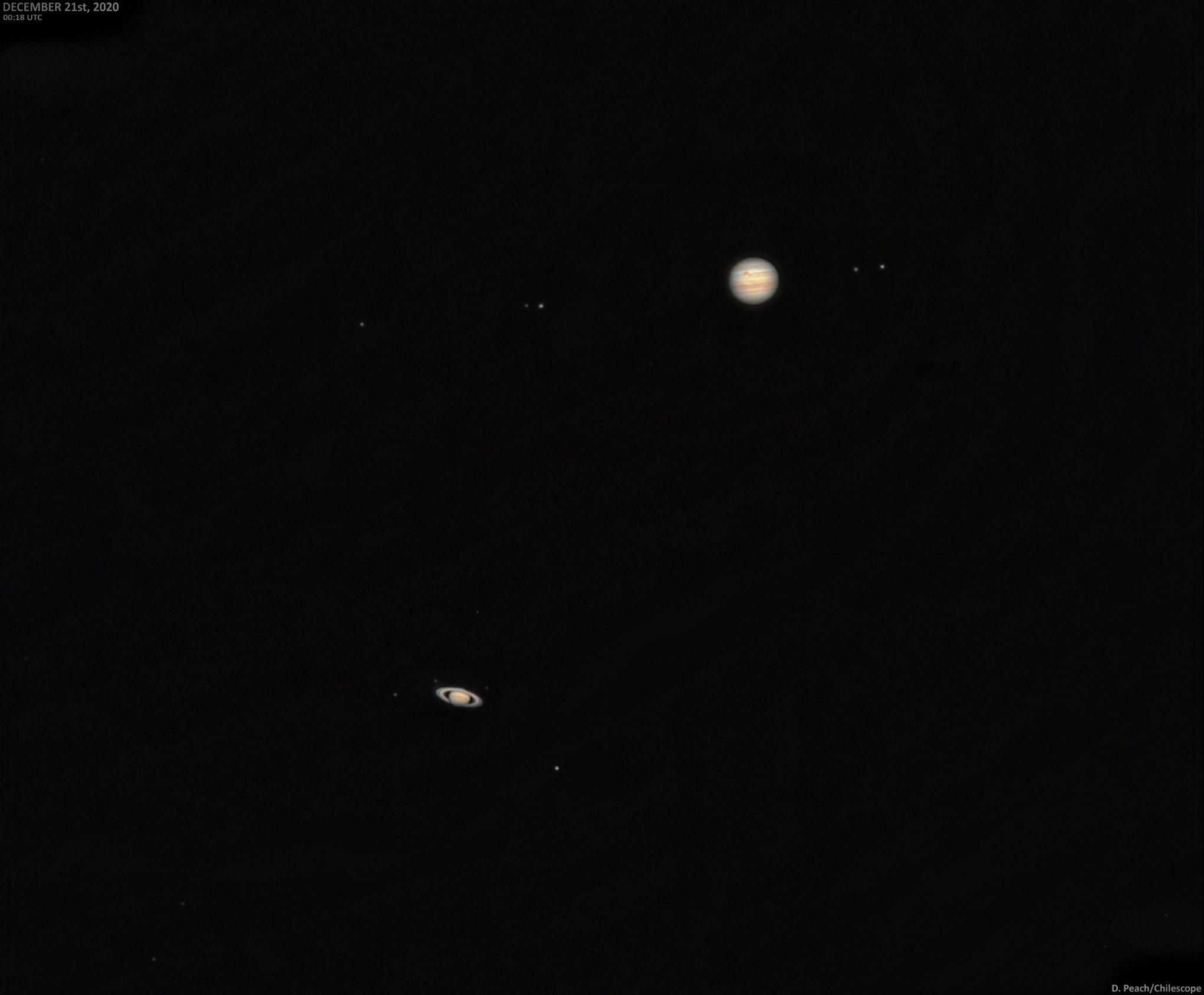
Behold: two gas giants passing in the night. What do you mean you missed it? To wit:

Two days ago Jupiter and Saturn passed a tenth of a degree from each other in what is known a Great Conjunction. Although the two planets pass each other on the sky every 20 years, this was the closest pass in nearly four centuries. Taken early in day of the Great Conjunction, the featured multiple-exposure combination captures not only both giant planets in a single frame, but also Jupiter’s four largest moons (left to right) Callisto, Ganymede, Io, and Europa — and Saturn’s largest moon Titan. If you look very closely, the clear Chilescope image even captures Jupiter’s Great Red Spot. The now-separating planets can still be seen remarkably close — within about a degree — as they set just after the Sun, toward the west, each night for the remainder of the year.

(Image: Damian Peach)

apod

Behold: Monty the space slug one of several dense, constantly eroding cosmic dust pillars in the Trifid Nebula (M20). To wit:

Visible in the featured picture is the end of a huge gas and dust pillar […] punctuated by a smaller pillar pointing up and an unusual jet pointing to the left. Many of the dots are newly formed low-mass stars. A star near the small pillar’s end is slowly being stripped of its accreting gas by radiation from a tremendously brighter star situated off the top of the image. The jet extends nearly a light-year and would not be visible without external illumination. As gas and dust evaporate from the pillars, the hidden stellar source of this jet will likely be uncovered, possibly over the next 20,000 years.

(Image: NASA, ESA, Hubble Space Telescope, HLA; Processing: Advait Mehla)

apod

Behold: the annual horizontal transit of the rising sun. To wit:

The featured image shows the direction of sunrise every month during 2019 as seen from near the city of Amman, Jordan. The camera in the image is always facing due east, with north toward the left and south toward the right. Although the Sun always rises in the east in general, it rises furthest to the south of east on the December solstice, and furthest north of east on the June solstice. Today is the December solstice, the day of least sunlight in the Northern Hemisphere and of most sunlight in the Southern Hemisphere. In many countries, the December Solstice is considered an official change in season: for example the first day of winter in the North. Solar heating and stored energy in the Earth’s surface and atmosphere are near their lowest during winter, making the winter months usually the coldest of the year. On the brighter side, in the north, daylight hours will now increase every day from until June.

(Image: Zaid M. Al-Abbadi)

apod

Behold: a spectacular 35 frame, hour-long exposure of the annual Gemenid meteor shower taken just after midnight last Sunday in the Italian Dolomites. To wit:

Sirius, alpha star of Canis Major and the brightest star in the night, is grazed by a meteor streak on the right. The Praesepe star cluster, also known as M44 or the Beehive cluster, itself contains about a thousand stars but appears as a smudge of light far above the southern alpine peaks near the top. The shower’s radiant is off the top of the frame though, near Castor and Pollux the twin stars of Gemini. The radiant effect is due to perspective as the parallel meteor tracks appear to converge in the distance. As Earth sweeps through the dust trail of asteroid 3200 Phaethon, the dust that creates Gemini’s meteors enters Earth’s atmosphere traveling at about 22 kilometres per second.

(Image: Stefano Pellegrini)

apod

Behold: the colliding galaxies of the Bullet Cluster, as you’ve never heard them before. To wit:

This massive cluster of galaxies (1E 0657-558) creates gravitational lens distortions of background galaxies in a way that has been interpreted as strong evidence for the leading theory: that dark matter exists within. Different analyses, though, indicate that a less popular alternative — modifying gravity– could explain cluster dynamics without dark matter, and provide a more likely progenitor scenario as well. Currently, the two scientific hypotheses are competing to explain the observations: it’s invisible matter versus amended gravity. The duel is dramatic as a clear Bullet-proof example of dark matter would shatter the simplicity of modified gravity theories. The featured sonified image is a Hubble/Chandra/Magellan composite with red depicting the X-rays emitted by hot gas, and blue depicting the suggested separated dark matter distribution. The sonification assigns low tones to dark matter, mid-range frequencies to visible light, and high tones to X-rays. The battle over the matter in the Bullet cluster is likely to continue as more observations, computer simulations, and analyses are completed.

(Image: X-ray: NASA/CXC/SAO; Optical: NASA/STScI, Magellan/U.Arizona; Lensing Map: NASA/STScI, ESO WFI, Magellan/U.Arizona; Sonification: NASA/CXC/SAO/K.Arcand, SYSTEM Sounds (M. Russo, A. Santaguida)

apod

Behold: Simeis 147, aka Sharpless 2-240, aka the Spaghetti Nebula – a giant supernova remnant worthy of your praise. To wit:

Seen toward the boundary of the constellations Taurus and Auriga, it covers nearly 3 degrees or 6 full moons on the sky. That’s about 150 light-years at the stellar debris cloud’s estimated distance of 3,000 light-years. This composite includes image data taken through narrow-band filters where reddish emission from ionized hydrogen atoms and doubly ionized oxygen atoms in faint blue-green hues trace the shocked, glowing gas. The supernova remnant has an estimated age of about 40,000 years, meaning light from the massive stellar explosion first reached Earth 40,000 years ago. But the expanding remnant is not the only aftermath. The cosmic catastrophe also left behind a spinning neutron star or pulsar, all that remains of the original star’s core.

(Image: Georges Attard)

apod

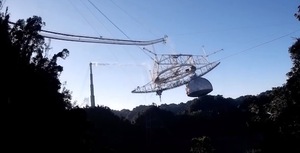
Up close footage of the collapse of the Arecibo telescope in Puerto Rico earlier this month, already in the process of being decommissioned having degraded and lost structural integrity in recent years. Mmf. To wit:

Starting in 1963, the 305-metres across Arecibo Telescope in Puerto Rico USA reigned as the largest single-dish radio telescope in the world for over 50 years. Among numerous firsts and milestones, data from Arecibo has been used to measure the spin of Mercury, map the surface of Venus, discover the first planets outside of our Solar System, verify the existence of gravitational radiation, search for extraterrestrial intelligence, and, reportedly, locate hidden military radar by tracking their reflections from the Moon. 

(Video: Arecibo Observatory, NSF)

apod