Tag Archives: Anne-Marie McNally

00010196


anne-marie-291x300

From top: Dick Spring (left) and Barry Desmond launching Labour Party’s General Election campaign, 1992; Anne Marie McNally

In Irish politics, long-term performance is less important than short-term factors

Anne Marie McNally writes:

To support the ins when things are going well; to support the outs when they seem to be going badly, in spite of all that has been said about Tweedledum and Tweedledee, is the essence of popular Government’ (Walter Lippman, The Phantom Public)

Those words were uttered in 1925 over 90 years ago but surely we, as an engaged citizenry, have evolved from such simplistic political actions and we instead base our electoral decisions on a complete overview and a more considered analysis of the long-term performance of those we might consider gifting our vote to.

We’re not simply going to fall for the hype and the fancy spun-out words tapping into the zeitgeist sure we’re not?

We’re going to judge people and their respective parties based on past actions and their ability to stand by their word, aren’t we?

You would think, nay hope, that would be the case. However, recent experiences, and current polls, seem to indicate that that is not in fact the case.

In 1992 when Labour swept to power, political scholars including Brian Girvin commented that despite the strong showing by Labour the result was less a vote of confidence in that party but rather a vote for change.

The same can be said of Fine Gael’s success in 2011 when the electorate quite literally went ABFF (Anybody But Fianna Fáil), most recently in 2016 the desire for change raised its head in its most dramatic way yet – but dramatic only by virtue of the increased choice available outside of the traditional 2.5 party system so long prevalent in Ireland.

But on the margins of that significant vote for change was a decided move back towards the old lover/enemy; Fianna Fáil.

The old adage of ‘better the devil you know’ seemed to resound in many voters heads. It was likely helped along by the fact that their 2011 vote for ‘change’ had resulted in 5 years of a Fine Gael/Labour coalition which had cut to the bone in ways few thought imaginable based on the promises and hyperbole from both parties during the 2011 campaign.

In the absence of any meaningful change despite the many promises proffered throughout the decades, many voters have, it seems, chosen to give Fianna Fáil a pass and ignore previous indiscretions in favour of their current stance as the party holding things together and making things happen.

The same Fianna Fáil who paved the path to the privatisation of education is now sanctimoniously decrying the removal of student grants.

I could list myriad other examples. It’s the popular message of the day and so it’s their message – and that’s fine for a centrist party who seek to tap into Lippman’s hypothesis above.

I don’t mean this as a critique specifically aimed at Fianna Fáil, it just so happens that they are the party benefiting from the electorate’s rose-tinted glasses at the moment if polls are to be believed.

Equally the same criticisms can be levelled at any of the two and a half traditional parties of old Irish politics at various points throughout history it’s just that right now they’re the outs and Fianna Fáil are the ins.

Political academia is divided on this topic but increasingly the theory is that long-term performance is less important than short-term factors and specifically economic issues.

The irony is not lost on me that it was economic issues that decimated Fianna Fáil in 2011 yet just 5 years later they are back on the rise, clearly short-term really does mean short-term!

Personally, I’d rather be someone who will stand by what I believe whether its ‘in or out’ and hope that somewhere along the line the majority of the electorate will choose to reject both Tweedledum, Tweedledee and their little half pal tweedleio based on a bigger picture than fancy rhetoric and campaign slogans.

And instead choose to judge on actions over words.

Anne Marie McNally is a founding member of the Social Democrats. Follow Anne Marie on Twitter: @amomcnally

anne-marie-291x300

From top: Facebook Likes, Illustration by Jennifer Daniel ; Anne Marie McNally

Maintaining a veil of privacy over your personal life – even on social media – has nothing to do with fear of scandal and everything to do with protection and the maintenance of clear lines of demarcation.

Anne Marie McNally writes:

The personal is political or so the saying goes. But is that, or should that be, the case? Isn’t it perfectly acceptable to want to keep some things beyond the scope of inevitable scrutiny that comes from being in the public eye?

Or is there a legitimate expectation that every part of a politician’s (or aspiring politician) life be laid bare as required by the media outlet of the day?

The question I raise concerns itself more with the intimate details of one’s life rather than any public pastimes so before the commentators get carried away telling me that they have a right to know if someone is a member of the KKK or engages in some other type of behaviour which is likely to have a direct impact on their role in the public eye, then yes, I agree – fair game.

My question however refers to the truly personal.

As a woman I am repeatedly asked about my family status, perhaps that’s the same for men but I can’t be sure. When someone asks you directly ‘do you have children’ is it acceptable to say ‘I’d rather not say?’ and if not, why not? The same argument applies to any relationship? So far I have tried, wherever possible to keep my two worlds separate.

Why? I’m not 100% sure to be honest but I do know this, the scrutiny that comes from being in the public eye is not always pleasant and I’m loathe to subject anyone to it who hasn’t specifically chosen it.

I’ve chosen it therefore I’m good with it but would it be fair for me to open others up to the possibility of attention they may not desire?

For a while now I’ve been left with the distinct impression that my evasiveness on those type of questions is somewhat unacceptable and other times I’ve felt judgement for some perceived ‘disowning’ on my behalf.

We’re lucky here in Ireland that we don’t have a tabloid media as feral as Britain’s. As such we’re devoid of the regular ‘scandals’ regarding the personal lives of public figures but that’s not to say we don’t get the gossip type columns where innuendo and subtle clues point to the identity of the person involved.

Then there’s social media where speculation and finger-pointing comes with the territory. That’s one side of the coin but the less salacious, less obvious reason for maintaining a veil of privacy over your personal life has nothing to do with fear of scandal and everything to do with protection and the maintenance of clear lines of demarcation.

I tried to keep my personal Facebook page personal, but the friend requests kept coming and I now have people on there who are more colleagues than friends and so I’ve adjusted the personal content pertaining to others in my life accordingly.

This may mean that you’ll only see photos of me socialising with political friends – it doesn’t mean I don’t spend the majority of my life with those not in my political world, it just means you won’t read about it on Facebook.

During the recent General Election campaign I had a hugely positive campaign and response but there were blips. Unfortunately a woman becoming so visible in public life will always bring slugs from beneath rocks and I had some really nasty emails from clearly disturbed individuals.

I had hate mail from people who wanted me to not exist; I had ‘fan’ mail from delusional men who thought they were in love with me; and I had one or two ‘lovely girl’ emails with embedded rape threats.

I’ve even had one ‘nice’ man go to the bother of sending me an email recently to tell me ‘my lovely bum is too round for politics’ – though he did clarify that statement with the bracketed disclaimer (‘that’s a compliment by the way’) – well that’s alright so, thanks for that.

I brushed those incidents, and other similar ones, off without much of a second thought, I know what comes with the territory but my family and friends did not and so my unwillingness to involve them in that side of my life is not me choosing to pretend they don’t exist.

it’s me refusing to open their existence up to the same level of scrutiny that I’ve signed up for.

Anne Marie McNally is a founding member of the Social Democrats. Follow Anne Marie on Twitter: @amomcnally

leinsterhouse


anne-marie-291x300

From top: Leinster House, Kildare Street, Dublin 2; Anne Marie McNally

Though often chaotic and unseemly, we are finally getting a a parliament where issues are king.

Anne Marie McNally writes:

The first term of the 32nd Dáil has come to an end, marking a pivotal moment in the history of politics in Ireland.

It has been a term where we surpassed the previously held record for the length of time it took to form a Government.

It gave us a Minority Government and a convoluted partnership agreement that’s not a coalition – not in name anyway.

It also gave us the lofty claims of ‘new politics’, the oft-repeated phrase which has become the slogan of the 32nd Dáil.

It’s trotted out by politicians across the spectrum and political correspondents are equally effusive in both welcoming it and deriding it depending on which way the wind is blowing on a particular day.

For all the derision that can be levied at the 32nd Dáil (and Irish politics in general) I think it’s fair to say that ‘new politics’ has critically shifted the way business is done in this bubble of ours in Leinster House.

Gone are the days of Bills floating through the House on a sea of arrogant majority Government backbenchers.

Gone are the looming guillotines ensuring legislation is passed at times convenient to Government despite the protestations of the opposition.

Gone too are the refusals of Government to provide adequate time for opposition business or smaller parties and Independents.

Instead we have, though often chaotic and unseemly, a parliament where issues are king. Suddenly the substance of a particular piece of legislation is the most important thing and not the shade of the party proposing it.

We’ve had opposition support Government initiatives and we’ve had Government support opposition business. There is more time and scope for consensus and agreement. Opposition for opposition sake is increasingly – both inside the bubble and out –being derided as ineffective and damaging.

Fianna Fáil have tabled two pieces of legislation – one on Au Pairs and one on the sale of Local Authority Homes built under the Part V rules. Both Bills were defeated, not because they were Fianna Fáil Bills but because it was generally agreed that both were flawed pieces of legislation. The majority of opposition voted with Government in defeating those Bills.

Minister Simon Coveney’s housing plan has come about as a result of a consultation process he held with all other parties and Independents. We know from the substance of that plan that he listened and took on board some of the submissions made to him.

Similarly, Róisín Shortall has presided over the establishment of the All-Party Committee on Health which the Social Democrats put forward with a stated aim of ‘delivering a universally accessible publicly funded health service.’

This stated aim was almost universally accepted and supported (everyone except AAA/PBP signed up to and supported the motion) and the Committee was created.

Róisín, despite being from a smaller party was appointed as Chair of that Committee with the support of colleagues from every party as it was acknowledged that this had been a Social Democrats initiative and Roisin’s expertise and commitment was best placed to drive it.

Whichever way you look at things, that is an entirely new way of doing business.

The theatre of the shouting and balling across at each other still exists, particularly during the camera opportunities of Leaders Questions etc. but by and large those instances are much reduced.

There is a greater emphasis on getting to the heart of the issue and explaining why you support the legislation/motion or not. There is a sense that the other side is listening to you and prepared to work with you to make things happen. It is healthy.

It’s not all great and the time-tabling is still as crazy as ever with sittings until 10:30/11pm at night while nothing happens on a Friday for example but it is an improvement and when you’re in this dysfunctional bubble that is the Irish political system, you’ll take those improvements wherever they come!

Anne Marie McNally is a founding member of the Social Democrats. Follow Anne Marie on Twitter: @amomcnally

90425159

anne-marie-291x300

From top: Simon Coveney launching the government’s housing action plan yesterday; Anne Marie McNally

Rebuilding Ireland recognises that many of the author’s generation will likely never be in a position to purchase their own home.

Anne Marie McNally writes:

Yesterday the Government launched another housing report-this one called Rebuilding Ireland and to be fair, for the most part it’s good. It’s honest and I believe Minister [Simon] Coveney is a Minister that actually does like to get things done and mostly the right things.

In launching the report he described it as far-reaching and ambitious and that it is.

Indeed quite a few of the proposals in it will be familiar to anyone who has read the Social Democrats manifesto or our housing policy document.

And that’s great. A good idea is a good idea no matter where it’s coming from and once the end result is ultimately delivered I personally am less bothered about who takes the credit or not.

The report recognises that the current homelessness emergency is a very different beast from the homelessness problems that have always been a feature of city living.

It recognises that we now have functioning families going to work on a daily basis from a position of homelessness.

It recognises that we have families sleeping on relatives’ couches and families being split up simply because one relative be can take some while another relative or friend will take the other members of the family.

It also recognises that so many of my generation and the one coming up behind me will likely never be in a position to purchase their own home.

Those people are the ones for whom a Vibrant, sustainable  rental market is necessary in order to provide a housing option where they can have security of tenure, rent certainty and the long-term option which allows them to plan a family life and/or put down roots without ever having to buy.

Many, even if they can afford a mortgage, would prefer to rent if they knew it could provide them with a level of security which it currently does not.

The downsides of the report manifest in a number of ways most notably in its over-reliance on the relatively new HAP (Housing Assistance Payment) scheme which is essentially an outsourcing of social housing to private landlords.

It has been plagued with problems thus far with people being forced to top-up the payment in order to pay the rents asked by the private landlords.

Those people accepting a HAP property lose their place on the housing waiting list and are effectively shunted off into someone else’s property with very little security of tenure. It is not a great environment to encourage the putting down of roots and the subsequent community building.

For too long housing in this country has been viewed in terms of bricks and mortar and property prices. Not enough emphasis has been given to the creation of vibrant, sustainable communities with good social mix, decent tenure mix and property type mix.

Those elements, and the people who feel secure enough to call a place home are what create communities not bricks and mortar.

Anne Marie McNally is a founding member of the Social Democrats. Follow Anne Marie on Twitter: @amomcnally

Pic: Rollingnews

markhollingsworth01_I18DIGI_1185754k

From top: Mark Hollingsworth; Denis O’Brien.

You may have read reports this morning about a journalist called Mark Hollingsworth and his efforts last year to interview a number of politicians, political advisers and journalists in Dublin.

It’s been reported that Mr Hollingsworth claimed he was writing an article about Denis O’Brien for The Sunday Times.

Readers may recall how Social Democrat TD Catherine Murphy mentioned Mr Hollingsworth in a Dáil speech earlier this week, during a debate about the Cregan investigation into certain transactions involving IBRC – including the sale of Siteserv to Mr O’Brien.

Ms Murphy said:

I have since discovered a whole other world that I did not know existed. A journalist contacted me [in September 2015] on the false premise that he was writing an article and I took him at face value. He made an appointment to come to the Oireachtas for a meeting, but the sole purpose of it was to try to find out the sources of my information.

He is Mr Mark Hollingsworth.

He did not get the sources but it appeared to be more of an inquisition than an interview. That kind of world, which I did not know existed, is there bubbling under the surface. We must be conscious of that.

This morning, Mark Tighe, in The Times Ireland edition, reported:

[Mr Hollingsworth] told interviewees that he was planning to have his article published in The Sunday Times magazine. The newspaper has said that it did not commission him to research or write any such article.

In September last year, after making contact with Karl Brophy, the chief executive of Red Flag, Mr Hollingsworth was provided with access to a file in Red Flag’s online Dropbox account containing dozens of published stories about Mr O’Brien and privately authored documents concerning the billionaire.

The Times has learnt that after obtaining the Red Flag dossier, Mr Hollingsworth gave a copy to a private investigator working for Alaco… There is no suggestion that Alaco was involved in any wrongdoing. Alaco was formed in 2002 and is one of London’s most high-profile corporate investigation companies.

Mr Hollingsworth, who has written several books, is among a number of British journalists who sometimes collaborate with private investigators on stories.

He is understood to maintain that he was not working for Alaco last September but was willing to share his research with the company.

Further to this.

Screen Shot 2016-07-15 at 13.01.32

Screen Shot 2016-07-15 at 13.01.40Screen Shot 2016-07-15 at 13.03.15

Screen Shot 2016-07-15 at 13.39.15

Letters from British intelligence companies, Alaco, Diligence International and K2 Limited to Social Democrat TD Catherine Murphy (above left) and Social Democrats Political Director Anne-Marie McNally (above right)

The Social Democrats have released three letters (above) which Catherine Murphy and Anne Marie McNally were sent by three different British intelligence agencies – on foot of queries from the two women – in November and December 2015.

The party has also released the following statement:

Social Democrats TD Catherine Murphy has said she and her adviser Anne-Marie McNally both submitted Data Protection requests to a number of British Intelligence Agencies following interactions they had with Mark Hollingsworth in September of last year.

News articles today have identified Mr Hollingsworth as having passed files relating to Denis O’Brien to Alaco Limited, a British Intelligence firm.

Alaco was one of the firms contacted by Catherine Murphy and Anne-Marie Marie McNally but both received letters to say no details were held on file.

One of the agencies contacted, K2 Limited, advised Murphy and McNally that they would pass the enquiry onto the GCHQ and the NSA ‘so they can monitor your electronic and other communication’.

Mr Hollingsworth had presented himself as a journalist writing a feature on Denis O’Brien and Siteserv and had made numerous contacts with Ms McNally throughout August culminating in a meeting with Deputy Murphy and Ms McNally in Leinster House in September.

Both women felt his line of questioning was spurious and ended the interview promptly.

Meanwhile…

Speaking following today’s news reports Catherine Murphy said:

“Upon realising that Mr Hollingsworth’s intentions seemed different to his stated intentions we began to wonder what kind of information he, and whoever had employed him, were keeping on us.

We issued the data protection requests to a small few agencies in London that we had reason to believe might have an interest in details pertaining to Mr O’Brien – Alaco was one.

We had reason to be concerned that information was being compiled on us following the Hollingsworth incident and an unusual encounter Anne-Marie had with a taxi driver in the city during the Siteserv saga.

“I am concerned at today’s reports that Mr Hollingsworth passed a file to Alaco given that they have responded to both myself and Anne-Marie to say they hold nothing on file for either of us. I would like to think that Data Protection Acts give us a level of comfort but if there are loopholes being used I believe that merits attention.”

Journalist passed O’Brien file to London firm (Mark Tighe, The Times Ireland edition)

Previously: [REDACTED]’S 1.25% Interest Rate

Connecting The DOBs

90424547

anne-marie-291x300

From top; Soc Dem leaders, from left: Stephen Donnelly, Catherine Murphy and Roisin Shorthall launching the party’s charity regulation motion yesterday; Anne Marie McNally

it’s time we asked ourselves if vital services should be provided by the State rather than outsourced to charities.

Anne Marie McNally writes:

Last night in the Dáil the Social Democrats tabled a Private Members Motion calling for more robust scrutiny and regulation of the charity sector.

The motion comes on the back of the recent Console revelations which, despite the experience of Irish people regarding a charity ector scandal, still managed to shock us!

But it shouldn’t have shocked us given that we never put in place the framework to ensure there would be no repeat following the previous scandal or the ones before that.

Remember the Rehab scandal? Recall the Central Remedial Clinic scandal?

Yep, they continue to happen and we continue to be outraged for the requisite time then the headlines forget and we all go back to our daily lives.

But how many of us cancel the Direct Debits to various charities as we do? The many great people working and volunteering in the sector suffer and most importantly, the service users suffer.

In the wake of the Rehab scandal, charitable donations to Rehab fell by two million euro. Console has been all but wound up.

Given the negative impact on charitable donations caused by these recurring scandals it is incumbent on us to ensure we, in so far as is possible, rogue-proof the charitable sector so that public faith is restored and maintained.

In 2009 the Charities Act came into law. This act provided for the establishment of the Charities Regulation Authority and within that, the Charities Regulator. Part 4 of the Act provided the Regulator with investigative powers.

All sounds good right?

Well the problem arises when you think back to the 2009 Act and realise that actually the Regulator was appointed until 2013, four years after the Act was passed into law.

Even more astonishingly Part 4 of the Act, conferring investigative powers on the Regulator, was only commenced by the Minister just last week and will come into effect in September. Hardly a model of good governance and regulation in the sector now is it?

There are over 20,000 registered charities and you’d be surprised at some of the organisations that can classify as charities.

Schools and sports clubs, community organisations and myriad other endeavours will often be classified as charities. I previously worked in an organisation that had charitable status.

The organisation I worked within was funded almost entirely by public funds. There were reporting requirements to each funder and there was the necessity for annual audit. Yet within that setting, just as I joined, there was an instance of misappropriation of funds.

The funders moved in, the auditors scratched their heads and everyone was shocked. There was a criminal investigation that has yet to be completed seven years later.

Anecdotally I hear these types of stories regularly. The reaction that I witnessed from the funders and the authorities did not give me confidence of the infallibility of the sector to rogue operators.

And there will always be rogue operators no matter what protocols you out in place but the trick is to have an appropriate framework so as to ensure only the really determined will try to flout the rules and when they do the system is designed to both catch and hold accountable the culprit – in a timely and appropriate fashion.

Separately it’s time for us to start asking ourselves if some of these vital services should be provided by the State rather than outsourced to voluntary and charitable endeavour.

When concerns began to be raised about Paul Kelly in Console as far back as 2006 then again in 2009 and most recently in 2013, he was still in a position to go shopping on the Console credit card in 2016 because the HSE felt hamstrung. If they acted on him they risked closing down the vital helpline provided by Console and they couldn’t take that risk.

We paid dearly for the outsourcing of the responsibility of such a vital service. The entire sector will now pay dearly by way if reduced donations.

It is a progressive step that the Government accepted our Motion last night and with the political will to carry through on the premise of the Motion we can hopefully avoid a future outrage and a restoration of the public trust in a sector which should continue to play a pivotal role in civic society even if we take back responsibility for some vital services.

Anne Marie McNally is a founding member of the Social Democrats. Follow Anne Marie on Twitter: @amomcnally

Rollingnews

90422955

anne-marie-291x300

From top: Justice minister Frances Fitzgerald (left) and Attorney General Maire Whelan; Anne Marie McNally

On this extremely limited abortion bill they will hide behind excuses such as the can-kicking citizen’s convention or the cowardly and disingenuous assertion that they are following the Attorney General’s advice.

Anne Marie McNally writesL

Tomorrow, the Dáil will vote on a Bill tabled by Mick Wallace – a Bill aimed at providing for abortions to those women and their families who tragically find themselves dealing with a pregnancy diagnosis of Fatal Foetal Abnormality.

It is an exceptionally limited piece of legislation – it only addresses the abortion question within strict parameters of Fatal Foetal Abnormality.

It makes no reference to abortion in the cases of rape or incest.

It makes no reference to abortion provision for those who simply feel they cannot progress with a pregnancy for myriad reasons be they relationship issues, economic reasons, mental health reasons or any other reason a woman may feel that this pregnancy is just not right for her; in her body.

Her choice about her body in her life – this Bill does not make any provision for that.

It is extremely limited you see.

In fact it is actually only an Amendment Bill in that it is seeking to amend the already exceptionally limited Protection of Life during Pregnancy Bill (you remember – the one which requires a woman to be judged by a team of medical professionals as suicidal before she will be granted autonomy over her own body).

So this limited Bill is attempting to amend an already limited Bill. Yet it is likely to be rejected when it comes to voting on it tomorrow afternoon.

The limits of my patience on this issue have become far more limited than either of these two Bills.

Did Mick Wallace set out to deliberately give us a piece of legislation that was so limited it would ignore the issue of a woman’s right to choose? No, he didn’t.

He looked at the options available and he tried to relieve at least some of the most horrendous elements of the current ‘head in the sand’ Irish approach to abortion.

The approach that makes you sit in a room and listen while a father tells the story of how a DHL courier delivered ashes to him from Liverpool Maternity Hospital after he and his wife were forced to travel there following a fatal foetal diagnosis.

Or the woman who haemorrhaged on the Ryanair flight home following a procedure she’d had because of a fatal foetal diagnosis.

Mick Wallace’s Bill is an olive branch into the abyss of the raging abortion debate to try and insert some basic humanity. Yet it will most likely fail.

And why will it fail?

It will fail because too many politicians across the divide will make grandiose speeches, and in some cases personal, emotional and passionate speeches but when it comes down to pressing that vote button, they will vote it down.

They will hide behind excuses such as the can-kicking citizen’s convention, or the cowardly and disingenuous assertion that they are following the AG’s advice.

Shamefully, some of them will talk about flood gates and the worst among them will say there is no such thing as fatal foetal abnormality.

As they procrastinate and make their excuses, women and their families will board planes and boats (the lucky ones who can afford to) and they’ll make the heart-breaking journey to the UK or Europe to be shown compassion and to obtain the medical treatment they both want and need.

It is not just scandalous it is also a direct contravention of Human Rights legislation but far be it for that to have any bearing on good auld Catholic Ireland.

We’ll ship them off and pretend we don’t see them as our Oireachtas sits down to vote on Thursday and when the majority have voted against human rights, compassion, medical choice and bodily autonomy, they’ll saunter out of the chamber into the canteen, onto the plinth or off home for the weekend, content with a good weeks work done and never casting a second thought to the impact their vote has had.

While the no voters go merrily about their day, Irish women will have emerged from their procedures in foreign hospitals facing an arduous and heart-breaking journey home to a country that has no respect for them.

A fine Republic indeed.

Anne Marie McNally is a founding member of the Social Democrats. Follow Anne Marie on Twitter: @amomcnally

Rollingnews

enda-kenny-nicolas-sarkozy-dimitris-christofias-2012-1-30-10-1-22

anne-marie-291x300

From top: Taoiseach Enda Kenny and then French President Nicolas Sarkozy in 2012

It is time for us now to re-examine the EU project, to question its direction and to remind it of its founding purpose and to forego the lap-dog like personas our leaders assume when they go to Europe.

Anne Marie McNally writes:

What a week it has been. It was a mass exodus. Britain exited Europe. David Cameron exited office. The Labour shadow cabinet exited in their droves and we exited the Euros followed swiftly by Iceland forcing England to say goodbye to all things European for the second time in a week…the drama.

Online and off the debate has raged following the seismic Brexit result. Those on the leave side both here and in Great Britain declared it a ‘working-class revolt’ and pointed to people who had voted leave as a direct rejection of the undemocratic nature of the EU project and the effects of the austerity the institutions have imposed on working and middle-class communities across Britain and Ireland.

Those on the Remain side argued that Britain had made the single biggest mistake in its European history; that leave voters had now opened the door to anti-immigrant rhetoric (or worse) and had essentially facilitated both racism and recession to take hold across Great Britain.

Both sides of the argument are not without merit and the realities we now find ourselves in are entirely uncharted waters with neither side being entirely sure how to sail through what are undoubtedly choppy currents.

The arguments on the Remain side cannot be underestimated. There is no way of avoiding the reality that jobs have been and will continue to be lost, the economy has and will suffer and sterling has and will continue to weaken.

Many on the leave side will say ‘great, the financial big-wigs in the City will suffer’ and that’s true (we’ve already seen the million/billionaires having share wealth decimated) but it’s worth remembering that vast amounts of inclusion projects, community development projects and youth services are funded directly via EU initiatives. These will cease.

Vulnerable communities will notice their absence in a far greater way than Michael O’Leary will notice a few million gone from his personal stash.

In addition to the pulling of direct EU funding from community initiatives, UK Government funding is also likely to reduce as a result of economic hardship – either real or imagined because make no mistake, when there is a plausible excuse to cut such initiatives they do.

We’ve seen it here – our community sector suffered disproportionate cuts at the first sign of recession back in 2008 and it hasn’t recovered since.

Those on the margins of society and those suffering in working class communities are the ones who bear the brunt of these cuts. I worry about a nose being cut off to spite a face in the Brexit result.

On the flip side there are the arguments, the non-racist or ignorant ones, for Leave.

The reality that the EU has ceased to be a democratic project and that the notion of solidarity – one of the pillars upon which the EU was established – has long since been abandoned.

People have watched as unelected technocrats have assumed dictator-like positions of power and have sat on high issuing instructions for the whipping of the ‘little people’ in their kingdoms.

Citizens of every EU country watched as the Greek crisis unfolded, and whether you agreed with the Greek’s handling of their own economy or not – you had to be a least slightly concerned by the lengths the EU institutions were prepared to go to smash democracy into the ground in that country and if the citizens had to go with it then so be it, it seemed.

Likewise with the current refugee crisis – only the Trump supporters among us will look at images of families being water cannoned or lined up behind barbed fences or fished from the seas without feeling utterly aghast at the lack of human solidarity on display from the EU institutions who should be leading by example.

There is a massive disconnect between citizens and the EU and never has that been more clearly stated than in the Leave result.

It is time for us now to re-examine the EU project, to question its direction and to remind it of its founding purpose, to forgo the lap-dog like personas our leaders assume when they go to Europe and to begin challenging the undemocratic processes that have created a Game of Thrones style hierarchy of countries – us wildlings are getting angry and the self-appointed leaders will pay the price of that anger.

But I fear we may suffer huge hardship to our ranks before those on high hear the message.

Anne Marie McNally is a founding member of the Social Democrats. Follow Anne Marie on Twitter: @amomcnally

anne-marie

anne-marie-291x300

From top: Anne Marie canvassing during the last General Election; Anne Marie


Wouldn’t it be great if equal attention was paid to online trolling and the far more ubiquitous and damaging elements of the traditional media who seek to create division and hatred between us and our fellow humans?

Anne Marie McNally writes:

Last week I wrote about the horrific tragedy in Orlando – the hatred and intolerance that had bred the killer who carried out the atrocity and the public narrative which had sought to justify various positions of different groups which, in either a direct or indirect way, had facilitated such a tragedy.

This week is tragically no different. Jo Cox, a Labour Member of Parliament, a mother, a loved one, was brutally murdered as she went about her constituency business as normal on Thursday afternoon.

She was slain by a man reportedly shouting “Britain first”, a man who later identified himself in court with the statement: “My name is death to traitors, freedom for Britain.”

Jo herself was an ardent supporter of refugee rights and humanitarian efforts. Yet despite these pretty obvious pointers, many in the public space seemed loathe to label the murder as a far-right act.

‘Na, it was just a mad-man saying anything at all, his comments meant nothing’ went the refrain…probably from those who nod in agreement with Daily Express and Telegraph headlines about ‘Migrants taking Over’ or ‘Rapists hide among them’ or ‘One out of every five killers is an immigrant’ (Am I crazy that I’m worried about the other 4?!)

One of the most disappointing things I encountered during my recent outing in the General Election campaign was the insidious racism that was becoming evident in people’s everyday lexicon. They would never in a million years identify themselves as racist but it was there.

No matter what way you dress it up if you’re saying ‘I’m not racist BUT….. look after our own first; or there’s too many of ‘them’; or they’re getting benefits/jobs/school places/houses etc. etc.’…then yes, you may not mean to be but you are rationalising racist rhetoric.

In a culture where that attitude is not only being propagated by far-right extremists but is instead becoming parlance du jour for front pages and Betty next door out pruning her roses or changing her tyre, it is not difficult to see why extremists feel more comfortable mingling with Joe and Josephine Soap.

In a thankfully less serious but also horrifying way, we have seen our own racist attacks in this country recently, not least of which was the beating of an Afghan family with young children in the leafy Dublin suburb of Rathfarnham.

The rhetoric and indeed the proliferation of outlets for such rhetoric, hate speech and violence to be promoted and propagated is extremely worrying but so too is the counter-culture which, perhaps unwittingly or perhaps not, in some cases, seeks to dull the sound of legitimate dissent by labelling it as hate-speech, trolling or online abuse.

It is an entirely different thing to call out a politician for questionable policies or actions you don’t agree with than it is to threaten rape, murder or harm to family members.

Let’s not conflate the two. To do so is a dangerous perversion of free-speech, political discourse and active engaged citizenry.

Labour TD Joan Burton’s comments over the weekend called for ‘the problem of online abuse to be confronted and tackled now’ before it gets too far out of hand.

We’ve all seen idiots at play on social media. We’ve all seen the hateful crap and often the bile that online commentators can spew. It’s not acceptable.

Every right-minded person knows that, and in most cases, calls it out.

However we’ve also seen some of the stuff that has been labelled by Joan Burton, Lorraine Higgins, (the former Labour Senator who crusaded to control social media) and others, as hate speech and it’s not.

It’s not abuse. it’s simple disagreement with political actions, there’s a significant difference.

The other day I pointed out something regarding a former representative who I, and others, thought had acted inappropriately.

I was accused of ‘waging a war’ of ‘going after him’ and various other hyperbolic statements, none of which were true. I was simply pointing out something I disagreed with, in a respectful and appropriate fashion.

If we seek to close such responsible political discourse by means of somehow avoiding the irresponsible and dangerous elements of online trolling then we do ourselves a serious disservice.

Wouldn’t it be great if equal attention was paid to the far more ubiquitous and damaging elements of the traditional media who seek to create division and hatred between us and our fellow humans wherever they may hail from?

And…I know I can trust that the comment section under here will have armies of those who respectfully disagree with me and think I’m an awful person without wanting to cause me harm or spew bile at me.

And that’s perfectly OK, in fact it’s healthy – you wouldn’t want me looking to close the comments section would you?! ;-)

Anne Marie McNally is a founding member of the Social Democrats. Follow Anne Marie on Twitter: @amomcnally

90421597anne-marie-291x300

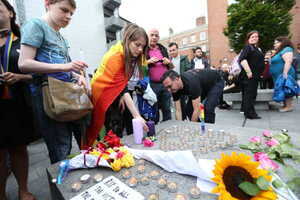
From top: Rainbow vigil, Barnardo’s Square, Dublin on Monday night; Anne Marie McNally

Can you preach intolerance of an entire demographic of people and then be truly sorry when they have been removed from the face of the earth?

Anne Marie McNally writes:

It was a terrorist attack. It was a hate crime. It was neither. It was the Federal Government’s fault. It was the club bouncers’ fault.

All actual opinions expressed, by media commentators of various shades, in the wake of the unspeakable tragedy in Orlando over the weekend which saw 49 people murdered, many others injured and the entire global LGBTQ community – and most other right-minded humans – devastated.

An intense narrative developed in the wake of the shooting and the revelation that the shooter had been of Afghan descent and had previous links to radicalised Islam groups. Clearly that meant it was a terror attack apparently.

The fact that the man’s own father claimed his son had been aggrieved by the sight of two men kissing and had previously displayed strong homophobic tendencies before murdering LGBTQ people in an LGBTQ space didn’t appear to matter to those who were determined to paint this as another example of jihadi terrorism perpetrated by those whose religion perhaps differs from yours.

It has since transpired that the man himself appears to have struggled with his sexuality delving in and out of the LGBTQ scene, perhaps struggling with a persuasion to something he had avowed to hate – yet another insidious consequence of the brutality of religious doctrine regarding sexuality.

The religion and terror radicalisation question is an issue for another day (though hopefully not another tragedy) but the issue for today is the seeming reluctance of so many in the public space to categorise the Orlando massacre as a hate crime because to do so would be to acknowledge the role that their beliefs may have played in such an event.

On Sunday, Twitter and other Social Media streams filled with lovely graphics and messages calling on us to #PrayforOrlando….but pray to whom?

The god who tells us that those in the LGBTQ community are misguided at best and sordid at worst?

Or would you rather I combined my prayers for the victims with incantations begging whatever God you believe in to absolve those victims of their apparent sins (that being their sexual persuasion) so that they may enter the kingdom of heaven or whatever other holy afterlife you believe in?

You see I’m confused. You can’t preach about intolerance, unacceptance and in many cases outright hatred of an entire demographic of people and then expect me to somehow believe you are truly sorry when you hear they have been removed from the face of the earth.

You either want me to disown these people, as they are, or you don’t.

And don’t give me some crap about you wanting to embrace them and make them see the light and the ‘error of their ways’ for loving who they love and living their life based on their own desires because that is almost more abhorrent than simply disowning them.

The horrific righteousness of that perspective is impossible for me to swallow and much more so as people have been brutally slaughtered because of their sexual preferences and a man, with easy access to a murder weapon, whose religion had thought him to hate himself for his own sexuality and to hate others who lived comfortably with their sexuality.

That hate, preached to him throughout his life, is what left 50 people dead on the floor of a nightclub where they had gone to enjoy life love and friendship.

If you have sat back and quietly allowed that hate, intolerance or unacceptance to go unchallenged in any religion that you are a member of then you are actively supporting an organisation that has facilitated the massacre we witnessed on Sunday.

I’m all for people finding solace in faith and I’m all for people believing in what they choose to believe in, but I’m not OK with what you choose to believe in being a catalyst for my friends, family and loved ones to be demeaned, degraded, disrespected and ultimately discarded.

We have to accept the correlation between the two and to not do so is not just ignorant it is dangerous.

Anne Marie McNally is a founding member of the Social Democrats. Follow Anne Marie on Twitter: @amomcnally