Tag Archives: Berkeley

90384579

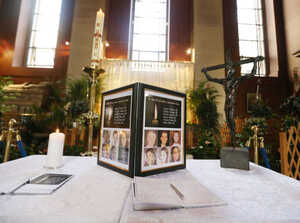
A Book of Condolence in the Dublin Pro Cathedral on Saturday 

Further to the return of the victims of the Berkeley tragedy.

Photo news agency editor Eamonn Farrell writes:

Subject to the request for privacy by family members of the J1 students who died in Berkeley, made through the offices of the Minister for Foreign Affairs and Trade, Charlie Flanagan*, Photocall Ireland will not be covering the return of the bodies to Dublin Airport
This was not an easy decision as the story is one of huge public interest and there are timeswhen the public interest must take precedence over the personal grief of bereaved families.The Stardust disaster is a case in point.
However on the basis that there has already been massive media coverage of the Berkeley tragedy, with text and imagery readily available from American media sources, we have decided to abide by the families’ wishes.

Eamonn Farrell,
Editor,
Photocall Ireland

Alternatively: Remains of Berkeley victim Olivia Burke arrive in Dublin accompanied by family and over 30 friends (Irish Mirror)

*It is essential that the families of the victims of the Berkeley tragedy be given the space they need to grieve. I appeal for their privacy to be fully respected as they make the difficult journey home tomorrow [Monday].” Charlie Flanagan

(Sam Boal/Photocall Ireland)

CHsMDIjWgAAVTA5

Dr Julien Mercille addresses the lack of coverage of the the 500 suicides caused by austerity, according to a major Irish study released on the same day of the Berkeley tragedy.

Dr Mercille writes:

On Tuesday, we learned about two tragedies: one has received extensive coverage, but the other has been ignored by the Irish media.

The first tragedy is, of course, the six Irish students who died in Berkeley, California, due to the collapse of a balcony, while away in the United States for the summer.

The second tragedy is that austerity and recession have resulted in 500 deaths by suicide in Ireland between 2008 and 2012, according to a major study by a team of researchers at University College Cork released two days ago [1].

Those are “excess” suicides, i.e., suicides that happened on top of the number of suicides that would have been expected if pre-recession trends in suicide rates had continued unchanged after 2008. As I write this, the study got zero mention in the whole Irish media except for one short article in the Irish Examiner.

The study confirms that economic crisis and austerity have led to higher numbers of suicides in many countries. Previous research had looked at 54 countries in Europe and the Americas and estimated that there were 4884 excess suicides in those countries in 2009 when compared to previous years.

Another report found that over 1000 excess suicides happened in England in 2008-2010. In Spain, the economic crisis has led to an 8% increase in suicide rates. In Greece, suicides appear to have risen by more than 60% since 2007. In the United States, between 2008 and 2010, there were 4750 more suicides than expected.

The Irish study found that the bulk of the 500 excess suicides are accounted for by men (the rate of suicide for women has been little affected by the recession and austerity).

One reason is most likely the loss of men’s construction jobs in the wake of the housing bubble collapse, which has led to unemployment and mental health problems that can lead to suicide.

However, there have also been 5029 more male and 3833 more female cases of self-harm (excluding suicide) than if pre-recession trends had continued, and thus women also have felt negative consequences.

The Irish media gave us a lot of details about the students killed in Berkeley, including individual profiles, pictures, and testimonies.

But we know nothing about the 500 people who killed themselves out of desperation or for any other reason under austerity. We don’t know their names, their faces, their families, what they were doing, or the circumstances of their deaths. We don’t even know they died.

How can the difference in media attention be explained? The main reason is very simple: talking about the deaths of 500 people by suicide under austerity automatically points the finger at the governments and politicians who have implemented such a policy, in Ireland and Europe. It also points a finger at the media, which has actively supported the policy. The media has thus little interest in talking about it, just like it has little interest in documenting the negative consequences of austerity in general.

On the other hand, talking about the Irish students who died in Berkeley leads to no such accusations. It’s a tragedy, period, and therefore makes it to the front pages.


[1] Corcoran P, Griffin E, Arensman E, Fitzgerald AP, Perry IJ (2015) Impact of the economic recession and subsequent austerity on suicide and self-harm in Ireland: An interrupted time series analysis. International Journal of Epidemiology (advance access here).

@JulienMercille is lecturer at UCD and the author of The Political Economy and Media Coverage of the European Economic Crisis: The Case of Ireland (2015, Routledge). His new book, Europe’s Treasure Ireland (Palgrave), will be out in July 2015.

90384288903842819038428990384292

This morning.

The Mansion House, Dawson Street, Dublin

President Higgins and Sabina Higgins sign the book of condolence for the six Irish students who died in the Berkeley balcony collapse.

The book will remain open until 5pm.

From top: dedications; Dublin Lord Mayor Christy Burke with President Higgins and Sabina Higgins; Madeline McDermott signs the book. queue forming outside the Mansion House.

(Sam Boal/Photocall Ireland)

920x920

Screen Shot 2015-06-17 at 21.30.52

Berkeley Mayor Tom Bates, above, and the balcony which collapsed, leaving six young people dead and seven injured, top

7 News WSVN reports:

“Berkeley’s mayor says early investigation points to moisture-damaged wood as a prime cause of a deadly balcony collapse. Mayor Tom Bates said Wednesday that investigators believe the support beams may not have been sealed properly at the time of construction.”

“Independent structural engineers who examined photographs of the broken balcony beams also have pointed to decayed wood as a likely main cause.”

“A structural engineer says it’s “surprising and unexpected” that the wooden beams supporting the Berkeley, California, apartment balcony that collapsed and killed six people had deteriorated so much on a building less than a decade old.”

“Darrick Hom, president of the Structural Engineers Association of Northern California, visited the site and said the wood was so decayed that the broken beams crumbled in the hands of investigators.”

“He said Wednesday that the wood breaking off at their touch indicates major deterioration in the joists and wondered how that level of damage happened in just eight years.”

“Hom says any building material exposed to the elements requires weatherproofing at the time of construction, so investigators likely will look at how weatherproofing was carried out at Library Gardens apartments.”

Meanwhile, further to that New York Times article, Eileen Murphy, spokeswoman for the newspaper, writes:

“This piece was a second-day story following yesterday’s news story of the collapse. It was intended to explain in greater detail why these young Irish students were in the US. We understand and agree that some of the language in the piece could be interpreted as insensitive, particularly in such close proximity to this tragedy. It was never our intention to blame the victims and we apologize if the piece left that impression. We will continue to cover this story and report on the young people who lost their lives.”

And one of the reporters who contributed to the article, Adam Nagourney, writes:

“… I mean this as by way of explanation and not excuse. By the time I came on the story, it had already been on our site for five hours or so and we wanted to do something to move it forward. The idea for a second-day story was to focus on the J-1 visa program, and the number of Irish students who, through the program, came here in the summer; I think that was a relatively new thought to us and many of our readers.”

“There are obviously positive aspects to the program, which has been a great resource for thousands of young Irish students, as well as negative ones. Looking back, I had the balance wrong; I put too much emphasis on the negative aspects, and they were too high in my story. That did not become clear to me until I got a distraught email from a reader right after the story posted. I made a minor change in the story to try to address that, but it did not go far enough.”

“Do I think that the program – as well as the problems associated with it – are fair game for a news story? Yes. But there was a more sensitive way to tell the story. I absolutely was not looking to in any way appear to be blaming the victims, or causing pain in this awful time for their families and friends. I feel very distressed at having added to their anguish.”

The Latest: Probe points to water damage in balcony collapse (7 News WSVN)

Valid Complaints on Story about Berkeley Balcony Collapse (Margaret Sullivan, Public Editor’s Journal, New York Times)

Previously: Anything Good In The New York Times?

Pics: SF Gate and Jessica Guynn

Nick-Schuster-MIEoghanCulliganOliviaBurkeEimear-WalshAshleyLorcan

From top: Niccolai Schuster; Eoghan Culligan; Olivia Burke; Eimear Walsh; Ashley Donohoe; and Lorcan Miller

Niccolai Schuster (21), Eoghan Culligan (21), Eimear Walsh (21), Olivia Burke (21), Ashley Donohoe (22) and Lorcan Miller (21) were celebrating a 21st birthday party at a Library Gardens apartment when the balcony collapsed on to the balcony below.

Niccolai Schuster and Eoghan Culligan were former pupils of St Mary’s College in Rathmines, Dublin.

Ashley Donohoe is an Irish-American from Rohnert Park, which is 50 miles north of San Francisco. She and Olivia Burke are cousins.

Seven other people were seriously injured. Berkeley police spokeswoman Jennifer Coats said the survivors’ injuries were “very serious and potentially life-threatening”.

Berkeley deaths: Six Irish students who died when balcony collapsed have been named (irish Times)

Officer Byron White of the Berkeley Police said 13 people were on the fourth-floor balcony when it collapsed about 12:40 a.m., sending debris and bodies plunging to the street. Less than an hour earlier, the police had received a call of a loud party.

Berkeley Balcony Collapse Kills 6, Including Irish Tourists (New York Times)


kettredgeCHoBTroUsAIVu85

Before and after.

From top: the balcony at Kettredge Street, Berkeley, California before and after the collapse this morning when five Irish students lost their lives.

1024x10241024x10241CHn9NQGUcAA5605CHn9NSUUEAEMKtk

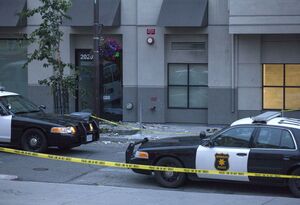
Outside the apartment block at 2020 Kittredge Street, Berkeley.

Pics: Stan BungerSFGate Earlier: 920x920balcony5CHnuoVZUEAA5ZQw 2

https://www.youtube.com/watch?v=7UPu0POEy8w

Authorities say five people are dead and eight others injured in a balcony collapse in Berkeley [California]. Officer Jennifer Coats of the Berkeley Police Department says many of the injured have critical, life-threatening wounds.
She says police received the call about the incident shortly before 1 a.m. PDT Tuesday. Arriving officers found that the balcony on the fourth floor of an apartment building on Kittredge Street had collapsed.”

The Department of Foreign Affairs emergency response number is 01- 418 0200

5 dead, 8 critically hurt in Berkeley balcony collapse (FoxSanDiego)

UPDATE at 1.15pm:

Foreign Affairs Minister Charlie Flanagan has confirmed to RTÉ that the five who died were Irish.

Pics via: Amy Hollyfield and ABC 7 Chicago