Tag Archives: Eamonn Kelly

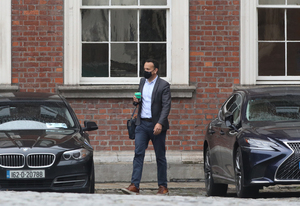
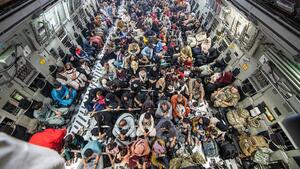
From top: Afghanis inside a US Air Force transport aircraft in Kabul airport last week; Eamonn Kelly

The week that was.

The Taliban started the week like recovering addicts, promising changed ways and mended fences. But by Wednesday they succumbed to cravings and were back killing innocent people again.

What appears to have happened is that they acquainted themselves with a few broad PR concepts, with the leadership, beards brushed, finally appearing on the world stage as statesmen, talking up tolerance and fair play.

Reporters on BBC and Sky were aghast at what they suspected was a new false front being sported by the Taliban, despite the fact that all political personages wear false fronts as a matter of course. Boris Johnson has such contempt for his own false front that he barely bothers wearing it at all.

Same game, different hairdos. If you can fake sincerity, you’ve got it made.

The Taliban however, simply couldn’t stay on the wagon, falling off in spectacular style, with reports of one woman being murdered for failing to produce a satisfying meal for the men, while protesters were being shot in the streets for attempting to hoist the Afghan national flag.

Taliban spokespersons were suddenly not available for comment. No doubt they have yet to tackle the intricacies of spin units.

The Taliban return must be horrific for families of veterans who died in the attempt to stabilise Afghanistan as a democracy, to see that effort now abandoned like some kind of fad.

No one’s happy with Joe Biden, except maybe Donald Trump, while critics of the US as international policeman must be as perplexed as everyone else by the spectacle of what occurs when they step back from that role.

Music and Sport

In other news, the musicians of Ireland are mightily fed up with apparently being the only remaining cohort to be still subject to covid restrictions, while sports events are being allowed tens of thousands of spectators.

Steve Wall of the Stunning told the IT that musicians need to take to the streets, by which he meant a march on the Dáil, I’m guessing, and not busking. He was facing into the prospect of playing a stadium but only being allowed an audience of 200 people. At that rate the audience and band would be on first name terms by the end of the gig.

Caroline Downey. Director of MCD promotions, told Newstalk that government leaders had basically passed the buck to Nphet. She went on to make the interesting point that the hospitals, due to funding cuts before the pandemic, have been struggling to cope, with the result that Nphet, in the absence of government assertion, are actually reinforcing restrictions to protect the hospitals. It’s a kind of double-whammy of government passivity and neglect.

Covid Confusion

While officials warn of misinformation, Ryan Tubridy, speaking to the Indo and looking forward to the first Late Late Show with an audience, is clearly under the impression that vaccinated people can’t spread the virus, which doesn’t appear to be the case.

Then the IT did a survey asking unvaccinated people their reasons for abstaining, with reassuring answers provided by two medical experts, the oddest being the answer to a man who said he disliked being a guinea pig, to be told that the vaccine had been tested on millions of people, the medical expert apparently not realising that these people had unwittingly acted as guinea pigs too.

To further complicate matters, news from the UK claims that the AstraZeneca vaccine may be only good for 90 days against the Delta variant, but no one is quite sure, while schools now plan to allow kids to attend class without masks or social distancing.

Are athletes and their supporters and schoolkids immune to Covid, while musicians, thespians and their audiences are susceptible to infection? What a discerning virus. It’s almost anti-intellectual.

Tents and Hostels

Dublin city council chief exec, Owen Keegan opined that tents on the streets of Dublin give a poor impression of the city. They certainly do. Who’s creating all these homeless people? Are they creating themselves?

Keegan suggested that there was plenty of homeless accommodation. The real question is, what is wrong with the homeless services that people would choose the street instead?

Most likely it’s because homeless hostels are managed by private companies, and private companies care less about people and more about profit. In an ideal world they’d prefer the profit without the people.

Apparently, Owen Keegan brought this focus onto homeless people when asked about the assault on Olympian Jack Wooley, unfairly linking homelessness to the assault.

It would be so much easier to just build some social housing.

Eamonn Kelly is a Galway-based  freelance Writer and Playwright. His weekly round-up appears here every Monday.

Previously: Eamonn Kelly on Broadsheet

PA/MoD
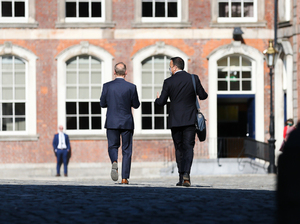
From top: Taoiseach Micheal Martin (left) and Taniaste Leo Varadkar; Eamonn Kelly

The week that was

Last week, Micheál Martin, apparently out to prove that politics can be kind, and against a backdrop of howls of complaint and derision from members of his own party, passed up a golden opportunity to take an authoritative stand and request Leo Varadkar’s resignation.

What was his thinking? That the coalition and his own leadership might be weakened by Varadkar’s resignation? Or was he practising a kind of fair play? If so, does he really believe that if their positions were reversed that his Fine Gael counterpart would be so charitable?

On Tuesday, Ógra Fianna Fáil called for Varadkar’s resignation, to which a Fianna Fáil TD growled, “They’ve asked the wrong man to resign.”, meaning Martin. With that kind of heat from his own party he might soon be looking to join Fine Gael.

They say nice guys come last, and I can only imagine that this rule of thumb is ruthlessly amplified in the world of politics. If Martin was being “nice”, or loyal, it may have been a fatal political miscalculation.

Not only has he passed up an opportunity to humble his political Fine Gael rival, but he has also passed up the opportunity to put a solid Fianna Fáil stamp on the coalition job-sharing arrangement.

By the end of the week there were reports of a potential heave against Micheál Martin from 11 FF rebels, while in FG, there were reports that Leo Varadkar’s support base in the party was rapidly deteriorating.

Cattle Flatus

Apart from that, the world appears to be actually ending, according to the Intergovernmental Panel on Climate Change (IPCC) report, issued on Monday. As if Mondays weren’t bad enough.

Ireland has two major carbon producing entities to be dealing with: cows and cars, with cattle flatus, or cows’ farts, accounting for one third of Ireland’s CO2 emissions. In this case you certainly don’t need a weatherman to know which way the wind blows.

With cars, the idea is to change over to electric cars, but Irish motorists haven’t really bitten the electric car idea yet, while public transport is still regarded by many as a step down socially, so the car won’t be going away just yet.

Ireland is peculiar in that it is a collection of disconnected cities, towns and villages that rely for connection almost totally on the private car. A serious climate plan would have to look seriously at an electric network of public transport serving the entire island.

To this end, senator Timmy Dooley of Fianna Fáil called for free public transport as a means of attracting people out of their cars, where they clog up the roads to and from the industrial estates, each carrying one person and re-defining the meaning of a waste of space.

Taxes

But free public transport is never going to happen with neo-liberals in power. They are more of the castles and moats lineage, and as things worsen, exclusion will likely become the norm.

At the moment, according to Paul Murphy of People Before Profit, they are trying to privatise public transport and are pressing bus drivers to work 10-hour days. That’s a long way from thoughts of free transport.

But conservatives don’t really do progressive social ideas. That’s what conservative means after all: avoidance, at all costs, of progressive ideas. They much prefer taxes and calculating percentages and declaring who can and can’t come to ball.

Finance minister Paschal Donohoe is the political equivalent of the concept, Give-a-man-a-hammer-and-all-he-sees-are-nails. Give Paschal a problem, any problem, and all he sees are taxes. Which is ironic, given that Ireland is a proud tax-free haven for people who don’t really need tax breaks.

The carbon-tax idea will likely impact on poor people the most. The idea is that the tax is a punitive measure taken against those reliant on fossil fuels, applied at point of sale. So, the more you use the more you are taxed. Carbon tax is a cousin of cigarette and alcohol taxes.

Percentages

Conservatives also feel comfortable with percentage targets and long-term deadlines to be met, even in a collapse of civilisation scenario. They can calculate the percentages down to annual increments, and fit the sums inside the assigned time-frame window, with the result that all looks to be under control.

If you have to achieve x carbon reduction by 2050, it means an annual target of y, plenty of time to do it, and plenty of wriggle room for finger pointing at the Left.

But this is badly missing the point of what is required to offset an increasingly unpredictable climate emergency. It is the type of thinking that still has both feet in the old world, when what is required is a total rethink of the way things are done.

On this note, Diarmuid Ferriter, writing in the Irish Times, says that Ireland needs a green social revolution similar to the social revolution that brought rural electrification: a total game-changer to quickly usher in a green infrastructure.

A beginning might be to look at creating an electric public transport network and Dutch-style flood defences; invest in a diversification of agriculture, and ditch half the cows and half the cars, halving CO2 emissions at a stroke.

Eamonn Kelly is a Galway-based  freelance Writer and Playwright. His weekly round-up appears here every Monday.

Previously: Eamonn Kelly on Broadsheet

RollingNews

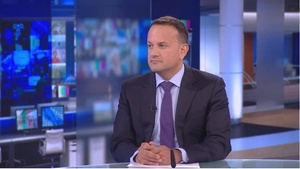
From top: Tanaiste Leo Varadkar on the RTÉ Six-One news last Friday; Eamonn Kelly

The week that was

The Merrion Hotel gathering dominated the news last week, along with the Olympics, where we learned it is not okay to thump a horse, but it’s thrillingly admirable to thump a female Brazilian boxer as a means of bringing home the gold.

It was an uncomfortable week too for the political class who went to ground, putting their heads together to devise some good excuses to explain the gathering in the Merrion Hotel, held to celebrate the almost successful crony bid to appoint Katherine Zappone into a UN position.

Leo Varadkar eventually emerged with a fresh haircut to appear on RTÉ news to explain, in his usual pass-the-buck way, why, as minister, he had somehow failed to alert the entire hospitality sector of the fact that it was now okay to host outdoor gatherings of up to 200 hundred people.

Blame

You would imagine that a minister for enterprise, trade and employment would be working night and day to ensure that the hospitality sector was kept up to speed on the changing interpretations of covid restrictions pertaining to social gatherings.

But somehow, in his RTÉ apology, Leo managed to blame the public for being “confused” about the guidelines, rather than blaming himself for confusing them. He even blamed the guidelines themselves for being unclear, despite the fact that he is the one who is supposed to make them clear.

He also blamed Sinn Féin for attempting to capitalise on the scandal by wrongfully suggesting that he, personally, actually drew up the covid directives for the hospitality sector; conveniently ignoring the fact that regardless of who draws up the actual details of the directives, it surely falls to the minister to be up to speed on the current interpretation of those directives, in order to relay this information, as quickly and as clearly as possible, to the sectors he represents.

A Simple Plan

Somewhere in the bowels of power a plan was hatched to have the attorney general interpret government legislation to forgive the Merrion gathering, and Leo assured us on RTÉ that the Failte guidelines were also “probably” rightfully observed too, somehow managing to give the impression that he too was a victim of his own failure as minister to offer clarity to the public on covid restrictions. This particular slice of fudge made it difficult to decide whether to commiserate with him or request his resignation.

When he did finally apologise, he apologised, not for confusing the entire hospitality sector and costing them potential millions, but for attending the Merrion gathering (the more the Merrion) which, he was quick to point out, was actually legal after all, thanks to the attorney general’s intervention, making it seem like there was actually nothing to apologise for and that the whole thing was really Sinn Féin’s fault for framing it as a “problem”.

This is a familiar song sung by this particular minister when he gets into potential resigning difficulties, which he manages to do quite regularly, making him seem unusually accident-prone. He casts around for someone to blame, and fudges the facts until he somehow ends up portrayed as a victim of circumstance, confusion and Sinn Féin.

Clarity and Fudge

On this occasion, the RTÉ apology demonstrated why the covid guidelines aren’t clear and why the public is “confused”. The lack of clarity is because Leo doesn’t do clarity, he does fudge, and he does it so well that he apparently can’t turn it off, even when he intends to be clear; resulting in the lack of clarity in defining covid guidelines for the benefit of the hospitality sector: an inadvertent fudging that had the effect of putting him in a pickle once again, where his only solution was to produce more fudge.

If the Merrion gathering wasn’t illegal, why then did the minister for enterprise, trade and employment, not immediately shout it from the rooftops to a struggling sector that it was now legal to host outdoor gatherings of up to 200 people?

Either he didn’t know, which means he wasn’t on the ball as minister; or, the interpretation of legality by the AG was politically motivated, as many suggest, and the Merrion gathering was illegal after all.

Whichever way you look at it, the failure is the minister’s.

He was either being elitist in placing himself above the law by attending the Merrion gathering; or he was incompetent in his role as minister for trade, enterprise and employment, by failing to clearly communicate beneficial changes in covid directives to the hospitality sector.

Integrity

Unfortunately, and ironically, all of this is likely to be over-shadowed by Portland Row’s Kellie Harrington’s brilliant, against-all-odds, gold medal win at the Olympics, which will likely serve as a smokescreen for another resignation situation to be successfully evaded by Leo.

But congratulations to Kellie on her gold medal win. And congratulations to her also for managing to punch her way out of Irish working-class obscurity, in a rigged socio-political system where the privileged elite, time and again, lily-liver their way out of accountability for their corruption and incompetence.

In his failure to stand accountable for his responsibilities as minister, both in this case and in previous political controversies, Leo Varadkar continually demonstrates, for anyone who cares to see, the manner in which elitist political cheats cheat us all.

Eamonn Kelly is a Galway-based  freelance Writer and Playwright. His weekly round-up appears here every Monday.

Previously: Eamonn Kelly on Broadsheet

RollingNews

At top from left: Simon Coveney, Leo Varadkar and Simon Coveney; Eamon Kelly

There was an old joke about a guy knocking on someone’s door and saying he was a handyman. A few questions revealed that he didn’t actually have any trade skills. The householder in frustration says, In what way are you handy? And the man says, I live just around the corner.

I was reminded of this when FG announced that Katherine Zappone would be a UN envoy, largely on the basis that she lived in New York. And while few would doubt her experience in campaigning for LGBT rights, her true credentials appear to be that she lives in handy proximity to the UN. She’s a political handygal.

Freedom of Opinion and Expression

However, there is another problem with Zappone’s credentials as a human rights activist, concentrated as they are mainly on gay rights, to the extent that John Downing in the Irish Independent described the post as “United Nations’ envoy on women’s, gay and LGBT rights.” While the Irish Times described the role as “special envoy for freedom of expression”. Elsewhere the role was described as “special envoy for freedom of opinion and expression”.

So which is it? If the concept of freedom of opinion and expression is being reduced to mean gender rights alone, that in a sense undermines the wider concept of freedom of opinion and expression.

If gay rights activism is Zappone’s main qualification for the role, the risk is that her appointment actually reduces the scope of the role to that narrower definition, while simultaneously jeopardising and greying out the wider concept of freedom of opinion and expression, as it has already begun to do.

What Katie Did

When opposition deputies accused FG of cronyism, the charge was flatly denied and the entire thing flared up into a great oul political row. Some said the job was dreamed up by Zappone herself, but this was vehemently denied by Simon Coveney on RTE.

What had happened was that Zappone mentioned to Simon Coveney that she would be available for any UN duties the government might have in mind, she being handy to the UN. This can in no way be construed as her creating the role for herself. It was more like she saw the potential of a role for herself in the UN and made a road sign that Simon Coveney could easily read.

Then, a year later, Simon Coveney appointed her as UN envoy of freedom of opinion and expression, apparently without bothering to tell anyone, demonstrating a brilliant capacity in himself for freedom to non-express.

But this is certainly not to suggest that the culture of nod/wink appointments, said to be the sole preserve of Fianna Fáil, as pointed out by Zappone herself in 2015, is now a FG habit too.

Rather this was a series of misunderstandings and oversights, which nevertheless resulted in Zappone somehow successfully landing the job she coveted.

But there were absolutely no nods or winks involved. We know this because Micheál Martin, who must be particularly sensitive and alert to nods and winks, given his Fianna Fáil lineage, hadn’t a clue what was going on.

Cronyism

The appointment may look and sound like cronyism, but we know it wasn’t cronyism, because FG spokespersons said it wasn’t cronyism, so therefore it mustn’t be cronyism. It must be some other thing that normal, sensible people can’t quite fathom.

Because if it was cronyism, you can be certain that FG would own up and say it was so. They wouldn’t spin the truth to make it sound like it was something else. True, they have a spin unit for doing just that, but this is different.

Even the idea that Zappone dreamed up the job for herself, apparently originated with the Tánaiste, who later backtracked and said, before buttoning his lip, that whatever Simon says is true.

Simon says, it’s not cronyism. Simon says, it was all a series of unfortunate oversights.

Common Sense

The appointment was framed ultimately as just a case of plain “common sense”.

Look, we need an envoy for freedom of expression, because all the other countries have a freedom of expression envoy, it’s the latest thing to make it seem like the growing epidemic of political bare-faced lying is being sensibly counter-balanced. We don’t want to be left behind.

Besides, as everyone knows, Fine Gael, who sent almost the entire arts community at one time or another to JobPath to retrain for something “realistic”, are singularly concerned about freedom of expression. They never tire of dreaming up legislation to cultivate freedom of expression.

Sure, under normal circumstances the job would have been advertised. But with the pandemic and everything and the cost of living it would be nonsensical to spend public money on advertising the position when we have someone, eminently qualified, living handy to the UN, who is also a proud friend of Fine Gael.

Freedom

So, for all the misunderstandings and all the unfounded tirades from the usual gallery of complainers, we now have a representative in the UN protecting and overseeing our right to freedom of expression. Even if questioning the dubious nature of the appointment itself is considered bad manners, if not downright subversive behaviour.

The inescapable conclusion must be that the Zappone appointment, given the political cronyism at play, coupled with the narrowing of the concept of freedom of opinion and expression with gender equality, has the effect of undermining the very concept the envoy post is designed to protect.

Eamonn Kelly is a Galway-based  freelance Writer and Playwright.

Previously: Eamonn Kelly on Broadsheet

Earlier: Well Now

RollingNews

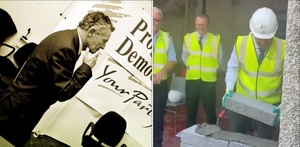
From top: Des O Malley (left), following his resignation as leader of the Progressive Democrats on September 5, 1993; “I’ve never laid a brick before,” joked Tánaiste Leo Varadkar while holding a concrete block at the Galway City Innovation District last Friday

A weekly round-up

In a photo op the Tánaiste Leo Varadkar went tricking around with a concrete block, which he referred to as a “brick”. Later, hard hat still on, he turned his builder’s eye on twitter and decided it was actually a sewer. One whose passages he’s often seen to scuttle through, both as himself and in disguise.

Speaking of building, Patrick Freyne had an excellent piece in the Irish Times about the small cottages in Dublin’s docklands being dwarfed by high rise buildings. But given that this was the Irish Times, Freyne felt it necessary to mention that two of the people finding themselves buried alive in this manner had a “beautifully tended garden”, just in case you might be thinking that they were tasteless working-class lazybones deserving of all the annoyances big business can inflict on them.

Why do ordinary people always have to prove they are good and decent people, undeserving of the crap that is often dumped on them by the generally awful people of big, unanswerable money?

Climate

Anyway, it hardly matters anymore, the way things are going we’ll all soon be washed away in a flood, fried like eggs on a griddle or simply starve to death from food shortages.

Will I tiresomely point out once again the relationship between neo-liberal policies – perpetual growth in a finite system – and climate change? No, I won’t. I’ll get in line with the delusionary talk, in the belief that thinking positive will somehow fix the climate.

RTÉ news reported that Madagascar is the first country in the world in the process of being almost totally destroyed by climate change. The people are starving due to drought and crop failure. This, according to scientists, will be the likely scenario for much of the Southern part of the African continent.

But David McWilliams in the Irish Times, thinking positive, countered this bleak view with the idea that Africa, due to demographic anomalies, would actually one day be the richest continent in the world, because everyone else is dying off. Given climate change, that sounds like traditional African bad luck to me. The meek shall inherit a scorched Earth with occasional severe flooding.

Des O’Malley

Desi O’Malley died. Known as the best taoiseach Ireland never had, there were fitting tributes from all sides of the political spectrum, as they say on RTÉ.

My one abiding personal memory of him was when I attended a rally in the 1980s, in Galway’s Leisureland, when the Progressive Democrats (PDs) formed. I was there more out of curiosity than any particular interest in the PDs, and simply because I happened to live nearby at the time. All the representatives of the new party were seated at a long table on the stage, not unlike the arrangement for the last supper. There was a podium out front from where Mary Harney stirred the partisan crowd to whoops and cheers with fiery rhetoric flung around the place more for effect than sense.

But the highlight for me was that Des O’ Malley kept dipping his head beneath the table while Mary roused the rabble. I wondered what he was doing and watched carefully to see that he was actually sneakily smoking cigarettes down there. That, in a way, formed my political opinion of the PDs. They were wont to sneak away to do things you mightn’t like.

Man Up Van

Van Morrison is still going ballistic about live gig starvation, demonstrating how much he really needs an audience to maintain his emotional equilibrium. I love his music, his style, his soulful singing. But in relation to the pandemic, he has been coming across as an awful prima donna. Man up, Van.

Across the water Boris Johnson declared that he had never lied to anyone, despite there being ample evidence everywhere that he had lied at one time or another to practically everyone. People rose up in indignation in the twitter sewer, apparently not realizing that he was actually just lying again.

Meanwhile in Tokyo, someone on the Irish Olympic team had the good idea for the team to bow to their Japanese hosts in a gesture that was both heart-warming and appreciated. Now that’s style.

Future’s So Bright…

The Galway Film Fleadh (FlimFla) did its thing in a local park to avoid the not so great indoors. This one was different because, even despite the heatwave, mask-wearing has curtailed the donning of serious sunglasses, changing the entire tone of the festival. What is it with plonkers who stare you down from behind dark glasses?

Meanwhile the pandemic continues. On Friday I heard at least a dozen ambulance sirens during the course of the day. While they might not all be virus related it added to the sense of urgency and panic. Or maybe they were just people being rushed to hospital from the Film Fleadh, blinded by the sun.

Finally, in a polity that can’t seem to regulate big business, greedy landlords, exploitative employers and corporate tax-dodgers, officials become Mr Speed when it comes to regulating soup kitchens. That, in a sense, is all you really need to know about FFFG Ireland. We can turn a blind eye to tax-haven billions, but we absolutely won’t tolerate possible low standards in soup kitchens.

Still, it’s not all bad news. Soup kitchens or not, the Indo reported that the Irish are now, proudly, the fattest people in Europe. It’s either a feast or a famine around here – and often at the same time.

Eamonn Kelly is a Galway-based  freelance Writer and Playwright. His weekly round-up appears here every Monday.

Previously: Eamonn Kelly on Broadsheet

RollingNews

From top: Actor Sinéad Cusack with her son, People Before Profit TD Richard Boyd Barrett in 2016; Eamonn Kelly

There was an interesting exchange in the Dáil between Richard Boyd Barrett and taoiseach Micheál Martin concerning the mysterious subject of actors’ residuals.

Actors’ residuals are agreed percentage royalties due to the actor when a show is re-screened elsewhere. They are how some American actors become amazingly rich. American actors in television’s early days were getting screwed on residuals, unaware of the potential money to be made on repeats of shows sold all over the world.

But how could they have known? The industry was young and all this came about through the development of recording technology and television, allowing for repeats and re-screenings of old films on TV.

Following a series of greater and lesser strikes by various film employee unions, the most significant being in 1960, residuals became a standard part of actors’ contracts in the US, handled by their agents and union representatives.

Take It Or Leave It

It would appear that Irish actors are now in a similar position as American actors were in the 1950s and 1960s. But there are a couple of very important differences. Film companies operating in Ireland are attracted here by government subsidies and tax breaks, while the actors themselves are, as I understand it, represented by their own agents and by Actors’ Equity, whose main focus seems to be theatre, not film and television. Plus, of course, everyone is wise to residuals by now, and the big money involved.

It appears then, that on the question of residuals, some producers may be factoring in the non-payment of residuals as a further financial enticement to produce film and television in Ireland.

In a way, Irish actors, like low paid workers the world over, are being short-changed as part of a deal to generate employment that, if not accepted by the worker, will simply lead to the production companies taking their business elsewhere, as per your by now standard globalisation model.

Richard Boyd Barrett described actor’s being faced with take it or leave it propositions: if you insist on residuals, you won’t be offered work; and he reported that some actors who had challenged this take it or leave ultimatum had since been black-listed by certain production companies.

But in terms of representation of the actors’, Boyd Barrett took the view that because of the public money subsidies and tax breaks to film companies under section 481, that it was the government’s business to intervene in ensuring proper pay and remuneration for workers, who in this case happened to be actors.

Taoiseach’s Response

Micheál Martin’s response to all of this was deflationary. He didn’t quite say it’s time for actors to get a “real” job, but he as good as implied this, segueing wonderfully into the now widely discredited concept of employment activation, which he insisted “does work”.

There are reports and statistics that show employment activation doesn’t work. Nevertheless, the taoiseach insisted it does work and offered some vague anecdotal observations about people having “happy” outcomes.

For those who don’t know, alongside the private companies contracted to provide employment activation, are also contracted private companies measuring “satisfaction” ratings. Most workers in these schemes are on the back foot and tend to respond positively to leading questions like: How happy would you describe yourself? Very happy, extremely happy, or deliriously happy?

The reason employment activation doesn’t work is because late-stage capitalism is not creating employment, it is creating profits by short-changing workers, and customers, the environment and often, the very concept of truth; and anyone or anything else it can short-change to ensure a profit for its investors.

In this particular case, the taoiseach, rather than standing with actors in facing up to the production companies to rightfully claim residual deals on their work, is saying instead, that actors will have to be prepared to submit to employment activation and all the consequent market mumbo jumbo that it spins about “re-skilling”.

Re-skilling

Employment activation, delivered by private companies who receive a payment for each individual “processed”, is quite literally the commodification of unwanted labour, from which corporations can turn a profit by inserting themselves into the public money stream created for “retraining”.

The assumption that supports this siphoning of public funds by private entities, is that the flaw is in the individual, and not in a system that empowers and enriches corporations at the literal expense of individuals. In this case, the flaw is considered to be in the actors in choosing a profession that’s not “normal”.

The Taoiseach’s promotion of activation “services” when asked to support arts workers at the raw end of corporate short-changing, makes it clear that he actually doesn’t have a concrete vision for the future of the Arts. That fundamentally, he appears to genuinely believe that arts work is not “real” work. He’s not alone in this. Lots of so-called “normal” people think the same. But they’re not making leader decisions.

He did offer a conciliatory suggestion that there might be a “social dialogue” about this. But that’s hardly what is needed when you are looking at a situation where people are being black-listed for essentially questioning contractual arrangements worthy of Flywheel, Shyster and Flywheel.

The question for the actors is: If the government won’t represent them, who will?

Eamonn Kelly is a freelance Writer and Playwright.

Previously: Eamonn Kelly on Broadsheet

RollingNews

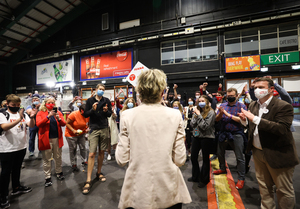
From top: Labour candidate Senator Ivana Bacik (back to camera) and supporters celebrating her election as TD in the Dublin Bay South by-election at the RDS count centre last Friday Eamonn Kelly

Dublin Bay South By-Election.

They say that by-elections don’t tell you much, but that certainly has not been the response of the various parties involved in the Dublin Bay South by-election. Fianna Fáil for instance were suitably informed by the event to begin quietly speculating about a new leader and rebranding the party as a genuine republican party, rather than the pallid acquiescent neo-liberals they’ve become in coalition with Fine Gael.

Fianna Fáil’s first preference vote share dropped from 14% to 6%, which certainly tells you plenty, and it certainly fired up Barry Cowen enough to write a letter calling for a meeting of the Parliamentary Party. What emerged from Cowen was that the Fianna Fáil inquest as to what went wrong in the 2020 election is still pending.

It is as if there is a profound denial at play in the party, an ignore it and it might go away type of thing. But the by-election has shoved it right back in their faces again. Despite Micheál Martin being taoiseach, the party appears to be sliding inexorably into irrelevance.

Leo’s Losses

The by-election also made it clear that Leo Varadkar’s strategy in dropping Kate O’Connell for James Geoghegan was also the wrong decision, while the poor result also had the effect of shining a less-than-flattering light on Leo Varadkar’s performance as party leader. As the Examiner reported:

“Since he was named Fine Gael leader, he has lost five by-elections and 12 seats in a general election.”

While the Fine Gael party may be able to forgive losses to others, such as tens of thousands of homeless people; children’s lives stunted in hotel accommodation; political attacks on the poor, and policies that lock young people out of the property market and into their parent’s homes, they’re unlikely to turn the same blind eye to Leo’s electoral losses.

It was instructive too to note that James Geoghegan, despite virtually zero political experience, apart from two years on the local council and a short apprenticeship lobbying for the tobacco industry, (“Smokin’” Jim Geoghegan?) he nevertheless easily took 7,000+ first count votes on the basis of party affiliation alone. This was less of a question of what is the man made of, and more of a question of who does he know? Which is as good an illustration as you’re likely to get as to how things actually work in Ireland.

The Others

Labour of course were the beneficiaries of Leo’s bumbling, and we can only hope that Ivana Bacik has landed with her centre-left side up and not her FG-inspired right side up, and will add some weight to the growing left alliance, rather than to the shrinking centre-right coalition.

As for the Greens, that limp lettuce of a leader, Ryan, came on TV after the result to complacently announce that the present government still has four more years of life left in it. He was taking the view that by-elections tell us nothing and there was nothing to worry about; that all is stable on planet Ryan.

Like the environment he also seems extraordinarily casual about, given that we only recently had 12 years to stop the melt, the government he now so sleepily supports also appears to be shrinking by the day. This is a man in for a rude awakening, likely to be on his bike sooner rather than later.

Sinn Féin’s role in the by-election was as scary monster. As Lynn Boylan gathered in almost 16% of first preference votes in Garret Fitzgerald’s old constituency, Sinn Féin scared Fine Gael into panicking on election day, begging on twitter for more people to come out and vote. SF’s performance also had a scary effect on Fianna Fáil, frightening the party into looking seriously at the concept of republicanism for the first time on over half a century, despite the word being their brand all this time.

Lazy Voters

The by-election also had the effect of shining a light on a particularly privileged sample of the electorate. With a poor turnout of only just below 35%, in contrast to over 62% in the general election of 2020, which took place in the depths of winter, the electorate in Dublin Bay South were the biggest let down of the entire event, given the importance of this by-election, the focus that was on this constituency and the amount of campaigning that took place by all parties and independents.

This being the Fine Gael heartland, this may indicate where Fine Gael complacency in social policy comes from. There was no rain, no hazardous conditions. It was just a dismal expression of political carelessness. The irony is that if they had come out, they might have elected Geoghegan. So, thank God on this occasion for leafy complacency.

Finally

Far from being a meaningless side-show, this particular by-election had plenty of drama, produced lots of now unavoidable and unpalatable truths for all concerned, and for entertainment value featured yet another Irish academic apparently veering off onto the wild side, this time in the shape of Prof Dolores Cahill laying siege to the count centre without a virus mask.

Finally, England footbal team last night tried to do an Ireland by holding onto an early one-nil lead over Italy, but came badly unstuck. You need a Paul McGrath and a Packie Bonner if you want to be attempting that kind of thing. Still, it was sad to see them go down. They seemed strangely helpless in the end. It was like they didn’t go for it and chose to get tired instead. As if they believed themselves fated to lose. Maybe that’s what a toxic tabloid press and a cruel hooligan element among your supporters does for you.

Eamonn Kelly is a freelance Writer and Playwright.

Earlier: Derek Mooney: A By-Election review For Fianna Fáil

Previously: Eamonn Kelly on Broadsheet

RollingNews

From top: Taoiseach Micheál Martin and Tánaiste Leo Varadkar; Eamonn Kelly

Michael Portillo’s investigation into the origins of the Northern Ireland conflict (“Partition” RTE 1.) led to a jaw-dropping moment in Gerry Adam’s office when Portillo realised, and to his credit, could no longer deny, (due to his own research and Adams’ input), that the conditions for the conflict had been set and inflamed by his own party, the Tories, in the years preceding the foundation of the Northern Irish state.

Yes, Partition and conflict came to you from the same people who brought you Brexit. It was a denouement as surprising and shocking as the ending of The Sixth Sense.

A couple of days later, Leo Varadkar, clutching at straws in the aftermath of a sobering poll drop, with abysmal political timing (given the panic and volatility of unionism), “envisioned” a united Ireland in his lifetime.

This apparently in a naked attempt to appropriate what he must have perceived as a Sinn Féin populist idea, apparently not realizing himself the irony that he is Ireland’s very own Tory, more at home with the privileges and ideologies of Johnson and Cameron than the largely socialist intent of Ireland’s founding fathers.

Stat Fiddling

Later in the week, at the Fine Gael Ard Fheis, the Tánaiste said that Ireland’s home ownership is 65%. He then set what appeared to be an ambitious goal for 70% ownership, to be achieved by building 40,000 private homes a year until the target is met.

But that 65% stat is a fiction, apparently deliberately under-estimated so that the target of 70% can be more easily achieved.

According to the Trading Economics Survey, Ireland’s home ownership is closer to 70% most of the time. It is currently 68.7%, which is considered low relative to the highs of 81% during the boom, before re-possession became a reality and everyone realized that when push comes to shove the banks own most of the homes anyway.

Rounding that 68.7% up to the nearest unit, home ownership in Ireland, according to the Trading Economics Survey for 2020, stands at just under 69%, just 1% short of Varadkar’s target of 70%, which is the norm for home ownership across Europe.

But what’s 1% among those who can so casually drop 4% to suit a rigged argument? In other words, the Varadkar goal of 70% has already been more or less achieved, and will be achieved with or without FG input.

The Tánaiste is basically pulling a salesman’s tactic, leaving himself room for certain success. Ultimately, it doesn’t matter who’s in government, the stats will still deliver a home ownership level of in and around 70% anyway.

Cultural DNA

To sell the idea of private home ownership versus social housing, the Tánaiste insisted that private home ownership is in the Irish DNA. This again is pure sales patter. This angle he’s working is no more than an exploitation of fear of homelessness, which may well be part of the Irish post-colonial DNA, due to hard lessons learned in the 19th century: lessons of eviction, condemnation, exclusion and starvation that still rightly spook the ancestral memory.

What we are perhaps looking at here is the cynical exploitation by an elite, of native post-colonial distress. Cynical because the exploiters are privileged and educated, in a system where education costs are also pricey, leaving the same elite with an almost exclusive hold on knowledge too.

They are not ignorant. They know well what they are doing when they deliberately mislead people with fake arguments and stats, in an attempt to sell over-priced private houses, by undermining the concept of social housing through the cynical manipulation of psychological anxieties embedded in the culture.

At a general election a number of years back the curtain slipped when a Fine Gael handler told a reporter that they’d “frighten the shite out of them” (the electorate) in the run up to polling day. They are capable of this level of cynicism.

The real idea behind this type of sales pitch is to divide people, in order to exploit prejudice between those who own and those who rent, in much the same way as the Tánaiste sought to divide low-paid workers from unemployed workers with the welfare cheats campaign, when the reality was that they were all basically the same people, just in different current relationships to jobs.

Here he seeks to divide property owners and non-property owners, with his mean-minded naming of social housing as “free”, the attempt being to saddle a target group with the label of parasite, while many would be more inclined to view the tax-dodging billionaires and the vulture landlords as the real parasites, if we must resort to labelling people like that.

The very group the Tánaiste is serving by trying to sell this idea that home ownership is in our DNA, like as if we’re wild fowl programmed to fly South in winter, and simply can’t help ourselves.

The whole 65% thing is a distraction from Fine Gael ideological opposition to the concept of social housing.

Even those boasts you occasionally hear about Ireland having the highest home ownership in the EU and so on, are just small statistical gradations of point zero percentage points. The reality is that home ownership across the entire EU averages in and around 70%, fluctuating by one or two percent here and there on an ongoing basis, with occasional outlier anomalies.

Same As It Ever Was

One of the shocking images you often see in films about World War II are the dead bodies on the streets of the Warsaw ghetto. Yet we have a housing system that often produces similar results, and many people apparently believe this to be “normal”, if not “deserved”.

How is homelessness, low wages, evictions, rack-rents and the condescension of the privileged any different from the 19th century exploitation the founding proclamation was designed to free us from? It’s a fair question.

This is the climate of social Darwinism Varadkar in particular has been cultivating since he arrived on the scene. A climate of moral bankruptcy, exacerbated, as Fintan O’Toole recently discussed, by the collapse of Church authority.

And what do you actually have to do to own a house in Ireland’s rigged system? Well, mostly, given the miserable wages and the outlandish house prices, you have to agree to be exploited by that rigged system for your entire life; while being in hock to a bank which will, as we have seen, at the first sign of a downturn in fortune, ditch you out onto the side of the road to be condemned by many of your countrymen as a ”loser”.

The neo-liberal plan is quite simple: Fib, Fog, Divide and Privatise. The pity is that a lot of Irish people, even after Trump, are still quite partial to that bitter, mean-minded diet.

You can hardly blame people, though. Who in their right mind would want to be at the bottom of Varadkar’s social heap? If someone has to be there, so the logic goes, let it not be me.

Eamonn Kelly is a freelance Writer and Playwright.

Previously: Eamonn Kelly on Broadsheet

RollingNews

From top: Leo Varadkar in 2011; Eamonn Kelly

One of the problems noticed during the Trump presidency was that there were so many outrageous actions and comments being unleashed by the administration that journalists couldn’t assimilate it all quickly enough before a fresh batch of bullshit landed.

This deliberate over-production of bullshit is similar in many ways to the strategy of the tobacco industry, flooding scientific research with an avalanche of studies, that they themselves paid for, to throw genuine scientific findings into doubt. It’s a game now played by the corporations, to keep the climate issue from interfering with business.

It’s beginning to seem like that here now, in a micro kind of way. Not a day goes by when there isn’t some new revelation that, under ordinary circumstances, would be a story with lots of creepy-crawly legs. Now these stories just scurry away and vanish while another one takes their place.

Undercover Students

The latest is that four of the main political parties use undercover agents to glean voter preferences from an unsuspecting electorate. This emerged in a thrilling backfire when an Indo journalist went casting aspersions against Sinn Féin for engaging in this practise.

But then it emerged that FF, FG and the Greens also engage in this practise, and that the only reason Sinn Féin did it, so they claimed, was because “everyone” was doing it. Which is not really a defence. Either way, the initial flung dung came home to roost, to mix some metaphors; leaving Leo, Micheál and Eamon “grow lettuce” Ryan with egg on their faces.

Then, to make matters worse – or better, depending on your perspective – it emerged that the Tánaiste, Leo Varadkar, he of welfare cheats fame and recently under garda investigation for sharing confidential cabinet documents with a “friend”, in order, some allege, to undermine a union; used students in his re-election campaign to surreptitiously collect information from voters by posing as legitimate and unbiased researchers working in the public interest.

Political Research

The Varadkar team apparently issued these students with business cards with a fake name designed to seem official, if not downright governmental: the “Political Research Association of Ireland”, no less. The irony of this is that the one thing Ireland could really do with is a political research association to maybe put some of this stuff into perspective.

These cards, described as business cards, were clearly designed by Fine Gael to dupe members of the public into answering questions which could then be used by Fine Gael handlers to gain clearer insights into the political opinions and preferences of voters. Such calculated duplicity has not been witnessed since the big bad wolf dressed up as Red Riding Hood’s granny.

But worse was to come. Some students enlisted by Varadkar’s team to play out this charade on an unsuspecting public, in return for a handy €50, were subsequently not paid, which makes the whole thing a kind of double exploitation. First the hiring of students to dupe the public, then the duping of students who end up unpaid after helping to dupe the public.

Sideshow

But this little story is just a sideshow. It will come and go in a couple of days. It’s probably already gone. Eaten up and forgotten, like a quick snack, and none of the awkward questions it actually poses will ever be fully examined, because there’s simply no time. There’s more bullshit on the way. That’s about the only thing you can be certain of in the ongoing story of We-do-what-we-like-and-You-do-what-you’re-told.

For instance, with this latest one, you have to wonder about the information gathered and was it in breach of data protection guidelines. And those €50 payments? Were they declared expenses, or quiet back-handers?

Whatever the deal was, in at least one case that we know of, the promised €50 wasn’t paid.

Now I realise that for many people €50 is just pocket money, or a tip. But for many others it is actually a quarter of their weekly income. Despite what the well-off may think, €50 means something to a lot of people, particularly now in the latest round of post-covid rent hikes, many people are genuinely hurting for the lack of a spare €50.

Bertie Denies All

Then the whole affair became even murkier when Micheál Martin, after admitting that Fianna Fáil also engaged in this practise of fake market research personnel, was contradicted by former taoiseach Bertie “Teflon” Ahern who denied that such practises ever took place in Fianna Fáil.

Who to believe? I’d be inclined to disbelieve Bertie, but that’s just me. From what I can recall, Bertie denied everything, all the time. It’s automatic with him. He was once asked in a restaurant was it him who had ordered the trout and he immediately denied it, out of pure reflex.

Pat Kenny gave Sinn Féin’s Eoin O’Brien a severe grilling on the subject of fake canvassers, since Sinn Féin too had also issued fake IDs to their teams of faux researchers. But somehow it was made to seem worse when Sinn Féin did it. In contrast to Pat Kenny’s grilling on Newstalk, RTÉ kindly forgave Leo Varadkar for hiring students to deceive the public in order to gather data under false pretences for his personal re-election campaign. That was all okay with RTÉ.

Polls and Talks

The week ended with a new poll that finds Fine Gael trailing Sinn Féin by 10 points, FG down 4 points to 24% and SF up 4 points to 34%, showing that a quarter of the electorate are still happy enough with the housing crisis.

Meanwhile, the G7 met in England to talk behind our backs about our borders. So that’s presumably where our officials get that habit of not consulting the powerless. They’re on the receiving end of the same treatment every day in the wider world. The disregard is just passed on down the line; to low-paid workers, to private renters, to the survivors of Church abuse; until somewhere deep in the urban landscape, where children eat dinner off the pavement, a la FG housing policy, a duped student, down €50, resorts to kicking a stray dog.

Eamonn Kelly is a freelance Writer and Playwright.

Previously: Eamonn Kelly on Broadsheet

RollingNews

Earlier: Derek Mooney: When Fake Pollsters Do Not Mean Fake Polling

From top: Tanaiste Leo Varadkar; Eamonn Kelly

Recently the Tánaiste had a pop at basic income. It was during a finger-wagging exercise on the need for Ireland to ratify the controversial CETA trade deal with Canada.

Misrepresenting the situation, as he likes to do, he described Ireland as “laggards”, despite the fact that Ireland is among several EU countries yet to ratify the deal, basically for the same reasons, not least of which is the fact that the deal will allow corporate entities the right to sue the state should the state interfere in any way with profits.

The Tánaiste’s angle about basic income was similar to the one he used recently to suggest that arguing for social housing is arguing against private housing. Here he was suggesting that arguing for a basic income is arguing against trade, as if the two were mutually exclusive.

A few days later he was describing social housing as “free” housing, as if social tenants don’t pay rent.

I’ll tell you what free housing is. It’s when your parents are wealthy enough to buy you the best education on the market, where you can classroom into your 20s, then hand you capital loans for your first house and car, introduce you to their influential circle of friends, guide you into politics as the best option for a lifetime of smugly lording it over the riff-raff, before eventually dying off and leaving you a free house.

Basic Income

It’s the first time I’d heard the Taniaste have a dig at basic income, and it was so out of context that I assumed that the idea is gaining in popularity and he doesn’t like it. Then, a few days later, it was announced that the long-awaited basic income pilot for artists will be given the green light starting in 2022. From this the assumption must be that FF have gone for basic income and FG are annoyed to see “free” money being released on their watch.

The announcement however was a bit dented by the news a day or two earlier that the pandemic payments would be cut in the Autumn. Along with this news came the other news that in practically everyone’s estimation €350 per week is not enough to live on, which I’m sure will interest other welfare recipients and pensioners still struggling along on €203 per week, not to mention the youths who receive less than half this in pocket money.

Tax Free

And all this in the shadow of the news that a Microsoft subsidiary with an address in Ireland paid no corporation tax on profits of €357bn. My understanding of tax breaks for corporations was that it was in return for jobs. But this particular subsidiary doesn’t have employees, just a few directors. It sounds more like some kind of elaborate money-laundering operation.

Still, it was charitable of the government to give them a “free” office here. Otherwise, they’d have been homeless in Bermuda, with only an off-shore bank to hold their hand. Corporations are frail creatures you know. That’s why they need protections, tax breaks and more rights than human beings. Otherwise, they’d just shrivel up, liquidate and get a bail out with bonuses for all their head honchos.

Above the Law

In other news, the authors of the Mother and Baby Homes report were being called to account for selectively editing survivor testimony, even allegedly altering facts to suit the “boss”, in this case the Church. The victims, unlike the Church, were given no right of reply when the report was published and were apparently kept in the dark wherever possible. Sounds familiar. A committee was asked to look into this and the authors refused to cooperate. That’s about as above the law as you can get without moving to Bermuda.

Still, it’s good news that basic income is being given a test run, even if the timing makes it seem a wee bit bribey. The danger of course is that by confining the payment to a select group, arts practitioners, there is a risk of stoking resentment elsewhere.

Ideally a basic income would be universal. That’s the accepted view if there is to be any hope of winding down capitalism, which is the underpinning idea behind basic income, as one of a range of possible ways to manage the climate crisis and somehow stop the corporations from eating up the planet.

However, it’s a good idea to test basic income on the arts community, since the positives are more likely to be immediately apparent given that arts practitioners tend to be self-motivated. This, by the way, is a characteristic of arts practitioners that the employer/employee paradigm absolutely fails to understand.

Good News and Bad Suits

There was more good news last week when a private member’s Bill on enshrining the right to housing in the constitution cleared second stage. This will hopefully lead to a referendum on the right to housing, or the right to “free” housing, as Leo would have it.

Expect lots of dillying, plenty of dallying and endless warnings about meddling with the Constitution, now that there’s a proposed change that might actually benefit non-millionaires.

The week ended on a celebratory note with massed Gardai mingling with massed revellers on Dublin’s streets, proving that there’s nothing like an onrushing line of baton-wielding cops to wreck a party vibe.

Finally, whatever about Edwin Poots’ creationist views, he desperately needs some wardrobe advice. Poots’ suit featured on RTE News as a kind of walking haberdashery tragedy. Best guestimates are that Poots’ suit is probably around 6,000 years old.

Eamonn Kelly is a freelance Writer and Playwright.

Previously: Eamonn Kelly on Broadsheet

RollingNews