Tag Archives: Harry’s Dublin

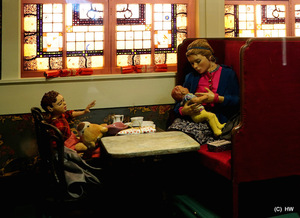
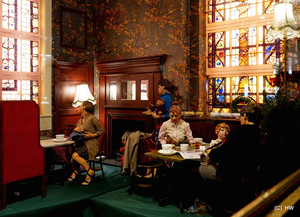
Bewley’s Christmas window (featuring a miniature Bewley’s).

Harry Warren writes:

In light of Johnny Ronan claiming that he owns the magnificent Harry Clarke stained glass windows in Bewley’s Cafe Dublin. I wonder will he also claim that he owns the miniature versions on display as a backdrop to the beautiful sculptures by Paddy Campbell currently on display in Bewley’s Cafe front windows?

All pics by Harry Warren

Earlier: Hate To be A Pane

Portobello Art Installation.

Harry Warren writes:

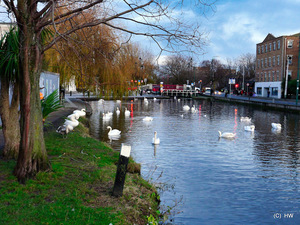
Portobello harbour in Dublin is a very nice area with its canal lock and a flock of very tame swans. Strolling along the canal I was very pleased to see the good use that has been made of the ugly hoarding around the building site of the new controversial 178 room hotel.

Despite widespread opposition An Bord Pleanála granted permission for the hotel despite its own inspector strongly recommending that planning should be refused on multiple grounds, but that is another story.

The hoarding has been turned into an outside art installation in a collaboration between Waterways Ireland and the National College of Art and Design. The NCAD students studying illustrations and graphics has resulted in a contemporary Zibaldone, or miscellany of artistic observations by the students, all of excellent quality inspired by our inland waterways.

The students artwork is playful and imaginative as well as creating some beautifully rendered information panels on nature and wildlife. So, if you find yourself in Portobello the art on display is well worth seeking out to enjoy.

Pics by Harry Warren

The Heart of The Liberties, Dublin 8

Harry Warren writes:

The Liberties area around the Coombe in Dublin is always worth a stroll, apart from it being a vibrant area in the heart of Dublin there are multiple items of cultural and historical interest to be enjoyed. Just off the busy shopping area of Meath St, there are two intersecting streets, Reginald St and Gray St.

The charming red brick houses in this part of the Coombe were built by the Dublin Artisan Dwellings Company in 1880-1882, chaired by the Victorian philanthropist, Sir Edward Cecil Guinness. Originally many of the houses were rented by the employees of the nearby Guinness brewery.

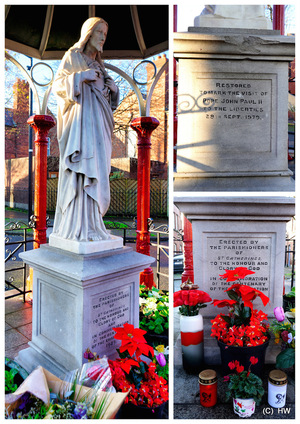
At the junction of Reginald Street and Gray Street there is a fine ornate structure with a statue of the sacred heart of Jesus at its centre. Perhaps surprisingly in these days of advancing secularisation, there are still many religious statues dotted around Dublin, particularly Marian statues, but this one is a statue of Jesus and it bears closer examination.

The statue is centred on beautiful wrought iron work set on an octagonal limestone base. In my over active imagination it always reminds me of a miniature Victorian band stand. I have heard it referred to as the Fountain, the Catholic Emancipation Monument or simply the Sacred Heart statue. Now a religious shrine it was originally a water fountain.

The fountain was commissioned in 1897 by the Earl of Meath, Reginald Brabazon to commemorate the visit of Queen Victoria to Ireland. The fountain was one of a large number celebrating Queen Victoria that were erected in Ireland and other British colonies of the time to a standardised design by Glasgow manufacturers Walter Macfarlane & Co. Manufactured at the Saracen Foundry, Possilpark, Glasgow, Scotland. There is a similar Victorian fountain at the bottom of Marine Road, Dun Laoire, but I personally prefer this one in the heart of the Liberties.

The water supply at the time was of poor quality so the fountain was installed to provide a source of clean water for the surrounding houses. Queen Victoria’s fountain did not last too long and as the words of the song “Dublin in the Rare auld Times” reminds us, there was a rebel streak in the Liberties. “A rogue and child of Mary, from the rebel Liberties,”.

During the War of Independence, there were skirmishes in the area and the fountain and canopy were severely damaged. There was an eagle originally mounted on the roof of the canopy but it was shot off by the Black and Tans and it is now replaced by a cross.

The copper canopy was once again damaged in the late twentieth century by a lorry. The current version of the shrine was restored to commemorate the visit of Pope John Paul II in 1979.

A plinth on the statue notes: –

“Erected by the parishioners of St. Catherine’s to the glory and honour of God and in commemoration of the Centenary of the Emancipation, 1929″

“Restored to mark the visit of Pope John Paul II to the Liberties 29th Sept. 1979″

So, the next time you are in the Liberties it is well worth diverting for a few minutes to enjoy this piece of street furniture. Proudly well maintained and kept in excellent order by local residents.’

Pics by Harry Warren’

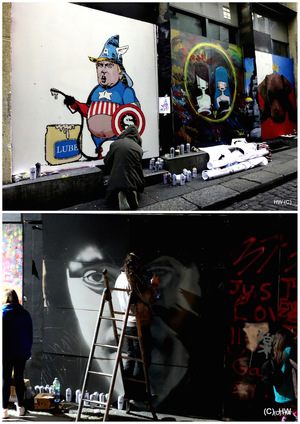
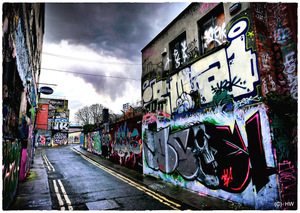
Recent examples of street art in Dublin including Liberty Lane (above) in Dublin 8

Dublin Street Art.

Harry Warren writes:

I love walking around Dublin and discovering new street art Frequently I will take a quick photo of a new piece of art as you never know how long it will be there. Art isn’t just for stuffy institutions and galleries. Street art can simply be a visual treat on its own merit, or for many artists, it is also a creative space for political and social commentary.

Dublin is lucky to have a vibrant bunch of urban artists, street artists and muralists. Their creativity and vitality are accessible to one and all and it brings a much-needed brightness and soul to many areas suffering from bland architecture and monotonous design.

To name but a few, not forgetting that there are artist collectives as well, the creativity by artists like Canvas, Solus and Maser are always a joy to behold. Aches is a master of colour and perspective. Emma Blake‘s artwork “Not Asking For It” painted in Dublin at what was the Bernard Shaw pub in Richmond St is a thought provoking example of social and political commentary in a very accessible form.

If you would like to see some excellent examples of Dublin’s vibrant street art scene, take a stroll along Liberty Lane, it is an alleyway that connects Kevin St to Camden Row in Dublin and it features a continuously changing canvas of colourful street art and graffiti. If you are lucky you may catch one of the artists hard at work on their latest masterpiece.

In the past Liberty Lane extended all the way to Portobello and led to the long-gone St Kevin’s Gate, that was the entrance to the Liberty of St Sepulchre but that’s for another story. Follow the route up Camden Street and check out the side streets of Grantham St and Pleasants’ Place that also feature some excellent work. Continue towards Portobello and you will find more excellent art around the environs of the old Bernard Shaw pub.

Some folk see street art as vandalism. I personally draw a distinction between a type of tagging and street art i.e. those mere scrawlings that are motivated by a desire to mark territory. It is disappointing to see tagging scribbled over a street artist work or mural, or when I see the gable end of houses, walls and apartments defaced with bad tagging.

More effort and encouragement should be put into encouraging the tagging brigade to develop their self-expression away from tagging and into more artistic efforts. Real street art is urban culture in action and more designated wall space should be given over to it.

I hope you enjoy just a few of the many photos I have taken of Dublin Street art. If any Broadsheet readers have any favourite street artists or know of some good locations to visit please let us all know in the “replies” section.

Anyone?

Pics by Harry Warren

St. Kevin’s Park, Camden Row, Dublin 8.

Harry Warren writes:

Dublin has some beautiful well-known parks but one of my favourites is the petite St. Kevin’s Park on Camden Row. It is usually bypassed by tourists but favoured by locals. St Kevin’s Park is unusual in having the ruins of a church and being a half park and half graveyard.

The grounds were redeveloped some years ago and the cemetery became todays park. It has a long history, the first mention of a church on the site dates back to the 13th century. The church ruins in the park today are a later addition built in 1750. This church was closed in 1912.

The park grounds still have some notable headstones in situ but the majority have been removed. The old headstones now line the perimeter of the park and more are around the walls of St. Kevin’s church.

Unsurprisingly the park is reputed to be haunted. Archbishop Dermot O’Hurley was buried there after being executed for treason in the 16th Century. He secretly baptised Catholics during penal times in St Kevin’s. He was eventually arrested, imprisoned and tortured and was sentenced to death. The authorities had him executed by slowly hanging him until dead. He was buried in St. Kevin’s but his grave is unknown today.

His spirit is said to be seen in the park where he performed the baptisms. During the transformation of the graveyard into today’s park, the owners of graves that could be traced were offered to have the occupants remains exhumed and buried elsewhere but many graves were unidentified and their bones still lie there today. The angry souls of these disturbed graves reputedly haunt the park.

Notable existing graves on view in the park are:

The Moore Family, relatives of Thomas Moore the poet and composer.

Hugh Leeson, brewer, and whose family gave its name to Leeson Street in Dublin

Jean Jasper Joly captain of the Irish Volunteers in 1798.

John Keogh, friend of Theobald Wolfe Tone, he once owned the land that is now Mount Jerome Cemetery in Harold’s Cross

Also, of note, the 1st Duke of Wellington of the Battle of Waterloo fame, was baptised in St Kevin’s.

During the 18th century the cemetery was a hunting ground for body snatchers, a very lucrative business. After dark a fresh grave with loose soil was sought out. A hole was quickly dug down to where the head lay . On reaching the coffin, two broad iron hooks under the lid, pulled forcibly up with the rope, broke off a sufficient portion of the lid to allow the body to be dragged out.

The body was stripped of the grave clothes, which were scrupulously buried again. The body was then put in a sack for transport and the soil was restored. The body was then sold to one of Dublin’s many medical schools, Trinity College, the Royal College of Physicians and the Royal College of Surgeons.

There is a dark history to the park as well. Tommy Powell a six-year-old child, was tragically murdered here in 1961. Broadsheet had an excellent 2017 article about the unsolved murder that you can read at this link here.

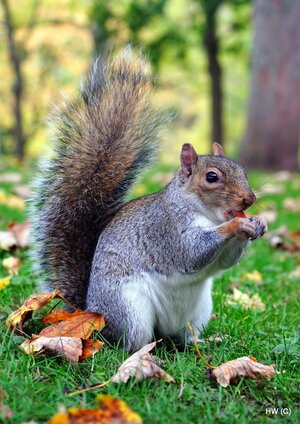
Today St. Kevin’s is a haven for wildlife. There are many species of birds including wrens, blue tits, robins, magpies, blackbirds and wood pigeons as well as mammals like hedgehogs, urban foxes, squirrels and wood mice.

Three species of bat are to be found in the park, Leisler’s bat, the common pipistrelle and the soprano pipistrelle. These bats make use of the ivy around the old church ruin as a roost. It is a lovely place to visit but perhaps for those of a nervous disposition, not after dark.


Pics by Harry Warren

Previously: Harry’s Dublin on Broadsheet

The Iveagh Gardens, Dublin 2.

Harry Warren writes:

I created this collage (above) of the same trees in the Iveagh Gardens in Dublin over a few seasons. Nature doing what it does best. The photos were taken during Summer, Autumn and now what I fear for some, is going to be a long Winter.

Because of the worldwide outbreak of COVID-19 it has been a rough year for many up to now. One can see how fractious many of the posts on Broadsheet have become but hope is on the horizon, everything comes in cycles and I do look forward to Spring blossoming when it arrives. All things come to pass and the current scenario will fade away in time. Watch out for the photo when Spring returns.

Pics by Harry Warren

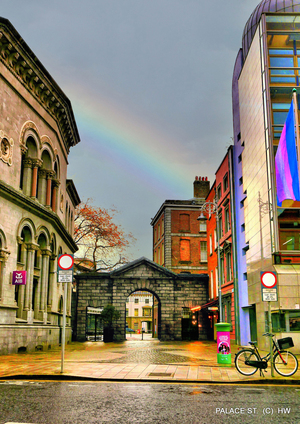
From top: Palace Street, Dublin 2 (pics 1 and 2); Dean Street and Kevin Street Cross, both Dublin 8

On Dublin’s shortest streets….

…Harry Warren writes:

Just before one of the last lockdowns, I was happily enjoying a coffee outside of the lovely French restaurant Chez Max on Palace Street, Dublin 2. An American gent at the table beside me, in all seriousness said to his lady friend, “so what do they have to be indignant about? “Maybe the name is Olde English”, she replied”.

I couldn’t resist joining in the conversation. “Are you admiring the building? The Sick and Indigent Roomkeepers Society was a charity and its now a listed building”.  “Were they indignant because they were poor?”, he replied. Then badly paraphrasing G.B. Shaw, I offered “two nations divided by a common language”, gently advising that “indigent” now a rarely used word meant “poor”.

The penny finally dropped, we laughed and we had an enjoyable conversation about the locale and Palace Street. They were quiet taken with Palace Street and said it was the smallest street they had ever seen.

Palace Street. is one of the shortest streets in Dublin, it links Dame Street to one of the entrances to Dublin Castle. One side of the street has a fine elegantly designed building now an AIB bank. On the opposite side at number one is Chez Max and number two was the home of Dublin’s oldest charity, The Sick and Indigent Roomkeepers Society. It was founded in 1790 “for the relief of the poor without religious discrimination.”

Number three is a hideous Lego block lump of architecture, oversized, grimly designed and lacking in any finesse, popularly known as Robocop on Dame Street.

Palace Street. is one of the shortest streets in Dublin, followed by Dean Street in the Liberties [Dublin 8] but I would argue that Kevin Street Cross has to be the shortest of them all. Kevin Street Cross joins Bride Street. with New Bride Street on the way to St. Patrick’s Cathedral. Other short streets in Dublin? There is a hint in my name of my favourite one. I am sure there are more.

If any Broadsheet readers know of any shorter street or road in Dublin than Kevin Street Cross, I would love to read a comment in the Reply section.

Anyone?

Pics by Harry Warren

Yesterday.

Phoenix Park, Dublin.

Harry Warren writes:

Even in lockdown, Autumn is a wonderful time in Dublin when the parks and gardens turn to bright golden hues of yellow, red and brown.

The sun sets early casting long evening shadows highlighting Autumnal colours to enjoy.

I would heartily recommend a stroll in Dublin’s Phoenix Park to view the beautiful trees and wildlife in abundance and after your gentle exertions perhaps a visit to the wonderful octagonal Victorian Tea Rooms (above0) to enjoy a fresh tea or coffee.

Pics by Harry Warren

Some Neck Guitars.

4 Dean Street, Dublin 8,

Harry Warren writes:

I visited Some Neck Guitars recently to have a guitar repaired. They did an excellent professional job for a very fair price. They are doing their best to support the live music industry in Ireland, despite the assault on it due to the Corona Virus restrictions.

Some Neck Guitars is Dublin City’s first dedicated classic Vintage and Modern guitar and amp store. Apart from a very friendly and helpful staff they have an excellent range of classic guitars and amplifiers for sale. They also offer a full and comprehensive guitar set up and repair service.

Name those ‘axes’, anyone?

Pics by Harry Warren

Sheridan Le Fanu’s grave.

Mount Jerome Cemetery, Harold’s Cross, Dublin 6.

Harry Warren writes:

At Halloween, many trick or treaters will be dressed in vampire costumes due to the enduring legacy of the 1897 novel Dracula, by Irish author Bram Stoker.

The novel was also immortalised on screen by many great actors, Max Schreck playing the cadaverous vampire Count Orlok in F.W. Murnau‘s 1922 silent classic “Nosferatu: A Symphony of Horror“.

Then Bela Lugosi‘s genre defining Dracula in 1931 and later in the superb Gothic horror films of Dracula starring Christopher Lee as the count.

Most people today associate Stoker as the originator of the vampire in modern novels but Irish author Sheridan Le Fanu can be rightly credited as having written the first vampire story.

Le Fanu belonged to an old Dublin Huguenot family. He was educated at Trinity College, Dublin, he published 14 novels and wrote superb stories featuring the supernatural, Uncle Silas (1864), The House by the Churchyard (1863) and a book of five long stories, probably his best work, In a Glass Darkly (1872).

The book was published 26 years before Bram Stoker’s novel also includes his classic Gothic vampire story “Carmilla“, arguably the first time a vampire appears in a modern story. The story tells of a young woman preyed upon by a female vampire. “Carmilla” popularised the theme of the female vampire replete with hints of lesbianism.

Sheridan Le Fanu rests today in Dublin’s wonderfully atmospheric Victorian Harold’s Cross cemetery. His grave has a notable plaque ” Here Lies Dublin’s Invisible Prince, Novelist and Writer of Ghost Stories”.

I would recommend a visit this weekend.

Previously: Harry’s Dublin

Pics by Harry Warren