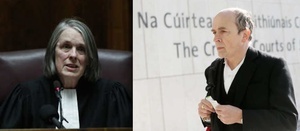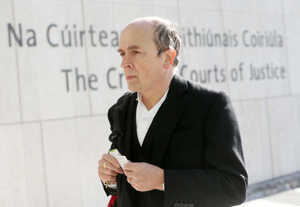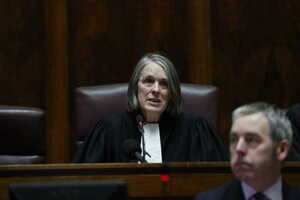


From top: Susan Denham, Patrick Gageby and George Gibney; Law report on the Supreme Court hearing
The High Court judicial review in 1994 that quashed all sex abuse charges against swim coach George Gibney did not just set free a suspected paedophile.
It was a landmark decision which paved the way for similar successful actions over the next 20 years.
But it was only made possible by a judgment reached in the Supreme Court just before Christmas, 1993.
Six months earlier, Mr Gibney had been charged with 27 counts of indecency against young swimmers and of carnal knowledge of girls under the age of 15.
Seven swimmers had come forward and sworn statements to the Gardaí that Mr Gibney had assaulted them at various times between 1967 and 1981.
On July 12, 1993 Mr Gibney’s legal team, including barrister Patrick Gageby, applied in the High Court for a judicial review restraining the Director of Public Prosecutions (DPP) from proceeding with the prosecution.
A judicial review allows orders to be made against State decision-makers (including the DPP) if there is a a breach of fair procedures in the decision making process.
Mr Gibney’s legal team argued that the delay in initiating the prosecution infringed their client’s right to a fair trial.
On July 19, Justice Vivian Lavan in the High Court refused to stop the DPP from proceeding with the charges. He said that the delay did not infringe Mr Gibney’s right to a fair trial.
Mr Gibney appealed this decision to the Supreme Court.
On December 14, 1993, the Supreme Court granted Mr Gibney leave to apply for judicial review on the basis that his right to a fair trial might possibly have been infringed.
This was the first case in Ireland to recognise that delay in making a complaint of sexual abuse could preclude a subsequent prosecution.
Justice Declan Costello conducted the judicial review and held that Mr Gibney’s right to a fair trial would be infringed if the prosecution were to be proceeded with.
He granted an order precluding the DPP from proceeding with the charges.
An opportunity to appeal the decision was declined by Eamonn Barnes, then Director of Public Prosecutions.
George Gibney left Ireland – travelling first to Scotland, where he coached young swimmers, and then to America.
What went unreported at the time of the Supreme Court decision and what few outside the legal fraternity knew, least of all Mr Gibney’s alleged victims, was that Susan Denham, sister of Patrick Gageby, was on the bench that day.
Ms Denham was in ‘complete agreement’ with the majority judgement and placed her feelings on the record.
She said,
‘all persons charged or convicted of an offence are entitled to the rule of law and have constitutional rights. Such persons are also entitled to due process of law. A trial, in a court of law is not an exercise in vengeance but is a trial in due course of law in the pursuit of justice on behalf of the community.
The rule of law was the essence of a civilised society. In so far as there were, developments and knowledge in society a about issues relating to this case, these must be dealt with in a fair and just way by the courts.’
Ms Denham added that on ‘the affidavit and statement filed [in this case] it was clear that such a case had been established to meet this initial burden of proof.’
There was no objection to Ms Denham hearing her brother’s case from the Director of Public Prosecutions, represented in court by the late Eamon Leahy.
The Code of Conduct of the Irish Bar provides that:
“Barristers shall not habitually practice in a court in which their parent, spouse or near blood relative is a presiding judge.”
In O’Reilly v Cassidy, a decision of a Circuit Court judge in favour of a client represented by his daughter was set aside by a superior court.
In the United States, Australia and the United Kingdom, rules specifically provide that a judge shall not hear a case in which a family member appears for a party – a principle which is also contained in the Code of Judicial Conduct laid down by the United Nations.
Irish law is also subject to general rules of fair procedure, including the principle ‘nemo iudex in causa sua‘ (no man shall be a judge in his own cause), which provides for the quashing of judicial decisions made in ‘circumstances which would lead a fair-minded and informed observer to conclude that there was a real possibility … that the tribunal was biased’.
Last year, the Supreme Court quashed a decision of a High Court judge who had held shares in one of the companies party to the litigation in circumstances where he had mistakenly failed to disclose the full extent of that shareholding.
In this instance Susan Denham, now Chief Justice, gave the majority verdict.
She said objective bias was a matter not just for the parties, or the trial judge, but brought in issues regarding
“the fundamental concern for the manifest impartial administration of justice and the confidence which the people rest in the judiciary.”
Following the Gibney judgment, a significant number of applications to stop prosecutions for sexual offences on the basis of delayed complaint were made through the courts.
Patrick Gageby made 16 of these applications, most of which were heard in the period 2004-2007.
Seven of his applicants were successful including a psychiatric nurse facing 32 counts of indecent assault against a patient between 1975 and 1979, a man charged with 63 sexual offences against his sister from the 1960s and 1970s, and two priests accused of sexual offences in the late 1980s.
One unsuccessful applicant was Dublin swimming coach Derry O’Rourke who was convicted in 1998 for 12 years on 59 sample charges of assaulting and raping 12 girls. In 2001, he was convicted of child rape and sentenced to seven years and, in 2005, he received another 10 years for a third set of convictions.
In 2003, the Irish Times reported Mr Gageby telling a conference that there was a ‘subversion of the presumption of innocence’ with historic sexual abuse cases.
“People asked why a person would “say such a thing” if the offence had not happened,” he is reported as saying.
The paper reported:
‘[Mr Gageby] warned that cases up to 40 or 50 years old might be given a credence they did not deserve. Judges should give carefully worded warnings to juries when they were summing up old cases. Proper and full disclosure was vital, he said. The gardai were not there primarily to help the victim, but to assist in the administration of justice.’
In 2005, Mr Gageby told a prosecutors’ conference that there should be a limit on the time allowed to elapse between an alleged sex crime and the prosecution of a suspect.
in 2007, Mr Gageby was appointed by the then Justice Minister Michael McDowell to review the Garda investigation of the 1973 death of then 11-year-old abuse victim Cynthia Owen‘s daughter Noleen Murphy and concluded no public inquiry should be carried out into the death.
A year after the sex abuse charges against George Gibney were dropped, police in Colorado investigated a complaint of sexual assault made by a young swimmer against Mr Gibney, who had been working as a coach in the North Jeffco Parks and Recreation District.
Pics: Rollingnews
Earlier: Unreasonable Delay