Tag Archives: Perseids

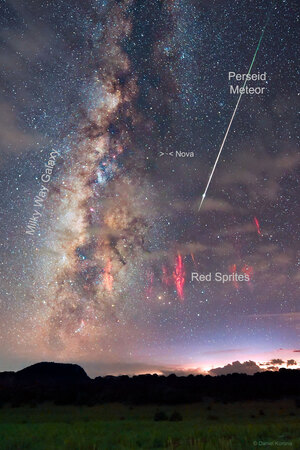
Behold: a most usual sky. To wit:

It wasn’t unusual because of the central band the Milky Way Galaxy, visible along the image left. Most dark skies show part of the Milky Way. It wasn’t unusual because of the bright meteor visible on the upper right. Many images taken during last week’s Perseid Meteor Shower show meteors, although this Perseid was particularly bright. This sky wasn’t unusual because of the red sprites, visible on the lower right. Although this type of lightning has only been noted in the past few decades, images of sprites are becoming more common. This sky wasn’t unusual because of the nova, visible just above the image center. Novas bright enough to be seen with the unaided eye occur every few years, with pictured Nova RS Ophiuchus discovered about a week ago. What was most unusual, though, was to capture all these things together, in a single night, on a single sky. The unusual sky occurred above Zacatecas, Mexico.

(Image: Daniel Korona)
apod

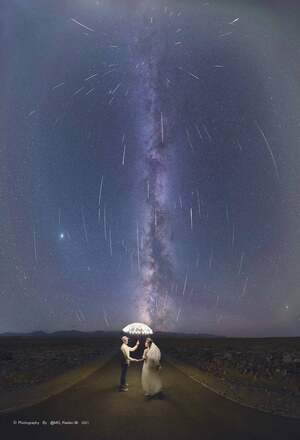
Behold: comet dust raining down last week in a composite shot taken during the peak night of the annual Perseid meteor shower. To wit:

The umbrella was not needed as a shield from meteors, since they almost entirely evaporate high in the Earth’s atmosphere. Many of the component images featured individual Perseids, while one image featured the foreground near Jiuquan City, Gansu Province, China. The stellar background includes the central band of our Milky Way Galaxy, appearing nearly vertical, as well as the planets Jupiter and Saturn on the left. Although the comet dust particles are traveling parallel to each other, the resulting shower meteors clearly seem to radiate from a single point on the sky — the radiant in the eponymous constellation Perseus. The image captured so long an angular field that the curvature of the sky is visible in the trajectory of the Perseids. 

(Image: Luo Hongyang)

apod

How best to watch a meteor shower? Well, later this week, the annual Perseid Meteor Shower will hit its peak. So what next for the avid skywatcher? To wit:

One thing that is helpful is a dark sky, as demonstrated in the featured composite image of last year’s Perseids. Many more faint meteors are visible on the left image, taken through a very dark sky in Slovakia, than on the right image, taken through a moderately dark sky in the Czech Republic. The band of the Milky Way Galaxy bridges the two coordinated images, while the meteor shower radiant in the constellation of Perseus is clearly visible on the left. In sum, many faint meteors are lost through a bright sky. Light pollution is shrinking areas across our Earth with dark skies, although inexpensive ways to combat this might be implemented.

(Image: Tomas Slovinsky (Slovakia) & Petr Horalek (Czech Republic; Institute of Physics in Opava)

apod

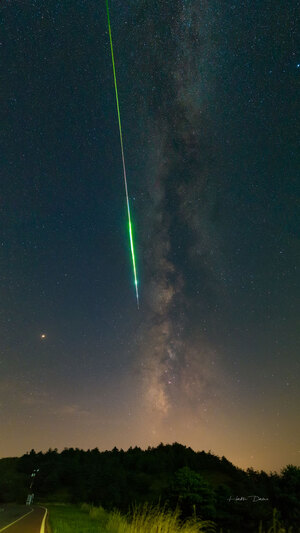
Behold: a flashing object that streaked across the sky against the backdrop of the Milky Way nearly three years ago, leaving a bright green trail that took 30 minutes to dissipate. To wit:

Given the day, August 12, and the direction, away from Perseus, it was likely a small bit from the nucleus of Comet Swift-Tuttle plowing through the Earth’s atmosphere — and therefore part of the annual Perseids meteor shower. The astrophotographer captured the fireball as it shot across the sky in 2018 above a valley in Yichang, Hubei, China. The meteor’s streak, also caught on video, ended near the direction of Mars on the lower left. Next week, the 2021 Perseids meteor shower will peak again. This year the Moon will set shortly after the Sun, leaving a night sky ideal for seeing lots of Perseids from dark and clear locations across planet Earth.

(Image: Dandan Huang)

apod