

Tag Archives: Public Services Card

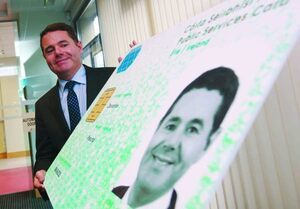
From top: The PSC card; Minister for Employment Affairs and Social Protection Regina O’Doherty (left) and Helen Dixon, Data Protection Commissioner

This afternoon.

On RTÉ’s News at One, Pat Leahy, of The Irish Times, spoke to Christopher McEvitt about his article concerning the Government’s decision appeal the Data Protection Commissioner’s report on the Public Services Card.

It comes ahead of a Cabinet meeting this afternoon whereby it’s expected that ministers will be briefed about this decision.

Christopher McEvitt: “Tell us a little bit about the sense of embarrassment felt by the minister in charge of this project, Regina Doherty?”

Pat Leahy: “Yeah, Government have been very quiet about this. Albeit that the report was issued during August – the full report, by the way, hasn’t been published, merely the announcement of the report by the Data Protection Commissioner.

“But there was calls for Regina Doherty, who’s the Minister for Social Protection, who had promoted and defended the use of the card during her period as minister, calls from the Opposition for her to resign, came under a lot of criticism, not just from Opposition politicians, but also from activists in the field.”

“She’s said very little about it since then now and frankly I suppose some of that period was during the traditional political holidays, during August. But we haven’t heard from her in any great detail about the Government’s response to it. But today we find that she is bringing a memo to Cabinet which will inform that Government intends to appeal this, or to challenge the findings of the Commissioner’s report in the High Court.”

McEvitt: “And presumably she has found good reason to appeal the Data Protection Commissioner’s findings on the Public Services Card, we have no idea, have we, as to what the legal argument would be?”

Leahy: “No we don’t have any sight of the detail of the Attorney General’s advice on it, but I’m told what ministers will be briefed on this afternoon, when they meet for the first Cabinet meeting since the August break, is that advice has been taken not just from the Attorney General’s Office but also from an external counsel engaged by the Attorney General’s Office.

And the advice is that the decision of the, or the findings of the Data Protection Commissioner, in relation to the Public Services Card, were wrong in law, that she exceeded her legal powers and that they are likely to be set aside by a court.

“So I think the next stage that will be taken will be that the Data Protection Commissioner will be informed of this and if her report is not withdrawn that then, which I suppose is unlikely to happen, that High Court proceedings will be issued.”

McEvitt: “Any response thus far to your story on the front page of The Irish Times today from those civil liberties groups, those rights campaigners who were very concerned and who, indeed, welcomed the Data Protection Commissioner’s decision or findings on the Public Services Card, i.e. that it was being used beyond its scope unlawfully, by the Government?”

Leahy: “Well, I suppose campaigners who had been saying these sorts of things about the extension of the use of the Public Services Card for some times felt vindicated by the Data Protection Commissioner’s report and many of them pointing out that this could spawn a series of legal actions against the Government.

“I suppose many of them will not be surprised by the Government’s decision to challenge he findings of the Data Protection Commissioner. I suppose at a basic, political, level, it kicks the issue into touch.

“I think there will likely be criticism by both the Opposition and activists on the Government’s decision but from the point of view of Government Buildings, once that criticism is out of the way and I suppose once this story has died down, then it means it’s not something that has to be immediately addressed by the Government until such time the legal action has resolved itself which, as we know, is not something, that generally happens very quickly.”

Listen back in full here

Earlier: ‘They’ve Been Collecting Data About Voters For A Very Long Time’

Put It On The Card

David Carroll, of The Great Hack

This morning.

On RTÉ’s Today with Seán O’Rourke.

Mr O’Rourke had a discussion about data protection concerns with David Carroll, professor at Parsons College in New York who sued Cambridge Analytica to access data the group had on him.

Unfortunately, they did not discuss the Irish Government’s intention to appeal the Data Protection Commissioner’s decision on the Public Services Card which found the use of the card, which has been issued to more than three million citizens, for many Government services had no basis in law.

Mr Carroll is one of the main subjects of Netflix documentary The Great Hack and will be in Dublin tomorrow to speak at the Tech For Good conference.

He is attending the conference as a guest of the Irish Council for Civil Liberties which has vowed to fight the Government over its decision to appeal the Data Protection Commissioner’s report…

From their discussion…

Seán O’Rourke: “A lot of concern, obviously, about data being scraped from people who had not consented but I mean advertisers, surely, and politicians indeed, they’ve been collecting data about voters for a very long time, to target them and persuade them.”

David Carroll: “Yes the practice has been going on and it gets sort of, each election cycle, it gets more and more sophisticated, aggressive. The volume of data increases. The pace of technology  goes faster than any of us can even understand its roll-out. And so it’s the concern that the trajectory of this is to become increasingly aggressive unless we do something about this.

“The general concerns, related to the democratic process, are the general idea of are candidates choosing voters or are voters choosing candidates?

“And then are advertisements related to elections so precise and targeted to such small audiences that you’re not having a community-wide discussion about the issues that two neighbours or two members of one household are seeing totally different things? So, how could we possibly have a conversation about who we want to elect, or the issues that we are debating in our communities?”

Listen back in full here

Tech For Good conference (Eventbrite)

Earlier: Put It On The Card

Pic: Netflix

Public Services Card; Minister for Employment Affairs and Social Protection Regina Doherty

A week on from the Data Protection Commissioner Helen Dixon announcing that there is no legal basis for anyone to have to present a Public Services Card in respect of any transaction between a person and a public body outside the Department of Employment and Social Protection…

And that the supporting information that millions of card holders had to hand over in order to get their card – such as utility bills, proof of ID, etc – must now be deleted…

And that the Minister for Public Expenditure Paschal Donohoe was informed of Ms Dixon’s report’s findings a year ago

A press release released this lunchtime by the Department for Employment Affairs and Social Protection includes the following comment from Minister Regina Doherty:

“Both myself and my department take very seriously the findings of the Data Protection Commission and the good work it does.

“For that reason it is important that bodies that are subject to findings by the commission give very careful consideration to those findings.

“Such careful consideration is also necessary in order to be fair to the commission and to ensure that when we do speak that the public hears a properly prepared response.

As soon as our consideration of this final report is complete, the department will publish its response along with the report and any other relevant information on its website and I will speak then at greater length on the matter.”

Meanwhile, in the same press release from the department, a spokesperson said:

“The Department is currently reviewing the report together with the Attorney General’s Office and the Department of Public Expenditure and Reform. This process is not yet complete and is expected to take another week or so.

“While the Department understands that some may wish for us to respond sooner, it should be noted that this is a comprehensive report and requires significant attention.

It is not true, as has been reported in some quarters, that the Department has had this report for a year.”

“The Data Protection Commission (DPC) provided a draft investigation report in August of last year at the mid-point of a two year investigation. It came with instructions that it was provided on a strictly confidential basis and was not to be shared with any third parties.

“This draft report contained what it described as preliminary findings and the DPC asked the department to make submissions on these findings. The report also posed a number of additional questions in the form of requests for information.

“These submissions and response to requests for information were sought to assist the DPC in the ongoing investigation and to inform the content of the final report.

“The department together with Department of Public Expenditure and Reform considered the interim report very carefully and sought and received the advice of the Attorney General’s Office.

Based on this consideration, and the advice received, the Department submitted a very detailed response setting out how it believed the SAFE process/PSC was administered in full compliance with all relevant law.

“In this context, in the absence of any determination by the DPC and pending the receipt of the final report, the Department and other specified bodies continued to rely on the PSC and SAFE process.

“The revised and final version of the report was received last Thursday. It contains a significant volume of additional analysis, a number of the findings have been changed and some have been removed.”

Previously: House Of Card

Rollingnews

Meanwhile…

Then Minister for Public Expenditure and Reform, Paschal Donohoe, at the Public Services Card Centre, D’Olier House in Dublin after he registered for a Public Services Card (PSC) with the Department of Social Protection on September 8, 2016

This morning.

Cianan Brennan, in The Irish Examiner, reports that Public Expenditure Minister Paschal Donohoe was briefed on Data Protection Commissioner Helen Dixon’s interim report on the Public Services Card a year ago.

This is despite him telling RTÉ last Friday that he had been briefed by his officials on the report’s “key points” that morning.

Ms Dixon’s report found that there is no legal basis for anyone to have to present a Public Services Card in respect of any transaction between a person and a public body outside the Department of Employment and Social Protection.

She also ordered that the supporting information that the 3.2 million card holders had to hand over in order to get their card – such as utility bills, proof of ID, etc – and held by the department must now be deleted as it was unlawfully held.

It’s interesting to note comments made by Mr Donohoe after he apparently saw the report:

On September 25, 2018  he said:

“During 2017 and over the course of this year, my Department and the Department of Employment Affairs and Social Protection have worked with a number of specified bodies to integrate the PSC and MyGovID, into their processes in order to improve access to and the security of public services.

“Currently, the PSC and MyGovID underpin access to social welfare entitlements, first time adult passport applications, citizenship applications, Revenue services, SUSI grants, driving licence and driver theory test applications.

During the rest of this year and 2019, access to more public services will be underpinned by the PSC and MyGovID. My Department along with the Department of Employment Affairs and Social Protection is engaging with the relevant Departments to assist with the transition of services in line with the schedule set out in the eGovernment Strategy 2017-2020.”

Also, on October 24, 2018, he told the Dáil:

“I listened to Deputy [Éamon] Ó Cuív’s comments about the need to simplify the tax code and the sharing of information between Departments, which is what underpins the public service cards.

“I agree with his point that if a citizen supplies information to the State, particularly when it is created by the State in the first place and then made available to the citizen, it should not be the case that the citizen must supply the same information to multiple agencies.

“It is a fair point and it is why the work is under way in the SAFE 2 process, where citizens who must provide information to the State receive a single digital identity which, once it is has been provided, is used by the State to ensure information is available to all Departments more quickly than it is now.”

Meanwhile, separately, before Mr Donohoe would have seen the report, on March 22, 2018, Mr Donohoe told the Dáil the following:

“I want to reiterate to the House that we have the highest level of protection in place to ensure that citizens’ information and private data are safe, secure and stored and regulated in accordance with data protection law.

“I am aware of the issues of concern that were raised in the second half of last year. That is why we have published the document I referred to a moment ago on the website of the Department of Employment Affairs and Social Protection.

“It explains to citizens how we are handling the various issues of concern. We have responded, and will continue to respond, to any matters of public concern and any observations or views that the Data Protection Commissioner may have.

“We are dealing with matters of concern for the public, and that is why we have tried to communicate what the benefits are.

At a time when there are such legitimate concerns about how we protect our digital identity and make sure information that people share is securely protected I would have thought that the rationale for the public services card has actually grown rather than been diminished.”

Donohoe was briefed on investigation into public services card last year (Cianan Brennan, The Irish Examiner)

Transcript: Kildarestreet.com

Rollingnews

Previously: Your Card Has Been Declined

House Of Card

Meath TD and Minister for Employment Affairs and Social Protection Regina Doherty

The resignation of Minister for Social Protection Regina Doherty, on foot of the very expensive Public Services Card debacle, is not “compulsory”, but it is “mandatory” if we are serious about the creation of accountable governance.

Jim O’Sullivan,
Rathedmond,
Sligo.

Public Services Card debacle (The Irish Times letters page)

Previously: House Of Card

Rollingnews

Then Minister for Public Expenditure and Reform Paschal Donohoe with a Public Services Card in 2006; Solicitor Simon McCarr

Solicitor Simon McGarr, of Dublin firm McGarr Solicitors, was very vocal about his concerns in respect of the Public Services Card for years.

This was long before the Data Protection Commissioner Helen Dixon last week found that there is no legal basis for anyone to have to present a PSC in respect of any transaction between a person and a public body outside the Department of Employment and Social Protection.

At the weekend, Mr McGarr tweeted redacted documents that he obtained which show how closely the Department of Social Welfare was following his media utterances on the matter – including his tweets…

Related: The Facial Images on the PSC are Biometric Data (Simon McGarr)

Previously: House of Card

Your Card Has Been Declined

UPDATE:

Gavan Reilly, political correspondent at Virgin Media One and presenter of Newstalk’s On The Record interviewed Mr McGarr yesterday.

Towards the end of the interview, they had this exchange…

Gavan Reilly: “If there is an internal note on the Department of Social Protection about your appearance on this show here today, what do you imagine they’re saying about you?”

Simon McGarr: “I can’t imagine it’s complimentary based on the previous notes that I got. But what I will say is this: One of the talking points which have emerged since the report [from the Data Protection Commissioner] is the argument is that ‘well, look, surely everyone acknowledges, our intentions were good while we illegally collected a database on three million people.

“And, at some point, the intentions were good, absolutely. In the sense that nobody intended to break the law, at some point when this was being designed.

“The question is at what point did they become aware that the law was being broken and being carried on anyway.

“And I do know that the Journal.ie received documents between the Department of Transport and the Road Safety Authority which said that Shane Ross had received a verbal briefing from the Attorney General in March 2018.”

Reilly: “So the Attorney General was giving advice, nearly 18 months ago, that there already some legal concern or ambiguity about this?”

McGarr: “Well, on foot of the conversation, having cited the conversation as the reason for doing it, the Department of Transport instructed the Road Safety Authority  to stop requiring the public to use the Public Services Card in their online application.

“And the Road Safety Authority complained that they’d spent millions building that. So, in March 2018, Shane Ross took the right decision on the Attorney General’s advice and he said ‘no, we won’t do that’.

“Now, the question is: at what point did everybody else in the public service become aware of the Attorney General’s opinion and why did they take no action from March 2018 to now?”

Listen back in full here


Above:Data Protection Commissioner Helen Dixon on RTÉ Radio One this morning; Minister for Employment Affairs and Social Protection Regina Doherty

This morning.

The Data Protection Commissioner Helen Dixon spoke to Miriam O’Callaghan on RTÉ’s Today with Miriam O’Callaghan.

It followed Ms Dixon’s finding that there is no legal basis for anyone to have to present a Public Services Card in respect of any transaction between a person and a public body outside the Department of Employment and Social Protection – such as obtaining a drivers’ licence, passport, education grants, etc.

And her finding that the supporting information that the 3.2 million card holders had to hand over in order to get their card – such as utility bills, proof of ID, etc – must now be deleted.

Ms O’Callaghan told listeners that the show sought an interview with the Minister for Employment Affairs and Social Protection Regina Doherty – who famously, in 2017, said the cards were  mandatory but not compulsory” – but she was not available.

Her spokesperson said she has received Ms Dixon’s report and that she will respond in “due course”.

Ms Dixon clarified a number of her findings outlined in her press release issued this morning.

In respect of her call for the destruction of data held on the 3.2 million card holders, she said:

They have to delete the supporting documentation that they collected. They do not have to delete the PSI dataset elements and what that Public Sector Identity set elements are are the name, address – the information that they extract and validated from the supporting documentation will not be deleted. Because existing cards are not invalid. It’s the supporting documentation that they must delete.”

In respect of how the card has been used – by departments outside the Department of Employment and Social Protection – Ms Dixon said that she has found other departments have recently been rowing back on demanding that a Public Services Card be presented.

She said:

“As far as we can see the only mandatory requirements at the moment, outside of the department itself, are from the immigration service for citizenship applications and the passport office for new adult passport applicants.

“So in fact, already, some of the bodies have rolled back and usefully so in light of our findings.”

She added:

“As I say, what the Government does from here, and what it intends and wants the system to be, is a matter for the Government.”

Asked by a listener if they should cut up and destroy their card, Ms Dixon said:

“No I hope it’s clear from what I’ve said that cards that have been issued are valid, can continue to be used to avail of free travel and if the individual asking is a benefit recipient from the department then they must still produce it as required.” 

Meanwhile

Independent TD Catherine Connolly

Independent TD for Galway West Catherine Connolly also joined Miriam O’Callaghan this morning.

Ms Connolly said:

“As I understand it, the Department has had a copy of the draft report since August of last year and I’ve just heard Helen Dixon say that in August last year, notwithstanding that the Government had a copy of the draft report with all of these concerns, they simultaneously extended the requirement to have this card for other services.

“That in itself tells me something.”

Ms Connolly also said that since she started being a TD in 2016, she and other TDs have consistently raised the issue in the Dáil and the Public Accounts Committee.

She also paid tribute to a “female Irish Times” journalist who has been writing about the matter but failed to mention her name. Presumably Ms Connolly was referring to Elaine Edwards.

Ms Connolly said:

The response from the minister and the Government was patronising. They said they knew best. We were raising matters that weren’t relevant, that we were making a big deal out of nothing.”

She added:

“What has happened here is it was the introduction of an identity card by stealth. There may well be arguments for an identity card but they were never discussed in the Dáil. In fact, it was frankly denied by the Government.”

Ms Connolly also asked why no comprehensive business case was given the Public Accounts Committee for the roll-out of the cards – which is estimated to have cost €62million to date.

Listen back in full here

Earlier: Your Card Has Been Declined

Meanwhile…

Paschal Donohoe, then Minister for Public Expenditure and Reform, launches the Public Services Card (PSC) in 2016

FP Logue Solicitors write:

FP Logue received confirmation today that the Department of Employment Affairs and Social Protection has agreed to pay social welfare benefits to a client who refused to register for the Public Services Card (PSC).

Our client had presented a passport and proof of address with an application for benefits and received a formal decision from the Deciding Officer that the payments would be available for collection in the local post office in due course.

Subsequently our client was informed by a member of staff that the approval had been a mistake and that the payments would be suspended until such time as an application for the PSC was processed.

Our client refused to make the application and asked for written reasons to be provided. The position was subsequently confirmed in writing that payments were suspended until a PSC application was processed.

We wrote to the relevant official on our client’s behalf pointing out that there was no requirement under social welfare law for an applicant to register for the PSC and that the payment had been unlawfully suspended and that our client had been grossly misinformed as to their rights by officials.

We received confirmation today that payments have been released confirming our assertion that a PSC registration is neither mandatory nor compulsory for the purposes of accessing social welfare benefits.

There you go now.

FP Logue secures social welfare payments for client who refused to apply for Public Services Card (FP Logue)

Paschal Donohoe, then Minister for Public Expenditure and Reform, launches the Public Services Card (PSC) in 2016

This morning.

It’s being reported that the Department of Employment and Social Protection is refusing to release information with regard to an investigation by the Data Protection Commission into the legality of the public services card.

The request for information was made by the Irish Council for Civil Liberties.

In addition, the DPC has confirmed to The Irish Times that the DPC doesn’t intend to publish its report in full.

Instead it will publish a summary of its findings.

Elaine Edwards, in The Irish Times, reports:

A request from the Irish Council for Civil Liberties to the department asking it to release an interim investigation report by the commission into the card and connected projects has been rejected, on grounds that releasing it could reveal the department’s plans or have a significant adverse affect on its functions.

The ICCL call comes as the final stage of Government legislation which will allow wider sharing of personal data with organisations and agencies is set to be debated in the Dáil on Tuesday.

ICCL director Liam Herrick called for “full transparency on the legal basis for the public services card because it violates the privacy and data protection rights of people living in Ireland.

“We have been campaigning against its introduction because it’s unnecessary, costly, and of questionable efficacy – and it targets in particular economically vulnerable people, such as those dependant on social welfare. Further, it is deeply troubling that the Government has continued to roll the card out for essential services while a question hangs over its legality,” he said.

Ms Edwards also reported that the DPC sent the department “a draft confidential report” in recent months for comment and that this report contains “13 provisional findings on issues spanning legal basis to transparency matters”.

Further to this…

Solicitor Simon McGarr has tweeted his thoughts on the matter…

Meanwhile…

Nurse Polly has also tweeted her experience of having to get a card.

UPDATE:

Department refuses to release details of public services card inquiry (The Irish Times)

Rights group challenge over public services card (The Times Ireland)

Previously: Thank You, Nurse Polly

Rollingnews

Paschal Donohoe, then Minister for Public Expenditure and Reform, launches the Public Services Card (PSC) in 2016

Augmented identity.

It’s all the rage.

Elaine Edwards, in The Irish Times, reports:

“…Details of the new contract, published on the eTenders website on Thursday, reveal the €9.41 million contract for the cards was awarded to DLRS Ltd, a company owned by Smurfit Kappa and Idemia, formerly known as Morpho.

The consortium is trading as Security Card Concepts was called Biometric Card Services Ltd a month ago.

“Idemia, the Dutch company, says it offers services including “augmented identity” products that rely on “the most physical, natural and authentic verification: the body’s own biometric data”.

While the Department of Employment Affairs and Social Protection has previously insisted it does not process biometric data, its new privacy policy, admits that “at times” the data it may collect includes:

“data concerning health and biometric data used for the purpose of identification and at times, information concerning trade union membership. We acknowledge that we can also collect, indirectly, data in relation to the religious beliefs and sexual orientation of our customers.”

‘Augmented identity’ firm gets €9m contract for public services cards (Elaine Edwards, The Irish Times)

Rollingnews