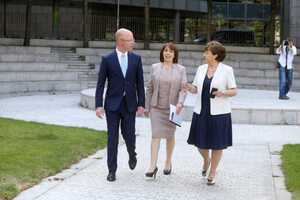
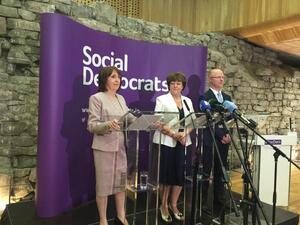
From Left Roisin Shorthall, Catherine Murphy and Stephen Donnelly at the Social Democrats launch yesterday
The Social Democrats.
A short-lived home for popular if routinely disaffected TDs?
Dan Boyle writes:
And so we have a new political party. Formed by three of the more able members of the current Dáil it has a chance of being something different.
Against that it is starting life in much the same way as most political parties in Ireland have been established, being part of the system it wants to change.
Since the foundation of the State only Clann na Talmhan, Clann na Poblachta and The Green Party can be said to have become involved in the political system having been formed from outside of it.
Most ‘new’ political parties have been breakaways from traditional parties. Some have have been new alignments. Some of the more committed independents become frustrated at the limits an individual can do before seeking out other like minded people.
Some of the more iconoclastic members of the Dáil have flitted between both. James Dillon was elected first for the short lived National Centre Party, a brief tying together of the remnants of the old Farmers Party and the National League (itself the dying embers of the Irish Parliamentary Party that last represented Irish interests in Westminster).
The Centre Party became one of the founding components of Fine Gael, from whom Dillon would resign over the question of Irish neutrality during the Second World War. He was still independent in 1948 when he persuaded other independents to support him for cabinet membership.
With the Independent Alliance now, maybe more properly called The Committee To Make Shane Ross A Cabinet Minister, Deputy Ross is hoping that history can repeat itself. The Independent grouping in 1948 as with its Alliance counterpart now, was a fairly motley grouping.
Among Dillon’s supporters then was Oliver J. Flanagan, who while nominally an independent claimed to represent a national movement known as ‘Monetary Reform’. It seems we treated currency issues more seriously then.
The much admired Noel Browne hardly showed himself to be a model of consistency. Elected first as a Clann na Poblachta Minister he was then elected an independent TD, then as a Fianna Fáil TD. When elected again as an independent TD he formed with Jack McQuillan the National Progressive Democrats (not to be confused with).
While effective in opposition no real effort was made to build a party. One by-election was contested but only three candidates contested the 1961 election for the party. Browne and McQuillan were reelected of course, but both were soon to join the Labour Party. This was another party Browne was eventually to leave. There was one more flag for Noel Browne to wave that of the Socialist Labour Party in 1981. Of course this too would end in tears.
In positioning themselves between Labour and Sinn Féin, the Social Democrats could attract disappointed Labour votes on one side and from those who see Sinn Féin as an imperfect protest vehicle on the other. In this they seem better positioned than Renua whose placing of itself between Fianna Fáil and Fine Gael doesn’t seem likely to have many spare votes available to it.
Either newly formed party should look at the template established 30 years ago with the foundation of the Progressive Democrats. It was formed by three breakaway Fianna Fáil TDs, two of whom, [Desmond] O’Malley and [Mary] Harney, could be said to be creatures of privilege. O’Malley had inherited his uncle’s seat. Harney was appointed to the Seanad directly upon finishing her university degree.
The third TD, a now almost forgotten man was perhaps the strongest reason the PDs achieved initial success. Pearse Wyse, no ideologue, he, knew the importance of winning and holding onto a vote.
Our political careers briefly crossed over. I remember being regaled at a doorstep by a supporter of his, who let me know that as a Corporation tenant, Pearse had secured not only one but two toilet seats for her. The second of which was being recycled as a picture frame.
What the moral of this pithy history is meant to be is that those led only by high minded political principles cannot of themselves bring about change. Not without the support of agnostic grafters. These are the people who are needed to sustain any new political movement.
Dan Boyle is a former Green Party Senator.
Yesterday: What We Stand For
(RollingNews.ie)