From left: Stephen Donnelly, Roisin Shortall and Catherine Murphy
“Stephen Donnelly T.D. has informed us that he is leaving the Social Democrats.
We are disappointed that he has decided to walk away from the project, we undertook, to establish and build the Party.
The Executive Committee of the Party has reaffirmed its commitment to the vision of a strong economy, fair society and honest politics.
We are fully committed to the project and will endeavour to develop the Party into an exciting force for change in Irish Politics.
As is the case across the globe the defence of social democratic values is not dependent on one personality or politician – but rather is a collective pursuit.
Since the Social Democrats were first founded, in July 2015, we have worked to build the party brick-by-brick. This is a long term project which requires dedication, hard work, long hours and a major commitment from all involved including our elected representatives.
The levels of dedication required for such a major undertaking can be overwhelming for some.
However our elected Councillors, our staff team and our volunteers are passionate about our project and we will now get on with the job of building our party.
We wish Stephen the best in his future endeavours and look forward, with excitement, to the future development of the Social Democrats.”
A statement by the Social Democrats announcing the departure of Stephen Donnelly.
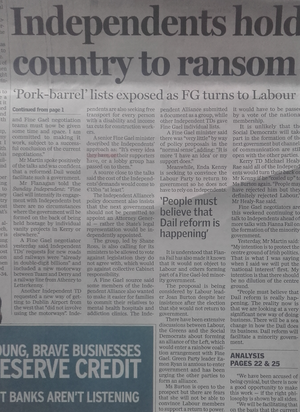
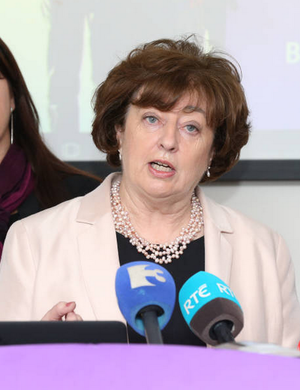
From top: Yesterday’s Sunday Independent and Social Democrat TD Catherine Murphy
Yesterday the Sunday Independent reported that there have been discussions between Labour, the Greens, and the Social Democrats about “forming an alliance of the Left which would enter a rainbow coalition arrangement with Fine Gael”.
Further to this, Social Democrat TD Catherine Murphy spoke to Gavin Jennings on RTÉ One’s Morning Ireland this morning.
Grab a tay…
Gavin Jennings: “The Sunday Independent was reporting yesterday that secret talks have been held within the confines of Leinster House and elsewhere in Dublin between Labour, the Green Party and the Social Democrats– is that true?”
Catherine Murphy: “No it’s not. We’ve had no formal or informal talks with the Labour Party about joining any coalition.”
Jennings: “And Roisin Shortall or Stephen Donnelly haven’t been involved in any such talks either, no?”
Murphy: “No.”
Jennings: “The paper was also reporting that Green Party leader Eamon Ryan has been in constant contact with Fine Gael’s chief negotiator’s Simon Coveney. He strongly believes that the next government – this is Eamon Ryan – needs to be more balanced in terms of political ideologies and has been urging Labour and the Social Democrats to join him in providing this balance. Has he been urging you?”
Murphy: “He has, yes. We wouldn’t share his view that, we campaigned saying we wouldn’t support more of the same and we pretty much reaffirmed that commitment but we believe we’re in an entirely different situation and, indeed, the Dáil Reform Committee has been busy rewriting the Dáil rules to reflect the new reality and we would be, for example, quite, we would encourage and would be involved for example in setting out a framework for the Dáil with all the other strands of the Dáil in setting out a programme for the Dáil as opposed to a programme for Government because there has been a shift in power and that’s the message that the voters gave, there’s been a shift in power from Government to the Dáil and the rules have been rewritten, or are being rewritten, to reflect that so I think we’re in a very different scenario where, for example, if there was a broad strategic approach taken on major issues like health, like housing, we feel that there is a programme there that, there’s lots of possibilities of support for.”
Jennings: “But in terms of making up the numbers to make up this Government, are you ruling the Social Democrats out?”
Murphy: “We did some weeks ago…”
Jennings: “And that’s still the case?”
Murphy: “It is still the case.”
Later
Jennings: “When you mention an election, there is a possibility that we may have another election quite soon. Why do you think that voters would be more favourable to you for sitting aside and allowing a Government to be formed rather than getting in there and trying to do something about it?”
Murphy: “You see I actually don’t believe that’s the case. I think that the shift in power in the Dáil, the rewriting of rules actually opens up a really exciting prospect of sharing that power in a way that we haven’t seen before. And, as I said, it’s a question of drawing up a programme for the Dáil so as that the 158 TDs in the Dáil can participate, that it’s not confined to 15 members of Cabinet and everyone else is, you know, kind of has influence but there the only ones with power. It’s an entirely different prospect and it’s one that we would be very constructive and enthusiastic about participating in. So, essentially, this is a changed environment and, as I say, the Dáil rules have been changed to reflect that or are being changed to reflect that.”
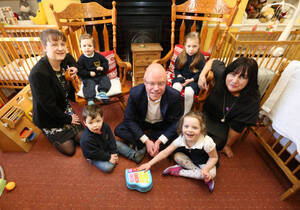
Aisling O’Neill, Meath East Soc Dem candidate (left), Stephen Donnelly TD and Glenna Lynch, Dublin Bay South candidate (right) with children (front) Isobel and Rory and (sitting in the back) Abel Balog and Maja Tazbir in Fitzwilliam Nursery and Montessori School, Herbert Street, Dublin 2 this morning.
Not the tykes.
The grown ups.
“We’re trying to get a message out on a fraction of the resources available. When the State broadcaster is essentially engaged in censorship of four of the eight political parties three days before the debate, it makes it very difficult.
So, we’re fighting against the State broadcaster’s position on protecting the establishment.”
Soc Dem co-leader Stephen Donnelly, on RTÉ’s decision to exclude four of the eight political parties from the leader’s debate tomorrow night.
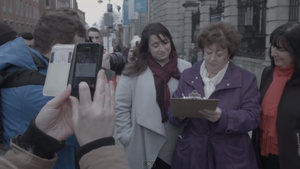
Social democrat candidates and canvassers on Grafton Street, Dublin, including ‘sheet columnist Anne Marie McNally (centre) and Gary ‘tracking shot‘ Gannon (second right)
He’s veering right!
From left: Catherine Murphy, Roisin Shorthall (with unidentified chocolate Lab) and Stephen Donnelly on Grafton Street yesterday.
The Social Democrats launch their first General Election campaign with the slogan ‘Reducing The Cost Of Living’ and a series of videos including this message (above) on corruption from Denis nemesis Catherine Murphy. Fight. etc.
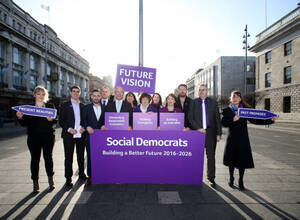
Above from left: Cllr. Gary Gannon (Dublin Central), Glenna Lynch (Dublin Bay South), Anne-Marie McNally (Dublin Mid-West), Roisin Shortall TD (Dublin North-West), Cllr. Cian O’Callaghan (Dublin Bay North), Catherine Murphy TD (Kildare North) and Liam Coyne (Dublin South-Central).
The Social Democrats have called for the setting up of a new body, called the Independent Anti-Corruption Agency, to tackle corruption and white-collar crime in Ireland.
The body would be answerable to a newly established Oireachtas Committee for Public Interest Oversight.
Ahead of the launch, Social Democrat TD Róisín Shortall said:
“The purpose of this new body is to tackle the corruption that has so tainted politics and public life in Ireland. The existing legislation and infrastructure are totally inadequate in preventing, investigating and prosecuting corruption both in public office and in the corporate world. The effective collapse of the Cregan inquiry into IBRC transactions is just the latest example of what isn’t working.”
“Despite the many tribunals of inquiry and commissions of investigation, there remains minimal accountability and few consequences for those responsible for wrong-doing and the result is a perception of a golden circle of insiders who appear untouchable. With the creation of an Independent, fully responsible body, we are proposing root and branch reform of the anti-corruption regime in Ireland.”
From left: Councillor Cllr Brid Smith, Richard Boyd Barrett TD and Ailbhe Smyth, outlining People Before Profit’s Alternative Budget proposals (more to follow).
(Leah Farrell/RollingNews.ie)
Meanwhile…
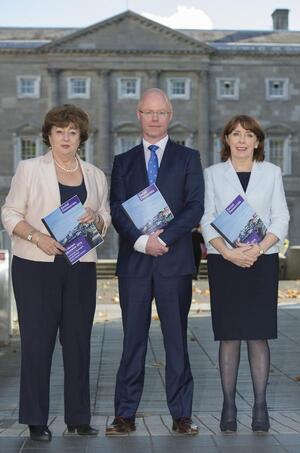
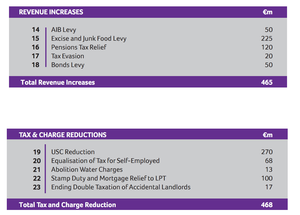
From top: Social Democrat TDs Catherine Murphy, Stephen Donnelly and Róisín Shorthall and a table from the party’s pre-Budget submission released earlier today
It’s in.
The Social Democrats’ pre-Budget submissions whatsit.
The Social Democrats propose a revenue-neutral budget that invests the full €1.5bn available into areas including job creation, housing, education, healthcare, children and communities.
Reducing Ireland’s tax base is irresponsible in a growing economy and will inevitably lead once again to instability. A wide range of economists and institutions have warned against adopting such an approach.
It is exactly what happened during the bubble, and the same political parties seem determined to do it again.
…Our budget raises c.€465m in revenue by targeting junk food, pension relief and excise, while introducing an AIB levy and a tax on bonds.
This revenue is then returned through measures including: – Reducing USC by 0.5% for earnings up to €70k; – Introducing a tax credit for the self-employed; – Abolishing the domestic water charge; – Reducing local property tax for mortgage holders (up to cap of 50% of LPT owed).
In comparison to the Government’s additional €110m announced recently for the Capital Investment Plan, we have allocated €550m for capital investment.
Our measures include: – Full €110m for recently announced capital programme; – €300m for housing; – €75m for primary care centres; – €65m for innovation centres, community centres, cultural centres and high speed broadband for all primary schools.
Pending legal and regulatory compliance, we would begin to allocate funding from NAMA for additional capital investment in housing.
We are committing €1.1bn in new current expenditure. In doing so we have focused clearly on dealing with:
Education: 3,000 additional teachers; Reinstatement of Guidance Counsellors; 10% increase in funding to higher education.
Healthcare: €40m towards the trolley crisis; 900 primary care staff; Implementation of chronic disease management programmes; New funding for mental health. Carry out a full health-need and socioeconomic analysis of each health area.
Parents and childcare: 2 weeks paternity leave; Additional 10 weeks parental leave; Funding for childcare providers to build quality [sic]; Second ECCE year; Reduction in childcare costs for all families.
Children: Free primary education; Funding to alleviate child poverty
Enterprise: Scaling up of Enterprise Ireland programmes; Rates holiday for start-ups; R&D tax credits for small firms; Changing of commercial rates regime; New Smart Cities fund.
Social Protection: Increase in One Parent Family Payment age (12) and income disregard (€130); Assistance for people living with disabilities; Funding for telephone allowance; Respite care grant; Funding for refugees andhomelessness; Fuel allowance increase; Christmas bonus increase.
Communities: New funding for the arts; New supports for community centres and groups.
Fintan O’Toole at the Social Democrats policy night
Last Friday night, The Social Democrats hosted a policy event at the Hilton Hotel, Charlemount Place, Dublin 2 .
The keynote address was given by Fintan O’Toole.
Grab a tay.
It’s a huge pleasure and privilege to be here with you tonight and I suppose I’m here for the same reason the vast majority of you are here. Firstly, because I have enormous admiration for the work that Catherine [Murphy], Róisín [Shortall] and Stephen [Donnelly] have done.
Over the lifetime of this Dáil, they have been, in some ways, very dark days for Irish democracy and it’s really mattered deeply to all of us I think that we have had examples of democracy in action, of people who have had a fundamental sense of public service and what it means, who understand the concepts of accountability, who do hold on to the belief that power does come from the people and that the Republic does belong to its citizens.
And to put that in action, in a way that transcends the sort of politics or patronage and clientelism that has held this country back for so long. On a personal level, it’s lovely to be here.
I just thought it would also be an opportunity to just talk a little bit about what is social democracy? What is it that we mean by this concept and why do we need to address what seems, in some ways, a political concept that’s been around for a very long time.
Well I suppose the first thing we say is: it hasn’t been around for a very long time in Ireland.
One of the distinguishing things about Ireland, when people ask, ‘Why don’t basic things work? Why do we not have a functioning system for childcare, for example, why is our childcare one of the least adequate and most expensive in the world? Why do we not have a system of public housing provision that functions? Why do we not have a health service that functions?’
Well, one of the obvious answers is we are one of the very few societies in Europe that has never had a social democratic government. Never.
Social democratic values, social democratic institutions are under enormous pressure all over Europe and all over the developed world but at least they have existed and they have built things over generations which are actually quite hard to shift.
Even the Tories in Britain find it hard to take away the public’s relationship with the National Health Service, for example, because it has been built and because it has functioned, not perfectly, but it has a really important place in people’s identity with Britain.
We haven’t we had that? We’ve had bits of it. And the bits that we have had have worked. One of the reasons why social democracy, to me, is not an abstract concept is I wouldn’t be here talking to you if not for the little bits of social democracy that we got in the Irish context. Two big things happened to make me who I am, for good and ill.
One of those is a massive public housing project after the Second World War when Ireland was on its uppers, when it was still in the post-war depression, when it was not sharing in the great prosperity of Western Europe, it still was able to clear the slums of Dublin, public housing was built.
I grew up in one of those houses, I grew up in one of those communities, they were by no means perfect, they were by no means magnificent or grand but they were a hell of a lot better then what people had experienced before.
My parents moved out of slums, they moved into relatively decent housing: that had an enormous impact on my life. And on the lives of hundreds of thousands of people. If we could do that in the grim 1940s, why do we find it impossible to imagine that we could solve our housing crisis now?
The second thing that really shaped me was a bold, outrageous, reckless idea which was that we might have free secondary education.in 1968, when I was ten years old.
Remember this was brought in by a minister against the wishes of the Department of Finance and indeed, against the knowledge of the Department of Finance, Donogh O’Malley announced it before it had been approved. Why? Because it wouldn’t have been approved, it didn’t make sense, we didn’t have the money. It was an irresponsible thing to be doing.
So you had an actual Fianna Fáil minister who had to go out and announce it, make it a fact and then, of course, once it was a fact, it became something that was obvious to everybody: why was Ireland one of the last developed societies to have free secondary education because we didn’t have social democratic tradition.
We didn’t see this as important. But if it wasn’t for that people like me, and again hundreds of thousands of people like me, I’m sure like many of you, would not have even got to secondary school, it was not something that was available to us.
So social democratic choices being made at key points in people’s lives are not abstract, they actually change the life chances of individuals and, by doing that, make a better society.
There’s a sense, I think, and a narrative that’s being put out at the moment is that what we need overall is stability, about the great value in stability and that what we have at the moment is working fine and we just need more of it. Just three statistics, I don’t want to bore you with statistics, but three that are relevant:
One is we have,over the last five years, effectively doubled consistent child poverty. Now leave aside the human cost of that, leave aside the outrage of the attack on the basic human rights of children who are growing up in poverty, the economic, fiscal costs of this is absolutely enormous.
We know that whatever money we supposedly saved through austerity, we will pay ten times over in the cost of health, of not having productive people in the economy paying taxes, in the cost of the criminal justice system and so on and so on. We know this, this is evidence-based, this is not airy fairy, this is reality.
Two figures from the OECD report on Ireland, produced [last] week, that should really be quite shocking to us, to start with. One is that one in six Irish-born people, people born in the Republic of Ireland, one in six of us is now living abroad. And they’re doing so, by a large extent, by choice. Very, very many of these people are not people who are completely unemployed and don’t have a choice whatsoever, they are choosing to do so because they don’t believe in this place.
They don’t believe that Ireland is capable of offering them opportunity to be the kind of people that they think they can be. And that’s alarming to us. Again, it’s bad for our society, it’s bad for our families, it’s bad for our communities.
But, again, just think about the cost of that. These are people of working age, who are largely very well educated. We’re losing their skills, we’re losing the demographic boldness that we had in this young population. That’s a fiscal cost, that’s an economic cost that we’re not counting.
And one other startling figure from the OECD report: 50 per cent of Irish people – 50 per cent – depend on the State to keep them out of poverty. It’s an astonishing statistic, it’s the highest proportion of population in the entire developed world.
So one in every two people in Ireland would be living in poverty, if it were not for social transfers. That tells us a couple of things, it tells us that the State matters enormously to huge numbers of people in our society in the simple sense that they cannot make a living, they can’t live a decent life without the State.
But it also tells us that our economy, which is, in some ways, a success story, in some ways, it really is. But it’s not an economy which is currently capable of allowing the majority of its citizens to actually earn a living, a decent living.
Fifty per cent of people can’t make enough money in the ordinary economy, without welfare payments, they would be in poverty, and one in six are out of the country, making their living elsewhere.
And these are things that we tend to just accept, as normalities. And they’re not normalities. Even if you look within the contemporary developed world, with all its problems, with all the growing, you’ve got massive disjunctions of inequality that are around the world, we are outliers in this regard.
There isn’t always [inaudible]. And therefore if we are unique in this, it suggests that we don’t have to put up with this, things don’t have to be like that. And so we come up to social democracy as a political philosophy, the way of looking at the world that can begin to address these kinds of issues and make Ireland a better place for all its citizens.
I think social democracy, in a sense, the first thing to say about it is it’s not a utopian set of ideas.
Social democracy isn’t based on the idea that the State, the Government, can make everybody happy, that it can create a perfect society. It’s not about that, at all. It’s not about the maximum human beings can achieve because there shouldn’t be any limit on what that maximum is.
Social democracy is actually about the minimum. It’s actually about: what are the most basic things that people need in order to lead a dignified existence – that’s the question social democracy asks.
A dignified existence, what is a dignified existence? Well a dignified existence really has five basic components: they are five things that a human being needs in order to be able to feel that they are citizens in a Republic.
The condition of being in a Republic is defined by the Irish political philosopher Philip Pettit, actually rather brilliantly, as that condition where ‘we can look one another in the eye without reason for fear or deference’.
It’s a basic equality that we all look one another in the eye, we don’t need to be afraid of each other, we don’t need to defer to each other. Why? Because we are equal citizens.
And that’s fundamental to human dignity. That’s what it means to be a full human being. And to do that you need five things. First of all you need the democracy bit of social democracy. And Catherine [Murphy] has already spoken about this but it is very, very clear that the promised democratic revolution, that we apparently had in 2011, has been nothing of the kind. If anything what we’ve had is a further centralisation of power, away from public control. We’ve had the entirely unconstitutional Economic Management Council invented. There’s no basis for this in Irish law or in the Irish constitution. It’s the most powerful body in the State. It accounts to nobody.
We’ve had an even further, it’s very hard actually to say this, it did not seem possible in 2011 that the Dáil could become less central to democratic life in the country. It was already probably the weakest parliament in the democratic world, in terms of its ability to actually do its job of imposing accountability on power.
It’s actually, if anything, become weaker: the use of the guillotine to force through legislation, the attitudes of Government towards the representatives of the people as, again, Catherine [Murphy] saw most obviously when Michael Noonan found himself giving the exactly same answers or explanations as to why he misled the Dáil as Ray Burke gave, in the early 1990s in the beef scandals. Ray Burke was asked in the beef tribunal, ‘why didn’t you answer these questions in the Dáil?’ and he said, ‘well if you don’t ask me the right question, I don’t give you the right answer.’
Michael Noonan gave exactly the same answer as to why he had refused to divulge information which was absolutely pertinent to the questions that were being asked. The only thing that changed is that actually Catherine [Murphy] was asking the right questions: exactly the right questions, precisely the right questions and they were still not answered.
So that attitude to citizenship, that attitude to our democracy is absolutely key one. We do need to empower ourselves as a political community and this will not be done from the top. What we’ve discovered is that if things just carry on as they are, we may get minor reforms but there is no real interest in using the capacity of Irish citizens to actually responsibly take part in the key decisions that affect their own lives.
The second thing that is absolutely central is equality: is a notion of equality and, of course, equality has very many different parts. Of course it includes equality of gender, of sexual orientation or ethnicity. But it also has an economic component. One of the things that social democracy brings to the table is that it says: equality is not just a set up of legal structures, it’s actually something that has to exist in our day-to-day lives. And there has to be a sufficient level of economic equality for people to actually be equals in society.
Which of us can look at Denis O’Brien in the eye without reason for fear or deference? I suppose we all try to do that. But the fact is there are fundamental inequalities and those inequalities come out of the grotesque disparities of income and of wealth. And I don’t think social democracy says, ‘you know what? we’re going to have absolute equality of income,’
it doesn’t try to do that. But what it says is that you need sufficient level of equality in order for people to be able to function as equal citizens. And you need to have a sense that there is a project that we’re moving steadily towards greater equality rather than moving away from it, as we have been over the last 20 years in most of the western world.
What does equality mean? Well we know damn well what it doesn’t mean. We know damn well that if you double consistent child poverty over five years, you are building in structural inequalities which will distort our society for 20, 30, 40, 50 years to come. But we also know and this is what social democracy has to act on is that we’re not doomed to do this.
These cycles are not fate, they’re not god-given, they can be broken. There are now extremely successful ways of intervening early, in the lives of children, which can actually have a really measurable outcomes in their educational achievements, their social connectivity, their relationships with the communities within which they exist. We can actually do this.
So we can do this in a relatively short period of time and it seems to me that if we prioritise equality in terms of say, at least, at least our 18-month-old children, at least we start with a sense that at the very beginning of life, children have the same kinds of opportunities as they can chances. We don’t have that right now.
The most shocking document in Ireland is probably the Growing Up In Ireland study which is being done, it’s a longitudinal study which is looking in detail at a real group of children who were born in 2008 at the time of the crash. What do we see?
We see that, at three years old, you could walk into a room and you could pick out, without absolute accuracy, the children who are poor from the children who are not poor.
Why? Because they look different. They look different at three years old. They’re a different height. They’re a different weight. This is what we’re building into our society. We don’t need to do that. There are other ways of prioritising public policy to focus on the things that really matter.
The fourth and fifth things that we need to focus on, sorry the third and fourth things we need to focus on are very obvious. I mean one of the basic necessities for human dignity is shelter, is housing. We know that the market, in itself, is not going to solve the housing crisis in Ireland. Why do we know this? Because we’ve been through it. We’ve been through a period in which we built astonishing numbers of houses, the market produced vast numbers of houses.
The market produced, from the late 1990s up to the crash, produced 800,000 new houses in Ireland. That’s one new house for every 5 and a half people in the country. Astonishing numbers and yet we still had 250,000 people in housing need. We had, at one point, we actually had 250,000 empty houses and 250,000 people in housing need. Why? Because market-led housing, yes of course it has a huge place but it’s not going to address the fact that in order to have housing as a basic human right, you need social housing, you actually need housing which conceives of the right to shelter as being a fundamental one in human society.
And, again, we know we can do this. We’ve done it before. For a lot of the history of the State, 30 per cent of housing being built in Ireland was social housing. When Ireland was much much poorer it was able to do these kinds of things. There’s no reason why we can’t do it again. Yet what do we see? We see the Government’s housing strategy’s complete dependence on the market, on the private sector, on the rental sector to solve these problems. They will not be solved, there is another way of doing it. And these are things that don’t necessarily require enormous genius, they require political priority, a sense of direction, a sense of long-term thinking about how we’re going to deal with these things.
And then the last two things are very basic and I’m not telling you anything you didn’t already hear: health and education. We do not have, still, in this State, approaching its 100th anniversary, we do not have a health system which treats the lives of each citizen as being worth exactly the same as any other citizen.
We know that there are grotesque inequalities in the way our health service works but we also know that those inequalities are also grotesque inefficiencies. If you keep trying to do as we do: run two parallel health services, you shouldn’t be surprised that you misallocate resources, that nobody quite knows what’s going on, that you can’t get a fix on how resources are being used.
The basic principle of an efficient health service is that the money follows the patient. Health professionals get paid for treating people, it’s not that difficult to grasp. And yet what we have is a system in which the clarity of where that money’s going, how it’s being used, and whether it’s being used for the very basic purpose of treating the people who are in most need first – all of those kinds of questions – simply can’t be answered within the system that we have.
And again we have promises that this is going to be revolutionised. The key social priority of the Government, apart from the austerity programme, was universal health insurance. It has been a complete failure. There’s been absolutely almost no progress not that. And we see some of the reasons for that in some of the things Róisín Shorthall tried to stand up for – the use of patronage and clientelism going back into the allocation of basic resources.
Putting justice into the health service, building a health service over time, which actually is capable of making a very basic statement which is that the life of every single person in Ireland is worth as much as the life of every other person. It has to be a key, basic demand of a social democratic party.
And finally, of course, there’s education. We know that the shape of our society is increasingly determined by education and our education failures and inequalities reproduce themselves in an economy that doesn’t work. The reason why 50 per cent of people in Ireland can’t make a living is because they are not sufficiently well educated. Again, the OECD report is very, very stark on this.
People who have less than a Leaving Cert in Ireland have 40 per cent of the median, so education is shaping the economy and shaping people’s chances within the economy. And education is a public good. It’s not a private enterprise. It’s a public good, it’s something we do, it’s something we organise, it’s something we can organise differently, we can organise better. It’s something in particular again, that we can go back to start thinking about how do we begin at birth and give children opportunities to develop themselves to be the best they can be.
Think about the enormous, economic cultural community and social benefits that we would get, from being able to do something that is actually quite possible which is that by the end of this decade of centenaries, when we’re actually looking a the centenary of the foundation of the State, we actually could be in a position to say that we have virtually eliminated child poverty. That might sound utopian, it’s not at all, these are things that can actually be done. There are practical policy approaches that can make these things happen.
If we were able to do those kinds of things, then we would be saying that we actually are a society which has the capacity to think about the future, which has the capacity to build things over time, that make life better for the majority of its citizens and would return to Irish citizens what they have lost, I think particularly since the crash which is a sense that they can make a difference to their own lives. That they can have pride in their status, as citizens, that they can feel that they really belong to a Republic that also belongs to them.