
Tag Archives: taft on tuesday

At top. from left: Minister for Finance,Paschal O Donohue , Taoiseach Leo Varadkar and Minister for Communications, Climate Action and the Environment Richard Bruton; Michael Taft

We are now getting crash courses in pro-cyclical and counter-cyclical fiscal strategies. This has the potential to be more mind-numbing than discussion of fiscal space. But at the risk of numbed minds let’s jump into this by first defining these terms.

Pro-cyclical means a fiscal policy that accelerates either the upward or downward trajectory of the economy.

We have two recent examples:

Prior to the crash, Fianna Fail-led governments accelerated the economy and the property market through tax cuts and spending increases that resulted in unsustainable growth. They were feeding an economy to the point of gluttony.

Following the crash, Fianna Fail and Fine Gael-led governments accelerated the decline of the economy through tax increases and spending cuts, taking money out of a cash-starved economy.

Successive governments pursued the same fiscal policy both before and after the crash – a pro-cyclical policy. At their extremes such policies lead to booms and busts which is exactly what Ireland suffered.

The alternative is to pursue a counter-cyclical fiscal strategy. This is intended to smooth out the inevitable ups and downs of a capitalist market economy.

Therefore, when the economy is accelerating, a prudent government would try to slow it down to something approximating normal. This would entail raising taxes and slowing down spending increases.

For instance, had the government removed property tax breaks and introduced a property-tax in 2003/04, this would have taken some of the heat out of a runaway property market.

And if the government had stimulated the economy through investment increases in 2009/10, the economy would not have collapsed to the extent it did.

Now we are getting lectures about the current pro-cyclical policies, how we should have been cutting back when the economy started growing; and how we should be running substantial surpluses (the budget won’t go into surplus until next year and, even then, only marginally).

That, however, is the wrong way to read our current situation.

We are stuck in upside-down fiscal strategies. Yes, the right-side up approach would be to start cutting back (reduce the pace of spending increases, reduce the level of tax cuts) as the economy recovers.

But you only do that if fiscal strategy expanded during the preceding downturn. That didn’t happen here. We cut back during the recession.

So when the economy started growing, the government had to raise spending to make up for the cuts during the austerity years, while at the same time trying to turn the deficit into a surplus.

Public spending only started increasing in 2015, but the deficit was still nearly 2 percent of GDP. It wasn’t possible to do both.

Indeed, the Government struggled to return spending to pre-crash levels.

Factoring in inflation (GDP deflator), public spending per capita – in particular, investment – has not returned to 2008 level. Not only did spending increases struggle, deficit reduction started to lose steam.

Upside-down fiscal strategies cannot be corrected by simply flicking a policy switch. We may be stuck in a pro-cyclical trap that is structurally embedded in our public finances. And, like a finger trap, if we start reducing spending just before an economic slow-down we could end up reinforcing the trap by accelerating the slow-down.

This gives a different perspective to the oft-repeated phrase ‘well, austerity worked’. It didn’t. Austerity was many things, but in this context it was like cramming clothes into a suitcase and then sitting on the cover to close it shut.

It seemed to work for a while but it wasn’t sustainable. Eventually, the cover blows open and the clothes spill out on the floor. This is the pro-cyclical trap we are in.

So how should we proceed? Carefully, eschewing quick-fix solutions. Let’s look at two things that could help inform a more viable and sustainable fiscal policy.

First, strengthen our automatic stabilisers. This usually refers to unemployment benefit. Unemployment benefit replaces the reduced purchasing power of those who have lost jobs.

In other EU countries, unemployment benefit is pay-related which means most of the purchasing power is replaced. This helps maintain consumer spending and domestic demand.

In Ireland, the benefit is low which means only a small amount of purchasing power is replaced.
In the upcoming budget it is imperative to introduce a pay-related component to unemployment benefit (Fine Gael actually advanced this proposal recently).

This should be paid for by a small, incremental increase in employers’ social insurance which is ultra-low by EU standards.

Second: never mind the deficit, focus on the debt. We have considerable savings to help prevent the debt from rising out of control.
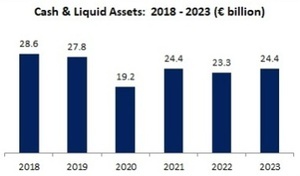
We have more than €20 billion in Exchequer savings. Judicious use of these funds (it is unclear if this includes the NAMA surplus of €4 billion or the liquid assets in the Strategic Investment Fund) could help moderate any increases in the debt arising from a hard Brexit.

This will depend on how bad the hit is. The ESRI projects a small hit, with the budget immediately going into deficit but returning to surplus by 2023 with debt falling again.

The Central Bank’s projection is more pessimistic, with the county’s finances still mired in a significant deficit in 2023 with debt still rising.

There are other measures we can take to mitigate the downward impact on public finances (a small example would be the net assets tax outlined here) and using the NAMA surplus for public housing in order to maintain revenue-generating activity (and to house people).

The very last thing we need to do is take fright and start cutting and taxing without regard to economic and fiscal harm – like we did in the last crisis.

If we do go down that route we’ll just be reinforcing the pro-cyclical trap. And picking clothes off the floor for a very long time.

Michael Taft is a researcher for SIPTU and author of the political economy blog, Notes on the Front. His column appears here every Tuesday.
Sam Boal/ Rollingnews

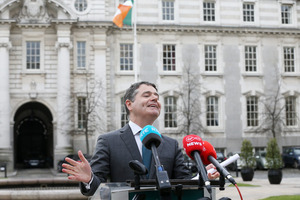
From top: Minister for Finance Paschal Donohoe; Michael Taft

The Minister for Finance believes in the property tax and the ‘latent potential for the tax to play a more significant and positive role in our overall taxation system’.

Any increase in the tax should be ‘affordable’ says the Minister, while the ‘progressivity’ of the tax should be upheld. Potential, affordable and progressive: yes, the Minister is a believer.

But a true believer would promote a full property tax – one that attaches itself to all assets, in particular those assets (such as financial property) that are held mostly by higher income groups.

The residential property tax is levied only on some property. It is confined to houses and apartments which are the main capital asset for low-average earners.

It is not applied to financial property (shares, bonds, pension funds, cash) or land beyond the one acre associated with the residential dwelling. This is a major omission.

If we put together real (land and buildings) and financial property, and exclude liabilities (e.g. mortgages), we find that total net assets come to approximately €750 billion following the red line in the following graph comes from the Central Bank.

This equals €156,600 average net wealth per capita or roughly €440,000 per household. This would be concentrated among higher income groups.

So what would happen if we started to refocus our tax system away from income and the productive economy and on to wealth, assets and property?

As the Nevin Economic Research Institute states:

‘The weight of evidence suggests that taxes on property, wealth and passive income have minimal negative consequences for economic growth compared to other taxes and are highly redistributive. Recurrent taxes on land and immovable property appear to be particularly pro-growth, and very likely pro-equality, and we can design these taxes in such a way as to make them progressive.’

We could start by extending the tax to all property with appropriate reliefs where necessary.

This is traditionally called a wealth tax but, in truth, it is merely ensuring a property tax is applied to all property; in particular financial assets.

The CSO’s Household Finance and Consumption Survey can help.

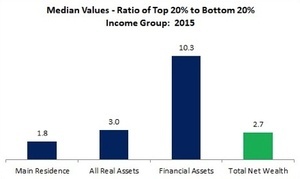
When we look at the ratio of asset values between the top and bottom 20 percent income groups, we find that for the main residence (home), the ratio is rather narrow due to widespread home ownership.

However, when we include all real assets (land, other real estate property, self-employment business wealth, vehicles and valuables), the inequality gap starts to widen with the top 20 percent owning three times the median value of the bottom 20 percent.

When it comes to financial assets, the top 20 percent own 10 times the value of the bottom 20 percent. Financial property is highly concentrated at the top.

Martina Lawless and Donal Lynch of the ESRI have produced a useful paper outlining the impact of an asset or wealth tax. They looked at nine different tax models applying a 1 percent tax on wealth.

We can see the range of models from those with high thresholds (income) and high exemptions (particular assets) to those with much lower thresholds and exemptions.

These models have the capacity to raise between €53 million and €3.8 billion. The variations are due to exemptions and thresholds. We should start a national conversation over the optimal model.

From NERI, Dr. Tom McDonnell’s seminal work on a net assets tax shows similar yields – ranging from €250 and €750 million in revenue (and this was published in 2013).

Of course, there will be the usual criticisms of a comprehensive net assets tax; namely, that it would disrupt our collective entrepreneurial chi. However, as Martin Sandbu from The Financial Times points out:

‘Compared with taxes on profits, dividends and capital gains, the wealth tax favours those who deploy their assets more productively. That is because it is a levy on the same slice of a fortune regardless of the returns the assets produce. Owners of a high-return asset . . . keep a larger share of the income generated by their wealth than owners of low-return assets . . . a net wealth tax effectively redistributes from those who invest their capital badly to those who find high-return uses for it. That should reward talented entrepreneurs and boost productivity growth in the economy overall — a combination that could just begin to look politically attractive.’

Extending the property tax to all property – making it a comprehensive tax on all assets – has the potential to make a positive impact on public finances, reduce inequality and extend the tax base.

This would vindicate the Minister’s belief in a property tax with potential, affordability and progressivity.

Indeed, it would make him a true believer.

Michael Taft is a researcher for SIPTU and author of the political economy blog, Notes on the Front. His column appears here every Tuesday.
Sam Boal/ Rollingnews

Taken together, progressives did not have the best of elections. There will be more detailed analysis in the days and weeks ahead, so this should be considered a small, opening contribution.

First, which parties are ‘progressive’?

This question alone can ensure arguments and splits. For the purposes here there are four broad groupings in the progressive spectrum:

These four groups – Social Democratic, Sinn Fein, Radical and Greens – constitute the broad range of progressive parties.

That is not to say that relationships – external or internal – are free of contradictions, tendencies, disagreements; nor do they collectively constitute coherence.

But the 2016 RTE exit poll found the voters of these parties to be on the left side of the fence when asked them to self-identify on a Left/Right scale with Left = 1, Right = 10, and Centre = 5).

So how did this grouping do in the recent elections?

Let’s focus on the locals.

Overall progressives fell back from 27 percent in 2014 to 25 percent.

Sinn Féin’s popular vote fell by 37 percent with the loss of nearly half their seats. Labour’s first preference vote declined as well (by nearly 20 percent) but they managed to gain 5 seats.

The Social Democrats’ first time out locally saw them receive 2.3 percent and 18 seats.

Solidarity/PBP experienced a similar loss in votes to Sinn Fein, falling from 28 seats to 11.

The Greens saw their popular vote more than treble (to 5.6 percent) while increasing their seat total from 12 to 49.

The Independents4Change experienced an increase of 0.3 percent (over the United Left result in 2014) but elected only two councillors.

Why the collectively poor performance?

First, many progressives have not moved on from the austerity period while people and the economy have.  There are more people at work, growing incomes and falling poverty. This is not to dismiss issues such as housing. But without a discourse that places current issues in today’s context, the leaflets are left unread.

In the eyes of many Labour is similarly stuck in the austerity period, unable to break free from their role in Government and chart out a new direction.

The Social Democrats will need to translate local gains into national seats but this will be a considerable challenge. All the more so because they share some of the same ideological and social class space as Labour and the Greens.

Only the Greens seemed in step with the times but we should be cautious. Nationally, they received less than six percent of the vote and in Dublin less than five percent of the seats (though had they run more candidates in key wards, they would have gained more).

The Greens will need to work hard to consolidate their ‘surge’. Labour in 1992 and 2011, Sinn Fein in 2014, the PDs in 1987 – all saw their ‘surges’ quickly dissipate.

Compounding these individual party challenges is the lack of a common economic narrative.

If you were to ask people what progressives stand for they would be hard-pressed to give an answer beyond build more houses, tax the rich, or in the case of the Greens, halt climate breakdown.

Even were progressives able to achieve a consensus, there is no agreement over how that consensus should be implemented.

Already, the coalition abacuses are being pulled out: will Fianna Fail woo Labour, will Fine Gael entice the Greens, which way will the Social Democrats go, and will anyone take up Sinn Fein’s offer to join a coalition?

Currently, progressives sit on the same of the House. After the next election they may scatter to different aisles.

At root, there is no agreement over long-term goals.

Is the aim a progressive-led government? Is it to implement policies within conservative parameters? Is it to grow votes and seats and then figure out what to do?

Again, if people were asked ‘What do progressive parties want?’ there would probably be more shrugs than replies.

The 2019 RTE exit poll shows both the opportunities and dangers in achieving a consensus in a complicated public debate:

64 percent believe that ‘economic market forces will mean those who work hard will be rewarded’, yet 89 percent believe ‘there should be more policies to resolve the gap between the rich and the poor’.

59 percent believe the country is ‘going in the right direction’ (only 29 percent believe we are on the wrong path), yet the majority don’t ‘trust this government to manage the economy and public spending well’.

88 percent ‘feel the government needs to prioritise climate change more’ but in an Ireland Thinks poll 60 percent are opposed to a carbon tax (though this poll was taken in January and the climate breakdown debate is quickly evolving).

And in this complication we may be faced with a General Election soon.

When Ciarán Cuffe was asked by an RTÉ journalist what advice he would give the current generation of Green members on the issue of coalition he replied the Greens should not enter government on the eve of a recession.

And with a disorderly Brexit, changes in international taxation (which the Government reluctantly accepts), the housing crisis and other external and domestic dangers, a downturn could exacerbate the current downward slope of our economic cycle.

Lower tax revenues, more joblessness, rising unemployment costs, pressures on spending, slower growth, rising debt – does the Green Party have a fiscal and economic response? They didn’t the last time and they paid.

But this is not a problem exclusive to the Greens. None of the progressive parties seem to have a response to this, so far opting out of the fiscal policy debate.

Yes, progressives are fragmented. And, yes, we need cooperation. But merely demanding ‘unity’ from the social media side-lines is not an adequate response. We need concrete cooperation strategies.

Campaigns: The participation of progressive parties and organisations in campaigns such as the National Homeless and Housing Coalition and Raise the Roof are positive examples of cooperation. There are any number of issues – national and local – where this can be replicated.

Dialogue: this can happen among activists or elected representatives. The key here is that it takes place in safe spaces operating under Chatham House rules and organised by trusted neutrals facilitators. And if all that can be achieved is agreement on the weather – well, that’s a start
.
Open Space: An open online media space (e.g. a website) where progressive parties’ policies, analysis and proposals can be uploaded – if only to show up the similarities. Again, this could be hosted by neutrals.

Honest Broker: or such brokers (individuals, non-party civil society organisations) could assist in dialogue between the different parties without prejudice, even if it takes the form of proximity talks.

And patience. It would be nice to think progressive forces might coalesce around a set of minimum demands to campaign on with a view to acting with cohesion after the next general election but there might not be enough time or interest, too much suspicion this side of a vote. We might have to wait a while.

We need a new popular front, a broad coalition of progressive parties, individuals and groupings.

We need to ditch sectarianism and pre-conditions. Progressive cooperation is about persuading, not hectoring; leaving the door open to all, not closing it to some.

It is not about abandoning principles. We do not lose our ideological convictions or strategic preferences because we seek a cooperative relationship with those who don’t share them all right down the line. But I know this.

We undermine our convictions and preferences if we don’t cooperate, seek out allies, come to new understandings. That’s a dismal road where we are all losers.

And we have travelled that road long enough.

Michael Taft is a researcher for SIPTU and author of the political economy blog, Notes on the Front. His column appears here every Tuesday.

From top: Local Election posters in Phisborough, Dublin; Michael Taft

It is hard to know what the main issues in the local government election are but they seem to revolve around two themes: commitments to spend more money and commitments to lessen/reduce/depress local property tax (has the property tax replaced the USC as the most ‘hated tax’?). Spend more, tax less and the let devil take the fiscal hindmost.

All this is being discussed without reference to a very serious context; namely, that the budgetary heart of local government has been ripped out during the austerity years.

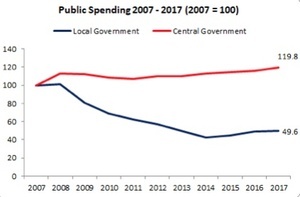
In the decade leading up to 2017, local government spending fell by 50 percent. The biggest casualty is investment: local authority investment (primarily housing and economic infrastructure such as transport) fell from €6.2 billion in 2007 to €1.2 billion in 2017.

This collapse in local authority spending can also be seen in the fall in local authority employment.

Proportionately, local authority employment carried the burden of public sector employment cuts during the recession/austerity years and is still nearly 20 percent below 2008 levels.

Irish local government was never very strong to begin with. Today, it is even weaker.

Ireland has the weakest local government, as measured by spending levels, in the EU bar Malta, Greece and Cyprus. It is even weaker than Luxembourg which is essentially a one-city state.

So whatever about the party manifestos and candidate slogans, there is a lot less money to spend than 10 years ago and a lot less people to produce the services.

It is unfortunate the campaign ‘More Power to You’ – sponsored by Connect, Forsa and SIPTU – didn’t feature more prominently in the local election debate.

Do we really want a local government that actually governs? Do we want a strong local government system with revenue-raising powers or guaranteed funding from central government; employment levels capable of providing a wide range of services; elected councillors with real democratic powers as opposed to the managerialist regime that currently dominates.

This paper by Dr. Mary Murphy (commissioned by the campaign) details the issues regarding an enhanced local government.

Admittedly, a debate over a radical decentralisation of powers to local levels is hard to kick-start during an election campaign; especially one that is more focused on which party will get more votes and what it might mean for a general election.

Hopefully, this debate can be continued past polling day.

For progressives it provides an opportunity to promote more resources for public services which would be, through a strong local government system, closer and more accountable to people. This would be key to vindicating a strong public service state.

Michael Taft is a researcher for SIPTU and author of the political economy blog, Notes on the Front. His column appears here every Tuesday.
Earlier: Derek Mooney: Mayor Culpa

Rollingnews

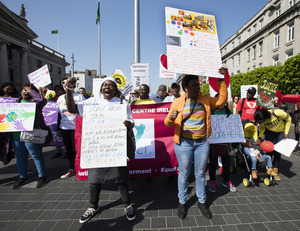
From top: Refugees march during The International May Day festival in Dublin in 2017; Michael Taft

The far Right and their allies may not yet be a significant political force in Ireland but they are proliferating on a number of internet platforms, with the constant threat this could spill out into the mainstream debate.

Working under the cover of extremist hashtags one of their weapons is to distort data to give their claims some credence.

Claims that Ireland has a high level of non-citizens, that we are being inundated with asylum-seekers, that immigrants come here to live off our ‘generous’ social welfare payments dominate the far Right discourse.

One might be tempted to ignore them since to date, they are a tiny force. But, as we have seen with the suspected arson attacks on proposed direct provision centres in Moville and Rooskey, their claims can feed into dangerous results.

So let’s go through their assertions.


Non-Citizens in Ireland and the EU

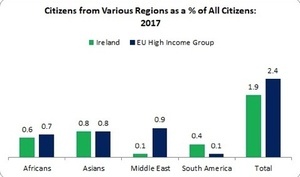
Ireland has a higher proportion of non-citizens than the EU high-income countries average – with nearly one-in-eight Irish residents being citizens of another country. But when we look under the hood, we find something interesting about the composition of Irish non-citizens.

Nearly one-in-five of non-citizens living in Ireland are UK citizens. In the EU high-income countries, UK citizens make up less than 2.5 percent. This is not surprising. Nor is the level of non-citizens from other English-speaking countries.

US, Canadian, Australian and New Zealand citizens make up twice the proportion of non-citizens living in Ireland as compared to other high-income EU countries. There is no data for France and the UK across these groups – though US citizens made up 2.5 percent of all non-citizens living in the UK; the comparable figure for Ireland is 2.2 percent.

Maybe the Far Right is concerned about all those English, Scots, Welsh and even Northern Irish (Eurostat categorises them as non-citizens) living here. Or similarly with Yanks, Aussies, etc.

I suspect, however, that what agitates the Far Right are all those ‘others’ – Asians, Africans, South Americans and people from the Middle East.

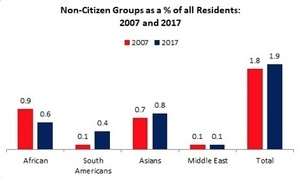
These are small numbers. And when the Irish Far Right gets in their ‘Islamophobia’ mode they are getting worked up over really small numbers. Of course, they might reply the situation is ‘getting worse’. Translation: there are more and more of these folk pouring in here, tsunami-like.

But no, there is almost no growth in the population of these non-citizen groups in Ireland.

Immigrants and the Labour Market

Another feature of the Far Right discourse is that immigrants come here to ‘live off the state’ (like senior creditors of banks, I suppose).

So let’s examine the unemployment rates among non-citizens in the high-income EU countries. The labour market gives us a sense of alleged ‘sponging’. It is also an indicator of integration – work being that social space where people from everywhere come together to contribute to the economy and society.

The following looks at the unemployment rate among citizens and non-citizens and the resulting ratio. Unfortunately, this database doesn’t break down unemployment by the countries of non-citizens.

The higher the ratio, the greater unemployment is among the non-citizen group; the lower the ratio the higher the level of integration.

Let’s walk through this table. The unemployment rate here among Irish citizens was 6.6 percent in 2017; among non-EU citizens it was 8.9 percent. This results in a ratio of 1.3. This is the best result among the high-income EU countries.

Other countries are struggling to integrate non EU-citizens into their labour markets. For instance, in Sweden, while unemployment among Swedish citizens was 5 percent, among non-EU citizens it was a staggering 29 percent – a ratio of 5.4. Germany, Austria and Belgium are similarly struggling – though it should be pointed out that over the recent past these countries welcomed a large number of people fleeing wars and deprivation. It will take time to integrate these people into the domestic labour market.

The point here is that the claims that people come here to sponge off the state are ill-founded. We have one of the best records of integrating non-EU citizens into our labour market.

Asylum Seekers

A third trope of the Far Right is that we are being overrun with asylum-seekers or, as some would have it, ‘bogus’ asylum-seekers.

Again, the data doesn’t bear this out.

Along with the UK (which puts their Brexit/immigration debate into some context), Ireland had the lowest level of asylum applications in the period between 2015 and 2017 – the years of the European migrant crisis.

Over the three-year period there were 8,400 asylum applications in Ireland. If the applications were at the high-income EU average, this would have meant 39,000 (if at the level of table-topper Sweden, it would have been 96,000).

And lest some would argue that we have a lax regime, that anyone who applies for asylum is granted it, the fact is that Ireland is rather tough.

Only 39 percent of asylum applications are met with a positive decision here. The average for high-income countries is 55 percent.

* * * *

To summarise:

Ireland has a relatively high level of non-citizens in its population. But this is down to the high level of UK citizens and citizens from other English-speaking countries (US, Canada, Australia and New Zealand).

Ireland has significantly fewer non-citizens from outside the English-speaking world than high-income EU countries.

The proportion of non-citizens has remained stable over the last 10 years (i.e. there is no ‘surge’).

Non-citizens in Ireland are more integrated into the labour market than any other high-income EU country – that is, there is lower unemployment among non-citizens. So much for the ‘sponging-off-the-state’ argument.

We have had far fewer asylum-seekers and we grant asylum to far fewer than most other high-income EU countries.

The claims of the Far Right and their allies collapse when we look to reality.

There are many who get taken in by the Far Right and not because they are racist or anti-immigrant. Many are confused, hurting, looking for answers. Progressives must engage with this constituency with empathy, pointing out the reality and providing a better alternative for them, their families and their communities.

As to the Far Right and their allies, I am loathe to use the label ‘racist’. However, their manipulation of information can legitimately lead one to conclude that many, if not most, are either conviction-racists or instrumental-racists (i.e. they are not racist themselves but use racist arguments in pursuit of their agenda). I’m not sure there is any objective difference.

But progressives should not be content to point out the failings of the other side. Throughout Europe, the issue of immigration has divided the Left. Its complexity – culturally, economically – means there are no simple answers.

It is imperative we create a space to hear a range of progressive viewpoints. We don’t have to agree – indeed, we can disagree robustly – with different propositions and analysis. However, to curtain-off the debate over migration-management leaves us with fewer tools to construct an alternative.

The Far Right – through its extremism and manipulation of facts – is trying to poison the immigration debate in order to polarise positions. In reality, the Far Right doesn’t want an informed debate on immigration. They want a shouting match.

They hope, in this atmosphere, to make gains. We shouldn’t allow them that oxygen. We should challenge them at every turn.

And engage in an inclusive dialogue throughout society that can win people over to a positive message – about the economic, social and cultural benefits of immigration and the immigrants themselves.

Michael Taft is a researcher for SIPTU and author of the political economy blog, Notes on the Front.

Rollingnews


From top: Irish waste workers would need nearly 60 percent pay rise to reach their EU peer-group’s mean average; Michael Taft

In their EU peer group, the Irish low-paid are some of the lowest paid, according to recently published Eurostat data.

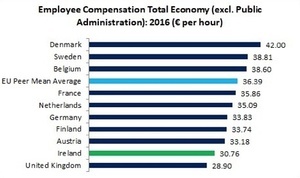
In the overall economy, Irish employees are paid less than their peer group – other high-income EU economies (essentially, the EU-15 excluding the poorer Mediterranean counties and, very shortly, the UK).

Eurostat estimates employee compensation (including labour costs which make up a fraction of the total) for firms employing 10 workers or more. Public Administration is excluded as many countries do not report this.

Ireland is at the bottom of the table, above only low-paid UK. On average, Irish employees would need an 18 percent increase in compensation to reach the mean average of our peer group.

It should be noted that the average is mean; another measurement would be the weighted average but Eurostat does not provide this. However, the weighted average would, in most cases, be somewhere between German and French levels since they dominate this grouping. This would still leave Irish workers requiring a 13 percent increase.

Let’s turn to the Irish low-paid sectors in the market economy (essentially the private sector), which for the purposes here are calculated at 2/3 of the Irish average.

There are eight sub-sectors below this benchmark: retail, hotels, restaurants, waste collection, security, building services (cleaners and gardeners), and wearing apparel and furniture manufacture.

There are 315,000 people employed in these sectors, or one-third of market economy employment.

The largest sub-sector is the retail sector with over 153,000 employees. Ireland is at the very bottom, even below low-paid UK.

Irish retail workers would need a 43 percent increase in compensation (a 33 percent increase if we use our short-cut weighted average; that is, half the difference between Germany and France). The gap between Irish and average peer-group pay is more than twice as much as the national gap.

The next two biggest sectors are in the hospitality industry: hotels and restaurants.

If anything, the situation is worse for the 128,000 Irish hospitality employees – with a larger gap with their peer-group than retail workers have.

There are two other low-paid service areas: private security personnel and building service workers (primarily cleaners and gardeners).

The 27,000 Irish workers in these sectors also see their compensation trailing significantly.
The story is much the same for the other sectors. The small manufacturing sectors of furniture and wearing apparel also find themselves well behind their peer-group.

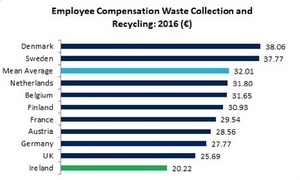
There is one last group: the waste collection sector. These are the workers – 3,500 of them – who pick up, treat, recycle and dispose of our rubbish.

Irish waste workers would need a nearly 60 percent compensation increase to reach their peer-group’s mean average. Even taking the short-cut weighted measure, they would need a 42 percent increase, but this probably understates this measurement given the high compensation levels pertaining in other countries.

None of the above factors in inflation (purchasing power parities). If we did that we would find the gap with the mean average shrinking but, when using a weighted average, it would widen (largely because Germany is low-inflation economy).

It should be further noted that employee compensation includes both the direct wage (paid directly to the employee) and the social wage (paid to a Social Insurance Fund).

Through the social wage, employees in continental Europe can access free (or low-cost) health care, subsidised prescription medicine, and in-work income supports (pay-related sick benefit, maternity and paternity leave, etc.).

Further, in many countries the social wage – apart from social insurance – subsidises public transport (e.g. Paris) and generous family supports (e.g. Austria).

Even when you exclude the social wage, Irish wages are low – with retail workers needing a 22 percent increase just to reach their peer group mean average (or 15 percent when inflation is factored in).

Add in all those costs Irish workers bear that workers in other countries get subsidised through the social wage, and we now we see why Irish living standards are relatively low.

Getting a pay rise is only one aspect of correcting this situation.

There is a need to increase the social wage (employers’ social insurance) so that workers can consume more public services and supports collectively.

We need to focus on the lowest-paid in society. It is scandalous that so many are left behind on such low wages.

We need to focus on employees’ rights in the workplace (e.g. collective bargaining), bargaining across sectors and, just as importantly, a social-cultural transformation that no longer tolerates such grim conditions.

These are the people – our neighbours, friends, family members, and fellow residents – who serve our meals, clean up after us, secure our buildings, assist us in the shops, pick up our rubbish and manufacture the goods we use.

Maybe it’s a bit passé or old-fashioned to say that this is a moral issue. But given the level of low pay, hopefully not.

Michael Taft is a researcher for SIPTU and author of the political economy blog, Notes on the Front.

From top: Irish Fiscal Advisory Council Chairperson Seamus Coffey (left), Chief Economist and Head of Secretariat Mr Eddie Casey (centre) and Mr Michael G Tutty speaking to the media at the launch of the The Fiscal Assessment Report last week; Michael Taft

The Irish Fiscal Advisory Council has provided the Left an open goal. If we shoot, we score. But first we have to get on the pitch. And right now the Left has not even put on their jerseys.

In their latest Fiscal Assessment Report, the Fiscal Council got more than a bit tetchy with the Government’s handling of the public finances.

They used some undiplomatic language:

‘ . . . the medium-term budgetary plans are not credible . . . ‘

Ouch. The Fiscal Council’s critique of the Government’s fiscal policy boils down to (a) failing to drive a budgetary surplus in the good times; (b) leaving the debt at an elevated level; (c) stimulating an economy to the point of over-heating; and (d) failing to factor in the downsides in future projections.

All of this is leaving us badly exposed of the inevitable slowing down of the economy, never mind the damage Brexit, changes international taxation and trade wars could do.

In short, Fine Gael is squandering the recovery. Put this together with Fianna Fáil’s reckless pre-crash policies (never mind the equally reckless austerity measures both parties pursued) and the Left has a good starting narrative: you can’t trust the Right to manage our public finances.

This doesn’t mean people will automatically trust the Left, which to date has had little to say about the issues of debt, over-heating, deficits, etc.

This allows the Taoiseach to get away with deflecting the debate away from the Fiscal Council’s criticism:

‘[The Taoiseach] insisted the Government’s spending was modest compared to the constant demands of the left-wing Opposition for increased spending . . . if people listened to that kind of left-wing rhetoric the economy would plummet very quickly.’

The Left’s silence allows our opponents to monopolise the issue and distort its position. So let’s start engaging the debate.

Here are some ideas. These are not comprehensive or necessarily authoritative. But hopefully it will get things started.

1. Stick with the Fiscal Rules.

Never thought I’d write that but for now the Fiscal Rules are a practical defence against more orthodox policies. Sticking with the Rules’ deficit target will allow us more space than Government spending projections. We can still critique the Rules’ faults, though: the treatment of investment, the inapplicability of the Rules’ methodology to a small, open economy; their deflationary bias, etc.

2. Strengthen Automatic Stabilisers

There are two key stabilisers: Unemployment Benefit: In the event of a slowdown higher unemployment benefits will help maintain domestic demand. In our EU peer group, unemployment benefit is far stronger – over €300 and €400 a week; in Ireland, it is only €193. Increase unemployment benefit with a small increase in Employers’ social insurance.

Employment Subsidy: It is important to maintain employment in downturns. Therefore, rather than job losses, employers would reduce workers’ hours with the state subsidising workers’ income to prevent loss in take-home pay. This programme was pursued by Germany during the last downturn with considerable success. This would be less costly than growing the dole queues.

3. Underpin the Productive Economy

There are three main areas: Introduce cost-rental housing to substantially reduce rent levels. This would increase spending on goods and services and reduce unnecessary upward pressure on wages.

A new financial model for childcare: current policies are not working (last year, the Government handed over €1,000 in cash subsidies to childcare providers– and fees still increased). Reducing fees would, again, allow for higher expenditure on goods and services, and reduce entry costs into the labour market.

Human capital, education, and innovation capacity: to see us through the medium and long-term, increase resources into education, innovation, and basic and applied research (Ireland compares poorly to other EU countries), switch away from tax credits to grants for SMEs, increase links between state, universities and progressive enterprises, etc.

4. Collective Bargaining Rights for Workers

Optimising our response to any downturn requires employees to be part of the solution, part of the decision-making process at firm-level. Further, sectoral committees should be set up in those sectors most at risk of Brexit or other-related slowdowns with full employee participation.

Collective bargaining has two significant benefits:It tends to favour those on low and average incomes – the groups that have a higher propensity to spend during a downturn

It tends to reduce precarious contracts which currently exclude people from fully participating in the consumer economy (that is, they are forced to save during those weeks they have less work or no work at all).

5. Keep Public Banks Public

Notably, AIB. Banks are notoriously counter-cyclical; when the economy goes into downturn banks withhold lending. A public bank can act differently since it is not beholden to short-term shareholder interests. It can continue to support viable companies, which might not otherwise be able to access credit.

6. Engage in Real Public Services Reform

We need to ensure efficiency and productivity in our public services. So why not bring in the actual producers of public services; namely, the employees. Employee-driven innovation is a feature in many other EU countries. It is employees who are best placed to know why something isn’t working and how it can be put right.

7. Unleash Public Enterprise

Public enterprises are essentially investment-driven businesses. This will be all the more needed in the rough periods ahead. During the last recession, public enterprises maintained investment. Currently, the top six public enterprises invest the equivalent of 40 percent of the state’s capital budget.

* * *

It might seem curious this hasn’t focused on tax issues. Budgets, however, merely reflect the state of the economy so we must first look to economic policies.

You will increase revenue if you raise the wage floor, end precarious contracts, drive investment, strengthen stabilisers, reduce rents and childcare fees, and support innovation.

Measures that put the economy on a more sustainable footing can then be complemented by tax measures – in particular, taxation on property, assets and passive income.

Two short-term measures would be to introduce a net assets (wealth) tax and substantially increase inheritance tax. And, of course, stop Fine Gael from introducing its €3 billion tax cut bonanza.

However, the debate involves, whatever other and better measures are proposed, the key thing is to resolve in the New Year to enter the fiscal debate. Let’s put on our jerseys and get on the pitch.

An open goal awaits us.

Michael Taft is a researcher for SIPTU and author of the political economy blog, Notes on the Front.


From top: Wages have barely exceeded inflation over the last 10 years; Michael Taft

Tom Healy, Director of the Nevin Economic and Research Institute, put up the graph (below) on Twitter with the comment:

‘Average Weekly earnings flat in real terms since 2009. Yet, non-labour incomes rising significantly.’

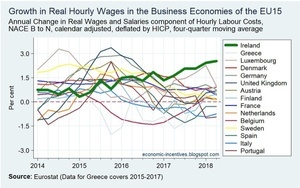
Seamus Coffey, Chair of the Irish Fiscal Advisory Council, responded with a graph of his own (below) commenting:

‘Current trends are surely more informative? Ireland has had the fastest real wage growth in the EU15 for nearly 18 months.’

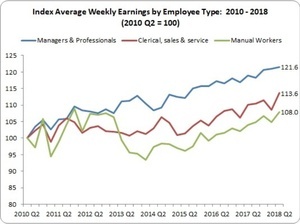
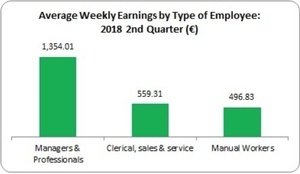
I threw in my two cents. I tweeted a graph (below) of the CSO’s average weekly earnings for three employee types: managers & professionals; clerical, sales and service workers; and manual workers (production, transport, craft and other manual). My comment:

‘But we have to look at who’s benefiting. Weekly earnings increases are taken up by the higher income groups with white and blue-collar workers trailing.’

Managers and professionals have experienced a 22 percent increase in weekly earnings over the last eight years; white and blue-collar workers received a 14 and 8 percent increase respectively.

With inflation running at nearly 6 percent over this eight-year period, most of the gains for manual workers have been wiped out with white-collar workers seeing nearly half of their gains eaten away. Managers and professionals are still well ahead of the game.
And ahead of everyone else.

Unsurprisingly, the group that received the highest increases is the highest income group. Managers and professionals earn more than twice as much as other employees.

What does all this tell us? First, it’s good that people swap graphs on social media rather than insults. Second, data tells you what it tells you. It is the framing and interpretation that fuels the debates.

For instance, Tom Healy is right to point out that wages have barely exceeded inflation over the last 10 years. Seamus Coffey is right to show that in the recent past (18 months) wages are starting to rise, faster than other EU-15 countries (though if you go back a few years the story changes).

I hope that I have shown that the gains over the last eight years (that’s as far back as that CSO dataset goes) have gone to the highest income groups.

Of course, all the data in these graphs beg questions. And the answers can slightly alter the conclusion. For instance, when looking at the data for types of employee, we should remember that the numbers could change – not because of actual pay increases or working hours increase – but because the composition of the group has changed.

However, the main point I would draw from all three graphs – growth in real wages, relationship to other countries and the distribution of those earnings – is that we’re heading into greater inequality if we rely on ‘market forces’.

We need a wage market that is negotiated between employers and employees. Such negotiation has a tendency to favour low and average income earners whereas market forces tend to favour higher income groups who have stronger bargaining leverage.

In short, we need a negotiated economy.

Michael Taft is a researcher for SIPTU and author of the political economy blog, Notes on the Front.

Rollingnews

From top: Construction work last month on the Elsmore housing estate in Naas, County Kildare; Michael Taft

Since the crash bottomed out in 2012, employment growth has been substantial – 377,000 according to the CSO. This is a strong performance by any standard.

But there is some confusion as to where the growth is coming from and what it says about the economy.

Let’s run through some numbers focusing on employees or wage-employment (excluding self-employed) and the market economy, which excludes the mostly public sectors such as public administration, health and education.

In the period of 2012 to 2018 (2nd quarter), the number of employees in the market economy grew by 268,000, or 28 percent (in the non-market sectors employment growth was lower reflecting the Government’s hiring freeze – 72,000 or 14 percent).

Construction employment nearly doubled in the last five years; not surprising given the collapse of building work during the crash.

The next biggest increase came from Administrative and Support Services (a category that includes high-paid aircraft leasing employees and low-paid cleaners and security guards).

Coming third was the hospitality sector. Notably, while tech companies are usually associated with high employment growth, the increase in the Information and Communication sector was below the market economy average (though being high-income their consumer spending will help create jobs in other areas).

From what sectors did these 268,000 jobs come from?

Nearly one-in-four jobs came from the hospitality sector – a low value-added, low-wage sector. Employment increased by over 60,000. The next largest sector was construction, bouncing back from the crash. This sector grew by 53,000.

Combined, hospitality and construction made up over 42 percent of all employee growth in the market economy. Growth rates appear to be concentrated in these two sectors.

Let’s look further under the hood.

Administrative and Support services had the second highest growth rate. Eurostat tells us that 75 percent of this growth came from ‘employment agencies’ – primarily, agency workers.

While we can’t necessarily apply this calculation to the CSO data (different methodologies may be at work), it is indicative and is confirmed by Eurostat’s finding that the number of temporary agency workers has more than doubled between 2012 and 2017.

Another potentially worrying trend is the rise of temporary employment or fixed-term contracts in the latter part of the last five years. Temporary employment is considered at high risk of precariousness.

The trends over the last five years show that the total number of employees increased by 23 percent while temporary employment increased by 13 percent. However, the data shows a sharp rise in temporary employment in the last 15 months – 66 percent of the increase in wage-employment was temporary contracts.

We should be cautious about this, as the data has a couple of breaks in the time series which means that there was a change in methodology (e.g. different questions which could alter survey responses on precariousness). Nonetheless, it is consistent with the increases we saw above with temporary agency workers.

While the above refers to the market economy, there is one interesting insight from the non-market sector. Health wage-employment increased by 19,000 between 2012 and 2018. However, only 30 percent of that growth came from the public sector.

Public sector wage employment makes up only 56 percent of total health wage employment – and it is falling. Is this particular stat trying to tell us a story about the slow privatisation of our health sector?

The Irish Times’ Cantillon observed:

‘The rapid return to near full employment here is undeniably a good thing, but it highlights a remarkable volatility at the heart of the Irish economy that allows us go from boom to bust to boom again in barely 10 years. Stability is not what we do here.’

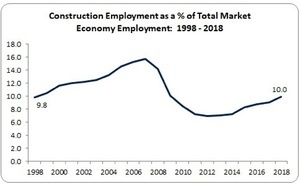
Too true; one has only to look at the boom-bust-emerging-boom in construction employment. This chart includes the self-employed.

At the very end of the boom in 2007 nearly one-in-six people employed in the market economy were in the construction sector, and this doesn’t count other property-related jobs.

While we are still a way from that peak, we should expect construction employment to climb as residential and commercial building increases. Are we on another incline on the roller-coaster that is our construction sector?

The headline story for employment growth is good. However, when we look under the hood we find some worrying trends – growth in low-wage and precarious job creation along with the strong growth in the volatile construction sector.

It’s a good story but not without downsides.

Michael Taft is a researcher for SIPTU and author of the political economy blog, Notes on the Front.

Rollingnews

From top: Free public transport is central to a Universal Basic Service; Michael Taft

We have all heard of Universal Basic Income – the proposal that everyone receive an income sufficient to meet basic needs, regardless of income or employment status.

Now, there is another proposal from the University College London’s Institute for Global Prosperity. They are proposing Universal Basic Services (UBS).

They describe it as:

‘The provision of sufficient free public services, as can be afforded from a reasonable tax on incomes, to enable every citizen’s safety, opportunity, and participation.’

Free public services: they claim this will meet needs more directly, increase economic efficiency and reduce costs, and buttress the social fabric by focusing on public needs.

Based in the UK, the ICP’s starting point is the National Health Service – a free service based on need. They take this principle and apply it to:

Education

Shelter

Food

Transport

Information

Democracy & Legal Services

Some of these are fairly self-explanatory. Education should be free – from early years to third level. Households shouldn’t have to sacrifice to educate their children (education, in any event, is a public good) while students shouldn’t have to start out their working life in debt. And in Ireland we would have to include free health.

Other candidate services for a UBI are a bit more debateable. For instance, it is proposed that social housing be doubled (1.5 million in the UK) and be provided for free on a needs basis.

In this proposal, shelter is not a universal service but a free means-tested service. Similarly with food – UGL proposes to provide one-third of meals free to those experiencing food poverty (8 percent of UK population). Again, this is not a universal service but a free means-tested approach.

The proposal for free public transport is on more solid ground. A number of cities throughout Europe provide free public transport – including ferries and bike rental schemes.

In Ireland, nearly a million people have free travel passes, or more than one-in-four adults. There are further free travel schemes for island residents (e.g. Tory Island residents receive 8 free journeys on the seasonal helicopter to the mainland). So the principle of free travel is established for a significant number of people.

The UGL also propose free information which would include a household package of free basic phone, Internet and the BBC TV licence fee. Certainly, if digital participation is a necessity in the 21st century, then there is a logic for free internet.

While free universal public services are appealing, the perfect is the enemy of the good. Ireland struggles to reach the level of public service spending in our EU peer-group, never mind providing public services for free.

Ireland is a bottom dweller. Just to reach the second lowest spender – Austria – we’d need to increase spending on public services by €5.6 billion; to reach Danish levels we’d have to increase spending by over half, or nearly €19 billion (gulp).

However, UBS can help reframe the debate over public services. For instance, cost-rental or income-linked housing can deliver affordable housing to a huge swathe of the population.

Regarding public transport, it’s not just fare levels – it is also about urban planning (costs fall in higher density areas), frequency, ease of access and comfort.

However, a flat-rate fare of €1 for all Dublin public transport could provide an incentive to move from car-reliance and reduce costs for passengers.

We can also innovate the way we pay for certain services. I have written about turning the TV license from a flat-rate payment into a fractional charge on income. This would turn a regressive charging structure into a progressive one; as well as eliminating administration and enforcement costs, and license-evasion.

And if you think that providing basic internet to all households would be costly, it would come to only 0.6 percent of gross personal income (but the immediate issue is coverage, particularly in the rural areas).

There are other services we could look at. For instance, why shouldn’t childcare be free, like early childhood and primary education?

Recently, TASC proposed that childcare workers be paid directly by the state with childcare providers given a capitation grant for each child in their service. While there still might be a household co-payment, it would not constitute a bar to labour market entry or a burden on parents.

A key element in the UGL’s proposals is a radical decentralisation of public services to local and regional government. Once again, Ireland is a bottom dweller when it comes to local government spending.

In the Nordic countries over half of all public spending comes through local government, compared to 7.5 percent for Ireland. This may help explain why there is a general consensus in Nordic countries for higher spending – at local levels accountability is potentially enhanced.

However, ambitious and radical reform would be needed for Irish local (or sub-central) government to have the political and economic capacity to administer public services.

Most of all, UBS, in reframing the debate, could promote an inclusive and authentically democratic dialogue about the nature, operation and delivery of public services – a dialogue not just of ‘expert’ consultants but one that is extended throughout civil society, rooted in the experience and ideas of the producers (workers who deliver public services) and the users of those services; that is, all of us.

The emergence of public services in the late 19th century – education, health, sewers, water, waste collection, energy – was the foundation of social modernisation. We need to launch a new debate over the foundations of a 21st century public service infrastructure.

Universal Basic Services should play a significant role in that debate.

Michael Taft is a researcher for SIPTU and author of the political economy blog, Notes on the Front.

Rollingnews