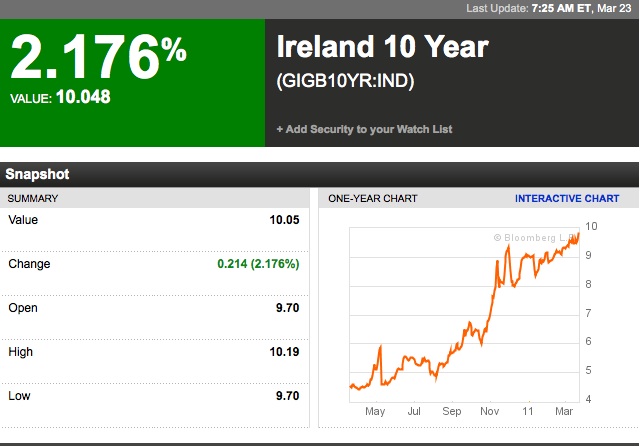
 There goes our 10 per cent ceiling.
This is not a good thing.



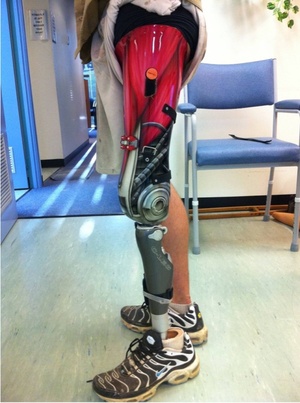
This custom-airbrushed, Terminator-style beauty, belonging to Redditor, captaincripple is a god-damned prosthetic leg.
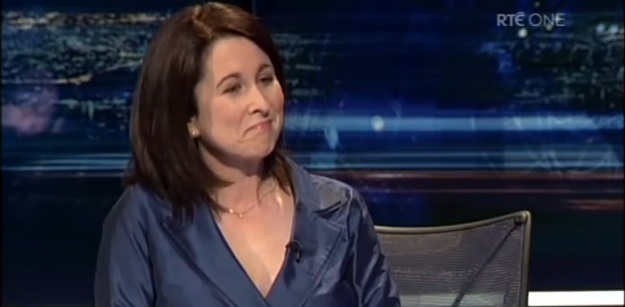
Irish Times columnist, presenter of TV3’s Midweek, Moriarty Tribunal witness and Denis O’Brien chum Sarah Carey went on Prime Time last night.
Her task was twofold: Put a gloss on the findings of the Moriarty Report that related to Denis and herself.
And could she do this without appearing smug and shifty?
It was a big ask.
Miriam O’Callaghan: “What’s your reaction…?”
Sarah Carey: “Well, Miriam, apart from working for Denis O’Brien I was a witness at the tribunal. I had run-ins with them. I leaked some information about a donation Denis O’Brien made to the Progressive Democrats, and I denied that to the tribunal. And as one of my friends said to me today: ‘Sarah, you’re emotionally involved in this’.
“So I understand that people will naturally and, you know, logically discount my opinion on it. But if I thought for a second, you know – and I just want to assure you on this – that there was anything about that licence that was unsound, I wouldn’t be here tonight to defend it, and I wouldn’t flinch from condemning anyone who was a party to that. ”
O’Callaghan: “So why would Moriarty say this?”
Carey: “So I heard all these phrases today, like, you’d a ‘venal’ abuse of power, and ‘overreaching’, you know all this really inflammatory language, so when I went to the report and got to the sections where the actual substantive issue of what this so-called venal abuse of power was, I actually couldn’t find anything that changed my mind about the point that I have been making all the time.”
O’Callaghan: “Before I get onto what he said about you, Sarah, what you say is you reject what Justice Moriarty found?”
Carey: “What I say is that, based on the sworn evidence at the tribunal of the 17 civil servants, of the senior counsel Richard Nesbitt, of the independent consultant Michael Andersen, of the staff from the Attorney General’s office, who swore that there had been no interference, I believe that evidence to be credible – and this is the important bit – in order for Michael Moriarty to have drawn the conclusions that he has drawn, he has had to completely discount that evidence.”
O’Callaghan: “And the 900,000 sterling to Michael Lowry?”
Carey: “Yeah but when you go through all of those, it’s kind of flimsy, and, and I would say this: as bad as the money trail looks, you have to go back then to the fundamental question, was there a benefit – ”
O’Callaghan: “OK I just want, I just want to put something because you brought it up yourself, obviously, that you were in the tribunal, but just to say what he said about you. In relation to the leaked confidential information relating to the political donations. When you were asked about this, he says, at the tribunal, you first lied and denied it although you did later admit to it. The report describes what you did as irresponsible and not remotely justified by the explanation you provided.”
Carey: “Em, yeah, I mean there was a lot of leaking going on and, ah, I naively and stupidly got involved in that. But I don’t think that changes the fundamental issue which is that those civil servants swore under oath Michael Lowry had not interfered in the process, that Esat Digifone was the fair winner, and nothing that anyone draws about the conclusion can change that sworn evidence.”
O’Callaghan: “One last question about yourself: the report also found that you used your Fine Gael connections to put you at the centre of a number of substantial donations of cash from Denis O’Brien to Fine Gael, and in particular it quotes one letter from you to Phil Hogan, and I’m just, it’s, very briefly because I think it says a lot about connections. It goes: ‘Dear Phil, please find enclosed a draft for the golf on the 16th’ – this is to be a Fine Gael fundraiser – ‘I understand Denis O’Brien has requested that there are no references to be made to his contribution at the event. Best of luck on the day’. Doesn’t that just say to people watching Sarah Carey, powerful people buying influence?”
Carey: [laughs] “OK. Look. We’re talking about a golf fundraiser and there was a donation of a few thousand pounds to it. These kind of things were run of the mill for all political parties and Denis O’Brien was making donations to all political parties – Fianna Fáil, the PDs, Fine Gael, everybody. You know. It’s really peripheral to the main issue.”
Read the Irish Times oh-so-responsible coverage of Sarah’s boo-boo here.
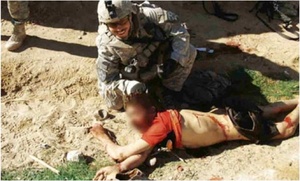
The face of Jeremy Morlock, a young US soldier, grins at the camera, his hand holding up the head of the dead and bloodied youth he and his colleagues have just killed in an act military prosecutors say was premeditated murder.
Moments before the picture was taken in January last year, the unsuspecting victim had been waved over by a group of US soldiers who had driven to his village in Kandahar province in one of their armoured Stryker tanks.
Photos Shows Soldiers In Afghanistan Posing With Dead Civilians (Guardian)
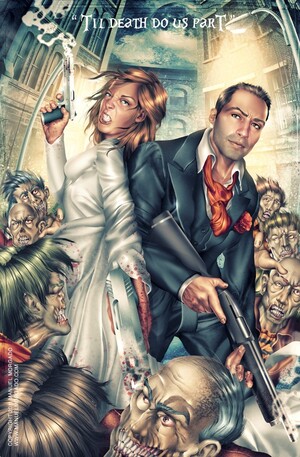
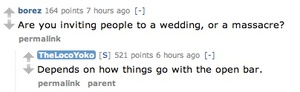
Redditor TheLocoYoko decided to eschew the conventional gilt-edged copperplate approach and instead had illustrator, Manuel Morgado depict himself and his bride-to-be thus. From the comments:

Taken an hour ago.
Outside the Department of Justice after the announcement of a new deputy Garda Commissioner, Noirin O’Sullivan (centre) with justice minister Alan Shatter and Commissioner Martin Callinan.
You’re never going to read all that.
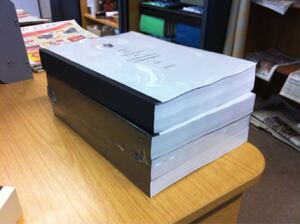
Here then, courtesy of RTE News, are the Moriarty report’s main bullet points:
1) It is ‘beyond doubt’ that Michael Lowry imparted substantive information to Denis O’Brien which was ‘of significant value and assistance to him in securing the licence’.
2) Mr Lowry deprived the Government of its decision-making function. The Tribunal’s report describes Mr Lowry has having a ‘strategy’ of depriving Government of an opportunity to scrutinise and review the result of the process.
3) Mr Lowry bypassed consideration by his Cabinet colleagues and thereby not only influenced, but delivered the result for Esat Digifone.
4) Mr O’Brien made or facilitated payments to Mr Lowry of £147,000 Sterling, £300,000 Sterling and a benefit equivalent to a payment in the form of Mr O’Brien’s support for a loan of £420,000 Sterling.
5) In advance of the closing date of the competition, Esat Digifone had available to it confidential information regarding the weighting matrix adopted by the project group that it was not entitled to have.
6) The report refers to Mr Lowry’s ‘cynical and venal abuse of office’ and his brazen refusal to acknowledge the impropriety of his financial arrangements with Denis O’Brien and Ben Dunne.
7) Mr Lowry used a ‘groundless rumour’ relating to the Persona consortium to his advantage and displayed an appreciable interest in the process and had irregular interactions with interested parties at its most sensitive stages.
8) The ‘most pervasive and abusive instance’ of Mr Lowry’s influence was his action in withdrawing time from the Project Group, when it had requested an extension to its work because it was not convinced that Esat Digifone should be nominated as the winner.
9) Mr Lowry ‘misled’ the party leaders as to the clarity and certainty of the result that he had recommended.
10) Mr Lowry sought to overreach his own party leader, John Bruton, by ‘intimating that the Government should have no discretion’ in the matter.
11) The $50,000 donation to Fine Gael was made through Telenor on behalf of Esat Digifone.
12) The tribunal report criticises the Fine Gael party for not revealing the clandestine nature of the €50,000 donation made by Denis O’Brien after his company won the mobile phone licence.
13) The report finds that Michael Lowry displayed qualities ‘similar in nature’ to Charles Haughey and says Lowry’s actions have cast a ‘further shadow’ over this country’s public life.
14) The Moriarty Tribunal has described Michael Lowry’s actions in influencing the awarding of the mobile phone licence as ‘disgraceful’ and ‘insidious’.
15) Mr Moriarty says greater precautions ought to have been taken to segregate those conducting the evaluation of the process from their political master.