


Monthly Archives: March 2013

Jp13-021-5DII Jp13-361D8 volcano-2 Jp13-084-5DIIJp13-084-5DIIdet Jp13-089-5DIIPhotographer Martin Rietze’s extraordinary photos of the Sakurajima volcano in southern Kyushu, Japan as it disgorged smoke, fire and lava bombs in January, culminating in a violent 20 second lightning show.

The exact cause of volcanic lightning remains unclear. It could be caused by electrically charged volcanic dust or the motion of electrically charged magma bubbles as they are catapulted upward. Or lava pixies. Maybe not lava pixies.

colossal

Screen Shot 2013-03-13 at 16.12.48Keoghs Image 2

Everybody wants their shamrocks.

Who’d blame them?

*swoon*

International sensation, Keogh’s Crisps, the Shamrock flavour crisps, are back for the St. Patrick’s Day celebrations.

They remain the ONLY only food offering in the world to contain real shamrock.

And, while maybe not bilingual, they do speak the universal language of Nom.

We have, yes just the ONE, Keogh’s hamper bursting at the seams with Keogh’s Shamrock crisps “and goodies” to give away in a crunchy four-leafed competition.

To enter, just complete this sentence.

PLEASE give the Keogh’s Shamrock Crisp Hamper to…………..because………..

Republic of Ireland only (apologies)

Lines close at 6pm 7.30pm (winner announced in comments)

 Thanks Susie Pollock

stockpicWallace Turbeville, writing earlier this week in The American Prospect, reveals the following chilling but less-than-surprising reduction to near absurdity in the world of stock trading:

For me, the story starts with a book, Dark Pools, written by Wall Street Journal Reporter Scott Patterson. The book, published in the summer of 2012, is an account of the rise of high-frequency trading or “HFT.”That is automated trading of securities and derivatives using powerful computers driven by complex algorithms. It is widely accepted that trading activity in most markets is dominated by HFT. Firms that specialize in this practice trade in enormous volumes but start and end the day with few if any holdings. Their purpose is to profit from intra-day market moves, not from fundamental investment. They buy and sell in the blink of an eye, churning the markets constantly. Mr. Patterson’s book contains the following passage:

At the end of World War II, the average holding period for a stock was four years. By 2000, it was eight months. By 2008, it was two months. And by 2011, it was 22 seconds, at least according to one professor’s estimate.

Gone In 22 Seconds: How Frequent is High Frequency Trading? (The American Prospect)

(Hat tip: Mark Malone)

(Pic: AP)

Screen Shot 2013-03-13 at 14.22.54

A few months ago we featured a sledding video from the guys at Soundwave, one of the current crop of Irish start ups that’s driving the real Smart Economy and not the one our Government bangs on about (and doesn’t understand).

They’re at South By Southwest in Austin pitching to everyone that’ll listen to them about their music discovery app.

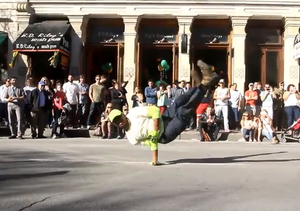
To get a bit of notice, they hired some dancers to dance with headphones in and wearing t-shirts with #SXDancingGuy on them.

All standard market guff until a local street cleaner decided to instigate a dance-off.  Now you’ve got marketing gold.

Soundwave Music Discovery