



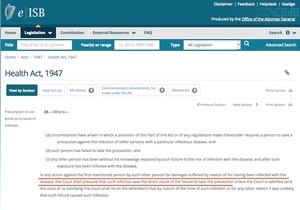

From top: Section 43 of the Health Act 1947; Barrister Tony McGillicuddy
Yesterday.
On RTÉ’s This Week.
Barrister Tony McGillicuddy spoke to Carol Coleman about gardai receiving powers to enter people’s homes.
It followed the Cabinet last Friday rejecting proposals for criminal penalties for people organising gatherings of more than six people but Tanaiste Leo Varadkar later saying a ‘civil offence’ may be introduced.
Carole Coleman: “Could you explain for us briefly what a civil offence is? And how it is investigated or prosecuted?”
Tony McGillicuddy: “Yeah, there is no such thing as a civil offence, Carole. It’s a contradiction in terms. I mean, under our Constitution and our laws, we have statute laws and then regulations which fill in the details of those and they can be enforced either through civil orders that are made in the courts or else by a criminal sanction if those provisions are made criminal law offences.
“So there’s two streams. And we have that at the moment with our regulations on, for instance, wearing a facemask in shops or shopping centres. So that is a provision. The power to make that order is in the Health Act 1947. The minister made the relevant regulations to make that a requirement of all persons. And if a person is in a shop today and they’re not wearing a facemask, a garda can approach that person and give them a direction that they must wear a facemask.
“If that person doesn’t wear a facemask after getting that direction from a garda, that is a criminal offence and the garda can arrest that person and can prosecute that person. So it’s the failure to comply with a direction of a garda to wear a facemask in a shop that would then be a criminal offence.”
Coleman: “They’re now planning to involve gardai in the house parties or the house gatherings. So what you’re saying is that it would become the law of the land but not a crime. What use would this be in say a flagrant breach of the house gathering rules?”
McGillicuddy: “Yeah, I mean, it is possible, that there could be a requirements set out in regulations or in a primary piece of statute law, whereby a person would be prohibited from having a gathering of six people in their household from three or more households. And they could then decide not to make it a criminal offence, they could just say it’s in statute, it’s in the law of the land and it doesn’t have any criminal sanction.
“I think the only thing that I can see that might have an importance at the present time is that there’s a very interesting provision in the Health Act 1947 which has not received public commentary up to now.
“It’s Section 43 of the act and that outlines that if a person, if there are requirements for a person to take certain precautions to avoid Covid or other infectious diseases, and if they don’t do so, and if a person then, in their household, becomes infected with Covid, that person who has attended, as an invitee at their house, could sue them for damages. And it would be presumed in law that they obtained the infection from attending at their house unless the householder can prove otherwise.
“So you could have a situation whereby the Government will say ‘well, we’re gonna make this the law of the land, we’re not going to impose a criminal sanction but if you invite more than six people into your house of a night and if one of them subsequently finds out that they have Covid, they could sue you for damages’. And it would be up to the householder to show that they hadn’t been infected at their house that night.
“And I think if members of the public knew that that presumption in law could act against them, in such a scenario, that might have its own coercive effect on people organising house gatherings.”
Coleman: “OK, well that’s very complicated and lots to be discussed there, barrister Tony McGillicuddy, thank you very much for joining us.”
Anyone?
Listen back in full here


so does that not do away with the whole ‘innocent until proven guilty’ thing?
When are we going to call halt to this kind of madness.
Hey what about getting everyone to print off and sign some kind of disclaimer before they arrive?! :P
“I have been made fully aware of the risks of attending this party and of the instructions to arrive in a hazmat suit and wear it at all times for my own protection. By not complying with these instructions, I understand that I would have no viable grounds to pursue a claim for compensation if I become infected”
It is total madness.
But sure as long as everyone is safe – that’s all that matters.
Sure only about 850K people have died from it. I mean it’s not like 150K people don’t die EVERY SINGLE DAY on the planet regardless of Covid or what we do to try to stop it.
So, we’re at an extra 5-6 days worth of deaths globally for the last 9 months of this pandemic.
Spanish Flu was 50 Million deaths in a population of under 2 billion!
Kinda puts it in perspective. We need to cop on.
Another piece of anti-citizen legislation?
What are you talking about?
There is no legislation.
“Cabinet last Friday rejecting proposals for criminal penalties for people organising gatherings of more than six people “
Apart from you, who mentioned anything about “criminal penalties for people organising gatherings of more than six people “ Poor attempt at distraction and diversion. Read the full article.
I did read the article.
A random barrister is talking about what could be done and how it might be implemented. He also looking at 70-year old legislation and what laws the government could implement. The whole article is strawman stuff.
Now your turn.
– On this post what legislation are you talking about when you said “Another piece of anti-citizen legislation”?
– What **other** pieces of legislation exist that are “anti-citizen”.
You keep mentioning “anti-citizen legislation” but refuse to divulge what legislation you are talking about.
Wow – a random named qualified Barrister vs. a random guy whose main object here is to divert and distract.
You’ve just said that there is something that ‘could’ be done via Legislation. You’ve made one step up from yesterday at least by accepting there’s anti-citizen legislation.
Every citizen is has the right to liberty – correct?
Every citizen has the right to freedom of assembly – correct?
Every citizen has the right to earn a livelihood – Correct?
Inviolability of a citizen’s dwelling – Correct?
Are you saying that there’s no legislation at the moment that diminishes the citizen’s rights above?
It is *your* opinion the current/previous governments are implementing “anti-citizen legislation”.
So it is up to *you* to provide evidence of said legislation.
As for your four “rights”, none of those are total – all have had exceptions/qualification since before the founding of the state.
That’s it Cian, divert, distract etc.
Each and every one of those i’ve listed has have legislation slapped on it that is anti-citizen. One very glaring one is a person’s right to earn a livelihood. Pubs closed. The owners seemingly don’t have such a right.
Liberty? Gardai stopping people at county lines?
Freedom of assembly? Clifden.
And the attempt then to allow the police enter peoples homes – to make sure that people aren’t assembled there.
So I gave a list, and all you can come up with is a schoolboy debating team answer, and of course try twist what I’ve written. Glad you’ve conceded that there’s anti citizen legislation there to implement.
Surely this wouldn’t just apply to homes, it would apply to mask wearing in shops and public transport too.
Imagine despite my best efforts I get covid.
I look at the payment history of my contactless payment card to establist what shops I visited and when.
I then request all CCTV footage of me from the shop at the relevant times.
On viewing the CCTV I note several persons were near me and not wearing masks.
Can I take a civil case agains the shop and / or the unmasked persons.
P.S. Most of the unmasked persons could be identified by linking the CCTV footage at the checkout with the transaction log of the register identifying the card used for payment (note to self, always use cash at LIDL)
Could I force the shops to identify their customers by the payment cards used (or loyalty cards / apps)?
On the bus CCTV should easily match unmasked offenders with LEAP card transactions.
(note to self, get a new leap card and this time don’t register it)
@ Just Saying
An amusing look at the situation and let’s hope this never becomes a reality – though, this time last year, would we not have seen the present reality as science fiction?
According to the act (see under the red-lined bit at the top), the court would assume that the infection was caused by the failure to take precaution unless it was satisfied, by reasons given by the defendant, that this was unlikely to be the case. Theoretically the unmasked individual in a shop might be sued, therefore. However, one would trust that the amount of time in close proximity, should make a difference as to whether the court would be satisfied as to the likelihood of an individual being infected because of the lack of a mask on the defendant, should this ever be taken to court. It would be an interesting situation, though, if the unmasked person had what the Government has recognised as a reasonable excuse.
At the moment, we have ridiculous ‘measures’, which few people are able to interpret (even Liam Herrick, ICCL, was confused in the figures he quoted). Additionally, I would suggest, most people cannot tell whether ‘measures’ are advice, guidance, requirements or law. The Government does not clarify matters, eg ‘should’ and ‘must’ are used interchangeably.
As regards numbers who can meet indoors (excluding special circumstances like weddings and theatres), we have the following measures. A household – no size stated – can have up to 6 guests at a time, from up to 3 other households. ‘This is to allow physical distancing of 2 metres.’ The drafters of this measure have, clearly, not visited many houses in Ireland – 4 households in one room, all 2m from each other, would be a tall order for many people’s homes. Perhaps, though, one or two households could sit in another room and a baby’s intercom could allow a joined-up conversation.
The alternative of gathering in, eg, the local parish hall, instead, is not on, even if it can seat 100. Then the limit would be 6 people from 3 households, maintaining social-distancing – ie fewer people and fewer households but far more space than in the house!.
The 6 people from 3 households who have to socially-distance in the parish hall, though, can sit round a table in a restaurant. Conversely, more than 6 people from the same household cannot do so, even though they may do this at home.
On top of this, now, is the threat of a further imposition, which, if added to the wording of the Health Act 1947, could end up with a householder having to show that an individual hadn’t been infected at their house. The only way that this could be shown for sure (assuming, that is, that someone in the household had tested positive) would be if the individual were not there! In normal circumstances, the defence would be that the individual was in other situations where they could have been infected so there was a doubt. Doubt, apparently in this case, would be no defence.
When will people recognise that the Government is losing the run of itself? Too late, I fear, to save us.
Cheezuz here as well?
I really weeweeed someone off there in the Broadsheet Standards Department
Lawyers all over the King’s Inns are rubbing their hands at the anticipation of the first court challenge.