Tag Archives: House Parties

This morning/afternoon.

A report by the Health Information and Quality Authority (Hiqa) – based on ‘international evidence gathered by researchers’ – shows that while the rona spreads easiest indoors, schools are not a ‘major source’ of infection as they are ‘supervised’ settings.

Via Irish Examiner:

The report singled out drinking and dining indoors, shouting or singing, and prolonged face-face conversation in crowded poorly ventilated settings as factors increasing the spread of coronavirus.

“Consistent evidence” that the virus does not spread as easily outdoors was cited in the report however clusters from outdoor settings were noted.

The report also emphasised the distinction between controlled and uncontrolled environments when communicating Covid-19 risk to the public.

It said a house party was “unsupervised” while schools were “supervised“. The report said this environment impacts a person’s awareness of public health measures.

Schools in Ireland according to the data gathered in the report have not been a major source of Covid-19 infections….

Anyone?

Covid-19 spreads easiest indoors but schools not major source, says Hiqa (Irish Examiner)

RollingNews

Meanwhile…

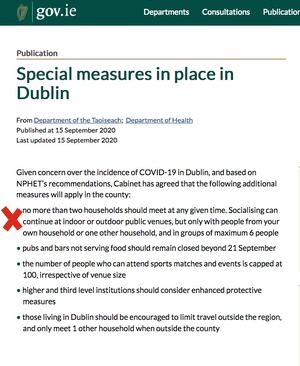
From top: Pre-Covid revelry; Special measures for Dublin

This afternoon.

Legal boffins Dr Oran Doyle and Dr David Kenny are members of the COVID-19 Law and Human Rights Observatory at Trinity College Dublin.

Since the rona outbreak, they have studied the ‘divergence between the announcement of restrictive measures and what is actually prohibited by law’.

You may recall Dr Kenny spoke at a recent Oireachtas Special Covid-19 Committee meeting about possible government overreach and lack of clarity.

Of the new restrictions, Doyle and Kenny write on their blog [at link below]:

It is in relation to the [red marked bullet-point, above] that significant divergence emerges between the Regulations and the Government announcement.

As presented by the Government, this measure prohibits more than two households meeting at any time, whether indoors or outdoors, and with a maximum of six people.

Part of this is included in the regulations and is a legal requirement; a large part is not.

Regulation 5A only applies to events in private dwellings. ‘Private dwelling’ is not defined in the Regulations, but the definition of ‘dwelling’ in the primary statute, which refers to a dwelling including a part of a house, strongly implies that the dwelling is the physical structure in which people live.

It seems to follow that there is no legal prohibition on events in, for example, the gardens of private dwellings.

Still less so is there any prohibition on more than one household gathering in public places outside.

The second way in which the Regulations diverge from the Government announcement is that no numerical limit is placed on the number of people from two households who may gather in a private dwelling.

Moreover, Regulation 5A is not deemed to be a penal provision, meaning that breach of the provision— although unlawful — cannot lead to criminal punishment, nor to enforcement powers for the Gardaí. This was notably termed a “civil offence”, though this is not a term with established legal meaning.

They add:

….it is difficult to read the [red marked bullet point] as an announcement of anything other than legal prohibitions. This impression is then enhanced by the fact that some of the measures contained in that bullet-point are now implemented through legal prohibition, while some are entirely absent from the regulations.

It is hard, without skill in compiling and reading secondary legislation, to know what the law truly requires, and so citizens will inevitably be confused as to what the law is and what they are legally required to do.

All back to mine.

FIGHT!

Special Measures for Dublin: Legal Restrictions and Government Announcements. COVID-19 Law and Human Rights Observatory (TCDLaw)

Top Pic: Eventstock


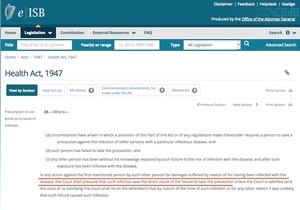
From top: Section 43 of the Health Act 1947; Barrister Tony McGillicuddy

Yesterday.

On RTÉ’s This Week.

Barrister Tony McGillicuddy spoke to Carol Coleman about gardai receiving powers to enter people’s homes.

It followed the Cabinet last Friday rejecting proposals for criminal penalties for people organising gatherings of more than six people but Tanaiste Leo Varadkar later saying a ‘civil offence’ may be introduced.

Carole Coleman: “Could you explain for us briefly what a civil offence is? And how it is investigated or prosecuted?”

Tony McGillicuddy: “Yeah, there is no such thing as a civil offence, Carole. It’s a contradiction in terms. I mean, under our Constitution and our laws, we have statute laws and then regulations which fill in the details of those and they can be enforced either through civil orders that are made in the courts or else by a criminal sanction if those provisions are made criminal law offences.

“So there’s two streams. And we have that at the moment with our regulations on, for instance, wearing a facemask in shops or shopping centres. So that is a provision. The power to make that order is in the Health Act 1947. The minister made the relevant regulations to make that a requirement of all persons. And if a person is in a shop today and they’re not wearing a facemask, a garda can approach that person and give them a direction that they must wear a facemask.

“If that person doesn’t wear a facemask after getting that direction from a garda, that is a criminal offence and the garda can arrest that person and can prosecute that person. So it’s the failure to comply with a direction of a garda to wear a facemask in a shop that would then be a criminal offence.”

Coleman: “They’re now planning to involve gardai in the house parties or the house gatherings. So what you’re saying is that it would become the law of the land but not a crime. What use would this be in say a flagrant breach of the house gathering rules?”

McGillicuddy: “Yeah, I mean, it is possible, that there could be a requirements set out in regulations or in a primary piece of statute law, whereby a person would be prohibited from having a gathering of six people in their household from three or more households. And they could then decide not to make it a criminal offence, they could just say it’s in statute, it’s in the law of the land and it doesn’t have any criminal sanction.

“I think the only thing that I can see that might have an importance at the present time is that there’s a very interesting provision in the Health Act 1947 which has not received public commentary up to now.

“It’s Section 43 of the act and that outlines that if a person, if there are requirements for a person to take certain precautions to avoid Covid or other infectious diseases, and if they don’t do so, and if a person then, in their household, becomes infected with Covid, that person who has attended, as an invitee at their house, could sue them for damages. And it would be presumed in law that they obtained the infection from attending at their house unless the householder can prove otherwise.

“So you could have a situation whereby the Government will say ‘well, we’re gonna make this the law of the land, we’re not going to impose a criminal sanction but if you invite more than six people into your house of a night and if one of them subsequently finds out that they have Covid, they could sue you for damages’. And it would be up to the householder to show that they hadn’t been infected at their house that night.

“And I think if members of the public knew that that presumption in law could act against them, in such a scenario, that might have its own coercive effect on people organising house gatherings.”

Coleman: “OK, well that’s very complicated and lots to be discussed there, barrister Tony McGillicuddy, thank you very much for joining us.”

Anyone?

Listen back in full here

RollingNews

This morning

RTÉ Radio One’s Today with Claire Byrne.

Liam Herrick, Executive Director of the Irish Council for Civil Liberties (ICCL), spoke about the implications of a possible “crackdown through legislation on gatherings in homes”.

Liam Herrick: “I think the idea that we’re leaping to more criminalisation of private behaviour implies, first of all, that the Government has done all that it can do to deal with proven evidence of problem areas such as direct provision and meat plants and nursing homes. And it also assumes that the Government has exhausted all of its resources in terms of clear public health communication and support of the community and, only as a last resort, has leaping to criminalisation.

“I think they are two assumptions that are very, very questionable, given what we’ve seen over the last number of weeks.”

Claire Byrne: “But given what we know, right, about what’s happening with the cases of Covid-19 and we heard last night there’s nearly 400 clusters. We also heard that 252 of those clusters relate to social gatherings in private households. So we have a problem.”

Herrick: “Well, let’s define, Claire, what do they mean by social gathering in private households. If we’re talking criminalising gatherings of more than six people in a private home. There are almost an infinite range of events or situations in which more that six people might gather in a home. My family has seven people in it so does this mean that if we have two more people into the home from two other households, we’re committing a criminal offence?

“Other people share houses, rented accommodation, where there may be more than six people renting the house. They may wish to have one or two friends to attend them. You can have family events, people can be caring for each other. The idea of this kind of social gathering being blurred with the purported problem of house parties of 100s of young people gathering at locations is I think very problematic and the idea that there are clusters and outbreaks – well, are these linked to large events? Or are they linked to the fact that young people are being encouraged to go back out into the economy and work and because, inevitably, they’re coming into contact with community transmission that there may be problems in homes.

I think this is a very unproven, vague and I would say something that really can’t be dealt with properly by the law and this is without, of course, looking at the huge, legal obstacles that we are dealing with here. We have the protection of the family home, the inviolability of the dwelling and the right to private and family life under the European Convention on Human Rights.

“And if we are talking about inserting the criminal law into the ordinary family and private life of members of the community, I think the Government has to go much, much further to make a case for such drastic action.”

Byrne: “I suppose though, if you’re looking at those numbers though, as they have been on the increase in the last number of weeks, the alternative to doing something like this is another lockdown?”

Herrick: “Well, this is, I think, the absurdity here. We don’t have, at present, restrictions on movement outside of one particular county. So we’re saying to people: you’re free to move about, you’re free to work, you’re free to go to a pub, you’re free to go to a restaurant, but we are considering criminalising you inviting a small number of people into your home. And we’re saying that we can’t trust you to behave responsibly in your own home.

I mean we have the absurd situation at present that you can’t attend a small sporting event, a GAA, soccer event with 100 or 200 people, you can go to a pub to watch the same event. But we’re now saying to people that they won’t be able to invite one or two friends over to watch the same event in their own home. And I think we really are in danger here of bringing the law into disrepute.

“And the idea that the guards would be drawn into policing private behaviour is, I think, going against the whole ethos of what the guards have tried to, and succeeded in doing, over the last couple of months, is strengthening the relationship with the community.”

Byrne: “I see what you’re saying and it makes logical sense but I suppose, on the other hand, we do have this problem and it’s really difficult to square the circle isn’t it? I mean for the authorities that are dealing with this, how do we control the infection rates without telling people, through legislation if they need to, to stop gathering indoors?”

Herrick: “I think what we’re losing here is the logic and the coherence of how we go from public health advice to the Government weighing that up and making policy decisions and only as a last resort introducing legislation that is necessary and proportionate. I think as we moved away from the phases that we had earlier, as NPHET has been given a role of actually recommending criminal sanctions it seems now and there is a confusion, at a very profound level now between what’s advice, what’s regulation, and what’s law.

“I think we are losing the coherence of our approach. The public had accepted incredible restrictions on their rights and at the Irish Council for Civil Liberties, we accept the need for many of the restrictions that have been introduced but they need to be done in a lawful way, they need to be done only where necessary and proportionate and I think we are now leaping to very invasive, criminal sanctions without the Government actually articulating the necessity.

Why, for example, are we going to have restrictions on private homes when we don’t have restrictions on movements between homes. And I think that the Government really needs to be doing more to explain this rather all of us only reading about this in The Irish Times this morning. I mean two weeks ago we were told the Government were considering primary legislation, now it seems this is going to be one of the health regulations.

“I mean, it really is not a proper to go about dealing with the public on such an important matter.”

Listen here

UPDATE:

RTÉ reporting:

“Cabinet is set to give gardaí three new enforcement powers to close pubs that do not serve food or maintain social distancing on the premises.”

….”Government continues to worry about the impact of social gatherings in houses on Covid-19, but it is not considering legislation today that could give gardaí powers to enter a home where more than six people are visiting.”

Par-tay!