



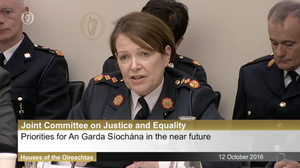
Garda Commissioner Nóirín O’Sullivan, and other senior gardaí, at the Joint Oireachtas Committee on Justice and Equality on March 30
You may recall how Garda Commissioner Nóirín O’Sullivan’s recent appearance before the joint Oireachtas committee on justice and equality, in the wake of the near 1million false breath tests and 14,700 wrongful convictions. See a timeline of the matters here.
After the meeting, the committee asked Ms O’Sullivan to respond to 27 questions by noon yesterday.
The following are some of the questions sent to Ms O’Sullivan, parts of her answers that are pertinent to the questions and some notes on the same.
It would appear Ms O’Sullivan and the Medical Bureau of Road Safety’s accounts of events still do not tally.
Q1. Can you confirm that the anonymous April 2014 letter from the Garda reservist in the Western Region was the only prompt for the initial audit of breath test figures in the Southern Region, and the subsequent national audit? Or is it the case that the information from the MBRS given to An Garda Siochana had a role to play in the audits being ordered?
A. The anonymous letter originating from a Garda Reserve in the Western Region was the catalyst for the examination in the Southern Region and the subsequent national examination. A number of other actions were also taken before the examinations commenced, which are set out below. An Garda Síochána had no information in July 2015 from the Medical Bureau of Road Safety to influence the decision to initiate the examination in the Southern Region.
The examination in the Southern Region had already commenced when concerns were first mentioned, informally, to a Superintendent from the Garda National Traffic Bureau by the Director of Medical Bureau of Road Safety. He stated, at the time, that these concerns were not raised as a ‘red-flag’ issue, however reassurance was given that any concerns he had in this regard would be addressed in the context of the examination underway.
…The letter, dated 22nd August, 2014, from the Medical Bureau of Road Safety pertained solely to procurement matters. It did not highlight discrepancies in the records held by An Garda Síochána and those of the Medical Bureau of Road Safety.
Broadsheet: During an interview with RTÉ’s Cathal Mac Coille, on Morning Ireland, on March 28, 2017, Denis Cusack of the MBRS said that the MRBS wrote to An Garda Siochana in July 2014 about discrepancies between the figures the MBRS had for the breath test mouthpieces that they had supplied to the gardaí and the number of breath tests that the gardai claimed to be carrying out. Of this letter in July 2014, Mr Cusack said: “It was an alert that something wasn’t adding up.”
Q2. Can you state unequivocally that all conversations with the MBRS between 2014 and November 2015 that touched on breath test data discrepancies happened solely within the procurement department of An Garda Síochána?; that no Garda of senior rank was made aware of the content of those conversations?; and that that information did not leave the procurement department before the audit of the Southern Region was completed in November 2015?
A. Assistant Commissioner, Roads Policing is not aware of any conversations on this matter being relayed to the Garda National Traffic Bureau in 2014 or in 2015, prior to the commencement of the examination in the Southern Region.
Assistant Commissioner Roads Policing has no record of correspondence from the Medical Bureau of Road Safety apart from the letter, dated 22nd August, 2014, in relation to procurement.
The Director of the Medical Bureau of Road Safety has stated to Assistant Commissioner, Roads Policing that conversations took place between his store staff and staff at the Garda Stores in Santry in August/September, 2015 when the procurement orders were being considered.
The examination in the Southern Region had already commenced when concerns were first mentioned, informally, to An Garda Síochána by the Director of Medical Bureau of Road Safety.
He stated, at the time, that these concerns were not raised as a ‘red-flag’ issue, however reassurance was given that any concerns he had in this regard would be addressed in the context of the examination underway.
Meetings take place between An Garda Síochána and the Medical Bureau of Road Safety on a regular basis. The frequency of these meetings is dependent on operational matters. For example meetings, concerning roadside drug-testing, have been taking place regularly over the last 18 months ahead of the roll-out of this procedure. A formal meeting between the agencies takes place at least once per year.
Discrepancies in roadside breath-tests or the ordering of mouthpieces were never discussed, as an agenda item, at any of the formal meetings.
Broadsheet: During the Morning Ireland interview, Denis Cusack, of the MBRS – after stating that it had regular meetings with the gardaí – had the following exchange with Cathal Mac Coille:
Cathal Mac Coille: “In either 2014 or 2015, did you ask them the question: you appear to be carrying out or, at least according to your records, carrying out more breath tests than you’re using these mouthpieces. Did you ask that question?”
Cusack: “That would have come up in the discussions at the meeting but it…”
Mac Coille: “In 2014?”
Cusack: “In 2014/2015…
Q2 (ii). When exactly anyone [sic] outside of the procurement department was told that the MBRS had identified discrepancies?
A. The first time that An Garda Síochána became aware that the Medical Bureau of Road Safety had any concerns in relation to breath-testing was 2015. As mentioned previously, the examination in the Southern Region had already commenced when concerns were first mentioned, informally, to An Garda Síochána by the Director of Medical Bureau of Road Safety. The Director stated, at the time, that these concerns were not raised as a ‘red-flag’ issue, however reassurance was given that any concerns he had in this regard would be addressed in the context of the examination underway.
As highlighted earlier Assistant Commissioner Roads Policing has no record of any correspondence from the Medical Bureau of Road Safety apart from the letter, dated 22nd August 2014, in relation to procurement.
Q2 (iii). On what date did that information reach Commissioner Level?
A. … In June 2016 the matter was reported to the office of the Garda Commissioner and the Department of Justice & Equality was informed in writing that a national examination of MAT checkpoints was being undertaken, in light of the issues raised in the examination of data in the Southern Region.
Broadsheet: On March 30, 2017, during the meeting of the justice committee, Garda Commissioner Noirin O’Sullivan said she was aware of the letter that the MBRS sent to the gardai in July 2014 – in which, according to Mr Cusack, the MBRS said the breath test figures didn’t add up.
Q3. Why did the Gardaí not seek data from the Medical Bureau for either its southern or national audit in 2015 and 2016 (as they eventually did in February 2017) even though the Medical Bureau had informed the Gardaí in July 2014 of discrepancies identified in its data?
A. …On 10th January 2017 An Garda Síochána communicated with the Medical Bureau of Road Safety regarding data held on their databases. The Medical Bureau of Road Safety cautioned that their data would not have sufficient information to assist with the national examination, as breath-testing devices are only submitted to the Bureau for calibration on a six-monthly basis.
On the 20th February 2017 further contact was made with the Medical Bureau of Road Safety, by telephone, and a sample of the data held by the Bureau was supplied to An Garda Síochána on the 24th February 2017.
On the 28th February 2017 a delegation, including Assistant Commissioner, Roads Policing, met with the Head Analyst at the Medical Bureau of Road Safety. At that meeting Gardaí outlined to the Medical Bureau of Road Safety the data they were looking for. While the Medical Bureau of Road Safety had certain data, Gardaí were seeking a broader range of data. The Medical Bureau of Road Safety undertook to provide as much data as they could extract from their database, but it would take a number of days to interrogate its systems.
On the 8th March 2017, the Medical Bureau of Road Safety requested that An Garda Síochána seek the data required, in writing, which was provided on 8th March, 2017. On the 10th March 2017, the Medical Bureau of Road Safety provided An Garda Síochána, by email, with an extensive copy of data held on its databases.
Broadsheet: There is no mention of An Garda Síochána communicating with the MBRS on January 10, 2017 in the timeline it published during the press briefing of March 27, 2017. An Garda Síochána did mention other incidences of contact between them and the MBRS in the timeline.
In addition, during the justice committee meeting on March 30, an Irish Times article, by David Labyani, was mentioned. This February 20th article reported that a national audit into breath tests was under way following the discrepancies discovered between the MBRS and PULSE figures.
After it had been confirmed during the justice meeting that the MBRS had sent the gardaí a sample of data it had in respect of breath tests, on February 24, 2017 – four days after the Irish Times article – Fianna Fail justice spokesman Jim O’Callaghan asked Assistant Commissioner Michael Finn when the gardaí first contacted the MBRS for information in 2017, and if it was after February 20. Mr Finn said it was days before February 24 but he couldn’t say if it was four or fewer days.
Q7. Did the publication or impending publication of an article in The Irish Times on 20 February 2017, entitled “Garda breath test figures fail to add up”, have any influence on the decision of the Gardaí to contact the Medical Bureau?
A. The publication of an article in The Irish Times did not influence the decision to contact the Medical Bureau of Road Safety. As indicated above, An Garda Síochána had already been in contact with the Medical Bureau of Road Safety, on 10th January, 2017, regarding data held by the Bureau relating to breath-testing.
The information contained in the article had been in the public domain since June 2016 when An Garda Síochána had placed a caveat on the Garda website advising that statistics published thereon relating to the number of breath-tests recorded at MAT Checkpoints were under review and subject to further examination.
Q8. Did the Gardaí intend to disclose publicly the results of its audits or inquiries into the discrepancies in the breath test data prior to the publication of The Irish Times article?
A. The discrepancies highlighted at the press conference, on 23rd March, 2017, were not known at the time the article in The Irish Times was published. Consequently no decision was considered as to when the information would be published or how it would be published.
As alluded to previously, with the exception of the Policing Authority, all of the key stakeholders were informed in June 2016 that the examination was taking place and that An Garda Síochána would keep them informed of the outcome of the examination. This oversight was subsequently addressed with the Policing Authority.
As a consequence of the action taken in June 2016 and making the information known that the examination was ongoing, it was always intended that An Garda Síochána would update the public in relation to its statistics.
While no decision had been made, in advance, that the outcome of the examination would be disclosed publicly, a caveat had been placed on the Garda website in relation to breath-test statistics it was intended that the information would be clarified, publicly, as quickly as possible.
Q9. What prompted the press conference held by senior grade [sic] on the 23rd of March? Was it prompted by the leak of various issues pertaining to the number of breathalyser tests conducted?
A. On the 10th March 2017 An Garda Síochána received advice from the Director of Public Prosecutions in relation to the processing of the appeals pertaining to Fixed Charge Notices. The DPP advised that An Garda Síochána could not rely on the provisions of the Criminal Justice (Spent Convictions and Certain Disclosure) Act, 2016 and would have to appeal the cases to the Circuit Court. In that context all of the parties involved would have to be contacted by An Garda Síochána and their consent obtained to process the appeals.
A decision was then made by Assistant Commissioner, Roads Policing and the Garda Press Office that a press conference, notifying and updating the general public, was necessary.
On the 10th March 2017 An Garda Síochána received an extensive copy of data held on its databases from the Medical Bureau of Road Safety. By the 16th March it became apparent, from the data provided by Medical Bureau of Road Safety that there was a significant discrepancy between data recorded from Drager Breath-Testing devices and the number of breath-tests recorded on PULSE.
…In addition, the issue of breath-tests had been discussed at the public meeting of the Policing Authority on the 23rd February 2017.
Broadsheet: A report was given to the Department of Justice in June 2016, in which it was stated that an issue had been identified in relation to breath test figures recorded by the gardaí, and that a national audit was to begin. It also stated an audit of MAT checkpoints had been conducted and completed in relation to the Southern Region, which had raised concerns as to the reliability, veracity and authenticity of the data. At a meeting of the justice committee on March 30, 2017, Garda Commissioner Noirin O’Sullivan said: “The review was unable to reconcile the PULSE data and our paper-based breath-test data, primarily due to significant gaps in our manually recorded breath-test data.”
Q10. Following the anonymous letter of April 2016 in relation to mandatory alcohol checkpoints, the Garda investigation, which took just four weeks, found that there were no problems. How comprehensive was this review?
A. An Garda Síochána is not aware of any anonymous letter dated April 2016. It is assumed that this question pertains to the letter of the 11th April 2014 received by An Garda Síochána from the Department of Transport.
The report submitted to the Department of Justice & Equality in May 2014 was an initial, factual, response to the issues and concerns raised in the correspondence received.
Given the anonymous nature of the letter it was not possible, at that point in time, to identify if there was substance to any of the issues raised. Notwithstanding, the enquiries in relation to those issues continued during 2014 and action taken, as outlined previously in this correspondence.
A formal concluding response from An Garda Síochána was subsequently submitted to the Department of Justice & Equality in January 2015.
Q15. Could the overstatement of breathalyser tests by a staggering 937,000 have been used as a justification for Garda overtime? If so, can you put a value on this?
A. The results of breath-testing were neither used as a performance indicator nor justification for incurring overtime.
Broadsheet: During the justice committee meeting, Fianna Fáil TD Jack Chambers asked Noirin O’Sullivan if a bonus system paid to senior gardaí between 2006 and 2010 could have played a part in the exaggerated figures. Ms O’Sullivan said she did not know the details of such a bonus system and agreed to come back to the committee on the matter.
Q16. Do you stand over the accuracy of the figure of 937,000 for breath tests falsely recorded on the Pulse system? Is there any evidence, or any reason to be believe, that this figure could in fact be higher?
A. The national examination of MAT checkpoints and breath-test data is on-going. Analysis of the data provided by the Medical Bureau of Road Safety and from individual breath-testing devices is continuing. Assistant [Commissioner] Michael O’Sullivan has been tasked with examining all of the facts and circumstances surrounding the figures published. The examination will include any further information that may be in the possession of the Medical Bureau of Road Safety or any other source.
Q17. Why was the Minister for Justice not aware of the issue with figures for breathalyser tests before the media? Why was the Minister not informed in advance about the press conference on the 23” of March?
A. On 8th June 2016 the Department of Justice & Equality was notified that an examination of MAT checkpoints in the Southern Region had raised concerns in relation to the veracity of data held by An Garda Síochána in relation to breath tests. On that basis the Commissioner had directed that a national examination should be undertaken.
On the 10th March 2017, the Medical Bureau of Road Safety provided An Garda Síochána, by email, with an extensive copy of data held on its databases. The data includes a significant volume of data for a period of years from over 1,200 devices which are issue to An Garda Síochána. That data continued to be subject of analysis and verification up to the date that it was publicised at the press conference on 23rd March, 2017. As a result, no report was prepared or submitted to the Commissioner’s Office or the Department of Justice & Equality prior to the press conference.
Two days prior to the press conference the Policing Authority received a short briefing on the information to be provided at the press conference.
Broadsheet: In a statement released on March 23, 2017, the Policing Authority said it started to seek answers and challenge An Garda Síochána in relation to discrepancies in relation to road side breath tests in January 2017 but it was not told that a national audit was under way. In relation to the Policing Authority not being notified at that time, Garda Commissioner Noirin O’Sullivan told the justice committee on March 30, 2017, that “it was a complete oversight”.
Q18. Why was information about the discrepancies in the figures not shared with the Policing Authority? Deputy Commissioner Twomey informed the committee, with regard to the failure to inform the Policing Authority regarding the breath test issues, that “Letters were written and the letter was not sent out. It is a simple. There was a letter to go to …” Given that the letter was drafted, could a copy be made available to Committee? Why was, at least, an email not sent to the Policing Authority regarding the breath test and fixed charge notice issues?
A. Reports were prepared and submitted to the Department of Justice & Equality in June, 2016, but it was an oversight that these reports were not copied to the Policing Authority. It was the intention at the time of writing to the Department of Justice & Equality that the reports would be copied to the Policing Authority.
The explanation for not conveying the material to the Policing Authority was explained to them at the first available opportunity and this oversight was apologized for.
Q19. Can you provide full disclosure of any current audits or investigations ongoing into other systemic problems within the Gardaí? This should include any and all audits, even if they are only on a localised or regional level, or considered of minor significance.
A. …In light of issues raised by the Garda Inspectorate and the Central Statistics Office, a Working Group has been established to oversee data quality management and, at the time of writing, An Garda Síochána is reviewing the classification of incidents including domestic violence. While this work is at an early stage, all developments will be reported. The Policing Authority has been informed of this examination and has been invited to partake in the working group.
A data quality examination in respect of a number of homicide incidents recorded on Pulse is also currently ongoing and is nearing completion.
Given the time frame allowed it is not possible to provide an exhaustive list of all audits and reviews currently within the programme of work being completed by the Garda Internal Audit Section and the Garda Professional Standards Unit. This information can be provided if required to the Committee in due course.
Q22. Can the Commissioner confirm that no specific data exists for the years 2006-2011 in relation to figures for mandatory alcohol testing?
A. …Data exists in relation to MAT checkpoints from 2009 to 2011. However this data was not included in the examination, as a cut-off point of October 2011 was selected. This date was chosen as breath-testing devices were submitted to the Medical Bureau of Road Safety at this time for recalibrated for dual-recording as new alcohol limits were coming into effect at this time. All breath-screening devices were returned to the Medical Bureau of Road Safety in that period and, as a consequence, it was possible to get a reliable record of data from those breath-screening devices at that time.
Prior to the 7th June 2009 there were no specific data fields on PULSE to record MAT checkpoints. Some MAT checkpoints were recorded on PULSE during the period 2006 as ‘part o the narrative’ but, as it was not mandatory, there is no complete record across Garda Divisions. As a consequence the data is considered unreliable for statistical purposes.
Q24. You have indicated that you were not aware of the Medical Bureau of Road Safety’s concerns in August 2015 as “Professor Cusack did not correspond with me or communicate with me. He and his staff communicated with people in the traffic policy bureau”. Are you satisfied with the current Garda chain of command structure in this regard? Was there a failure of communications that left you uninformed on issues of such importance?
Correspondence received in August 2014 from the Medical Bureau of Road Safety was received at the Garda National Traffic Bureau and solely related to the procurement of consumables. In that context the matter was dealt with by the National Traffic Bureau. The correspondence made no reference to discrepancies. The correspondence was received and a reply returned to the Medical Bureau of Road Safety from the National Traffic Bureau.
This information came in the context of a comment made by the Director of the Medical Bureau of Road Safety to a Superintendent from the Garda National Traffic Bureau. The Director was informed that the examination had already commenced in the Southern Region and that any concerns he had in this regard would be addressed in the context of the examination underway.
The Director of the Medical Bureau of Road Safety has not expressed any concern to An Garda Síochána in relation to any lack of communications or breakdown in communications between either agency.
Q25. Can you detail the number of and rank of officers who were aware of the Medical Bureau of Road Safety’s concerns?
The first time that An Garda Síochána became aware that the Medical Bureau of Road Safety had any concerns relating to breath-testing was in 2015.
This information came in the context of a comment made by the Director of the Medical Bureau to a Superintendent from the Garda National Traffic Bureau. The Director was informed that the examination had already commenced in the Southern Region and that any concerns he had in this regard would be addressed in the context of the examination underway.
Q27. Arising from your attendance at last Thursday’s public engagement with the members of the Committee, its live broadcast and considerable media coverage, the most often heard remark is that, given the universality of the “wrongdoing” involved, there had to have been some level of centralised direction, that it is not credible to suggest that these inflated statistics presented from across the structures of An Garda Síochána spontaneously. Do you agree? If not, please explain.
A. The results of roadside breath-testing were neither used as a performance indicator nor was there a coordinated effort or drive to inflate the level of activity from MAT checkpoints. As outlined at the recent Oireachtas Committee meeting, these checkpoints were primarily preventative in nature but always designed, and located, to improve road safety and to reduce road deaths.
Assistant Commissioner Michael O’Sullivan has been appointed to examine the processes and procedures in place, for the period 2010 to 2016, for the recording of breath testing at MAT checkpoints and which resulted in the inaccurate recording of those statistics. He will provide an update report in one month.
Read the questions and answers in full here
Previously: A Breathtaking Timeline
H/T: Gavan Reilly

Oh look it’s just some more vile corruption..
Shatter must feel even more hard done by. Shame he made such a mess of the whistleblowers.
The Guards are clearly a badly managed mess and have been for some time.
They clearly haven’t been modernised and professionalised over time as they should have been.
The model of all senior positions being filled from within the existing force and of lazy justice ministers (eg. Frances Fitz) is clearly not working.
+1 on all points
Two of my good friends are gardai and proud of the good work they do, but also say they have zero faith in the hierarchy and that you can believe pretty much anything you hear.
Yep agree.
Agreed Classter, as always
Looks like she’s lying? Or saying that Cusack is lying. If Cusack has documentation which shows his version, then is it good enough that we’d have a liar as a Commissioner?
No it is not good enough, and never will be. If we accept that a hard neck outweighs integrity and work then……….what is the point?
I can’t believe she is still in her job. I can’t believe it’s not butter.
I’m a politician.. let me fix that for you… hang on a mnute…
– is it fixed yet? ..well that would be the other crowd’s fault…
(2 weeks later…)
OMG..Is it fixed already? Sure amn’t I fecking brilliant?
PS.
Sorry for breaking everything.
We had no idea then, and we have no update scheduled.
Feck off please…we are the government.
It’s our turn.
Go away and allow us to dismiss you.
I speak for the people.
The money is good, but it’s the pension that matters.
Dont tell anyone I said that.
Please.
I have several tenants living in hovels, and building contracts that might end up in jeapordy so if you know what’s good for you, eh?
Guess what party I belong to..?
That’s it…
You cant*
*misspelling
PS.
Vote for me, or my friend. Thanks. See you at your funeral. G’wan ye mad thing. Sure me and you … eh…
PPS.
My Da used to bully your Da in primary school. We have heritage.
Vote for me or I will get the lads to dig a pothole outside your house.
Only messing.
Just vote for me.
Go memes.. You should try DMT :)
What’s DMT?
Does it taste as bad as brake fluid?
Is there not an easier option for people like me?
I’m not really a politician.
I fooled you.
But isn’t it great nowadays?
We can vent our anger publically on broader platforms than ever before.
We could be wrong.
We could be rght.
We could be wrong,
We could be right.
I say ‘WE.’
I meant ‘ME.’
Stop messing…just vote for me. I have no stance on anything but I live near you, sometimes…
Vote for me.
It’ll be fupping brilliant, I swear…
Hey, just a random thought, but…
If you were granted a wish of wiping TWO people off the planet forever, who would the second person be?
– Vladimir Putin or Hitler?
Dolores ORiordan
Wonder have they performed 100,000 incredibly stringent roadside drug tests already?