
Author Archives: Admin

Gaelscoil Phadraig

A demonstration by pupils and staff at Gaelscoil Phadraig, Ballybrack, Co Dublin

A candidate for the Independent Alliance argues that all schools, like their pupils, are not equal.

Carol Hunt writes:

Sick of hearing it yet? The phrase; “cherishing all the children of the nation equally” has been bandied around for decades now, usually when we try to persuade ourselves that we don’t actively target children for abuse or neglect, but that sometimes bad things happen and sure, we’ll say an act of contrition and try to be better in future.

It’s long been argued that the architects of the Irish Proclamation didn’t specifically mean ‘children’ as such, when they included this line – they meant people of all faiths and none should have equal rights before the law in our shiny, new Republic .

Which is probably just as well. Because when it comes to “cherishing all the children of the nation equally”, you’d have to admit that we have failed spectacularly. In fact, you’d be forced to concede that the very opposite would seem to be deliberate government policy for quite some time now.

We’ve long known that Enda and his entourage suffer from a rather pernicious strain of Alice in Wonderland Syndrome (AWS); an illness which makes one’s perceptual reality distorted, where one doesn’t know what’s real and what’s not.

Currently they’re sending members of the Defence Forces around every primary school in the country, armed with tricolours and copies of the proclamation, telling all the children how lucky they are to be living in a Republic which “guarantees… equal rights and equal responsibilities to all its citizens.”

Except of course that it does nothing of the sort. The number of young children suffering deprivation in Ireland doubled between 2007 and 2014. But it’s one thing to cite statistics, it’s another to see blatant discrimination right in front of your eyes.

A couple of weeks ago I met a young mother, Grace Byrne from Ballybrack [Co Dublin]. She asked would I come to a protest organised by the teachers, parents and young students of nearby primary school, Gaelscoil Phadraig.

“If we can call it a school”, she added. The teachers were brilliant, she said, the curriculum excellent, the pupils loved it it but…they had no building.

Twenty years the pupils of this school had spent in pre-fabs, despite innumerable promises from politicians of getting a new school.

One mother points to former Minister for Education, Mary Hanafin, and says; “she had the nerve to stand on my doorstep years ago and promised we’d have a new school. My husband wouldn’t come today [to the protest] because he was afraid of what he’d do if he saw her here again, looking for votes.”

I saw the pre-fabs. Some of them were damp, they had mould growing in them.They were a health hazard. Two floors were collapsing. Seriously. They were a danger area.

There was nowhere for the children to play safely. The children – enthusiastic, excited – stood around a tiny square with crayoned posters in their cold hands, singing “Twenty-years-a-waiting”.

The teachers are passionate and devoted to their students. They had, miraculously, won four green flags from An Taisce, despite having no school garden.

They wanted a library, a school hall, a place to safe and healthy place to learn. Is that too much to ask? Seemingly, it is. And despite the blatant disadvantages the school suffers for some reason it doesn’t qualify for DEIS (Delivering Equality of Opportunity in Schools) status [Dept of Education system for ‘identifying levels of disadvantage’].

They were assessed  for it during the Celtic Tiger and  just missed out. There’s been no assessment since although they’ve begged for it and a nearby school with same demographic gets it.

The next day I’m in another school just a few miles down the road. There is a new bright assembly hall, a big extension; gorgeous playing fields; a full library; warm, dry, well furnished rooms; lots of space and light and everything young students need and deserve to be educated in, to grow up in.

The children are the same though; enthusiastic, excited, hungry for knowledge. The teachers are just as passionate and dedicated to their young charges as those I met the day before.

Anyone who has the nerve to assert that we don’t practice blatant discrimination in the treatment of our children in this country obviously needs to get out more. Or at least that’s what I used to think.

But then I was told by the parents and teachers of Gaelscoil Phadraig that local politicians are very much aware of the dire conditions their young pupils have had to suffer over the past two decades. Many promises were made but none kept. There has been excuse after promise after excuse.

And still no school. Why is this? Is it because it’s not just children who are more equal than others, but also that there are voters who are more equal than others. Citizens who can be relied on to use their vote to retain the status quo are far more valuable to established parties than those who may choose to use it differently.

All voters are not equal you see. Consequently neither are their children. Or their schools.

Carol Hunt is standing as an Independent Alliance candidate in the Dun Laoghaire constituency in the forthcoming General Election.

90407868 90407869 90407876 9040788190407882

This afternoon.

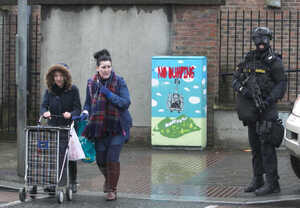
Masked members of the Emergency Response Unit (ERU) patrol a Garda checkpoint in Dublin city following the recent spate of gangland shootings.

Everyone stay cool.

Earlier: I Want My MP7

Sam Boal/Rollingnews

Labour calls for archbishop to mediate between ‘mafia-type gangsters’ (Irish Times)

thepoxmen

The Pox Men – Things To Do Tomorrow

Bill Hazzard writes:

Seein’ as it’s nearly the 1916 Centenary, and there’s an election comin’ up, but mainly ‘cos it’s Pancake Tuesday, here’s a new wee music video from [Donegal-based celtic punks] the Pox Men…

Name that movie anyone?

The Pox Men (Facebook)

CaxhvqaXEAAZOUECaxoRm2W4AQVnCw-1

Students and general election candidates at a mock election in Galway this morning; and students counting the votes

Second-year business students at Galway/Mayo Institute of Technology held an election debate and mock election involving the general election candidates from the Galway West/South Mayo constituency this morning.

The results…

First place went to Niall Ó Tuathail of the Social Democrats, followed by Fine Gael’s John O’Mahony and Independent Senator Fidelma Healy Eames, who finished third.

Independent Mike Hubbard finished fourth while Independent Noel Grealish finished fifth.

Public Debate (GMIT)

Pics via GMIT

Canm4d5W4AAcL3L

Further to Renua’s Dublin South West general election candidate Ronan McMahon using a picture of the late Nelson Mandela – and a quote – on his election flyer…

Edward Collins tweetz:

Hot on the heels of Renua’s Ronan McMahon Mandela flyer… his new samples…

CaxmsSQW4AQedXI

CaxmsTbWAAAk130

Ah here.

Top pic: Dale McDermott

Screen Shot 2016-02-09 at 13.31.00

Same Old Song And Dance.

By Emmet O’Brien, who writes:

A couple argue about their old-fashioned lifestyle but how long can they dance around the real issue?

Art and animation/music by Cethan Leahy and David Nelligan.

12695044_10207373029555342_602218353634201092_o

Friday February 12: Cian Nugent and the Cosmos @ The Grand Social, Lower Liffey Street, Dublin 1 (€10)

Nialler9 writes

Already an established guitarist with a discography on respected US independent labels, Dubliner Cian Nugent‘s third album Night Fiction features a new instrument, his voice; and songs now share the alternative blues and rock vibes of artists like Kurt Vile and a country-leaning David Kitt featuring the expressive guitar playing he’s made his name with. Friday is the launch of the album. Support from Al McKay (Dick Diver), Bad Sea & DJ Daniel Fox (Girl Band).

Nialler9’s Gig Guide February 9-15 (Nialler9)

90395150Michael-Taft

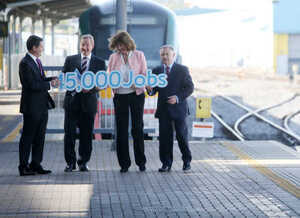
From top: The coalition launch its capital investment plans, September 2015.. From left: Paschal Donohoe, Enda Kenny, Joan Burton and Brendan Howlin; Michael Taft

Ireland has the lowest level of public investment in the EU bar Malta and Bulgaria while just three companies account for 70 per cent of R & D investment.

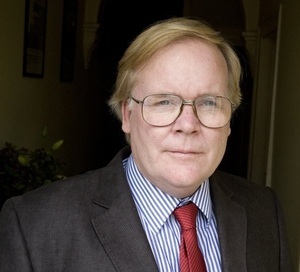
Michael Taft writes:

Continuing the recovery? Starting the recovery (for those who haven’t started feeling it yet)? Protecting the recovery from outside events? What should we be doing?

Voices from the fiscal orthodoxy insist we should use the additional resources to pay down debt – as if a few percentage points are going to protect us from external events.

There are others that call for tax cuts but that’s a poor economic response whatever about its political appeal (which, if the Millward Brown poll is anything to go by, looks to have little popular appeal).

So how do we start, continue and protect recovery?

One word: investment. Investment is the driving force behind enterprise success, economic growth and social prosperity. Investment drives growth, increases productivity, enhances skills, reduces costs and puts business and the economy in a stronger competitive position. You want to be competitive? Invest.

The problem is that Ireland has a poor investment record. And no one is talking about this in the election campaign; therefore, no one is talking about how to address it (if you’re not aware there is a problem, it is more difficult to solve it). The fundamental driving force behind economic growth and i’ts nowhere on the agenda.

Historically, Irish investment has been below the EU average – even during the boom times.

The following looks at Irish investment excluding dwellings and intellectual property/R&D. The latter – a new category under Eurostat’s recently introduced ESA 2010 – is excluded simply because it inflates investment numbers without necessarily contributing to growth.

For instance, multi-nationals are re-locating IP activity into Ireland from tax haven locations. But to what extent this is making any real contribution to growth-generating activity is open to question.

In 2013, 70 percent of industrial R&D investment came from just three companies.

invest1

As seen, Ireland has been a consistent under-performer. Regarding investment prior to the boom, Davy Stockbrokers didn’t pull any punches.

‘Perhaps the greatest legacy of the bubble period of 2000-2008 is our road infrastructure. The value of our roads leaped from €13bn to €27.5bn. That accounted for almost 30% of the increase in our ‘core’ productive capital stock (i.e. capital stock excluding dwellings, retail and transportation / storage).

The reduction in journey times and greater certainty of planning have helped to significantly boost output per capita across the economy. But it is interesting to note that most of the rest of the increase in our core’ productive capital stock was related to the state or semi-state sectors. It was not driven by private enterprise.’

So what was private enterprise up to? As Davy points out, it mostly went into the unproductive housing and property sector.

But public investment, the driver in the past, is currently being suppressed. Ireland has the lowest level of public investment in the EU bar Malta and Bulgaria. And public investment levels are nearly 50 percent below historical trends.

The Government’s Capital Programme did nothing to correct this. Currently, public investment is 2 percent of GDP; by 2012 under the Government’s programme investment will be only 2.1 percent.

The above Eurostat data only takes us up to 2013. There is evidence of a rebound in 2014 as pent-up demand breaks through. But this is only a temporary phenomenon if the Central Bank’s projections hold up. The Central Bank is estimating a growth of nearly 20 percent in machinery and equipment this year but they expect this to fall back to 5 percent by next year.

It is fortunate that we have what Dr. Aidan O’Regan calls: ‘ a path dependent state-led developmental strategy to attract inward Foreign Direct Investment from large global firms in high-wage, high-tech service sectors.’

It has been this public agency driven strategy – and not austerity and structural adjustment – that moved us out of recession and into fast-track growth.

Were it not for this we would have to rely on the indigenous sector and this would not be good news at all.

invest2

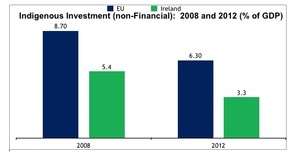
The Irish indigenous sector – excluding the construction sector – ranks near the bottom of the EU tables when it comes to investment.

It was low starting out at the beginning of the recession. It is even lower now. Where there is some growth it comes from the spill-over impact of multi-nationals in the ICT sector.

This is not the stuff of campaign fireworks but it is the stuff of economic growth – poor overall investment, poor public investment and poor indigenous investment. It will not be easy to transform this.

Irish private capital has, for decades, been content to sink money into finance and property. Finding new routes into the productive sector will not be easy. But there are some headline proposals to consider:

First, substantially increase public investment to our historical level by 2021. This could mean an additional €8 billion to €12 billion in capital expenditure. Yes, I know – this is more than the fiscal space allows and doesn’t factor in the need to increase spending on public services and social protection. Short response: stop this tax cutting nonsense and start debating which taxes we will have to increase in order to raise public investment levels.

Second, drawing on the lesson from Davy Stockbrokers analysis, drive investment through public enterprise. This has the benefit of not impacting on government debt or the fiscal space. This will require strategies to create new public enterprise companies, expanding current ones and promoting partnerships with private sector companies (e.g. the ESB/Vodaphone partnership to roll out advanced broadband).

Third, redesign enterprise support programmes to privilege those companies committed to expanding investment –through in-kind supports and/or equity investment.

Investment is the key to starting, continuing and protecting recovery. This is the issue we should be debating – how much, where it should go and how it can be done. This would turn a desultory debate over tax cuts into an informed one based on growing the economy. That would be a debate worth tuning into.

Michael Taft is Research Officer with Unite the Union. His column will appear here every Tuesday. He is author of the political economy blog, Unite’s Notes on the Front. Follow Michael on Twitter: @notesonthefront