



Author Archives: Admin

Katie Hannon
On The Ray D’Arcy Show…
…apart from Amanda Knox…
Sinead Harrington writes:
Ray will be joined on the couch by Sarah McInerney, Katie Hannon and Fionnuala Sweeney, the new presenters of RTÉ Radio 1’s The Late Debate….
…Sarah will chat about her shock departure from Newstalk and Katie will discuss some of the biggest issues facing Ireland today.
…Also on the show is 12 year old Allie Sherlock from Cork who will chat to Ray about how she has gone from busking to breaking America! She became the toast of LA this week when she received a standing ovation on The Ellen Show.
Viewers are in for a treat as singer Sean Keane will perform the classic ‘He Ain’t Heavy’ with the RTÉ Concert Orchestra.
The Ray D’Arcy Show at 10pm on RTÉ One.
Pic; RTÉ

What a night.
A big thank you to, clockwise from top left: ‘Preposterous‘; Neil Curran, Lucky Khumbula, Vanessa Foran and Olga Cronin, our panel on last night’s broadsheet on the Telly.
The show can be viewed in its entirety above.
Two and a bit hours of quality natter.
Our ‘at a glance’ guide:
2:00 – Joanne Cantwell takes over from Michael Lyster
10:40 – The “Grid Girls” out of a job
12:13 – Irish Rugby captain Rory Best attending the rape trial in Belfast
25:22 – “Preposterous’ and his steroid-free rugby career
30:53 – The return of Lucky with a Direct Provision update
55:30 – De Entertainment Slot
1:19:41 – De Papers
1.21.49 – tin foil chat
1:34:21 – Disclosures Tribunal with the ‘sheet‘s Olga.
Contains some unavoidable ‘effing and blinding’.
Sorry.
Previously: Broadsheet on the Telly

Tom Parlon (top) of the Construction Industry federation (CFI) believes bogus self employment in the construction industry is ‘grossly exaggerated’
In a recent interview with TheJournal.ie, Director General of the CIF Tom Parlon dismissed claims from a new construction union called ‘Connect’ that it would eliminate the Scourge” of bogus self employment in the construction industry.
Assiduously avoiding the term ‘Bogus Self Employment’, Tom told TheJournal.ie that there has been a move away from direct employment, not just in Ireland but internationally. However, he said the scale of this has been “grossly exaggerated”
There has indeed been a move away from direct employment in the construction sector.
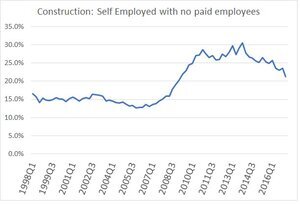
In 1998, the share of workers in the construction industry classified as self-employed was 16%. The Office of the Comptroller & Auditor General was, at that time, concerned that a significant portion of those classified as self employed were in fact bogus self-employed.
Partly because of the C&AG’s concerns, the Revenue Commissioners undertook a special program of 6,200 visits to Principle Contractors in the construction industry. During the visits, the status of 63,000 sub-contract situations was examined.
12,000 (19%) of those sub-contract situations were not genuine self-employment, they were bogus self employment.
In 2001, concerns were expressed at the Public Accounts Committee that misclassification was still rife in construction.
The then Chairperson of the Public Accounts Committee, Jim Mitchell, ordered a similar special program of visits to Principle Contractors in the construction industry. The results of this PAC investigation exposed the same high level of bogus self employment in the construction industry – circa 20%.
Over the following 6 years, the rate of self-employment in the construction sector fell almost 3% to 13% with a commensurate reduction in the percentage of Bogus Self Employed. The investigations instigated by the C&AG and the PAC were pivotal to that decrease.
In July 2007, Tom Parlon took up a position as Director General of the Construction Industry Federation. Within five years, in an unprecedented explosion unseen anywhere else in Europe, the percentage of workers in sub-contract situations in the construction sector more than doubled before peaking at almost 31% (Refer to QNHS data below).
Extrapolating from the only the widespread investigations available, instigated by the C&AG and the Public Accounts Committee, Bogus Self Employment in the construction sector was over 40% in 2013 and is currently running at almost a third (30% – 33%) of those classified as self employed in the construction sector.
In 2015, the Irish Congress of Trade Unions released a report which states that Bogus Self Employment in the construction sector was costing the tax payer 80,000,000 euro in PRSI per year.
This figure was based upon 30,000 – 40,000 sub-contract situations but later Dáil replies state that the actual number of sub-contract situations is in excess of 100,000, resulting in a loss to the taxpayer of circa 250,000,000 euro in PRSI per annum.
As was confirmed by the Minister for Social Welfare in recent weeks on Drivetime RTE, there are no official figures available from either Social Welfare or Revenue on Bogus Self Employment, however, the QNHS data is generally accepted as credible, unlike the Pernicious Mr. Parlon.
Martin McMahon podcasts with Tony Groves at The Echo Chamber and blogs at RamshornRepublic
Previously: Bogus Self Employment Cheats Us All
Rollingnews

Staying in tonight?
Broadsheet on the Telly returns tonight at 10pm streaming LIVE (above) and on our YouTube Channel.
Join old friends, surprise guests and the odd domestic pet as they chew over the news of the week from Ireland and ‘abroad’.
All the news that fits in 120 minutes including Gaming the System, Joanne Cantwell & the Sunday Game. and Ulster Rugby solidarity plus Lucky Khambula on recent Direct Provision developments and the ‘sheet’s Olga Cronin on the Disclosures Tribunal.
All welcome.
Drinks served.
Some ‘sailor’ language.
Sorry.
Previously: Broadsheet on the Telly




MORE to folly


Every week, we give away a voucher worth twenty five euros to spend freely wherever you see the Golden Discs sign.
All we ask from you is a tune we can share.
This week’s theme: A-Ha
Norway?
Yes, way.
To celebrate A-Ha’s reunion tour what song – apart from Take on Me – from the underrated chiselled Norwegian trio still gives you the pop chills?
To enter, please complete this sentence.
‘Apart from ‘Take on Me’, I am rather fond of A-Ha’s_____________________owing to its________________’
Lines MUST close at 10.45pm
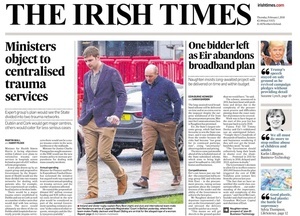
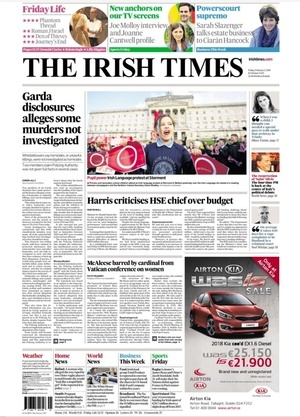
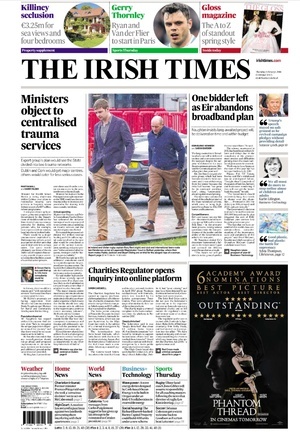
Today’s Irish Times
I am glad we put this picture on the @Irishtimes front page: Captain of the @IrishRugby team Rory Best and Ian Henderson attending that rape trial 👇🏻 pic.twitter.com/Lr0pXT0jrt
— Roisin Ingle (@roisiningle) February 1, 2018
Nat writes:
So the alleged victim in the Ulster rugby rape case goes on the stand yesterday, having already said she was terrified she’d have to face Ulster rugby if the case went to trial.
Who decides to turn up in court on the day she gives evidence? Their captain Rory Best and a teammate.
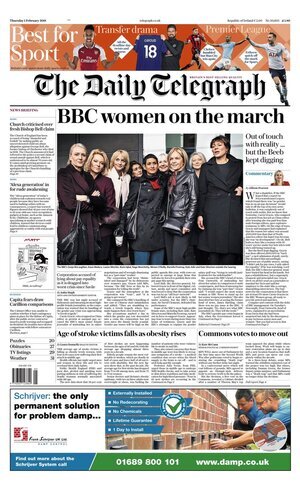
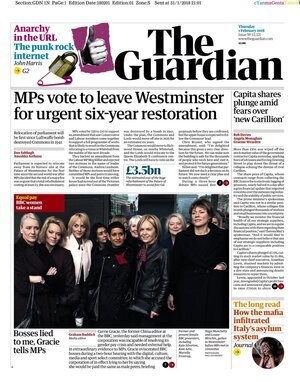
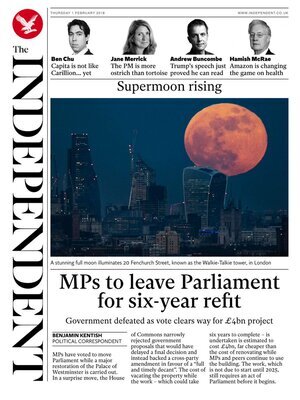
Team-mates show support for accused at Belfast court (Independent)
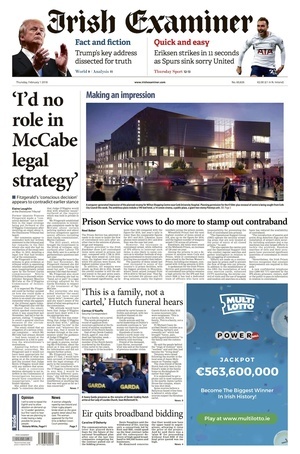
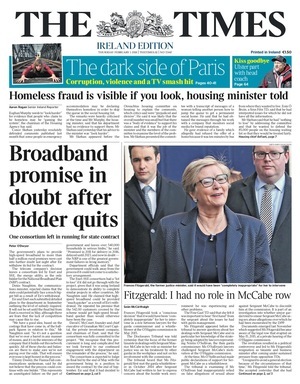
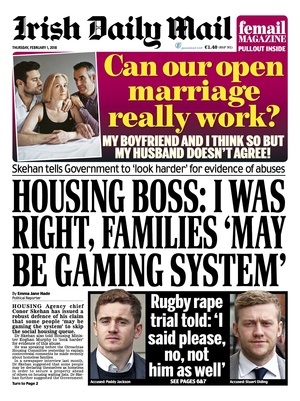




MORE to folly
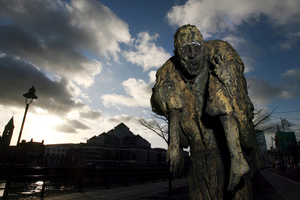
The Famine statues on the quays, Dublin
Legislation is set to pass through the Dáil soon to commemorate the Famine on the second Sunday in May each year.
Ciaran Tierney writes:
Yet news that Ireland is to get a Famine Commemoration Day has been greeted with a huge online debate over whether or not Ireland really experienced a ‘Famine’ in the 1840s.
The Irish term for the worst time in Irish history, An Gorta Mor, actually means The Great Hunger. More and more people are now of the opinion that there never was a famine, but that the five years of starvation were the result of a deliberate policy of genocide by the British authorities who ruled Ireland at the time.
Historian Christine Kinealy, in a book called ‘A Death-Dealing Famine’, acknowledges that there has long been an argument that the deaths of a million Irish people were a triumph of doctrine over humanitarian considerations.
What is beyond doubt is that food was exported from Ireland to Britain during the worst years of the catastrophe.
Kinealy points out that official export figures are unreliable because Ireland was considered part of the British Empire in the 1840s, it was part of a ‘free-trade’ zone and there was little need to keep official data of food imports from one island to the other.
But, considering that a million died, shipping reports from the main British ports at the time are startling.
In 1847, the worst year of the Famine, almost 4,000 ships carried food from Ireland to the major ports of Liverpool, London, Bristol and Glasgow. Over half of them went to Liverpool, where many Irish people also ran out of money as they strove to make their way across the Atlantic.
Records show that ports in some of the worst-affected parts of Ireland, including Ballina, Bantry, Ballyshannon, Kilrush, Sligo, Limerick, and Westport on the Atlantic seaboard, where thousands upon thousands were dying of starvation, were also sending food to the so-called mainland.
Oats, corn, and potatoes left Ireland for the ‘mainland’ while there was an on-going debate over whether or not the ports should be closed raging in British politics.
Merchants had pressed the British Government to keep the ports open and allow free trade to continue without intervention, even though the city councils in Belfast, Cork, Derry, Dublin and Limerick pressed for the ports to be closed so that food could be kept on the island of Ireland.
Mindful of the death and despair all around them, the cries from the Irish cities were ignored.
Under Sir Robert Peel, Indian corn was imported to Ireland following the first appearance of the potato blight in 1845. The main purpose of importing £100,000 worth of corn from America was to stabilise food prices, rather than to feed the destitute Irish.
Peel’s Government fell in 1846 with the Whigs, under Lord John Russell, coming to power in London.
This new Government decided to discontinue the policy of corn importation from America, leaving food importation to “market forces” even though there was far less food than in the previous year.
Merchants and grain producers, a powerful interest group at the time, campaigned to make sure that only a limited number of food depots would open in the West of Ireland, even as thousands were dying.
The Lord Lieutenant of Ireland, John William Ponsonby, criticised the merchants for striving to keep prices up even in the midst of an appalling catastrophe.
“It is difficult to persuade a starving population that one class should be permitted to make 50 per cent profit by the sale of provisions whilst they are dying in want of these,” he reflected at the beginning of 1847.
Soup kitchens eventually replaced the public works programme which was introduced by the Whig Government, and grain imports to Ireland rose, but by then it was too late for the hundreds of thousands who died.
Some historians now agree that British Government policies deliberately led to the deaths of hundreds of thousands of Irish people, leading many people to proclaim that there never was a Great Famine.
It could be argued that it was a deliberate act of neglect, if not quite an act of genocide.
During the tense Brexit border negotiations before Christmas, many Irish people were shocked by how little ordinary British people knew about their own country’s history in Ireland.
They don’t teach much, or anything, about the Great Hunger in British schools… (More at link below)
Why do the Irish not talk about ‘The Famine’? (Ciaran Tierney)
Rollingnews