From top: Leo Varadkar’s welfare cheats campaign; Minister for Social ProtectionRegina Doherty
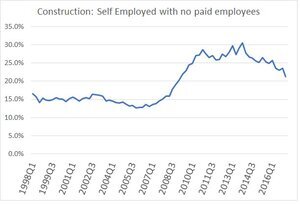
Writer and activist Martin McMahon has waged a lengthy campaign to end the situation where one in five self-employed workers in Ireland is not really self-employed.
Recently he got creative.
Martin writes:
I saw it happen. I was there. I contacted the Garda National Bureau of Fraud Investigation and attempted to report the crime.
I have no doubt that it is a crime I witnessed, it’s certainly an indictable offence under the relevant Social Welfare legislation. The Garda on the other end of the line in Harcourt Street didn’t want to know, saying:
“There’s noting to see unless the Minister for Social Welfare tells us there’s something to see”
I’ve contacted every Welfare Minister and at least two Justice Ministers since. Dermot Ahern didn’t want to know even though former Taoiseach John Bruton wrote to the Department and asked why nothing was being done.
Mary Coughlan, Seamus Brennan, Martin Cullen, Mary Hanifin and Éamon Ó Cuív all ignored it, Fianna Fail were a brick wall. I sat down with Dominic Hannigan and explained it to him.
Dominic got it straight away, in fairness anybody who has taken the time ‘gets it’. Dominic took it to Joan Burton as Social Welfare Minister, Joan replied that it was “Not currently an issue”.Since leaving office, Joan has a new found interest and pontificates regularly on why it is now an issue.
Last year I wrote to Justice Minister Fitzgerald and explained the crime I had witnessed and the implications. Minister Fitzgerald, against my wishes, forwarded it on to the then Social Welfare Minister Leo Varadkar.
Like all of his predecessors, Leo did nothing, didn’t even acknowledge that he had received it from Minister Fitzgerald.
Four weeks ago, I tweeted to the recently appointed Social Welfare Minister, Regina Doherty-
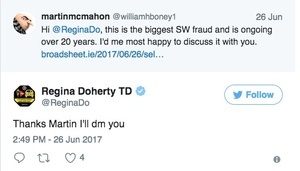
I wasn’t surprised that the Minister replied. I’d met the Minister and her team at the last general election. They were all decent people, friendly and accommodating.
The Minister contacted me by private message and we arranged to meet in the Pillo Hotel in Ashbourne on the 29th of June. The meeting lasted about an hour.
It was clear from the outset that the Minister had taken the time to read the piece I’d tweeted to her and more importantly had watched the videos attached to the piece.
I explained to the Minister how in January I’d set a trap for the Department of Social Welfare and that they’d walked straight into it, I used those exact words.
That in springing the trap, the Department revealed that it was still knowingly making incorrect insurability of employment decisions based on the crime I had witnessed 16 years earlier.
The Crime
On the 22nd August 2000, a Social Welfare Inspector wrote and signed a ‘Report’. The report was an account of a meeting he had with 2 representatives of a well known company which took place on 17th August 2000.
The report was submitted by the Social Welfare Inspector as evidence in a then ongoing ‘Insurability of Employment’ determination by the SCOPE office of the Department of Social Welfare, for the purpose of making a legally binding decision.
On March 1, 2001, the Social Welfare Inspector read aloud and submitted as evidence his report in an Appeal Hearing which took place in the quasi-judicial Social Welfare Appeals Office.
The Social Welfare Inspector’s report was (and is) accepted as the primary evidence in it’s overturning of the SCOPE Office decision. This event was witnessed by a Barrister, a Solicitor, A legal representative and the General Manager for the appellant company, a Senior Counsel and State Solicitor for the Social Welfare Mininster, a Barrister and Solicitor and 2 representatives for the Communications Workers Union, 2 representatives from the Scope Office, the Appeals Officer and me.
This event and the evidence contained in the Social Welfare Inspector’s report are reported and quoted in the Appeals Officers written account. The Manager named in the Inspector’s Report was not present in the Social Welfare Appeals Office when evidence attributed to him was accepted as evidence.
On December 6, 2001, in the Employment Appeals Tribunal, the Barrister representing the company (same Barrister as represented the company in the SWAO) objected to the use of the Social Welfare Inspector’s report.
The Barrister informed the Appeals Tribunal that the Company’s Manager named specifically several times in the Inspector’s report had never met the Inspector and that he emphatically did not give that evidence. The Manager named in the report was present in the Appeals Tribunal.
The Chairperson of the Appeals Tribunal commented at the time that the Dept. had questions to answer but was not present.
On the 14th of October 2002 in the Circuit Court, I called the Social Welfare Inspector as a witness. I had sent a summons to the Inspector some weeks previously.
Prior to the hearing, the Social Welfare Inspector pleaded with me not to call him. I refused his request. In the court, I asked the Inspector to read his report (as he had done in the Appeals Office).
The Barrister (same Barrister as previously) objected because the Manager named in the report, who was present in the court, denied that he had ever met or spoken to the Inspector. The Inspector conceded to the Judge that he had never met or spoken to the Manager.
This was a civil case, the Inspector was not on trial, the Judge ruled that the report was inadmissible as evidence. The Judge then addressed the Appeals Officer who was watching the proceedings from the body of the court.
The Judge informed the Appeals Officer that “This matter will need another day in court”. At the conclusion of the hearing, the Appeals Officer shook my hand and congratulated me with a “Well Done”.
The Department of Social Welfare has never sought another day in court about the Inspector’s Report and indeed continues to actively cover up the crime to this day. The Inspector’s false report remains the key evidence in a test case which continues to misclassify thousands of workers as self-employed.
The Inspector’s Report cannot be and is not accepted as credible evidence in any judicial or quasi-judicial proceedings except for the Social Welfare Appeals Office.
The Conspirators
In July 2000, I wrote to the SCOPE Office of the Department of Social Welfare. SCOPE is the office charged with deciding whether a person is employed or self-employed. I requested an insurability of employment decision.
I had been working for a number of years in an industry where all workers are labeled as self-employed under an agreement between Employer Representatives and the Revenue Commissioners.
My application for a decision prompted a secret meeting between high level representatives from IBEC, ICTU, Enterprise Trade & Employment, Finance, Revenue and Social Welfare.
This meeting was labeled “The Employment Status Group” and met within days of my application whilst the decision was sub judice. The application I had made was specifically discussed. Revenue, IBEC and Finance instructed that the worker (me) was to be forced to the High Court to overturn the self-employed label.
The Revenue representative at this secret meeting was also the person who had agreed this deal with employers in secret, in the Burlington Hotel on the 3rd of April 1997. The Social Welfare Representative at this secret meeting held a senior position in the Social Welfare Appeals Office until 2009.
The SCOPE Deciding Officer refused to bow to such political pressure in his legal deliberations and ruled that I was not self-employed and was, in fact and in law, an employee.
The Social Welfare Inspector was instructed to issue a ‘Demand Notice’ to the employer Company for arrears of unpaid employer PRSI.
The deal agreed between Revenue and Employers was exposed as creating and facilitating widespread bogus self-employment. The Scope Decision was immediately appealed to the Social Welfare Appeals Office by the Company.
Although not directly involved in the Appeal, the Department’s Representative at the Employment Status Group (also Senior Official in the SWAO) secretly submitted altered evidence and was present in the SWAO as the Appeal was being heard.
He met privately with several parties including a meeting he asked me to step into in a room in the SWAO during a break in proceedings. He told me everybody was ‘happy’ with the secret deal, I asked him how could he know when he hadn’t spoken to those being forced into bogus self-employment. I witnessed him, with my own eyes talking to his subordinate, the Appeals Officer who was hearing the Appeal, whilst it was under appeal!
This was the Appeal where the Social Welfare Inspector read aloud from his report and where it was submitted and accepted as evidence. The SWAO Appeals Officer overturned the Scope Office Decision based upon the Inspectors false report and the Revenue’s secret deal with Employers was safe.
The Trap
Late last year I got a call from a bricklayer on his way into a hearing in the Social Welfare Appeals Office. He was one of ten workers automatically labeled as self-employed by the Electronic Relevant Contracts Tax system agreed and operated between Revenue and employers in the construction industry.
These men had been in a high profile dispute with one of Ireland’s largest construction companies. As a part of that dispute, the men had individually applied to the Scope Office for insurability of employment decisions. The Scope Office decided that the 10 men were not self-employed and were, if fact and in law, employees.
eRCT is a massive system, many thousands of workers are automatically classified as self-employed under this system. Once again Revenue was facing the prospect of being exposed for operating and facilitating systems which create widespread bogus self employment.
These lads were looking for help when they rang me. I’d been following their dispute closely and wrote about it They had no legal or union representation. The Appeals Officer was pressuring them to have all the cases heard at once in some sort of ‘test case’ for the construction sector.
I hadn’t seen any of the evidence. I advised the lads that once they got in there, they’d be faced with an extensive legal team from the Appellant Company. I advised that they inform the Appeals Officer that they were unaware that they would be facing legal representatives and that they needed an adjournment to consider seeking legal advice. The adjournment was granted.
I instructed each of the men to request from Scope & SWAO all available data under the data protection acts which they did. I read through all the evidence and met with the men a number of times.
These 10 cases expose bogus self employment perfectly. I agreed to help the men. I warned them from the outset that the Scope Office decisions would be overturned. I explained that the SWAO was making decisions based on a political edict and not on legal precedent. I wrote about the cases which caused some consternation at high levels in the department –
The ten men had commenced work on site between April 2014 and August 2014. Two were ‘Labourers’, unskilled manual workers, and 8 were bricklayers paid per block laid. All were labeled as self-employed by the principle contractor using the eRCT system.
There is no directory of labourers or bricklayers and positions are generally filled by word of mouth as “Getting a start” on a particular site.
Some of these men had been telephoned by a person who the Company claims was the subcontractor but social welfare records show that the man was not a subcontractor and was indeed in receipt of a social welfare payment at that time.
It is the Department’s evidence that he played little or no part in this issue. The men worked for several weeks without getting paid. Two of the bricklayers were approached by management of the Company. They were informed that the only way they could get paid for the work they were doing, was to set up a company which the principle contractor would pay their wages into.
The managers had the paperwork ready and all it required was the two men’s signatures. Due to the lack of wages, these men were under severe financial pressure. They signed the paperwork and took it to an accountant as they were told to do by the principle contractor.
There was no profit margin in this arrangement, it was a straight forward funneling of the men’s wages through a third party company. The men were not required to provide their own liability insurance and the company agreed that the 10 men would operate under the principal contractor’s insurance.
The arrangement quickly fell apart on advice from the accountant that the company the men had been told to set up to get their wages was operating illegally. Scope had made the only legal decisions they could if the face of such overwhelming evidence, these men were employees of the principal contractor in every fact and practice of their labour.
In January, the appeal of these ten Scope Office decisions by the appellant Company was heard in the Social Welfare Appeals Office. Representatives for the Company stated that it considered these 10 men to be self-employed because they consider every worker below the level of site foreman to be self-employed.
No new evidence was presented at this Appeal and the Scope Office Deciding Officer stated at the end of the hearing that he had heard nothing which would change his original decisions.
Springing The Trap
I had two things to prove by setting the trap, the first, that the Social Welfare Appeals Office was making insurability of employment decisions based on a political edict of the Employment Status Group and not based on legal precedent, and the second, that the Appeals Office was deliberately and demonstrably misinterpreting the evidence to accommodate the political edict from the Employment Status Group.
On the 25th of May this year, the Appeals Officer issued his decisions in all ten cases. He upheld the Appellant Company’s Appeals in all cases.
The proof that the Social Welfare Appeals Office is making decisions based on the political edict of the Employment Status Group and not legal precedent comes in the first point of the Appeals Officers comments/conclusions section of the decisions in which he states –
“Comments/Conclusions: The Oireachtas appointed expert group to determine self-employment status provided a definition of a likely self-employed person”
The Oireachtas appointed expert group the Appeals Officer refers to in his decisions is the Employment Status Group which has no legal standing whatsoever.
Determinations of the Employment Status Group are political decisions and cannot be and are not accepted as legal ruling or precedent by the Scope Office, the office charged with making insurability of employment decisions.
The Employment Status Group was not established to determine self-employment status, it was established to prevent punitive employees from exposing that the Revenue Commissioners are knowingly misclassifying employees as self-employed.
Although there are many points in the Appeals Officer’s decisions which expose that the Appeals Office is deliberately and demonstrably misinterpreting the evidence to accommodate the political edict from the Employment Status Group, I draw your attention to a specifically significant point on liability insurance.
As was said previously in this piece, the men all of whom were labeled independent contractors, carried no liability insurance. I raised this point with the Appeals Officer who raised it with the appellant Company.
The company conceded that it had agreed that the men could operate under their liability insurance but stated that the men could lose financially by having to bear the cost of making good faulty or substandard work.
That position was accepted by the Appeals Officer and is quoted in his decision as being one of the factors determined by the Employment Status Group as a likely indicator of a Self-Employed person.
The issue of ‘Financial Risk’ and liability insurance in the context of self employment status was previously considered at length by the Employment Appeals Tribunal which ruled –
“In relation to the risk and profit factors, the Tribunal finds that the claimant carried little or no risk. In particular he was not required to have insurance”
In the construction sector the question of liability for faulty or substandard work is a well publicised hot potato issue in projects such as Priory Hall. Under self-certification of building standards, sub-contractors are responsible for signing off on work they have completed.
Yet these subcontractors were not required to have public liability insurance. If in 1, 5 or 10 years the walls these men built collapse, there is no public liability insurance to insure the public.
For the Appeals Office to accept that the men bore some vague concept of losing “financially by having to bear the cost of making good faulty or substandard work” in lieu of a legal requirement to have liability insurance as an indicator of self-employment, the Appeal Office exposes that it is deliberately and demonstrably misinterpreting the evidence to accommodate the political edict from the Employment Status Group and in the process of doing so, is leaving the public exposed to extensive financial and physical risk.
Bearing the cost of making good faulty or substantial work is a common practice for all workers and is not specific to the self-employed. Liability insurance to cover the cost of faulty or substandard work is not common to all workers and is specific only to independent contractors.
This deliberate misinterpretation by the Social Welfare Appeals Office is at the very heart of why insurability of employment decisions are so vital to the safety of the general public.
The Only Way Forward
Throughout this briefing, Minister Doherty asked intelligent and pertinent questions. The Minister explained to me that this was how she liked to do things.
The Minister acknowledged that the figures provided by ICTU on the cost of bogus self employment far exceeded the figures used to justify Leo Varadkar’s campaign against social welfare cheats.
The Minister accepted that the Social Welfare Inspector’s ‘Report’ could not be relied upon as evidence by the Social Welfare Appeals Office. The Minister committed to arranging a meeting with the same Senior Counsel who had represented the Minister for Social Welfare in the 2001 Social Welfare Appeals Office hearing with a view to me meeting with him also.
I explained to the Minister the only legitimate way forward was under the provisions of social welfare legislation.
Under Section 263 of the Social Welfare Consolidation Act 1993, the Chief Appeals Officer can set aside any Appeals Office decision the Chief Appeals Officer believes erred in law or fact. It is a fact that the Social Welfare Inspectors Report cannot be accepted as evidence in any proceedings and that this decision must be set aside pending judicial review.
It is also a fact that the 10 decisions of the construction workers erred in fact and in law with the SWAO’s acceptance that independent contractors can operate under a principle contractors liability insurance and that a political determination by the Employment Status Group in relation to liability insurance superseded the legal precedents and case law handed down over the years from the higher courts. In light of these facts, the Chief Appeals Officer has no choice but to set aside the 10 Appeals Office decisions pending judicial review.
There is no other legally prescribed route for the minister to determine which of the two offices (Scope & SWAO) under her control is erring in law and fact and one of them demonstrably is.
On what way to proceed in relation to the Social Welfare Inspector’s Report, I left that entirely to the Minister’s discretion. As far as I’m concerned, I’ve reported to the highest authority available evidence of a crime which has led to substantial financial losses for the Department of Social Welfare.
As far as I’m concerned the Minister has no choice but to request a full investigation by An Garda Siochana regardless of whether the Chief Appeals Officer sets aside the decisions or not.
The meeting ended with the Minister committing to meet me again in the near future. Later that evening the minister thanked me on twitter for bringing it to her attention and for trusting her with it.
On Saturday last the Minister contacted meand told me that she was ‘up to speed’. She asked was I available to meet last Friday. I confirmed that I was.
On Friday the Minister contacted me by twitter and at first confirmed that we would meet later that afternoon but later cancelled the meeting and asked for my phone number to have a telephone conversation and to rearrange our meeting for sometime after the holidays.
I have never doubted the Minister’s sincerity on this issue and I still firmly believe that the Minister is committed to tackling all social welfare fraud including bogus self-employment.
I am not disappointed that the Minister has not yet telephoned nor that our meeting was cancelled. I completely understand that the Minister has a heavy brief. I don’t need to be informed immediately that the Minister is taking action on foot of our meeting.
I do ask, in the current economic climate. if the Minister can afford to wait over a situation which is accepted to be costing the Department of Social Welfare at least 2 million euro every week ….. and the real cost is likely to be far higher.
Martin blogs at RamshornRepublic
Previously: Self Employment Is Not Working