Author Archives: Admin

https://www.youtube.com/watch?v=oHO-CKfxvH0&feature=youtu.be

The polls have closed.

Following last night’s shortlist…

Bertie Blenkinsop‘s choice of Cream drummer Ginger Baker as contemporary music’s finest tub thumper collected the most votes.

Bertie wins a Golden Discs voucher currently trading on the crypto vinyl market at TWENTY FIVE euros.

Baker beat out the likes of Stewart Copelnd, Brian Downey, Levon Helm and ‘Moonie’ to claim the hi-hat.

Bertie’s chosen Ginger performance is Crossroads (above) performed by Cream at their reunion concert in 2005.

Thanks all

Last night: Skin In The Game

Golden Discs

.

Clockwise from to left: Levon Helm, Brian Downey, Stewart Copeland, Keith Moon and Ginger Baker

Badum.

Tish.

Last week, with a twenty five euro voucher to spend in Golden Discs on offer, we asked you to name the greatest sticksperson in contemporary music.

You answered in your dozens.

And we still can’t decide.

We have whittled the shortlist down to five drummers ( controversially leaving out John Bonham for reasons best left to the judges).

Ginger Baker – Bertie Blenkinsop

Keith Moon – Cian

Levon Helm – Yep

Brian Downey – Scottser

Stewart Copeland – Leopold Gloom

Please VOTE now (below)

Lines will close at 6pm MIDNIGHT

Golden Discs

Last week: Drum Animals

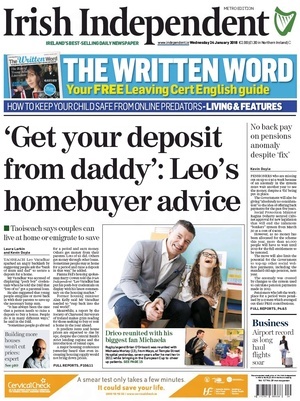
From top Taoiseach Leo Varadkar in the Dáil yesterday: Aengus Ó Maoláin

So Leo Varadkar got money from his parents for the deposit to buy his apartment (although…). Fair play to him. And fair play to you if you did the same. Let me be clear at the outset that I have no problem with that, aside from a little jealousy that that option isn’t on the table for me.

What I do have a problem with is that Taoiseach Varadkar seems to think that everyone can just go and get a loan from the bank of Mum and Dad. That or go away for a few years to save enough for a deposit, or just move back in with their parents for a few years to save on the cost of rent.

I’m personally quite angry about this, because on the first take, I am in this situation. We pay about 500 euro per month in rent more than we would be paying if we owned the place we live in.

By the way, we live 500 metres from the Taoiseach.

A deeper reflection on the Taoiseach’s comments makes me even angrier though, because it makes something really clear. The reason Fine Gael and Fianna Fáil aren’t fixing the housing crisis is that they don’t see the problem.

They find it impossible to understand that most people’s parents (if they have both or either) don’t have thirty or forty grand lying around.

They cannot imagine a circumstance where simply moving in with your parents (again if they have them) for a couple of years wouldn’t be appropriate or possible.

They simply cannot fathom that going abroad for a few years to earn money for a deposit could be disastrous for any number of reasons.

The whole Irish economy is built by and for people like Leo Varadkar. Everything is fine, because they have done and are doing very well for themselves, thanks. This failure to empathise with people who are struggling, or find themselves for whatever reason in less ideal circumstances is a serious political failing.

Ireland’s economy is built on luck – and if you are very lucky, it’s a great place to live. But if you’re not on the very top of heap, it’s bad, and it’s getting worse, as Rory Hearne wrote on Monday:

One million people in Ireland are experiencing deprivation.

Compared to before the crash in 2008, we have doubled our consistent poverty rate.

A full quarter of lone parent families and their children are living in consistent poverty.

Three quarters of a million Irish people are living on less than €14,000 per year.

All of those figures are increasing, all while official policy is to bend over backwards to allow foreign multi-billion euro companies to get even wealthier, and step daintily out of the way of the already wealthy to make more and more money off the backs of our own people.

And all of those figures are reflected in Dublin West.

Teachta Dála – TD – means a delegate from the constituency to the Dáil. It should be that every TD should represent their constituency. That means in the case of Leo Varadkar – me and everyone living in Dublin West, one of the most diverse parts of the country.

His lack of empathy, and casual dismissal of the real daily struggles of most people in Ireland and in his constituency should be shocking, and it should be remembered.

If Leo Varadkar’s comments yesterday annoyed you, then you must stop voting for Fine Gael or their facilitators and twins in Fianna Fáil.

Aengus Ó Maoláin is chairperson of the Social Democrats in Dublin West and the party’s representative for Castleknock and Blancharstown.


From top: Cover and inleaf of ‘Dark Secrets: The Inside Story of Joanne Hayes and the Kerry Babies‘ (published by The Kerryman, 1985) by Gerard Colleran and Michael O’Regan (edited by Gerard O’Regan)

Further to the Gardai apology to Joanne Hayes, the woman at the centre of the Kerry Babies scandal…

Dan Dowling writes:

In 1985, Gerard Colleran and Michael O’Regan co-authored the book ‘Dark Secrets: The Inside Story of Joanne Hayes and the Kerry Babies‘.

The hero of this book is Detective Sergeant Gerard O’Carroll.

The first reference to a guard is on page 27:

”Liam Moloney, a dark haired, handsome garda, from Mitchelstown, County Cork, a popular figure along with his wife Bridget and a ‘local guard’.”

Meanwhile, Locke the father of Joanne’s baby is:

“a low-sized, bushy-haired, native of Tralee.”


Chapter Three is titled “Garda Morale in Kerry”

At the time two Gardaí have been apprehended for assault; Tom O’Callaghan and Con Sullivan, a minister Sean Doherty had crashed a car after the Listowel Races with rumours the minister was drunk and driving with a well-known singer, a Sergeant John Reddington has forced people to build his house outside Ballyduff and five hundred people in Ballyduff marched and demanded he get out.

Morale was indeed low needed a break and an unsolved murder would have made things even more unbearable for “the force”

Chapter Seven ends:

“On the night of April 30, Gardai toasted chief superintendent John Doyle at a party in his office at the Tralee station. Doyle was leaving to move on transfer to Dublin as part of a number of changes at senior level which affected the Kerry division about that time. The Gardaí enjoyed themselves at the party. On the morning of May 1st , Tralee District Superinetendent Donal O’Sullivan presides over a Garda station that was a hive of activity” (p79).

This is how the book first refers to the night that the Hayes family were interrogated.

Chapter Eight is titled: “Courtney and his Men”.

“When he arrived in Tralee to investigate the murder of the Caherciveen baby John Courtney was perhaps our best known policeman”

“The murder squad were an élite group which tended to attract a particular type of personality lured by its glamour and the opportunity to get involved in high profile police work.”

“One of the more energetic members of “the triumvirate” of murder squad gardaí was Detective-Sergent Gerard O’Carroll, he did particularly well in his leaving cert, one of his brothers was a highly-rated neurosurgeon.” (p87-88)

“Like his boss he had sampled the nether regions of humanity”

Referring to a case Gerry solved by using the power of prayer:

“By 6am one of the country’s most notorious murders had effictively been solved. It had involved a subtle, but at the same time brilliantly orchestrated, piece of police psychology. But for ever more Detective-Sergeant O’Carroll would remain convinced that, in the dead hours of the night, he had been alone for a time with evil incarnate.”

Less flamboyant than O’Carroll was Detective-Sergeant Joseph Shelly:

“well spoken, a considerable presence, his ability within the force had been recognised at age 32. he looked forward to excellent career prospects, always well dressed , he spoke to the Tribunal in a pin-striped suit.”

Detective PJ Browne had a friendly “friar tuck” like appearance, “” I can express myself if you give me a pen” he once remarked.

As Courtney drove to Kerry he “carried his mantle of controversy with ease”

The Hayes family aren’t described like this:

Chapter Three “Home from Malaya” Joanne Hayes’ Auntie Bridie Fuller is introduced as having had an affair with a man when she was in Kuala Lumpur in 1947 and she is described as an incurable alcoholic.(p32).

Mike Hayes is introduced as the least intelligent member of the family, (p107) .Bridie is disheveled in court (p116).

Colleran or O’Regan or both introduce “Joanne’s subconscious” (P.42), having sex made her feel guilt when walking back to the bosom of her family and so on.The family aren’t helping out on the farm, The Hayes’s spend their time signing on the dole (p.98). Their kitchen is gloomy (p102)

More importantly the interrogation of Joanne Hayes and her family previously described as a hive of activity involved slaps shouting threats, being offered a newspaper on the floor to vomit on, Joanne being refused her right to leave the station despite not being arrested, her being pulled onto Detective Browne’s lap, the gardaí refusing to search the location of her baby on the family farm to check was she telling the truth.

…The gardaí producing a knife, a bath brush and a turf bag and telling her she used these to kill her baby and that her family had helped.

…Gardaí lying about matching blood samples and threatening that if Joanne didn’t confess her mother was going to jail and her baby was going to an orphanage, Garda O’Carroll whooping and hollering and saying he had cracked it” (P179,P173, P175,p178)

The description of Joanne’s trial is torturous to read and as well known as her mistreatment by the Gardaí. Colleran and O’Regan describe the legal teams in Rumpole of the Bailey terms, vigorous, colorful, flourishing, “he called out for The Observer” he “wore gold rimmed glasses” and on and on.

It is all drivel, all unjustified, the opposite of the calling to afflict the comfort and comfort the afflicted.

Dan Dowling is a Broadsheet reader from Tralee, County Kerry

Dan Dowling (Facebook)

Previously: It Was I Who Went On Trial

Update:

Dan writes

I added 28 screenshots from the book to the Facebook page (above), more of the same.

Meanwhile (below) is the book’s epilogue…

Epilogue

Now it all seemed such a long time ago – that time of her all-consuming love for a man she so often referred to as Jer. But in the cold light of enforced retrospection, Joanne Hayes realised something which at one time she would have regarded as impossible. She did not love Jeremiah Locke anymore.

Furthermore, the death of this love, mixed with a deep sense of rejection, and her old feelings of isolation, had given rise to an entirely new emotion. She felt betrayed.

That sense of betrayal would develop into other feelings, such as anger and resentment, coupled at times with a feeling of simply being used.

Joanne believed that Jeremiah had failed to protect her dignity during the Tribunal. What did those gifts they had exchanged now symbolise… the gold bracelet he had bought for her and the sweater she had bought for him?

Whatever she may or may not have done, Joanne Hayes could legitimately feel aggrieved by the tone, language and certain conclusions in Mr. Justice Lynch’s report.

For example, on the flimsiest of evidence he denigrated her relationship with Jeremiah Locke to little more than the inane infatuation of a young woman with a man who was only interested in sexual gratification. If the logic and assumptions of the judge were applied to contemporary Irish society regarding affairs of the heart it would represent a return to the repressive sexual norms which have so damaged this country for so long.

Only in a sense is it all over. Some questions have been satisfactorily answered. Others, of course, will never be. On central level, clear cut conclusions about many aspects of the Kerry babies affair are as hazardous as ever.

Yet there is one dominant feeling. It is that this story is above all else, an insight into a group of people- the Hayes family, the Gardaí and others- all of whom are unnecessary victims. Victims of what is the question to be answered.

But is this a fair conclusion? For example, would a different society with an alternative sexual culture have orchestrated things in a different way, or must there always be that certain inevitability around our Irish tragedies?

Perhaps, some of those nouveau riche mentioned at the outset of this book might try and rationalise the story as essentially expressive of rural life.

Yet, at its very core, the story of the Kerry babies is surely a reflection of much that is wrong with the very soul of Ireland in both town and country.

It was Dermot McCarthy, representing the Hayes family, who in the course of the Tribunal suggested there may have been a “dark secret” which could be leading the family to behave in a certain manner.

Many of the mysteries of the Kerry Babies drama remain. Perhaps it is a story from which there can be no ultimate truth. However, if one travels to those quiet roadways which lead to places like Abbeydorney and Caherciveen in the gloom of an evening the almost mystical reality of what it was all about may become clear.

It is that not quite tangible wayward spirit which is so much part of the Irish strength and the Irish nightmare.

If the truth be told, it is the well from which springs nearly all our dark secrets.

Dark….dark secrets, indeed….

From Dark Secrets: The Inside Story Of The Kerry Babies.

From top: Preparations ahead of this week’s World Economic Forum, in Davos, Switzerland; Dr Rory Hearne

The global elite of governments, corporate CEOs, and financial investors meet for the annual World Economic Forum (WEF) in Davos, Switzerland this week.

Their discussion topics include such heart-warming titles as ‘Saving Economic Globalization from Itself’, ‘Global Markets in a Fractured World’ and, interestingly, very aware of the inevitability of another global economic crash, ‘Could 2018 Be the Year of the Next Financial Crisis?’.

But at the World Economic Forum it is the global elite talking to themselves about how they can protect and expand the privileges and wealth of the elite, while doing just enough (or even giving the impression that they are doing something that’s just enough) to keep the majority of their populations happy and ticking along without politically challenging the system.

Just look at the world they lead – Oxfam’s Even It Up! campaign )see below) has highlighted that the eight richest people in the world own as much wealth as the poorest half of the world’s population.

This is the result of forty years of economic globalisation and hyper-capitalism – the policies promoted by the elite at the World Economic Forum. Inequality, economic instability and environmental destruction have worsened substantially under their leadership and policies.

The reasons for the rise inequality are multiple and complex, but strong contributing factors include the fact that wages (which is most people’s income) have not increased relative to the dramatic rise in the wealth of those at the top of society and corporations.

The deregulation and globalisation of financial markets and the spread of speculative investment into all aspects of our lives has also unleashed the inherent instability and boom-bust cycles of the market in increasing frequency and ever-greater impact.

Inequality has also risen because the state has reduced its role in providing public services like health, social welfare, housing, and education, which in the past played a strong role in reducing inequality and providing more balanced economic development. Now the private sector and the market are much more dominant in these areas.

And this was the ultimate purpose of the neoliberal globalisation revolution promoted by global leaders from Margaret Thatcher, George Bush, Bill Clinton, Tony Blair, Angela Merkel and their friends – to facilitate corporations to make as much profit as possible by reducing worker’s conditions and privatising public services, lowering the taxes corporations and the wealthy have to pay, and paying little attention to increasing the risk of financial crises and environmental destruction.

So now the dominant policies globally are free market economics (despite causing the great financial crash and recession of 2008) that measure countries’ development in terms of crude measures of economic growth such as GDP.

And this means that measures of people’s and society’s well-being – from health to mental health, economic and social inequalities, housing affordability, sense of safety and community, or the support for caring roles for our vulnerable populations and disadvantaged communities – these are all secondary (and even lower in policy and political priority terms) considerations and are not prioritised.

At the World Economic Forum (WEF), there will be lots of discussion, sincere frowns and strong words about the state of the world. This year they even have sessions on ‘Society Divided’ and ‘Solving the Economic Generation Gap’. But there will be no acceptance of the role of their policies in bringing us to where we are.

Business will continue as usual and governments, corporations and financial investors will meet, ‘network’ and exchange ideas and approaches on new ways of how the private sector can get more government contracts – like Public Private Partnerships – in areas like health care, elderly care, climate resilience, housing and transport – and how taxes on corporations, high earners and the wealthy can be minimised and finance further de-regulated.

How the economic globalisation train can be kept on its tracks – shuttling us and the planet towards a global dystopia.

Irish Finance Minister Pascal Donohoe (and possibly the Taoiseach) will be there speaking and representing the interests of big Irish businesses and large multinationals based in Ireland. But officially they are there representing you, the Irish public.

But don’t worry. They won’t mention any of the ‘downsides’ of the great Irish economic ‘recovery’. Instead they will extoll the speed and extent of the recovery (again using the narrow measurement of GDP growth).

There will be no mention of the socially and economically damaging housing crisis and homelessness (remember Fine Gael is the party whose Minister Damien English scolded us malcontents in the Dail in November last year for ‘talking down our country’ and ‘damaging Ireland’s international reputation’ by having the temerity to suggest that the government’s response to homelessness is ‘dysfunctional’).

And don’t worry – our reputation will be kept intact.

We will put our best face out for the global elite. There won’t be any mention of the deep inequality in wealth in Ireland. Where the wealthiest top 10% hold over half (53.8%) of all of Ireland’s wealth while the bottom half of the population have just 4.9% of the wealth. Nor will there be mention of the income inequality resulting from the very high rates of low pay in our workforce. 105,000 people who are working are living in poverty – the “working poor”.

Nor will there be mention of one of the most social corrosive and damaging issues which is given very little consideration – our high poverty rates – which are still double what they were prior to the crash in 2008.

The proportion of our population (8.3%) in consistent poverty is double the 2008 rate. And for our most vulnerable –lone parent families and their children – a quarter (24.6%) of them are in consistent poverty (up from 16.6% in 2009).

Don’t worry, neither the Irish Ministers nor the compliant media will embarrass you by mentioning the 790,000 people in Ireland who are living on an annual income below €12,358 (60% of the national median income – who are defined as being ‘at risk of poverty’.

Or that a quarter of a million of these are children. Or that a fifth of our population – 1 million people in Ireland – are experiencing deprivation. And a quarter of all children experience deprivation (still much higher than the 15% rate in 2007).

Deprivation is defined as households excluded from goods and services considered the norm in society, due to an inability to afford them. Individuals who experience two or more of eleven listed items are experiencing enforced deprivation. Don’t worry this hidden underbelly of a deeply unequal recovery will get little attention.

The reality is that Ireland, in contrast to what our Minister for Finance will be saying in Davos, should not be held up as a poster child economy for other nations to follow.

We are a tax haven facilitating some of the wealthiest corporations in the world to avoid contributing to society and we bailed out our banks and developers at enormous and devastating costs to society.

Both of which have resulted in massive austerity and under investment in public services leaving us with unprecedented housing and health crises that are amongst the worst in the developed world.

But if you think about it – Ireland is in fact the real poster child for global capitalism and the global elite in Davos. Here in Ireland we are a model ‘hyper-capitalist’ nation. Corporations pay little tax and make massive profits, workers do not have strong labour protections and collective bargaining –unions are not allowed to represent and organise workers in many private companies.

At the height of the crash and recession – the Fianna Fail/Fine Gael/Labour governments encouraged the vulture funds and financial investors to come in and feed off the carcass of an austerity ravaged population.

So the wealth of the global and Irish wealthy has grown even further from the exploitation of the population, most significantly the poor and young people paying ever higher housing costs as rents or mortgages. Public investment in public services is one of the lowest in the EU which leaves lots of opportunities for the private sector to provide public services and make a huge profit (we can see this in the growth of private healthcare).

There is scant constitutional protection for citizen’s human right to housing or healthcare – but the right to profit and private property is promoted and protected. Indeed, Leo’s Republic of Opportunity is a nice little corporate paradise for the private corporations, financial investors and the wealthy.

But Ireland’s reliance on its tax haven status, the financial sector and multinational corporate investment and the low level of public services and indigenous business investment makes Ireland deeply exposed to the future financial and economic crash, as was the case in 2008. This is rarely spoken of.

And even more importantly for the global elite – Ireland has played a very important role in the rise of global inequality in the past three decades – our financial tax haven industry based around the IFSC has helped the corporate and financial elite reduce and avoid taxes owed to national governments and thus increased their profits and wealth accumulation. No wonder then the Irish politicians get such a welcome in Davos.

But it doesn’t have to be like this. Countries like Sweden and Finland have much more equal societies, better public services, better businesses and more sustainable economies – everyone is better off in more equal countries.

And even the global elite at the World Economic Forum know that their global order of hyper -capitalist globalisation they have created is deeply unstable –with another financial crash inevitable, is deeply unequal, and threatens the future of the planet. But they aren’t going to change direction – they have already shown they have no interest in that, and why would they – the elite benefits from the status quo.

So, as always, it’s up to ordinary citizens, communities, social movements, trade unions, critical NGOs, progressive politicians, and others, like you, to come together and bring about the change needed towards fairness, social and environmental justice.

Dr Rory Hearne is a policy analyst, academic, social justice campaigner. He writes here in a personal capacity. Follow Rory on Twitter: @roryhearne

You can read more about what you can do at the Fight Inequality Alliance who are co-ordinating a week of action around the World Economic Forum, here

Top Pic: AFP