Author Archives: Bodger

This morning.

The NUI Galway socks are back!

Joanne Brophy writes:

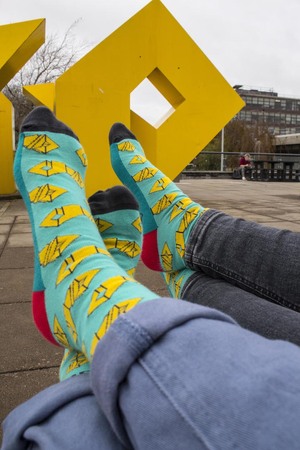
Our fundraising socks featuring a tribute to the iconic “Galway Yellow” (AKA Big Yellow Thing) sculpture on campus. The socks, a collaboration with Galway company Irish Socksciety, are on sale now for €9 a pair with all proceeds going to the SU charities. They’re an ideal present for anyone who has ever said “I’ll meet ya at the Big Yellow Thing” over the years!

The “Galway Yellow” sculpture outside the NUIG Library was created by artist Brian King in 1976 and has been a landmark and meeting point for UCG/NUIG students since then. It goes by a few nicknames most commonly “The Big Yellow Thing” but also “The Squiggle” and “Archimedes’ Balls“.

The socks are on sale now from the SU website (at link below) , the SU Office and the SU Shop at NUI Galway.

The SU Charities this year are: Galway Rape Crisis Centre and BeLongTo Youth Services.

NUIG SU Shop

Irish-made stocking fillers to broadsheet@broadsheet.ie marked ‘Irish-Made Stocking Fillers’

This morning.

Via Irish Times:

The average deposit needed to buy a home is now €52,500 for a first-time buyer (FTB) and €135,000 for a mover purchaser, according to figures from the Banking and Payments Federation Ireland (BPFI).

This is more than double what it was less than a decade ago, reflecting the rapid increase in house prices since the low point of the crash in 2012 and the Central Bank of Ireland’s mortgage lending rules, which require buyers to have bigger deposits relative to the value of the property.

The BPFI’s latest housing market monitor includes a loan-level analysis of the source of deposits in the first half of 2021.

It found that nearly 42 per cent of FTBs and 25 per cent of mover purchasers used gifts as part of their deposits.

First-time buyer needs €52,500 for average deposit (Irish Times)

Meanwhile…

Social Democrats Housing Spokesperson Cian O’Callaghan said:

“An entire generation has been locked out of the market. Average deposits are now more than double what they were just 10 years ago. How can anyone on an average income afford to save €52,000? Homeownership is simply slipping out of reach for many young people.

The pressure to save vast sums of money, while also paying incredibly high rents, is putting people under huge stress and strain. It is therefore unsurprising that four in ten first-time buyers are reliant on gifts from parents in order to fund the purchase of a home.

“House prices have shot up by over 12pc in a year. This is unsustainable. The housing market is out of control and there is no evidence that the Government’s housing plan is working. In fact, things are getting worse instead of better.

“The solution to this crisis is crystal clear – the State must build thousands of homes that are genuinely affordable. This can be done by using public land. To date, this has not been done anywhere near the scale that is required. We need 10,000 affordable homes to be built each year.”

RollingNews

Meanwhile…

This morning.

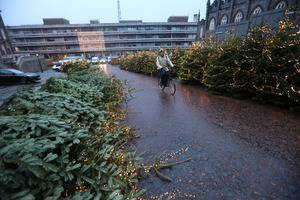
Tralee, county Kerry.

Via RTE News

After making landfall this morning, Storm Barra has caused some flooding in the south and has already left at least 33,000 homes and businesses without power.

A Status Red wind warning for Cork and Kerry has been active from 6am, while a similar warning for Clare will be in place from 4pm.

In all three counties, wind speeds of over 80 km/h, with severe or damaging gusts in excess of 130km/h, have been forecast by Met Éireann.

The weather warnings will be in place until 9pm tonight, when these counties will enter a Status Orange wind warning, which will remain in place until 6am tomorrow morning.

Storm Barra: Flooding in Cork, Limerick, Kerry as homes and businesses without power (RTE)

Pic via Cathy O’Halloran

This afternoon.

Earlier: “They’re Clearly Finding Places That They Can Get In”

Meanwhile….

 Tony O’Brien, former Director General of HSE

Last month, former Director General of the HSE, Tony O’Brien wrote in the Business Post:

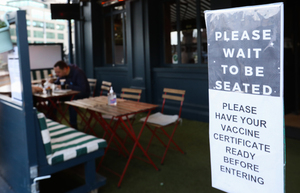
“We are currently witnessing an emerging trend of seeking to blame the upsurge in Covid-19 infections in Europe on those who have not yet availed of the offer of a vaccine. It is tempting to do that, but we should be cautious.

This “othering” of the unvaccinated is further compounded by an increasing tendency to refer to the unvaccinated and “anti-vaxxers” in the same breath, as though they were synonymous, which they are not.

“…Efforts to “other” the unvaccinated take many forms. In Austria, Alexander Schallenberg, the new chancellor, twinned his announcement of a new period of severe lockdown with advance notice of a “vaccine mandate” from February.

“This means that the unvaccinated will be subject to fixed penalty notice fines – the range under discussion is €500 to €3,600 – and a build-up of unpaid fines could lead to imprisonment. It is a classic political case of “don’t blame us, blame the unvaccinated” in a country with one of the lowest vaccine uptake rates in Europe.

Politicising the vaccine-hesitant in a country with a low vaccine uptake, and risking driving them naively into the arms of unreconstructed Nazis, is a high-risk and badly thought-out strategy.

“Here in Ireland, where vaccine rates are high, the political response to the ongoing increase in infection rates has so far been less dramatic. There is no planned return to lockdown, and no talk yet of any universal vaccine mandate. But we have seen the beginnings of an attempt to blame the increase in infections on the unvaccinated.

“…In terms of the spread of infection, it is inaccurate to suggest that it is down to the unvaccinated. Indeed, doing so deflects from three key issues that simply cannot be laid at the feet of the unvaccinated.

“The first is that the government knowingly pursued an opening-up strategy at a time when infection rates were rising, effectively encouraging mass gatherings indoors in nightclubs and other places. This sent a signal that led to a general relaxation of our individual protective measures in terms of hand hygiene, masking, caution about social contacts, and attention to symptoms and self-isolation.

“Secondly, the government has consistently misled us with the mantra that “schools are safe”, without any basis for that claim. The highest rates of Covid-19 infection of any age group are now being seen among primary school pupils.

“Finally, the government dithered all year long on the question of antigen testing, neither trusting nor properly educating the population in their correct use. This has deprived us of the benefits of antigen testing while visiting upon us the maximum harm possible through their well-intentioned but incorrect use.

“…simply blaming the unvaccinated for our troubles, whether in Austria or Ireland, is not the answer, especially when the truth is far more inconveniently complicated. In Europe, we should remember that finding scapegoats and trampling on their rights at times of crisis or social and economic turmoil is a dangerous path to tread.

“Occupationally-oriented vaccine mandates, such as in healthcare, are justifiable and reasonable; using vaccine passes and testing as a way of opening society is prudent. General vaccine mandates that interfere with the basic right to bodily integrity are, however, a whole other ball game.”


Tony O’Brien: Blaming the unvaccinated for Covid-19 surge is tempting but dangerous (Business Post, November 28, 2021)

RollingNews

Leo Varadkar and Micheál Martinunder the shadow of Arthur Griffith and UK Prime Minister Prime Minister David Lloyd George

This afternoon.

Dublin Castle, Dublin 2.

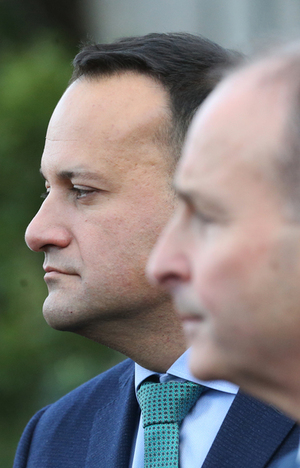
Tanaiste and Fine Gael leader Leo Varadkar with Taoiseach and Fianna Fáil leader Micheál Martin speaking to the media during a visit to The Treaty, 1921: Records from the Archives exhibition at Dublin Castle ahead of its opening to the public. On this day 100 years ago – 6 December 1921 – the Anglo-Irish Treaty was signed.

Earlier: Just For One Day

Sasko Lazarov/RollingNews

This afternoon.

Plans to build a whitewater rafting course in Dublin ‘appear to have been shelved‘.

Via RTÉ News:

According to the council’s Captial Programme 2022-2024 which will be discussed at meeting later tonight, there has been significant hostility towards the project and it has been unable to convince the various State funding bodies to support the project.

The report, from the council’s Chief Executive Owen Keegan, also says there has been a ”considerable amount of negative commentary related to this project […] that appears impossible to reverse and that has undermined the planned funding of the project”.

Dublin whitewater rafting facility appears to be shelved (RTÉ)