


Author Archives: Chompsky

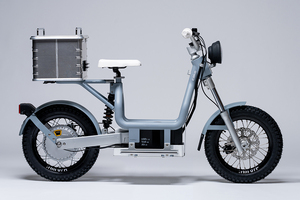
Behold: the Cake Makka – a lightweight, utilitarian ebike (probably destined for a Deliveroo fleet near you) from Swedish electric motorbike manufacturer Cake.

Available in two 60kg variants, the Flex and the Range: both upgradable with attachment points for passenger seats, cargo bins and racks, with fat knobbly tyres, LED lights, regenerative braking, TFT display, multiple ride modes and a 0-80% charge time of two hours.

The Flex has a top speed of 45km/h and a 50km range while the Range will do 25km/h for 56km.

Available to preorder (in white or, if you’re feeling especially frisky, grey) here.

hiconsumption

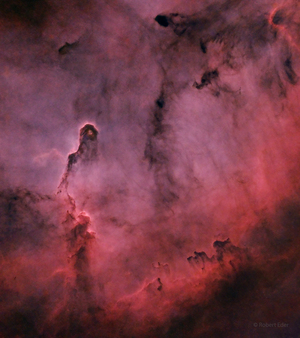
Behold: the Elephant’s Trunk Nebula winding said pareidoliac proboscis through the young star cluster complex IC 1396 in the constellation of Cepheus. To wit:

Also known as vdB 142, seen on the left the cosmic elephant’s trunk is over 20 light-years long. Removed by digital processing, no visible stars are in this detailed telescopic close-up view highlighting the bright swept-back ridges that outline pockets of cool interstellar dust and gas. But the dark, tendril-shaped clouds contain the raw material for star formation and hide protostars within. Nearly 3,000 light-years distant, the relatively faint IC 1396 complex covers a large region on the sky, spanning over 5 degrees. This starless rendition spans a 1 degree wide field of view though, about the angular size of 2 full moons. Of course the dark shapes below and right, marching toward the winding Elephant’s Trunk, are known to some as The Caravan.

(ImageRobert Eder)

apod

Bridging the gap between land and sea on the Chilean coast, Casa Izuga, aka 5 Beams House features, as advertised, five concrete beams supported by walls to the east and west.

The structure – built in 2015 and designed by Gubbins Poldura architects – offers privacy from the neighbours (such as they are), creating concealed spaces on the lower level, half submerged into the hillside, capped with a wall of sea-facing glass.

Public areas on the upper level are likewise encased in glazing with spectacular views of the landscape, expanding  via sliding panels into a pool and terrace overlooking the incoming South Pacific waves.

It’s a hard oul’ station, right enough.

uncrate

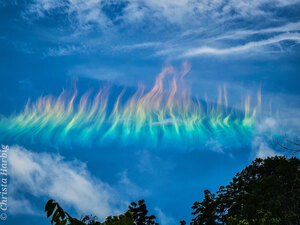
Behold: rare and eye-candiful prismatic refractions through ice crystals in a distant cirrus cloud formation. To wit:

Known informally as a fire rainbow for its flame-like appearance, a circumhorizon arc appears parallel to the horizon. For a circumhorizontal arc to be visible, the Sun must be at least 58 degrees high in a sky where cirrus clouds present below — in this case cirrus fibrates. The numerous, flat, hexagonal ice-crystals that compose the cirrus cloud must be aligned horizontally to properly refract sunlight in a collectively similar manner. Therefore, circumhorizontal arcs are somewhat unusual to see. The featured fire rainbow was photographed earlier this month near North Fork Mountain in West Virginia, USA.

(Image: Christa Harbig)

apod

Behold: the Everrati Land Rover Series IIA – an all electric conversion of the most iconic of all Landys.

Each donor vehicle is filed down, smoothed out, fully restored, upgraded and fitted with luxuries it never had in its former life: premium leather seating, power steering, 150bhp all-wheel electric drive and a range of customer-specified goodies.

Yours for $150,000 (€127,000)

uncrate

Asteroids.

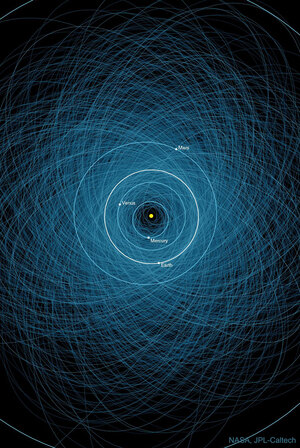
It’s all fun and games until one of them strikes your planet and causes a mass extinction event. We’re lucky that doesn’t happen more often. To wit:

Pictured here are the orbits of the over 1,000 known Potentially Hazardous Asteroids (PHAs). These documented tumbling boulders of rock and ice are over 140 meters across and will pass within 7.5 million kilometers of Earth — about 20 times the distance to the Moon. Although none of them will strike the Earth in the next 100 years — not all PHAs have been discovered, and past 100 years, many orbits become hard to predict. Were an asteroid of this size to impact the Earth, it could raise dangerous tsunamis, for example. To investigate Earth-saving strategies, NASA’s Double Asteroid Redirection Test (DART) is planned for launch later this year. Of course rocks and ice bits of much smaller size strike the Earth every day, usually pose no danger and sometimes create memorable fireball and meteor displays.

(Image: NASA, JPL-Caltech)

apod

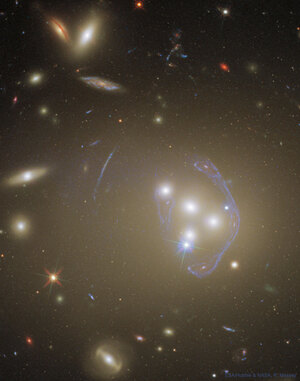
Behold: three galaxies in a row. Very similar to one another. Right – that’s what they want you to think. To wit

Toward the right of the featured Hubble image of the massive galaxy cluster Abell 3827 is what appears to be a most unusual galaxy — curved and with three centres. A detailed analysis, however, finds that these are three images of the same background galaxy — and that there are at least four more images. Light we see from the single background blue galaxy takes multiple paths through the complex gravity of the cluster, just like a single distant light can take multiple paths through the stem of a wine glass. Studying how clusters like Abell 3827 and their component galaxies deflect distant light gives information about how mass and dark matter are distributed. Abell 3827 is so distant, having a redshift of 0.1, that the light we see from it left about 1.3 billion years ago — before dinosaurs roamed the Earth. Therefore, the cluster’s central galaxies have now surely all coalesced — in a feast of galactic cannibalism — into one huge galaxy near the cluster’s centre.

(Image: ESA/Hubble & NASA, R. Massey)

apod