


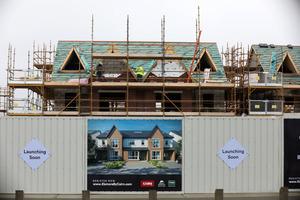
From top: construction work in April on the Elsmore housing estate at Naas Co Kildare which includes social housing; Dan Boyle
One of the favourite jobs I have had, now reduced to a single line reference on my CV, was three years I spent as the manager of a Housing Co-op in Cork.
The Co-op, as well as seeking to meet housing need, took a particular interest in sourcing neglected buildings of architectural interest. This project operated in a barracks square that had once been an arsenal. A subsequent project brought back into use the re-development of seventeenth century almshouses in Cork city centre.
Another goal of the Co-op was an emphasis in housing allocation that sought to develop a concept of community.
Of the eight units I managed, two single men had apartments. One was a wheelchair user, a Paralympic sailor. The other was a leading light in Cork’s Gay community, and also the main mover in this and several other co-ops in the city.
A pensioner couple occupied another unit. A family with teenage children contrasted with a two sets of couples with young children. A couple without children and a single parent family made up the complement.
While this come may across as the casting of a TV reality show by a production team that think themselves really clever, the actual reality was the variety of tenants helped bring about a real, cohesive sense of community.
Voluntary housing, like this, has been and remains the spare wheel of Irish housing policy. As far as successive governments, and state agencies, have been concerned, it has been known that the voluntary housing option existed, that very occasionally use has been made of the option, but it really it has been preferred not to use the option at all.
Throughout Europe voluntary housing represents a far higher percentage of housing stock than it does in Ireland. The reason why is obvious. In other countries housing policy is more holistic in approach. In Ireland policy is viewed though a very narrow prism.
Land, castles and profit is the Trinity that informs Irish housing policy. The desire to own, inculcated in the Irish psyche since the days of the Land League in the 19th century, has long passed its passion as the weapon to achieve a more equal society, to now being one of the instruments that is bringing about greater inequality.
Social housing gets a bad rap. Our main party of government seems to have a particular allergic reaction to the concept. This has probably been informed by attitudes shown by radio show text responders, whenever the subject gets mentioned.
Why should some people get houses for ‘free’ when I work hard to pay my mortgage – is a view that constantly gets aired. Such reductionist views conveniently ignore that those in social housing don’t get to own their homes.
Those who who buy houses acquire guaranteed long term appreciating assets. This on its own is one of the biggest factors in a widening wealth gap, generational in nature with an older generation owning, and a younger generation finding it impossible to own.
Only an ambitious social housing programme, State funded, and managed by local authorities and voluntary agencies, can kick start supply, reduce costs (especially social costs) and especially bring about a community approach to housing allocation, we have so sorely lacked to date.
Instead this government will continue to put its faith in the Construction Industry Federation, and with them a belief that the market will solve everything. It won’t. Some will become even more wealthy. Most will find it ever more difficult to be housed.
Dan Boyle is a former Green Party TD and Senator. His column appears here every Thursday. Follow Dan on Twitter: @sendboyle
Rollingnews