
Author Archives: Derek Mooney

From top:  David Trimble, former First Minister for Northern Ireland; Derek Mooney

British Prime Minister, Theresa May is in Belfast today to make a speech at… sorry… to give a speech to local business leaders. The speech will re-state her “absolute commitment” to avoiding a hard border, post Brexit.

Her statement of commitment is welcome, just as welcome as it was when first made over two years ago, but with only seven weeks to go to the March 29 exit and after 18 exhaustive months of negotiations, surely it is not asking too much to expect her to say how she will turn this commitment into reality?

This is a crisis of her own making. She says she is committed to no hard border, but then she also says that she is equally committed to having a Brexit that takes the United Kingdom of Great Britain and parts of Northern Ireland out of the EU’s Customs Union and the Single Market, as well as out of the EU institutions.

The hard truth is that she cannot commit to ensuring no customs union, no single market and no hard border at the same time. You can do two out of three, but you cannot do all three.

If she wants to avoid a hard border in Ireland, then simple logic dictates that those who want to have both Brexit and no hard border must yield somewhat on the issues of the Single Market and the Customs Union to ensure there is no hard border.

The Backstop is the way that both sides have agreed – and it is important to recall that the British government have already signed off on this – that Ireland and Northern Ireland can remain part of the same EU-UK customs territory with no tariffs, quotas, or checks on rules of origin until a future alternative arrangement is agreed. The EU has produced a very useful guide to what is actually in the Backstop.

But, the Brexiteers repeatedly shriek, there is no need for this beastly Backstop. Thereby missing the fact that the current version of the Backstop was effectively designed by them.

According to such grand pooh-bahs of Brexit as Johnson, Rees-Mogg and Baker you can magically have all three right now by way of “alternative arrangements”.

Unfortunately, none of them can point to any border anywhere in the world where these arrangements are in place.

As the deputy leader of the UK’s Liberal Democrats Jo Swinson MP put it yesterday, they are:

“…old men, who can’t operate a smartphone, talking about a technology that doesn’t exist.”

The fact that the technology does not yet exist has not stopped even supposedly sensible and moderate British Cabinet Ministers from peddling the myth.

Speaking on last Sunday’s Andrew Marr Show on BBC 1, the British Home Secretary, Sajid Javid, said an alternative arrangement to prevent the return of physical checks on the Irish/Irish border “can be done” with existing technology.

Oh no it can’t.

And this is not just me, the Irish Government, the EU negotiations team and the almost every trade and border expert saying it can’t…. it’s the British government too.

Just four days before Javid told Marr that existing technology could do it, on January 30 the Minister of State at the Northern Ireland Office, John Penrose MP told the House of Commons that:

‘I understand that the Cabinet Office commissioned work on what existing software and other technologies are available from other low-friction land borders around the world to see whether they could provide a solution to the problem.’

The conclusion was that no existing off-the-shelf package could deliver exactly what will be needed in Northern Ireland, so new solutions will be needed.

Talk about a lack of joined up government.

Meanwhile, as the Brexiteers continue their ham-fisted attacks on the front door of the Backstop, Lord David Trimble, the first First Minister of Northern Ireland under the Good Friday Agreement is set to launch an attack on the Backstop via the back door.

Trimble plans to ask the Courts rule that Backstop undermines the Good Friday Agreement.

It would be easy to brush aside Trimble’s action as mere Quixotic, Brexiteer nonsense, but his key role in helping to deliver the Good Friday Agreement and his political bravery in sticking by it, means he is deserving of a bit more respect.

Trimble’s argument appears to follow the same lines as those recently put forward by his friend and former adviser, Lord Paul Bew. Bew claims that the Backstop is a top-down imposition on Northern Ireland which takes away the people’s democratic control, i.e. their consent – consent being the core principle of the Good Friday Agreement.

Trimble (and Bew’s) pro Brexit champions hail them as the authors and architects of the Good Friday Agreement.

A deserved accolade, but they are not its sole authors. The Good Friday Agreement was the product of long painstaking negotiations between the two Governments and a cross section of Northern Ireland’s political parties – though not the DUP.

While the final agreement was the result of multiple inputs, its core architecture – particularly the Three Strands of relationships at its core: internal: between the two communities, North/South between the two parts of this island and east/West between the two islands, comes from John Hume.

Hume’s protégé, Mark Durkan, who went on serve with Trimble as Deputy First Minister, is widely acknowledged as the expert on the detail of the Good Friday Agreement.

He has deftly refuted Trimble and Bew’s claims by highlighting how the Backstop, along with the Jan 14th Juncker Tusk letter, upholds the existing Strand I and Strand 2 conditions of the Good Friday Agreement and rules out any new regulatory divergence.

As Durkan has observed, is it not curious how those who now claim the Backstop undermines the consent of the Northern Ireland people were perfectly content to ignore the, bottom up, democratic will of the 56% in Northern Ireland who voted to Remain.

And, as Durkan adds:

“…they gloried in the UK Supreme Court ruling that the principle of consent specified in the GFA applies solely to a democratic choice between United Kingdom and United Ireland… [and] does not extend to the UK’s relationship with the EU.”

Impartial academics agree with Durkan’s read, including QUB’s Dr Katy Hayward who has produced this response to Lord Bew’s claims.

Perhaps I am wrong. Perhaps May’s Belfast speech will provide some real insight into how she plans to resolve her own contradictory commitments?

Eh no… on reflection, I reckon we’ll see Simon Harris acknowledge his mishandling of the Children’s Hospital and the Nurses’ strike and resign long before we see that.

Derek Mooney is a communications and public affairs consultant. He previously served as a Ministerial Adviser to the Fianna Fáil-led government 2004 – 2010. His column appears here every Tuesday Follow Derek on Twitter: @dsmooney

Earlier: Red For Wrong, Blue For Right

Rollingnews

From top: Fianna Fáil leader Micheál Martin (centre) and SDLP leader Colum Eastwood (to Mr Martin’s right) at a press conference last Thursday; Derek Mooney

In the aftermath of the disastrous June 2016 Brexit referendum result, a result we should remember went 56:44 in favour of Remain in Northern Ireland, I started talking here about the need for the political system on this island, most particularly in Northern Ireland, to start catching up with the changing political landscape.

In a range of articles from late 2016 onwards I frequently quoted from a series of thoughtful speeches from the SDLP leader, Colum Eastwood.

As well as talking about the current crisis he was also looking to the longer-term implications of the Brexit vote, in particular the difference between the results in England those in both Scotland and Northern Ireland.

Eastwood was repeatedly saying that Brexit had consequences for all of this island because Brexit meant that the English had chosen, albeit narrowly, a very different future from that of the Irish people, north and south.

Thanks to the Brexit vote and the subsequent public discourse there was now a distinct divergence in both economic positioning and political values between these two islands, with England seeing its future outside the EU and Ireland seeing its future firmly inside it.

These post Brexit complexities, economic, political and constitutional, were going to require political parties to map out and shape the ideas and policies needed – but given all island nature of the problems and the dire state of Northern Irelands party politics wouldn’t that require new party political structures?

But I did more than write about it here. I ensured that Eastwood’s analysis and thinking was brought to the personal attention of the Fianna Fáil leadership. I felt that the implicit direction of Eastwood’s logic was clear, but I could also see that it was by no means certain or easy.

Let me digress here tell you a little about my own political history. I have long been an inadvertently public advocate of Fianna Fáil becoming a 32-county party. The inadvertent bit was courtesy of the Wikileaks dump of US Embassy cables in late December 2010.

Among the cables was a US embassy note from my February 2005 conversation with an embassy official accurately quoting me speaking in favour of Fianna Fáil running in the North. This made its way into the Belfast Telegraph.

A few months later I was asked by Fianna Fáil HQ to evaluate the progress made in developing Fianna Fáil in Northern Ireland to date (the party had established a network of six county forums in Northern Ireland in 2009) and to examine future options.

I entitled my evaluation report: When not If to signal my strong belief that Fianna Fáil contesting elections in the North was inevitable, the only issue was when. Indeed, in the opening paragraphs I quoted Éamon de Valera’s November 1926 comment that Fianna Fáil was:

“…intended to be an All-Ireland organisation… the time to start organising in the Six Counties would depend on conditions there.”

So, fast forward to last Thursday’s press conference by the leaders of the SDLP and Fianna Fáil announcing their two parties’ planned partnership.

Is this what I had envisaged or desired back in 2005, 2011 or 2017?

To be honest, it was not. Sadly, it falls well short of it. What was announced was almost as minimalist at the launch setting.

But am I against it? Certainly not.

I would have much preferred if both parties had gone far further in their ambitions and set out a clear timeline for the future of this relationship, but I am satisfied that this is a sufficiently solid first step. What matters are the next steps.

I was pleased to see that the initiative will be driven by policies and ideas rather than just organisation. Yes, developing organisationally is important, but having your politics driven by ideas and debate is far preferable to having it driven by organisation or even spin and presentation.

Nonetheless there are still organisational issues which the Fianna Fáil side needs to address. There are many Fianna Fáil members in Northern Ireland, including a prominent elected councillor.

For most of the last decade the William Drennan Fianna Fáil cumann in Queens University has been one of the biggest political groups on campus. What is the role for the hundreds of existing party members in the North in this partnership?

What should anyone who wants to join and vote Fianna Fáil in the North do over the coming months and years?

Micheál Martin and his advisers need to come up with clear answers to these questions – hint, they are in internal party papers I have written over the past few years.

That said, I was very encouraged that Martin’s speech made it clear that Fianna Fáil Oireachtas members and SDLP elected representatives “will begin their work within weeks” on both Brexit and Northern Ireland’s future relationship with the EU and that he was committed to widening the policy partnership agenda thereafter.

The lukewarm, somewhat negative response to the announcement is disappointing, but not too shocking given that it was neither flesh nor fowl for so many folks.

I can understand why some in both parties feel that the two leaders could have gone further, especially given some of the briefings and “informed sources” speculation from the Dublin end over recent months, but last Thursday’s announcement does not rule out any of that.

What is equally understandable, but a lot less forgivable is the whining and kvetching by assorted Irish Labour party apparatchiks in strategically placed op-eds.

I know there are left leaning members of the SDLP who would prefer to see an alignment with what is left of the left of the Irish Labour Party…. but the fact that Labour has been slow to move or is not sufficient reason for all of politics to stand still. Just as it is smug to think that the SDLP should disband to make sure that some folks are not discommoded – bear in mind that 11 out of the SDLP’s 12 MLAs were at last Thursday’s announcement.

Just as daft is the idea that Unionists, be they UUP or DUP, will be affronted or riled by the announcement. The Unionists I know, and I know a good few elected ones, largely see the partnership as positive, though they complain that it probably does not go as far as they had expected.

There are many progressive and forward-thinking Unionists, including in the DUP, who grasp that NI politics needs to move on and mature. My good friend Mick Fealty discusses this outlook here better than I can.

Finally, the merger word. Let me let you into a secret, in almost every note, analysis or recommendation I have written on this topic for the past decade, I have avoided the word ‘merger’.

I dislike the word and understand why both parties avoided it too. What our all island politics needs is an emerging policy driven focus, rather than an organisational driven administrative merger.

If what comes out of last Thursday’s announcement is less a merger and more a truly emerging partnership that can produce workable all-island policies on bread and butter issues that people north and south care about, then I am for it, bare bricks and all.

Derek Mooney is a communications and public affairs consultant. He previously served as a Ministerial Adviser to the Fianna Fáil-led government 2004 – 2010. His column appears here every Tuesday Follow Derek on Twitter: @dsmooney


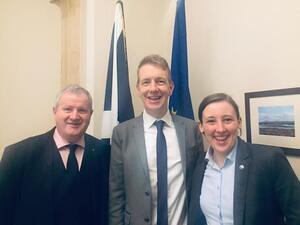
From top: Tiernan Brady (centre) with the Scottish Nationalist Party (SNP) leader Ian Blackford MP and the party’s youngest MP Mhairi Black at Westminster; Derek Mooney

If memory serves me right, back in the early 1980s Fine Gael ran a fancy half-page European election advert in the national newspapers that featured a massive photo of a big Aer Lingus jet taking off into the skies.

Beside the photo, in huge font, was the slogan: Send Your Best to Europe and beneath it appears the pics and short bios of its full slate of candidates.

It was quite an effective ad, until several wags observed that the airplane featured was a jumbo jet. These which only flew to the United States, so Fine Gael was sending them in the wrong direction.

Sending our best Europe is more important now that it was back in the 1980s. This is partly due to Brexit, but not exclusively.

As Fianna Fáil’s Micheál Martin said last Friday in a carefully considered speech to the Killarney Economic Conference: Ireland has to start playing a far more active role in shaping and promoting a more urgent and ambitious agenda for the EU.

Crucial to Ireland’s pursuit of this stronger agenda is the question of who will take on the three most important and senior roles in the EU.Who will be the next Donald Tusk, the next Jean-Claude Juncker or the next Mario Draghi?

As Martin said last Friday:

“…during 2019 we have to speak up while the Union goes about replacing all of its senior leaders. By this time next year members states will have chosen new leaders for the Council, the Commission and the European Central Bank.

We can’t afford for these decisions to be based on anything other than finding people who will not only lead their institutions well but will help to address a real lack of public understanding and faith in these institutions.”

The one institution not featured in Martin’s list is the European Parliament. This is not because it doesn’t matter, but rather because its composition will be in our own hands.

This year’s European Parliament Election will be the most important one since we started having direct elections back in 1979.

One way of ensuring that voters take the European Parliament election seriously is for the political parties to take it seriously by nominating candidates of calibre and ability.

Political parties, at headquarters and national level, need to select their European candidates using the same criteria they use to select top rung candidates for the Dáil – and if that means running MEP candidates who are currently sitting TDs, then so be it.

Avoiding a by-election here or there should not trump the need to pick the best candidates and to treat this European Election as if it was as vital and critical as the next general election.

As with almost every general election, the cockpit of this election will be Dublin.

What happens in Dublin is vital and the decision of two of the three current MEPs not to run again means that the election in Dublin will be fascinating. Add to this the likelihood that the capital will be electing 4 MEPs – though a withdrawal or delay to Britain’s Article 50 process, may bump this back down to three.

Within Dublin the race for the Fianna Fáil party nomination will be critical. On the surface it looks like a four-way competition but, to be brutally frank, the choice is binary.

In Column A you have Tiernan Brady, who many of you may know as an equality campaigner from his leadership in the Irish and Australian marriage equality campaigns.

And if you think Tiernan is not the kind of candidate you would expect Fianna Fáil candidate to field, well think again – because Tiernan is as dyed in the wool Fianna Fáil as any candidate the party has produced over the past decade.

I first encountered Tiernan back in 1992 when he was one of the Kevin Barry UCD Cumann members who came in to help Ben Briscoe TD on the (in)famous 10 day “long count” to decide the last seat in Dublin South Central – an event referred to by Ben at the time as “The Agony and the Ex TD”.

While Tiernan has followed the same political paths as others: elected as a Fianna Fáil county councillor, serving two terms, including some years as Mayor of Bundoran, running Dáil election campaigns for Pat (the Cope) Gallagher and former Tánaiste Mary Coughlan, Tiernan has gone beyond them and seen that the way to change things is to reach beyond your own traditional confines and loyalties.

Across from Tiernan, in Column B, you have three former ministers, each seeking a return to national politics after some time away though, to be fair to Mary Hanafin she did get back into local politics as a councillor for Blackrock in 2014.

All three former ministers, each carrying a family name with strong political associations: Barry Andrews, Mary Hanafin and Conor Lenihan have not just proved their capabilities as Ministers, they each have admirable ministerial records in their respective portfolios: Lenihan in international development, Barry Andrews in Children’s rights and Mary Hanafin in Education. Not alone that, all three are decent media performers, some perhaps more colourfully so than others.

On this basis it can be argued that the Fianna Fáil in Dublin cannot avoid picking a strong candidate, but – and this is why I lump the three ex-ministers together and describe the choice as binary – the perceived strengths of the three amigos is also their collective weakness.

Reading the campaign emails and social media posts announcing their candidacies, it was easy to mistake one for the other. Each claimed their time as a minister, their Dáil experience and their recognised family name as a unique qualification to run, but the “unique” strengths which they each see as defining them barely separates them.

It is 15 years since Fianna Fáil last won a European Parliament seat in Dublin with Eoin Ryan (in 2004). That is a long time.

If Fianna Fáil wants to win a seat in Dublin this time – and it needs to – then it must reach out beyond its existing hinterland and attract voters who not have seen Fianna Fáil as speaking to or for them. Only one of the candidates on offer has the proven ability to do this.

The seat will not be won by nostalgically getting the old band back together to play some favourites – no matter how much some of us may care for the tune. The choice is clear.

Derek Mooney is a communications and public affairs consultant. He previously served as a Ministerial Adviser to the Fianna Fáil-led government 2004 – 2010. His column appears here every Tuesday Follow Derek on Twitter: @dsmooney

From top:  First Minister for Scotland Nicola Sturgeon (right) with Irish actress Saoirse Ronan at the Scottish premiere of ‘Mary, Queen of Scots‘ in Edinburgh last night; Derek Mooney

Today is the day we find out just how truly batshit crazy some Tory and Labour MPs are.

Later tonight, probably around 8.30pm/9pm, we will know the results of the House of Commons meaningful vote on Theresa May’s Brexit deal.

I should probably say the first meaningful vote on the deal as she will likely resubmit the deal to another Commons vote in the hope that the looming approach of the Brexit abyss will compel MPs to switch.

At the time of writing (Tuesday 11am) it is certain that Theresa May will lose the vote, though is it possible that the margin of defeat will not be as great as her detractors hope, and probably not as great as it would have been if she had proceeded with the vote as planned last December.

Not that any of this speculation matters. Tonight is not the last we will hear of Brexit. The uncertainty that it has brought to politics on both these islands and the damage it has inflicted to relations between them will continue.

Brexit will continue to dominate the headlines on both sides of the Irish Sea and fill the opinion and comment pages of this and other media outlets.

British politics is in virtual freefall and almost anything is possible, including a slow break-up of the UK’s traditional two-party system and ultimately a break-up of the United Kingdom itself.

The determination of arch conservative and unionists to leave the EU in pursuit of an exceptionalist vision of a Britain that ceased to exist over a century ago may yet result in breaking up their precious union of English, Scotland, Wales and parts of Northern Ireland. Oh, the irony.

According to the pundits and the more sensible MPs there is no majority in the House of Commons for no Deal Brexit. This, they argue, means that it is yet possible that a hard, no deal Brexit can be avoided on March 29th next.

But the problem is that a no Deal Brexit is the default position. MPs do not have to vote for a No-Deal scenario, it is what happens next unless they take clear steps to avoid it.

So far, instead of any clear steps, all we see from the leadership of both the Tories and Labour is a series of stumbles – not all in the same direction.

Avoiding a No-Deal will require the concerted effort of a majority of MPs voting for a single alternative – and right now there is no clear majority for any of the alternatives to a no-deal.

One of the reasons for this is the fact that the component parts of any no-no-deal majority are scattered between the Tories, Labour, SNP, LibDems, Greens, Plaid Cymru and the sole non-DUP NI Unionist.

This is why it is hard to see the withdrawal or revocation of Article 50. It is the most sensible option, one advocated both last week and again yesterday by Tory grandee, Sir Kenneth Clarke who urged Prime Minister May:

“…to be flexible on some things, so if she loses the debate next Tuesday, will she consider moving to the obvious step in the national interest of delaying or revoking article 50, so that we have time to consider what the British actually want?”

However, the atmosphere in British politics is so febrile and fraught that the mere suggestion of seeking some breathing space and postponing Brexit is seen as treachery.

The other alternative is that of the #PeoplesVote second referendum, something I said some weeks ago here was clearly in Ireland’s best interests. While support amongst the public for the idea of a second referendum as a way to break the logjam is steadily growing, that is not enough.

There could be a succession of opinion polls showing a clear public majority in favour of a second vote, but until there is a clear majority in the House of Commons for passing the legislation required to hold one, never mind to agree the question to be asked, then I, regrettably, cannot see it happening.

I still hope it does and perhaps the attempt by Tory MP Dominic Grieve to reframe the choice that MPs must make as being between Theresa May’s Deal or No Brexit, perhaps via a second referendum, will work – but it’s still a long shot.

So, with the most sensible alternatives seeming like non-runners for now, it looks like we will have several more weeks of watching a succession of previously unheard of and obscure backbench Tory MPs appear on television to tell the British people, without a scintilla of evidence, that their default, no-deal Brexit will work out just fine and that it would all be jam and Jerusalem.

Indeed, I heard one of them argue on BBC2 TV last night that the No Deal default position would prevail as the most democratic option even though it was only the position of a minority of MPs because Britain has a first past the post system.

While the biggest immediate consequences of a no-deal Brexit for Ireland will be on the economy and trade with the border region’s agri-food sector being the first to take the hit, there will also we be political ramifications with the cohesion of United Kingdom itself coming into question.

I am not just talking here about the position of Northern Ireland – a question I have discussed here in before – but also that of Scotland.

As the UK political establishment stumbles its way through the next days and weeks you can rest assured that the Scottish government, led by the formidable Nicola Sturgeon, will not be stumbling.

It will, indeed it already has, started concrete work on moving towards independence from Westminster, within the EU, learning not just the lessons of the last Scottish independence referendum but also those of Whitehall’s crass lack of preparation for the Brexit vote and its aftermath.

While the Irish government has doubtless already started planning for how it manages bilateral relationships between London and Dublin and trilaterally between Dublin, Belfast and London in the future, I hope that somewhere in the marbled halls of Iveagh House there is also a unit preparing for the forging of deeper and more abiding relations with Edinburgh – as Scotland could well up as our newest and closest EU partner before long.

Derek Mooney is a communications and public affairs consultant. He previously served as a Ministerial Adviser to the Fianna Fáil-led government 2004 – 2010. His column appears here every Tuesday Follow Derek on Twitter: @dsmooney

Top pic via Nicola Sturgeon

Earlier: Once More Unto The Breach


From top: Irish Times’ New Year’s Eve 2018 message; David Runciman’s How Democracy Ends; Derek Mooney

A well-known Irish politician once allegedly opined that: “Irish Times editorials read as if they were written by an auld wan sitting in a bath of lukewarm water”. He may also have suggested, a little more colourfully, that the bathwater reached less than halfway up the tub.

The bath water must have been on the chillier side of lukewarm December 29th’s editorial entitled: “Democracy in Retreat” was being written. It expressed an almost dystopian concern that democracy is now under threat across the globe.

It cited a range of phenomena and political shifts to support its claim, including: Trump, Brexit, the rise of populism of nationalism and of xenophobia and the gains made by the both the far-left and far-right.

Even as I sit down to start writing this piece more evidence, which would seem to support the Irish Times line, is appearing with videos of the vile and nasty abuse Tory MP Anna Soubry endured on Parliament Square yesterday at the hands of a gang of ultra-hard-line brexiteers.

The irony of a group of aggressive and loutish middle-aged men trying to intimidate and bully an elected representative who is doing nothing more than expressing her sincerely held views, while calling her a Nazi and fascist is doubtless lost on them.

More worryingly it also seemed lost on the band of pundits and commentators who took to Twitter to suggest that Soubry was responsible for what was happening.

Though not the worst of them, the Conservative blogger and columnist Tim Montgomerie, who usually makes a virtue of his liberal democratic credentials, wrote:

“The abuse is unacceptable and I condemn it but a parliamentarian who advocates overturning a referendum result she promised to respect should not be surprised at unleashing such ugliness.”

The rough translation into plain English of these weasel words is:

I should be deeply embarrassed by some of my fellow brexiteers and should be finding a way to see how we can unite to tackle the extremists but, instead, I want people to blame Soubry and others for not going along with us and persisting in having views of their own

Are these all threats to very existence and continuance of democracy or are they the challenges that we cyclically face that serve to knock us out of our complacency and remind us that democracy can be fragile is at all times worth protecting and defending.

Is there a really and systemic threat to democracy today, or is what we are seeing with Trump, Brexit, populism etc., a worrying but manageable response to the climate of uncertainty following the 2008 global crash?

Indeed, has there ever been a time in modern history when, in the aftermath of an economic crash, there hasn’t been a group of people sitting in lukewarm baths thinking that the world outside their immediate social circle was going to hell in a handcart?

We should not be surprised that many people question the competence of their democratic and political institutions when the events of the past decade suggest that world of finance and banking has more sway than democracies.

Neither should we be complacent about the future of liberal democracy when the claim can be made that some banks are a bigger source of repression than extremist regimes.

Yes, there are very worrying signs and trends across Europe and the Globe.

Yes, far too many people feel that governments serve the vested interests of others and are not responsive to them, but all is not yet lost.

As the pro market economy academic Johan Norberg has argued:

”Contrary to what most of us believe, our progress over the past few decades has been unprecedented. By almost any index you care to identify, things are markedly better now than they have ever been for almost everyone alive.”

On almost every single metric life is better now than it was in the past. The world is now a safer, better educated and more peaceful place than it was.

It is a trend that continued in 2018.

Global poverty is falling steadily with more people being lifted out of poverty worldwide – at a rate of about 125,000 per day – than fall into it.

While there are still wholescale atrocities being carried out in Syria, Yemen and Sub Saharan Africa (Sth Sudan Mali, Chad etc), according to the Global Terrorism Index 2018 deaths from terrorism declined by 27% last year and are now 44% below their peak. According to the Uppsala Conflict Data Program (UCDP) the number of war fatalities is dropping and is now half of what it was four years ago.

At 3.9% the global child mortality rate is still far too high, but it is half what it was in 1998. According to UNESCO there are now 99.7 girls in primary and secondary schools for every hundred boys.

Democracies own numbers are also on the rise. According to any of the four academic ratings systems used to classify political systems in various counties around the globe, the proportion of democracies is at an all-time high. The Polity measure says the percentage that are now democratic is 59% compared to 50% in 2000.

Where there is an issue is the number of those democracies earning the top score. In 2005, 32% scored the top mark, that had fallen 28% by 2016 – though bear in mind that was during the period when the number of democracies significantly increased.

I could go on quoting stats, but you hopefully get the point.

The examples that the Irish Times gave are just as real as the ones I offer. So, where lies the balance?

I am, perhaps, being a bit unfair to Irish Times. I am sure their editorial was intended, on the eve of 2019, as a call to action: a reminder that we all have duty to protect the democracy that ultimately protects all of us.

It’s a call I heartily endorse, but I would strongly suggest that what is now in threat is not democracy itself – and at this point it is worth noting that their editorial was based on the warnings contained in David Runciman’s book: How Democracy Ends – but rather the norms of tolerance and fair play that underpin democratic discourse.

Picking the right target would make be easier to call more people to action – especially if you avoid telling them that the cause you are calling them to is destined to fail. Perhaps the lapping of lukewarm bath water took their mind off this?

Derek Mooney is a communications and public affairs consultant. He previously served as a Ministerial Adviser to the Fianna Fáil-led government 2004 – 2010. His column appears here every Tuesday Follow Derek on Twitter: @dsmooney


From top: Former UK Conservative Party minister Ken Clarke in Britain’s House of Commons yesterday; Derek Mooney

British people may, in time look back at yesterday’s political disarray and see it as point when things started to change. The inglorious moment when Britain unintentionally stepped back from the Brexit precipice and Westminster politics began to regain its composure.

In a day full of misinformation, misrepresentation, dithering and indecision, the sensible intervention made by Sir Ken Clarke, one of the few sane and reasonable voices left in British politics, stands out.

In two short paragraphs he summed up the quandary facing Britain, saying:

“On the question of Europe, this House is divided not just into parties; it is divided into factions. It becomes clear that, at the moment, there is no predictable majority for any single course of action going forward. Does my right hon. Friend the Prime Minister agree that no other Governments are going to start negotiations with us on any new arrangement while the British continue to explore what exactly it is they can get a parliamentary majority to agree to?

Furthermore, we are strictly bound, quite rightly, to the Good Friday agreement and the issue of a permanently open border in Ireland. Does my right hon. Friend agree that it is particular folly for a large faction in this House to continue with their argument that we should insist to the other Governments that the British will have a unilateral right to declare an end to that open border at a time of their choosing? That is why the backstop remains inevitable.”

It is a sad reflection on the current generation of British politicians that the most calm, considered and constructive comments on Brexit come from Clarke and from long retired political leaders such as Major, Heseltine, Brown and Blair.

As one wag observed on Social Media yesterday if this crop of British political leaders had been handling the 1921 Treaty negotiations we would have ended up with a united and independent Ireland that covered the whole island along with half of Wales and the Isle of Man. A result that would have meant no need for today’s Backstop.

The Backstop exists and must exist because of the political reality of the division across this island that established the six northern eastern counties of Ireland as Northern Ireland, a division considerably eased by 1998 Good Friday Agreement.

Any attack on the Backstop is de facto an attack on the Good Friday Agreement. It is as simple as that. The Backstop is the default/fallback setting within any Brexit deal that ensures that the border across this island is kept as open and frictionless as possible.

The only way for Westminster to be entirely rid of the Backstop, is to stop Brexit. There can be no Brexit without the Backstop, as that would mean entirely dismantling the Good Friday Agreement – an international agreement between Britain and Ireland.

While there are some in the DUP, Tory and (sadly) the British Labour party who would happily sunder the Good Friday Agreement, they are a tiny minority in Westminster – though there have been moments over the past few weeks when one has wondered whether Corbyn fully grasps this fact.

No amount of misrepresentation and dishonest positioning on the Border and the Good Friday Agreement from the DUP can obliterate the fact that in Northern Ireland voted to Remain in the EU in 2016.

A recent survey from the NI polling firm LucidTalk shows that the majority in the Northern Ireland for remaining in the EU has increased in the intervening two and a half years – from 56% in favour in 2016 to 64% in favour today.

Yet the DUP continues to speak and continues to be heard as if it spoke for the whole of the people of Northern Ireland. It does not. Where once a generation of DUP leaders were content to disregard the views of a sizeable minority, their successors are gleeful in disregarding those of the clear majority.

In such a scenario, how can anyone argue that the views of Westminster must prevail?

A few weeks back I argued here that a second Brexit Referendum, the so-called #PeoplesVote, would be more in Ireland’s national and strategic interests than the Withdrawal Agreement.

That was a time when the Withdrawal Agreement was in the intensive care ward but was at least able to sit up and eat a boiled egg. Today the Withdrawal Agreement has all but flat-lined.

Its only slim hope for survival lies in a heart transplant on the Rond-Point Schuman, but one that can only be executed without breaking the skin or making the slightest incision.

Barring a massive volte-face by the British Labour Party, Westminster looks certain to reject the post-op Withdrawal Agreement, complete with codicils and clarifications, when the “meaningful vote” is eventually called.

That then leaves just two viable options: a No-Deal Brexit, with Britain leaving the EU on WTO terms or, a Second Referendum, where the choices are Remain or the No-deal Brexit.

A No-Deal Brexit represents the worst of all possible worlds for us. It means no transition period, a hardening border, increasing cots for imports and exports. It means political and economic turmoil across this island.

Thankfully, most speakers in the House of Commons yesterday ruled out a No Deal Brexit and this is why I believe yesterday was pivotal.

It was the day on which the Second Referendum became a realistic prospect, not because people became convinced of its merits, but rather because it is the one remaining pathway out of the current impasse.

While there is a third option, a general election, nominally Corbyn’s preferred one, as Ken Clarke says, given the division Brexit has caused within parties, given the range of factions within and across the two main parties, how could an election between resolve Brexit?

Let’s be clear, however. A second referendum will not resolve the Brexit question.

Hard line brexitism is a sizeable movement across British politics, it covers the spectrum from the Tory Right, Rees-Moggian days of Empire brexitism to the Bennite brexitism of Corbyn and the London labour left that sees the EU as the tool of corporate capitalism.

Brexiteers of all these hues will be not be quietened by a second vote that resulted in a Remain majority.

The most (and best) that a second referendum can do is to hit the reset button. It allows both sides to bring the debate back to some pre-2016 point, with both leavers and Remainers keeping their ambitions and hopefully gives time to allow a longer, deeper and better informed Brexit debate, one informed by the emerging mayhem of the past two years.

A second British referendum that backed Britain remaining in the EU for the foreseeable future is every bit as in Ireland’s national interest as it is in the interests of Northern Ireland, Scotland, England and Wales. We should not be so constrained in saying so.

Heaven knows it operated the other way around for long enough.

Derek Mooney is a communications and public affairs consultant. He previously served as a Ministerial Adviser to the Fianna Fáil-led government 2004 – 2010. His column appears here every Tuesday Follow Derek on Twitter: @dsmooney

Rollingnews

From top: Taoiseach Leo Varadkar receives his Seal of Office from President Higgins in June, 2017; Derek Mooney

Enjoy it while you can. It has been over a week or so since the political commentaries have been filled with pointless stories of how Leo demands a commitment on Confidence and Supply from Micheál now or, how Micheál is not willing to let Fine Gael bounce him into agreeing something on Leo’s timeline.

While concerns over Brexit and the final negotiation of the UK/EU Withdrawal Agreement have pushed the sham Confidence and Supply battle down the agenda, the “meaningful vote” on May’s deal is not due in the House of Commons for exactly two weeks (Dec 11th). Cue a return to empty political chatter on Confidence and Supply.

A few weeks back I suggested here that Fianna Fáil would do its utmost to frustrate the timeline which Leo suggested, and thus far it appears to be working. Though this presumes that the timeline being touted by Fine Gael was genuine.

Maybe it was, maybe it wasn’t – but either way, it now redundant and, no matter how much FG spins to the media, it is unlikely there will be a Confidence and Supply arrangement in place this side of Christmas which, in effect, means not this side of the first week in January.

Indeed, I strongly doubt it will be in place then or any time after it.

As Fianna Fáil’s internal-irritant-in-chief, Deputy John McGuinness, said last week, there is no appetite either within the Fianna Fáil parliamentary party or the wider membership for another Confidence and Supply Agreement. The arguments made in 2016 for the first deal will not hold water in early 2019. The confused and unclear mandate the voters gave in 2016 has been honoured to the furthest reasonable extent possible.

We now see that the Dáil can operate the “new politics” scenario of the government not having complete control of the parliamentary agenda.

Having an election in early 2019 will not be viewed as a failure of politics, but rather an acknowledgement that the time has come for a government with a clear mandate, a refreshed platform and – hopefully – the will to actually govern rather than merely spinning about governing.

The notion that the voters will punish the party that precipitates an election is a nonsense. That “rule”, in so much as it is a rule at all, applies to unnecessary ones – elections triggered purely to gain party political advantage.

The voters do not fear an election about real issues: housing, generation rent and health. Political rows about who caused the election will be dead within two or three days of the campaign starting.

Though An Taoiseach publicly declares his wish, nay his desire, to see the current arrangement continue with a second Confidence and Supply arrangement with Fianna Fáil until the summer of 2020, no one thinks this is his real ambition.

They think the offer of a Summer 2020 election is a ruse, a bluff. Then why doesn’t Fianna Fáil call this bluff? To an extent they did. They counter offered a non-aggression pact until after March 2019, when the UK Brexits. It was rejected out of hand by Varadkar. But then, why play the game by Leo’s rules at all?

Varadkar wants an election as soon as possible as he is even more frustrated by the current set-up than the bulk of Fianna Fáil TDs. Whatever difficulties the Fianna Fáilers might endure, they are at least spared the presence of Shane Ross in their midst.

What if the next election sees Leo do well, but not well enough? What happens if Fine Gael get a dozen or so extra seats, but they at the expense of old or potential new allies? What if their only viable partner after an election is Sinn Féin?

Have no doubt, Leo will merrily lead Fine Gael into Cabinet along with Mary Lou and Sinn Féin. Fine Gael TDs may rightly assume that they will run as many rings around the Shinners down here as the DUP did in Stormont pre-January 2017, but will the traditional Fine Gael core vote, especially the rural one, be quite as a phlegmatic?

Leo will be content to let his successor worry about that problem, or should I say the fallout from that problem, in a few years’ time. His task is to get back in government and to continue in office.

Leo is a political risk taker, not in terms of policy, but in terms of political power play. He is willing to take chances and to play the political odds. It is how he has come so far, so fast. And it is how he plans to go further.

Being Taoiseach and Leader of Fine Gael is not his endgame. For Leo the next election is just another calculated rung on his climb to higher things on an international stage. But to get there, he must first win the next election.

This should make Leo the precise opposite of Micheál Martin, but that may be where the commentariat are about to misjudge the Corkman.

While cautiousness and predictability have been his watchwords for most of his career, Martin knows that the next election is make or break, even if others do not have high expectations for him.

Being Taoiseach is Martin’s endgame and this is as close as he has ever been or will ever be again to that goal. Though he may talk about staying around as party leader after another defeat, he knows that is not a realistic proposal.

This is not a negative. This is the impetus that will enable Martin to go for broke. To leave it all out on the field of play. There is no point in him holding something back for the next game. If he doesn’t win this one, there won’t be another one.

The traditional read of Martin suggests that it is this very dynamic which will tempt Martin to hold back, to take Varadkar’s 2020 election offer at face value, to do another Confidence and Supply deal and to live and fight another day.

I think this is the wrong read at this particular time.

When they had their close call over Frances Fitzgerald last year Martin and Varadkar got to see each other up-close, but it appears that it was Martin who took away the better insight into his rival. Martin realised that despite Leo’s advantages, despite all the spin and bluster of his strategic communications, he is beatable.

As with Leo, there is nothing substantial for Martin to gain from another Confidence and Supply deal. Both men are happy to take their case to the country and both are all but ready for that.

What we are seeing now is not a quarrel over doing or not doing a deal, it is two leaderships deciding separately whether it suits them better to have polling day in February, March, April or May 2019. I still back February.

Derek Mooney is a communications and public affairs consultant. He previously served as a Ministerial Adviser to the Fianna Fáil-led government 2004 – 2010. His column appears here every Tuesday Follow Derek on Twitter: @dsmooney

Rollingnews

From top: UK prime Minister Theresa May At Dublin Castle last year during a EU summit; Derek Mooney

Indefatigability. I like the word. Though more prosaic than poetic, I even like how it sounds. But it is the quality which it describes that attracts me most: dogged persistence, the cussed determination to keep on keeping on.

It is a word which fell into disrepute after it was deployed in 1994 by far-left British Labour MP George Galloway, in cringing televised audience with Saddam Hussein.

Galloway concluded his unperforated imitation of a wad of three-ply Andrex (other brands are available) with the peroration:

“Sir, I salute your courage, your strength your indefatigability. And I want you to know that we are with you until victory, until victory, until Jerusalem.”

While the taint of Galloway undoubtedly did the word harm, it is time to reclaim and rehabilitate it, not least as it is the best available word to describe Theresa May’s relentless commitment over the past year.

When future historians come to rank the British Prime Ministers of the past 100 years, May will appear well ahead of her immediate predecessor, David Cameron, on the list. What she lacks in style and charisma she makes up for in fortitude and resolve.

It is difficult not to admire her ability to withstand the fiercest and most vituperative criticisms and to manage to conclude negotiations on a Withdrawal Agreement, even a flawed one.

She has gone a long way to square what seemed to be an unyielding circle and secured a deal that delivers on Brexit by taking the UK out of the EU institutions.

She has done this by constructing a clumsy, if not grudging, relationship with the EU Customs Union and Single Market that will not excessively damage UK business or impose border infrastructures either on or around this island.

She has also managed, though most of the credit should go to Michel Barnier and his team, to design a situation that could allow Northern Ireland to become an EU/UK hub or gateway, putting it in an economically beneficial situation for the first time since its creation almost a century ago.

It is an achievement that has not been lost on the Scottish government. Indeed, the possibility of Northern Ireland having an economic advantage over Scotland is the reason why the SNP at Westminster will oppose the Agreement.

How ironic that Northern Ireland’s economic viability could be secured in a deal which the DUP will fiercely oppose and on which Sinn Féin will abstain. Further evidence of how broken politics in Northern Ireland has become.

But while Theresa May is deserving of admiration for what she has managed to achieve, we on this island – North and South – should not allow this to turn us into cheerleaders for the Withdrawal Agreement.

Yes, the deal is far preferable to a disorderly no-deal-Brexit, but there is still another and far better option available: a second referendum. A #PeoplesVote where the choices are (1) this deal or (2) No Brexit. It is the option now favoured by many across the political divide.

It is the option which Tony Blair backed strongly last week in a well-argued opinion piece for the Daily Telegraph and his Institute for Global Change website.

Though I have argued here in the past that holding a second referendum on Brexit could cause as many problems as it solves, particularly given the big turnout in the first one, British politics is now so divided and bust that I too have come to the conclusion that there is now no other way to resolve the folly of Brexit than by going back to the people.

The harsh reality of the House of Commons arithmetic is that it is impossible for Theresa May to construct a simple majority for the Withdrawal Agreement.

The DUP are again hellbent on saying No while the SNP looks almost certain to oppose the Withdrawal Agreement as do the Liberal Democrats

May will not get the support of all her own Tory MPs. On one side there is a tranche of 40-50 hard-line Brexiteer Tory MPs determined to oppose her Withdrawal Agreement on the erroneous basis that it concedes too much to Brussels.

On the other side there is the smaller counter group of pro-European Remainers, such as Dominic Grieve, Jo Johnson and Anna Soubry who will likely oppose the deal because it takes the U.K. out of the Customs Union and the Single Market.

This leaves the future of the deal in the hands of Jeremy Corbyn’s Labour party.

But Corbyn says he opposes the Withdrawal Agreement and that he could quickly negotiate a better deal with the EU, though that would presumably require an election.

Unless there a sizeable group of labour MPs are prepared to defy the whip, cross the floor to back May and risk the possibility of deselection at the hands of Corbyn’s “momentum” faction – then the Withdrawal Agreement is as good as dead.

This is dangerous situation as the likely default position in that event is a no-deal Brexit.

In this scenario – and right now it is the likeliest one – a second referendum as the only viable route out of the impasse. As Tony Blair argues:

“We need unity after the Brexit division. It can only come through clarity. And the only route to clarity is through the people. It may seem improbable; but everything else is now impossible.”

Though the clock is ticking fast and the window for holding a second referendum is closing, it is easier to construct a Commons majority for a second vote, especially among Labour MPs, than for May’s deal.

But there is another, more selfish reason, why we in Ireland should be using our influence to urge a second referendum and a complete rejection of Brexit.

Stopping Brexit entirely and keeping the U.K. in the EU institutions, in the Commission, the Parliament and, most importantly, the Council is in our interest as it is the only way we can keep our closest political ally in the EU by our side.

Ireland and the U.K. have each been the others most important ally since we joined the EEC in 1973. Though not always ad idem, we have shared a common outlook and approach to most economic, tax and trade issues and our interests have aligned better with those of the U.K. than any single other big player.

We need the U.K. at the Council table over the years ahead as issues such as the consolidated tax base and common defence and security are discussed.

While Varadkar and Coveney may feel that they have personal and party political capital invested in seeing the Withdrawal Agreement succeed, our long-term national interests will be far better served by stopping Brexit and a second Brexit referendum is the now the only way to do that.

Derek Mooney is a communications and public affairs consultant. He previously served as a Ministerial Adviser to the Fianna Fáil-led government 2004 – 2010. His column appears here every Tuesday Follow Derek on Twitter: @dsmooney

Rollingnews

Derek Mooney (above) overhears Trump and anti-Trump voices in Washington DC this week (top pic by Derek)

I write this week’s column while sitting in my hotel room, very late on Monday night/Tuesday morning. I am about 800m from the Pentagon, just outside Washington DC.

I am mainly here on business, though I should make it clear that my proximity to the Pentagon is completely unrelated to my work. I am at Pentagon City because hotels here cost a lot less than those downtown.

It is a trip that I usually make around this time of this year, though this time I decided to take a few ‘personal days’ beforehand rather than afterwards.

I only mention this as a way of explaining that this is my first time being in the US for Veterans Day. Veterans’ Day in the U.S. corresponds with WWI Armistice day – the eleventh day of the eleventh month. Though it was officially on Sunday, yesterday (Monday) is the public holiday in lieu.

It is why this hotel, indeed most of the local bars and restaurants, have been thronged for the past few days with military veterans of all ages, along with their families, coming to visit the nearby Arlington military cemetery.

Strolling to a local mall on Sunday, I was struck by the number of times I heard young locals say “thank you for your service” to ex-servicemen and women they passed on the street.

While this is perhaps not so unexpected in an area so filled with people who either work in the Pentagon or are associated somehow with the military, it is still unusual to hear it and – notwithstanding the legitimate concerns about US military actions in various parts of the world – even a bit moving.

If only our government held the service of those currently serving in Óglaigh na hÉireann, the Irish Defence Forces in such a high regard, but that is an article for another day.

Given the number of out of town veterans about, I tried to channel my inner Maeve Binchy and began earwigging conversations in bars and restaurants to hear what, if anything, they were saying about President Trump.

It was mixed result.

It ranged from the 32-year-old barman, in a great neighbourhood bar about an hour’s drive south of Arlington, who talked about how he can only find bar work despite having a degree in economics, to the local baristas who have recently come to live in the US and build their futures here. These were not Trump voters.

I did overhear a few possible Trump voters, some even in the bright red “Make America Great Again” Maga baseball caps, but not that many. My heart started to lift on Sunday morning as I listened eagerly to a married couple, in their 60s, at a neighbouring table at breakfast, speak disapprovingly of Trump’s behaviour in Paris.

While both were genuinely irritated and even embarrassed by Trump’s failure to attend some events due to rain, it was still not a deal breaker to them. “At least he gets things done”, said the wife, as they discussed Trump’s counter balancing merits. Her husband agreed, citing the number of new jobs and record stock market highs since Trump took the White House.

Remember this is a conversation between them. I was just an eavesdropper. That said, I nearly had to be restrained from intervening, shouting: “So what? Mussolini made the trains to run on time… was that worth the brutal fascism?”.

Fortunately, I didn’t. Partially because this old Mussolini trope is false – Fake News so to speak – but mainly because they were just a nice couple having a private chat as they watched the news reports from the Paris Armistice day commemorations.

They were not festooned with Trump hats or National Rifle Association t-shirts. They were a courteous, well-spoken, decent, middle-of-the-road couple in Washington for Veterans’ Day.

They did not match the mental image we have of Trump supporters, but could it possibly be that our mental picture of Trump voters is warped and that they represent most Trump voters?

Yes, they were both white. Yes, they were both in their sixties. But they were also something else – (a) they were not from a big city – from what I could glean in their chat with the waitress, they came from rural Carolina and (b) neither were college-educated – though this is more a hunch than a statement of unimpeachable fact.

What they were was an illustration of the reality that the big political divide in the U.S. today is between those who live in the large urban sprawls and those who live in rural, small town America. It is also between those with a third level education and those without one.

The divide is about a large part of America that feels passed over.

This is the America that has not felt the economic benefits of the success of the tech giants or globalisation. It is also a big chunk of America, especially in the old industrial heartlands of small-town Ohio, Pennsylvania, West Virginia and Michigan that once solidly voted Democrat.

Like it or not, there is a sizeable section of this non-urban, non-college population who perceive Trump as delivering on the things he promised. It is not a majority view – indeed the results of the midterms point to Trump having a major battle on his hands for re-election in 2020 – but it is still a sizeable and consistent minority.

Back in 2016, Trump won the Presidency with 46% of the national vote. Last week he secured a 45% approval rating. True, it was lower a few months back, but while some supporters may abandon him briefly, he still has a solid wall of support that will not desert just because the “big city” newspapers and national TV pundits don’t like him.

If anything, this “urban” disapproval may be one of his biggest plusses – though the biggest factor in his 2016 win still remains the fact that he was running against the second least liked major-party nominee of all time: Hilary Clinton. By the way, Trump was the first.

Where the Democrats won last week, their margins of victory (in the House of Representatives contests it was about +7%) were roughly in line with Trump’s net margin of disapproval (over approval) which has lately been around -9%. The health warning which accompanies this is, of course, the fact that Hilary Clinton (even with her historically high disapproval rating) won the popular vote in 2016 and got 2.9 million more votes than Trump.

What seems to have changed since 2016 is not that the Democrats have gotten their act together, but rather than the increasing number of self-identifying independent voters, especial ly those in suburban America, are backing Democrats.

The strong showing of Beto O’Rourke in once solidly Republican Texas may be a pointer to where the Democrats need to go. In 2016 Trump beat Clinton by a margin of around 800k votes (4.7million to 3.9 million). Last week O’Rourke slashed it back to just 200k votes.

To be fair, I know I am reading far too much into a few overheard conversations from a three-day stay in an area whose local voters, most of whom are on the Federal Government payroll, overwhelmingly voted Democrat, but hey, if you can’t trust the opinion of the guy serving you a few pints of Yeungling, who the hell can you trust?

Not the President of the USA if it is raining, it seems.

Derek Mooney is a communications and public affairs consultant. He previously served as a Ministerial Adviser to the Fianna Fáil-led government 2004 – 2010. His column appears here every Tuesday Follow Derek on Twitter: @dsmooney

From top: . Sinn Fein Presidential candidate Liadh Ni Riadh (right) with Party President Mary Lou McDonald (centre) , Michelle O Neill and Pearse Doherty speaking to the media at the Presidential election centre at Dublin Castle last month; Derek Mooney

Some of you may have noticed that, apart from one piece back in mid-July, I had avoided writing anything here about the Presidential election.

This was not due to any lack of interest or me not having any views on it. I had many views on it but, as I had worked with one of the candidates in the council nomination phase, I felt it would be unfair to comment until the election was over and the results were in.

The strange thing however, is now that it is over I don’t really feel the need to opine on the election or any of the individual campaigns, as such.

I understand much of the online and media hoopla over Peter Casey’s second place showing, especially as it seemed, for much of the campaign that he was going to struggle to even finish last. But, it is far too big a stretch to ascribe his second place showing to his nasty dog whistles alone.

Yes, the comments were appalling and appealed to a small cohort of voters, but is that cohort equal to 23% of all voters or even just those who voted? I think not.

On the eve of polling I thought Casey would come second, but I also thought he would just be a little ahead of both Gallagher and Ní Ríada. I had not imagined that he would pull so far ahead.

It was evident over the last few days of the campaign, especially in the final debates, that Casey’s plan was to attack Gallagher in a bid to peel away his voters. It worked. What I hadn’t realised though was the degree to which Casey would manage to do the same to the Shinners.

I thought their core vote would stick with the candidate that Mary Lou had picked. So, it seems, did Mary Lou. Indeed, it was hard at times not to think that Liadh Ní Ríada was running on a joint ticket with Mary Lou McDonald and Michelle O’Neill.

Mary Lou’s strategy backfired dramatically. The media focus on Casey since has helped Mary Lou to tend her wounds in the shadows, but she emerges from the campaign sustaining more lasting political damage even than the other Aras18 candidates.

Returning to make-up of the Casey 23%, it is more complex that some commentary would have us believe. It comprised a cross section of voters who saw Casey as a handy way to express their anger and rage on range of issues.

If you disliked the whole #aras18 campaign, you possibly voted Casey.

If you were fed up of Gallagher and Higgins, you likely voted Casey.

If you hated political correctness, you possibly voted Casey.

If you really disliked Varadkar telling you what to do, you probably voted Casey

And, as I was advised on Twitter, there was another motivation: if you hated the Irish Times and RTÉ, you almost certainly voted Casey.

Like it or not, there were many reasons why people voted Casey. Reasons that do not make those voters racist, deplorable or Alt-Right.

Recognising this simple truth also debunks the idea that Casey is some cynical political genius who possesses a deep understanding of the political psyche of a newly emerged Irish “flyover” class of voters. He isn’t.

He is a smart marketing guy. His ‘genius’ was to manage to get all that publicity and not have it cost him a cent. Having reached the support threshold (a quarter of a quota) he qualifies for a state refund of his election expenditure, up to €200k. On Oct 24th he announced that he was spending just under €80k – which he will now recoup.

It is this point which brings me to what is, in my view, the real political lesson from Aras2018. It does not, bizarrely, have anything to do with presidential races, but rather concerns my pet peeve, the promised 2024 Dublin mayoral election.

If you think the Aras18 race was awful, then prepare yourself for the horror show that will be a Dublin mayoral race. It will look, sound, feel and grate the nerves like Aras18 – only worse.

The Aras18 contest was what you get when you have a knockdown, drag-out, ego fuelled electoral contest with a multiplicity of candidates for an office with no power or policy role, especially where the two main parties refuse to tog out.

Though Aras18 had, at least, the saving grace of a politically astute and shrew incumbent who always seemed set to hold on. If and when we have a Dublin mayoral election it will have all the negatives of Aras 18 and none of the positives.

It too will be for a powerless, largely symbolic office whose role only a handful of people will grasp. Only this one will be newly created, without the record, example or gravitas of previous incumbents to guide any of the debate. Recall how often candidates at Aras18 attempted, regardless of gender, to channel the legacies of Presidents Robinson and McAleese.

Dublin Mayor is an office for which many maverick and non-traditional candidates will consider running. They will take their inspiration from Casey, not (hopefully) in their messaging, but in the fact that he has shown how relatively easy it is to run a low budget, low content campaign that talks about things that have nothing to do with office you are seeking and get a damn big bang for your buck.

They will be lured by the prospect of all the media coverage at a relatively low cost. Remember, Casey budgeted €80k for his national campaign. A pro-rata one (based on population alone) means a Dublin mayoral candidate, following Casey’s path, would just need around €32k for a campaign that could see them possibly come in second and maybe even land a slot on the Late Late?

And, if the antics at the Sept 13th Dublin City Council meeting that consider possible Presidential nominations are anything to go by, then we will have some delightful minor fringe candidatures awaiting us.

Whoever makes the podiums for candidates’ debates will have to start working overtime now to fill the demand.

Meanwhile the ballot paper will look be like a dilated Lidl till receipt with all of the above plus the two big political parties and Sinn Féin, whatever remains of Labour party, the Greens, the alphabet socialists/PBP, and Social Democrats all likely fielding candidates.

But even the presence of all the established parties is no guarantee of ensuring that they will dominate, especially when you will also have candidates from the Worker’s Party, Renua, Éirigí, Direct Democracy, the National Party etc.

You also need to factor in the likelihood that the candidate[s] of whichever of the main parties are in government at the time are going to find themselves polling badly as the take the mid-term political backlash for national policies unrelated to the powerless and empty office for which they are running.

#Aras2018 was a horrible and unseemly contest for a fine office. #DubMayor2014 will be a mass car crash race for a futile one.

Can we now please face up to the reality that having a directly elected mayor for Dublin is a bad idea and focus instead on finding a scaled system of city government that has authority, responsibility and can actually work.

Derek Mooney is a communications and public affairs consultant. He previously served as a Ministerial Adviser to the Fianna Fáil-led government 2004 – 2010. His column appears here every Tuesday Follow Derek on Twitter: @dsmooney