
Category Archives: Science

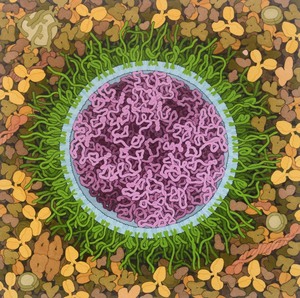
The COVID19 mRNA vaccine (ie. Pfizer/BioNTech and Moderna) painted by artist and biologist David Goodsell. To wit:

The vaccine structure is highly idealized, with spike mRNA in magenta, lipids in blue, and PEG-lipid in green. The background is blood serum or lymph.

In the spirit of biological ecumenism, he did a lovely portrait of the ‘boul coronavirus back in February.

kottke

There’ve been a few (but none quite like the outgoing one).

Behold: a spectacular display of mammatus (breast-like) clouds over Mount Rushmore last September. To wit:

Unlike normal flat-bottomed clouds which form when moist and calm air plateaus rise and cool, bumpy mammatus clouds form as icy and turbulent air pockets sink and heat up. Such turbulent air is frequently accompanied by a thunderstorm. Each mammatus lobe spans about one kilometre. The greater mountain is known to native Lakota Sioux as Six Grandfathers, deities responsible for the directions north, south, east, west, up, and down.

(Image: Laure Mattuzzi)

apod

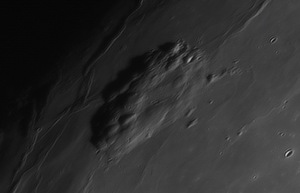
Behold: Mons Rümker: a 70km wide, 1100m high complex of volcanic domes in the great basaltic lunar mare of Oceanus Procellarum, the Ocean of Storms. To wit:

Daylight came to the area late last month. The lunar terminator, the shadow line between night and day, runs diagonally across the left side in this telescopic close-up of a waxing gibbous Moon from November 27. China’s Chang’e-5 mission landing site is also in the frame. The probe’s lander-ascender combination touch down on the lunar surface within a region right of centre and north of Mons Rümker’s domes on December 1. On December 3 the ascender left the Ocean of Storms carrying 2 kilograms of lunar material for return to planet Earth.

(Image: Jean-Yves Letellier)

apod

There’s nothing more peaceful and reassuring as the night sky. Until, as German educational design studio Kurzgesagt reminds us, you realise it’s full of huge objects whizzing about at terrifying speeds. To wit:

..space is big, and so the stars of the Milky Way are very unlikely to hit us. Unfortunately, they don’t have to hit anything to make us have a really bad time on earth. And there are already stars starting to get very close.

Previously: In And Out

Grand spirals like The Whirlpool and the Thousand Ruby Galaxy tend to get all the limelight, but little ‘uns form stars too, like NGC 6822, aka Barnard’s galaxy. To wit:

Beyond the rich starfields in the constellation Sagittarius, NGC 6822 is a mere 1.5 million light-years away, a member of our Local Group of galaxies. A dwarf irregular galaxy similar to the Small Magellanic Cloud, NGC 6822 is about 7,000 light-years across. Brighter foreground stars in our Milky Way have a spiky appearance. Behind them, Barnard’s Galaxy is seen to be filled with young blue stars and mottled with the telltale pinkish hydrogen glow of star forming regions in this deep color composite image.

(Image: Data – Martin Pugh, Processing – Mark Hanson)

apod

Behold: NGC 224, aka Messier 31, aka the Andromeda galaxy. And you can. With the unaided eye. Even though it’s 2.5 million light years away. To wit:

Most other apparent denizens of the night sky — stars, clusters, and nebulae — typically range from a few hundred to a few thousand light-years away and lie well within our own Milky Way Galaxy. Given its distance, light from Andromeda is likely also the oldest light that you can see. Also known as M31, the Andromeda Galaxy dominates the center of the featured zoomed image, taken from the dunes of Bahía Creek, Patagonia, in southern Argentina. The image is a combination of 45 background images with one foreground image — all taken with the same camera and from the same location within 90 minutes. M110, a satellite galaxy of Andromenda is visible just below and to the left of M31’s core. As cool as it may be to see this neighboring galaxy to our Milky Way with your own eyes, long duration camera exposures can pick up many faint and breathtaking details. Recent data indicates that our Milky Way Galaxy will collide and combine with the similarly-sized Andromeda galaxy in a few billion years.

(Image: Gerardo Ferrarino)

apod

Behold: NGC 7293, aka, the Helix Nebula – the brightest and closest example of a planetary nebula – the expanding, glowing shell of ionised gas created in the last days of a Sun-like star. One day, our own dear Sol might look like this. To wit:

The outer gasses of the star expelled into space appear from our vantage point as if we are looking down a helix. The remnant central stellar core, destined to become a white dwarf star, glows in light so energetic it causes the previously expelled gas to fluoresce. The Helix Nebula […] lies about 700 light-years away towards the constellation of the Water Bearer (Aquarius) and spans about 2.5 light-years. The featured picture was taken with the Canada-France-Hawaii Telescope (CFHT) located atop a dormant volcano in Hawaii, USA. A close-up of the inner edge of the Helix Nebula shows complex gas knots of unknown origin.

(Image: CFHT, Coelum, MegaCam, J.-C. Cuillandre (CFHT) & G. A. Anselmi (Coelum)

apod

Last Sunday, a SpaceX Falcon 9 rocket launched from from Kennedy Space Centre’s Launch Complex 39A. It would be back. To wit:

This 3 minute 20 second exposure traces the launch streak as seen over watery reflections from Port Canaveral, about 15 miles south of the launch. The rocket carried four astronauts en route to the International Space Station on the first flight of a NASA-certified commercial human spacecraft system. Dubbed Resilience, the astronauts’ Crew Dragon spacecraft successfully docked with the orbital outpost one day later, on Monday, November 16. At the conclusion of their six-month stay on the ISS, the Crew-1 astronauts will use their spacecraft to return to Earth. Of course about 9 minutes after launch the Falcon 9 rocket’s first stage returned to Earth, landing in the Atlantic Ocean on autonomous spaceport drone ship Just Read The Instructions. 

(Image: Jen Scott)

apod

Star clusters are impressive things on their own. But why have one when you can have a pair? Behold: open clusters NGC 869 and NGC 884. To wit:

Also known as “h and chi Persei”, this unusual double cluster, shown above, is bright enough to be seen from a dark location without even binoculars. Although their discovery surely predates recorded history, the Greek astronomer Hipparchus notably cataloged the double cluster. The clusters are over 7,000 light years distant toward the constellation of Perseus, but are separated by only hundreds of light years. In addition to being physically close together, the clusters’ ages based on their individual stars are similar – evidence that both clusters were likely a product of the same star-forming region.

(Image: Greg Polanski)

apod

Your man on the left there.  Big long streak. Very mysterious. To wit:

Known as Strong Thermal Emission Velocity Enhancements (STEVEs), these luminous light-purple sky ribbons may resemble regular auroras, but recent research reveals significant differences. A STEVE‘s great length and unusual colours, when measured precisely, indicate that it may be related to a subauroral ion drift (SAID), a supersonic river of hot atmospheric ions thought previously to be invisible. Some STEVEs are now also thought to be accompanied by green picket fence structures, a series of sky slats that can appear outside of the main auroral oval that does not involve much glowing nitrogen. The featured wide-angle composite image shows a STEVE in a dark sky above Childs Lake, Manitoba, Canada in 2017, crossing in front of the central band of our Milky Way Galaxy.

(Image: NASA, Krista Trinder)

apod