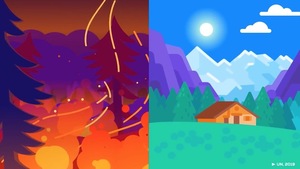
German educational design studio Kurzgesagt lays out the science with its trademark authoritative calm. To wit:
Since the Industrial Revolution, humans have released over 1.5 trillion tonnes of carbon dioxide or CO2 into the earth’s atmosphere.In the year 2019we were still pumping outaround 37 billion more.That’s 50% more than the year 2000 and almost three times as much as 50 years ago.
Three planets rising behind the Moon? No, just the one. And it’s not the Earth. To wit:
Just after sunrise two days ago, both the Moon and Venus also rose. But then the Moon overtook Venus. In the featured image sequence centered on the Moon, Venus is shown increasingly angularly close to the Moon. In the famous Earthrise image taken just over 50 years ago, the Earth was captured rising over the edge of the Moon, as seen from the Apollo 8 crew orbiting the Moon. This similar Venus-set image was taken from Earth, of course, specifically Estonia. Venus shows only a thin crescent because last week it passed nearly in front of the Sun, as seen from Earth. The Moon shows only a thin crescent because it will soon be passing directly in front of the Sun, as seen from Earth.
Meh. It’s been Summer in the north of Saturn’s largest moon since May 24th, 2017. To wit:
Orbiting the gas giant, Saturn’s moon Titan experiences the Saturnian seasons that are about 7 Earth-years long. Larger than inner planet Mercury, Titan was captured in this Cassini spacecraft image about two weeks after its northern summer began. The near-infrared view finds bright methane clouds drifting through Titan’s dense, hazy atmosphere as seen from a distance of about 507,000 kilometers. Below the clouds, dark hydrocarbon lakes sprawl near its fully illuminated north pole.
Because the moon’s not normally in the way, as it was on the morning of May 10th, 2013 when seen from Western Australia. To wit:
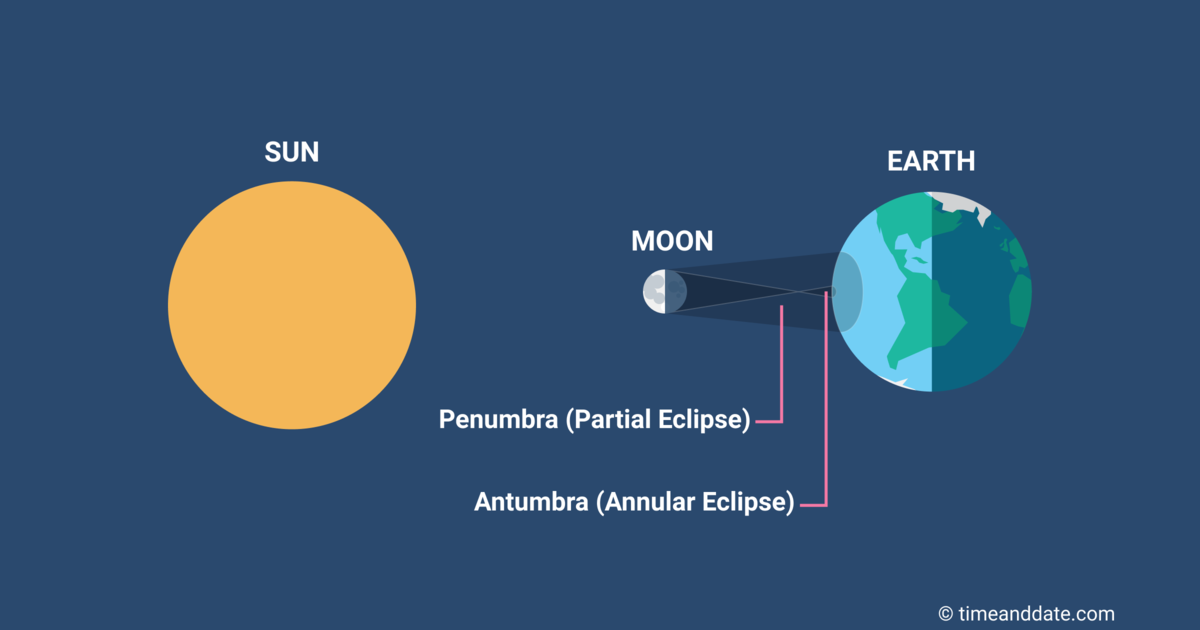
At times, it would be hard for the uninformed to understand what was happening. In an annular eclipse, the Moon is too far from the Earth to block the entire Sun, and at most leaves a ring of fire where sunlight pours out around every edge of the Moon. The featured time-lapse video also recorded the eclipse through the high refraction of the Earth’s atmosphere just above the horizon, making the unusual rising Sun and Moon appear also flattened. As the video continues on, the Sun continues to rise, and the Sun and Moon begin to separate. This weekend, a new annular solar eclipse will occur, visible from central Africa, the Arabian Peninsula, and a narrow band across Asia, with much of Earth’s Eastern hemisphere being able to see a partial solar eclipse.
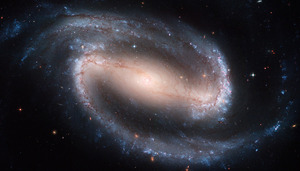
Behold: big, beautiful barred spiral galaxy NGC 1300 – a mere 61 million light years distant on the banks of the constellation Eridanus. To wit:
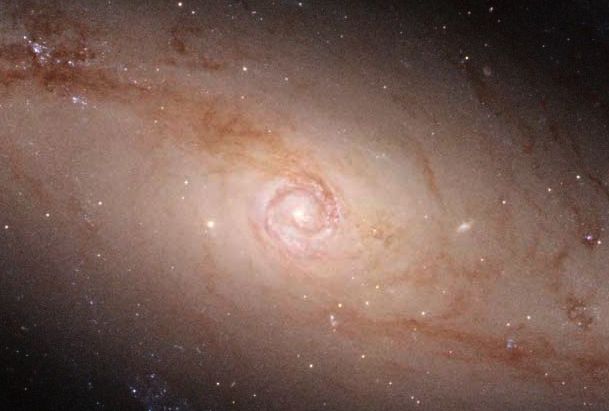
This Hubble Space Telescope composite view of the gorgeous island universe is one of the largest Hubble images ever made of a complete galaxy. NGC 1300 spans over 100,000 light-years and the Hubble image reveals striking details of the galaxy’s dominant central bar and majestic spiral arms. In fact, on close inspection the nucleus of this classic barred spiral itself shows a remarkable region of spiral structure about 3,000 light-years across. Like other spiral galaxies, including our own Milky Way, NGC 1300 is thought to have a supermassive central black hole.
Behold: the emission nebula NGC 2359 – a whopping winged lid (if that’s what you see) almost 30 light years across. To wit:
In fact, the helmet is more like an interstellar bubble, blown as a fast wind from the bright, massive star near the bubble’s centre inflates a region within the surrounding molecular cloud. Known as a Wolf-Rayet star, the central star is an extremely hot giant thought to be in a brief, pre-supernova stage of evolution. NGC 2359 is located about 15,000 light-years away in the constellation of the Great Overdog. The remarkably sharp image is a mixed cocktail of data from broadband and narrowband filters using three different telescopes. It captures natural looking stars and the details of the nebula’s filamentary structures. The predominant bluish hue is strong emission from doubly ionized oxygen atoms in the glowing gas.
Behold NGC 6543, otherwise known as The Cat’s Eye – a planetary nebula revealed here in a stunning false colour image that shows the huge (three light years across) but otherwise faint halo of gaseous material that surrounds it. To wit:
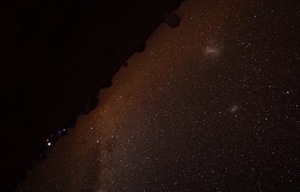
No, not witchcraft. Rather, 24 hours of locked-off Earth rotation condensed into a dizzying 24 minute time-lapse filmed at Tivoli, Namibia by Polish photographer Bartosz Wojczyński
Bartosz attached his camera to a SW Star Adventurer mount, if you must know.
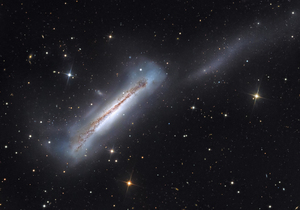
Behold: a deep portrait of the edge-on spiral galaxy NGC 3628, also known as the Hamburger Galaxy. To wit:
It also reveals a small galaxy nearby, likely a satellite of NGC 3628, and a faint but extensive tidal tail. The drawn out tail stretches for about 300,000 light-years, even beyond the right edge of the wide frame. NGC 3628 shares its neighborhood in the local universe with two other large spirals M65 and M66 in a grouping otherwise known as the Leo Triplet. Gravitational interactions with its cosmic neighbors are likely responsible for creating the tidal tail, as well as the extended flare and warp of this spiral’s disk. The tantalizing island universe itself is about 100,000 light-years across and 35 million light-years away in the northern springtime constellation Leo.