
Category Archives: Science

Wait. What the? To wit:

Pictured here are anticrepuscular rays. To understand them, start by picturing common crepuscular rays that are seen any time that sunlight pours though scattered clouds. Now although sunlight indeed travels along straight lines, the projections of these lines onto the spherical sky are great circles. Therefore, the crepuscular rays from a setting (or rising) sun will appear to re-converge on the other side of the sky. At the anti-solar point 180 degrees around from the Sun, they are referred to as anticrepuscular rays. Featured here is a particularly striking display of anticrepuscular rays photographed in 2016 over Dry Tortugas National Park in Florida, USA.

(Image: Bryan Goff)

apod

An image taken in Guatemala in late 2019. Lights from small towns are visible in the foreground behind the huge Pacaya volcano. But why does Saturn appear so big? To wit:

It doesn’t — what is pictured are foreground clouds on Earth crossing in front of the Moon. The Moon shows a slight crescent phase with most of its surface visible by reflected Earthlight known as ashen glow. The Sun directly illuminates the brightly lit lunar crescent from the bottom, which means that the Sun must be below the horizon and so the image was taken before sunrise.This double take-inducing picture was captured on 2019 December 24, two days before the Moon slid in front of the Sun to create a solar eclipse. 

(Image: Francisco Sojuel)

apod

An 84 second long exposure (from a revolving planet) capturing the flight of a Falcon 9 rocket and Dragon cargo spacecraft over Cape Canaveral Air Force Station shortly after launch, on a resupply mission bound for the International Space Station. To wit:

Beginning its return to a landing zone about 9 kilometers from the launch site, the Falcon 9 first stage boostback burn arcs toward the top of the frame. The second stage continues toward low Earth orbit though, its own fiery arc traced below the first stage boostback burn from the camera’s perspective, along with expanding exhaust plumes from the two stages. This Dragon spacecraft was a veteran of two previous resupply missions. Successfully returning to the landing zone, this Falcon 9 first stage had flown before too. Its second landing marked the 50th landing of a SpaceX orbital class rocket booster.

(Image: John Kraus)

apod

Behold: a wide field view of the busy celestial neighbourhood of Monocerous – the Unicorn Constellation – containing the Cone Nebula, the Christmas Tree Cluster, and more besides. To wit:

Pictured as a star forming region and cataloged as NGC 2264, the complex jumble of cosmic gas and dust is about 2,700 light-years distant and mixes reddish emission nebulae excited by energetic light from newborn stars with dark interstellar dust clouds. Where the otherwise obscuring dust clouds lie close to the hot, young stars they also reflect starlight, forming blue reflection nebulae. The featured wide-field image spans over three times the diameter of a full moon, covering over 100 light-years at the distance of NGC 2264. Its cast of cosmic characters includes the Fox Fur Nebula, whose convoluted pelt lies just to the lower right of the image center, bright variable star S Mon visible just above the Fox Fur, and the Cone Nebula just to the left. Given their distribution, the stars of NGC 2264 are also known as the Christmas Tree star cluster.

(Image: Greg Gurdak)

apod

Behold: zodiacal light – seen here as a band of illumination connecting the ground to the Milky Way in the sky above Chile. To wit:

Zodiacal light — a stream of dust that orbits the Sun in the inner Solar System. It is most easily seen just before sunrise, where it has been called a false dawn, or just after sunset. The origin of zodiacal dust remains a topic of research, but is hypothesized to result from asteroid collisions and comet tails. The featured wide-angle image shows the central band of our Milky Way Galaxy arching across the top, while the Large Magellanic Cloud (LMC), a satellite galaxy to our Milky Way, is visible on the far left. The image is a combination of over 30 exposures taken last July near La Serena among the mountains of Chile. During the next two months, zodiacal light can appear quite prominent in northern skies just after sunset.

(Image: Roman Ponča (ht: Masaryk U.))

apod

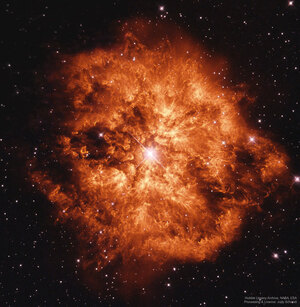
Behold: Wolf-Rayet star 124 – the ultimate action hero backdrop –  its violent stellar winds expelling glowing plumes of gas 300 times larger than the earth. To wit:

Wolf-Rayet star WR 124, visible near the featured image center spanning six light years across, is thus creating the surrounding nebula known as M1-67. Details of why this star has been slowly blowing itself apart over the past 20,000 years remains a topic of research. WR 124 lies 15,000 light-years away towards the constellation of the Arrow (Sagitta). The fate of any given Wolf-Rayet star likely depends on how massive it is, but many are thought to end their lives with spectacular explosions such as supernovas or gamma-ray bursts.

(Image: Hubble Legacy Archive, NASA, ESA; Processing & License: Judy Schmidt)

apod

Behold: the slow, slow dance of galaxies NGC 5394 and NGC 5395. How slow? Each turn takes several hundred million years. To wit:

NGC 5394 and NGC 5395, slowly whirl about each other in a gravitational interaction that sets off a flourish of sparks in the form of new stars. The featured image, taken with the Gemini North 8-meter telescope on Maunakea, Hawaii, USA, combines four different colours. Emission from hydrogen gas, coloured red, marks stellar nurseries where new stars drive the evolution of the galaxies. Also visible are dark dust lanes that mark gas that will eventually become stellar nurseries. If you look carefully you will see many more galaxies in the background, some involved in their own slow cosmic dances.

(Image: Gemini, NSF, OIR Lab, AURA; Text: Ryan Tanner (NASA/USRA))

apod

Behold: Sharpless 308 – the ‘Dolphin nebula’ – a cosmic bubble much larger than it appears to be. To wit:

…it lies some 5,200 light-years away toward the constellation of the Big Dog (Canis Major) and covers slightly more of the sky than a Full Moon. That corresponds to a diameter of 60 light-years at its estimated distance. The massive star that created the bubble, a Wolf-Rayet star, is the bright one near the centre of the nebula. Wolf-Rayet stars have over 20 times the mass of the Sun and are thought to be in a brief, pre-supernova phase of massive star evolution. Fast winds from this Wolf-Rayet star create the bubble-shaped nebula as they sweep up slower moving material from an earlier phase of evolution. The windblown nebula has an age of about 70,000 years. Relatively faint emission captured in the featured expansive image is dominated by the glow of ionised oxygen atoms mapped to a blue hue.

(Image : Chilesope 2, Pleaides Astrophotography Team (Peking U.))

apod

German educational design studio Kurzgesagt examines Peto’s Paradox. To wit:

Cancer is a creepy and mysterious thing. While we tried to understand it, to get better at killing it, we discovered a biological paradox that remains unsolved to this day: large animals seem to be immune to cancer. Which doesn’t make any sense – the bigger a being, the more cancer it should have. To understand why, we first need to take a look at the nature of cancer itself.

Previously: Got White Poison?

A two-hemisphere view of earth’s night sky composited from images captured at two corresponding latitudes – one at 29 degrees north of the equator, the other at 29 degrees south. To wit:

On top is the northern view from the IAC observatory at La Palma taken in February 2020. Below is a well-matched southern scene from the ESO La Silla Observatory recorded in April 2016. In this projection, the Milky Way runs almost vertically above and below the horizon. Its dark clouds and and bright nebulae are prominent near the galactic centre in the lower half of the frame. In the upper half, brilliant Venus is immersed in zodiacal light. Sunlight faintly scattered by interplanetary dust, the zodiacal light traces the Solar System’s ecliptic plane in a complete circle through the starry sky. Large telescope domes bulge along the inverted horizon from La Silla while at La Palma, multi-mirror Magic telescopes stand above centre. Explore this two hemisphere night sky and you can also find the Andromeda Galaxy and the Large and Small Magellanic Clouds.

(Image: Petr Horálek/ESO, Juan Carlos Casado/IAC (TWAN))

apod