
Category Archives: Science

Behold: NGC 1672 – one of many spiral galaxies (our own Milky Way included) to have a bar across their central core. To wit:

Prominently barred spiral galaxy NGC 1672  was captured in spectacular detail in an image taken by the orbiting Hubble Space Telescope. Visible are dark filamentary dust lanes, young clusters of bright blue stars, red emission nebulas of glowing hydrogen gas, a long bright bar of stars across the centre, and a bright active nucleus that likely houses a supermassive black hole. Light takes about 60 million years to reach us from NGC 1672, which spans about 75,000 light years across. NGC 1672, which appears toward the constellation of the Dolphinfish (Dorado), has been studied to find out how a spiral bar contributes to star formation in a galaxy’s central regions.

(Image: Hubble Legacy Archive, NASA, ESA; Processing & Copyright: Daniel Nobre)
apod

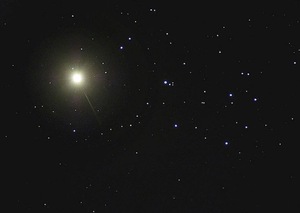
That especially bright star in the evening sky of late is actually the planet Venus. This evening, it will begin to cross the beautiful Pleiades or Seven Sisters star cluster. To wit:

This digital sky map illustrates the path of the inner planet as the beautiful conjunction evolves, showing its position on the sky over the next few days. The field of view shown is appropriate for binocular equipped skygazers but the star cluster and planet are easily seen with the naked-eye. As views from Earth (top pic, 2004), Venus again passed in front of the Seven Sisters (pic 2) 8 years ago, and will again 8 years hence. In fact, orbiting the Sun 13 Venus years are almost equal to 8 years on planet Earth. So we can expect our sister planet to visit nearly the same place in our sky every 8 years.

(Image: David Cortner, Digital image: Fred Espenak (Bifrost Astronomical Observatory)

apod

Behold: the centre of the Milky Way galaxy – 26,000 light years from us toward the constellation of Sagittarius, glowing with every type of light we can see, and a few we can’t. To wit:

In the featured image, high-energy X-ray emission captured by NASA’s orbiting Chandra X-Ray Observatory appears in green and blue, while low-energy radio emission captured by SARAO‘s ground-based MeerKAT telescope array is coloured red. Just on the right of the colourful central region lies Sagittarius A (Sag A), a strong radio source that coincides with Sag A*, our Galaxy’s central supermassive black hole. Hot gas surrounds Sag A, as well as a series of parallel radio filaments known as the Arc, seen just left of the image center. Numerous unusual single radio filaments are visible around the image. Many stars orbit in and around Sag A, as well as numerous small black holes and dense stellar cores known as neutron stars and white dwarfs. The Milky Way’s central supermassive black hole is currently being imaged by the Event Horizon Telescope.

(Image: X-Ray: NASA, CXC, UMass, D. Wang et al.; Radio: NRF, SARAO, MeerKAT)

apod

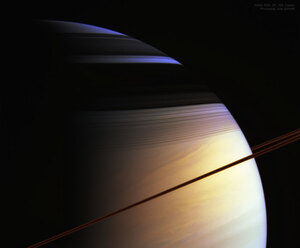
Behold: an only slightly exaggerated view of what one would see if hovering close to the ringed gas giant. To wit:

The image was taken in 2005 by the robot Cassini spacecraft that orbited Saturn from 2004 to 2017. Here Saturn’s majestic rings appear directly only as a curved line, appearing brown, in part, from its infrared glow. The rings best show their complex structure in the dark shadows they create across the upper part of the planet. The northern hemisphere of Saturn can appear partly blue for the same reason that Earth’s skies can appear blue — molecules in the cloudless portions of both planet’s atmospheres are better at scattering blue light than red. When looking deep into Saturn’s clouds, however, the natural gold hue of Saturn’s clouds becomes dominant. It is not known why southern Saturn does not show the same blue hue — one hypothesis holds that clouds are higher there. It is also not known why some of Saturn’s clouds are coloured gold.

(Image: NASA, ESA, JPL, ISS, Cassini Imaging Team; Processing & License: Judy Schmidt)

apod

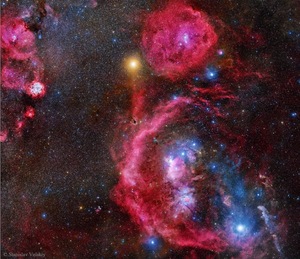
So much more than a belt of three stars, the constellation of Orion is rich in nebulae, as seen in this painstaking composite of extremely long exposures captured on clear nights in 2013 and 2014. To wit:

After 212 hours of camera time and an additional year of processing, the featured 1400-exposure collage spanning over 40 times the angular diameter of the Moon emerged. Of the many interesting details that have become visible, one that particularly draws the eye is Barnard’s Loop, the bright red circular filament arcing down from the middle. The Rosette Nebula is not the giant red nebula near the top of the image — that is a larger but lesser known nebula known as Lambda Orionis. The Rosette Nebula is visible, though: it is the red and white nebula on the upper left. The bright orange star just above the frame center is Betelgeuse, while the bright blue star on the lower right is Rigel. Other famous nebulas visible include the Witch Head Nebula, the Flame Nebula, the Fox Fur Nebula, and, if you know just where to look, the comparatively small Horsehead Nebula. About those famous three stars that cross the belt of Orion the Hunter — in this busy frame they can be hard to locate, but a discerning eye will find them just below and to the right of the image centre.

(Image: Stanislav Volskiy, Annotation: Judy Schmidt)

apod

Behold: star forming region Sharpless 106, at the centre of which is the massive star IRS4 – one of very few stars to be younger than the human race. To wit:

Born only about 100,000 years ago, material streaming out from this newborn star has formed the nebula S106.  A large disk of dust and gas orbiting Infrared Source 4 (IRS 4), visible in brown near the image centre, gives the nebula an hourglass or butterfly shape. S106 gas near IRS 4 acts as an emission nebula as it emits light after being ionised, while dust far from IRS 4 reflects light from the central star and so acts as a reflection nebula. Detailed inspection of a relevant infrared image of S106 reveal hundreds of low-mass brown dwarf stars lurking in the nebula’s gas. S106 spans about 2 light-years and lies about 2000 light-years away toward the constellation of the Swan (Cygnus).

(Image: NASA, ESA, Hubble Legacy Archive; Processing & Copyright: Utkarsh Mishra)

apod

Behold: the Pleiades and Hyades star clusters – proof that the longer you stare at the sky, the more insanely detailed it becomes. To wit:

 Long duration camera exposures reveal an intricate network of interwoven interstellar dust and gas that was previously invisible not only to the eye but to lower exposure images. In the featured wide and deep mosaic, the dust stands out spectacularly, with the familiar Pleaides star cluster visible as the blue patch near the top of the image. Blue is the color of the Pleiades’ most massive stars, whose distinctive light reflects from nearby fine dust. On the upper left is the Hyades star cluster surrounding the bright, orange, foreground-star Aldebaran. Red glowing emission nebula highlight the bottom of the image, including the curving vertical red ribbon known as the Eridanus Loop. The pervasive dust clouds appear typically in light brown and are dotted with unrelated stars.

(image: Hirofumi Okubo)

apod

Behold: Comet ATLAS C/2019 Y4 – the last reported comet discovered in 2019 by the  Asteroid Terrestrial-impact Last Alert System. It’s inbound, but don’t hold your breath. To wit:

Now growing brighter in northern night skies, the comet’s pretty greenish coma is at the upper left of this telescopic skyview captured from a remotely operated observatory in New Mexico on March 18. At lower right (top image) are M81 and M82, well-known as large, gravitationally interacting galaxies. Seen through faint dust clouds above the Milky Way, the galaxy pair lies about 12 million light-years distant, toward the constellation Ursa Major. (…/) Comet ATLAS is about 9 light-minutes from Earth, still beyond the orbit of Mars. The comet’s elongated orbit is similar to orbit of the Great Comet of 1844 though, a trajectory that will return this comet to the inner Solar System in about 6,000 years. Comet ATLAS will reach a perihelion or closest approach to the Sun on May 31 inside the orbit of Mercury and may become a naked-eye comet in the coming days.

Larger view here.

(Image: Rolando Ligustri (CARA Project, CAST))

apod

Behold: Messier 13 – the Great Globular Cluster in the constellationn of Hercules – one of the brightest in the Northern sky. To wit:

In 1716, English astronomer Edmond Halley noted, “This is but a little Patch, but it shews itself to the naked Eye, when the Sky is serene and the Moon absent.” (…/) Sharp telescopic views like this one reveal the spectacular cluster’s hundreds of thousands of stars. At a distance of 25,000 light-years, the cluster stars crowd into a region 150 light-years in diameter. Approaching the cluster core upwards of 100 stars could be contained in a cube just 3 light-years on a side. For comparison, the closest star to the Sun is over 4 light-years away. The remarkable range of brightness recorded in this image follows stars into the dense cluster core and reveals three subtle dark lanes forming the apparent shape of a propeller just below and slightly left of centre. Distant background galaxies in the medium-wide field of view include NGC 6207 at the upper left. 

Large version here.

Previous MGIFOS: Omega Centauri, NGC 6752 and NGC 7089

(Image: Eric Coles and Mel Helm)

apod

Why all this hoo-hah about soap and water? Surely we’re better off with that hand sanitiser we managed to wrestle out of the hands of some old lady before Tesco ran out? Nope.

20 seconds with even  the cheapest, nastiest soap spells dissolution and doom for COVID-19, as this usefully kid-friendly video from Vox explains.

tksst