

Category Archives: Science

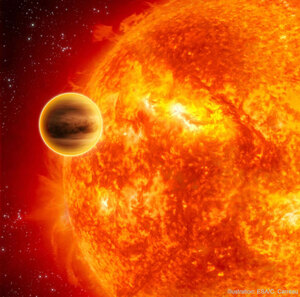
An artist’s impression of a ‘hot Jupiter ‘ recently discovered to contain water vapour (much good it’ll do it) by NASA’s Spitzer space telescope. ‘Hot Jupiters’ are giant planets that orbit much closer to their sun than our own Mercury does. And this one – NGTS-10b – is a doozy. To wit:

NGTS-10b, illustrated generically, is the closest and fastest-orbiting giant planet yet discovered, circling its home star in only 18 hours. NGTS-10b is a little larger than Jupiter, but it orbits less than two times the diameter of its parent star away from the star’s surface. When a planet orbits this close, it is expected to spiral inward, pulled down by tidal forces to be eventually ripped apart by the star’s gravity. NGTS-10b, discovered by researchers at the University of Warwick, is named after the Next Generation Transit Survey, which detected the imperiled planet when it passed in front of its star, blocking some of the light. Although the violent demise of NGTS-10b will happen eventually, we don’t yet know when.

(Illustration: ESA, C. Carreau)

apod/alexrlowe

Behold: LDN 1622 – Lynd’s Dark Nebula – an intriguing cosmic silhouette visible (but only in long telescopic exposures like this one) against a faint background of glowing hydrogen gas. To wit: 

In contrast, the brighter reflection nebula vdB 62 is more easily seen, just above and right of center. LDN 1622 lies near the plane of our Milky Way Galaxy, close on the sky to Barnard’s Loop, a large cloud surrounding the rich complex of emission nebulae found in the Belt and Sword of Orion. With swept-back outlines, the obscuring dust of LDN 1622 is thought to lie at a similar distance, perhaps 1,500 light-years away. At that distance, this 1 degree wide field of view would span about 30 light-years. Young stars do lie hidden within the dark expanse and have been revealed in Spitzer Space telescope infrared images. 

(Image: Min Xie)

apod

An otherworldly lunar display captured two weeks ago (in three combined exposures) above Manitoba, Canada – moonlight refracted, reflected and diffused by millions of falling ice crystals. To wit:

The colourful rings are a corona caused by quantum diffraction by small drops of water or ice near the direction of the Moon. Outside of that, a 22-degree halo was created by moonlight refracting through six-sided cylindrical ice crystals. To the sides are moon dogs, caused by light refracting through thin, flat, six-sided ice platelets as they flittered toward the ground. Visible at the top and bottom of the 22-degree halo are upper and lower tangent arcs, created by moonlight refracting through nearly horizontal hexagonal ice cylinders. A few minutes later, from a field just off the road to work, the halo and arcs had disappeared, the sky had returned to normal — with the exception of a single faint moon.

Related: Halo You

(Image: Brent Mckean)

apod

Behold: one of the most familiar sights in the night sky: Orion – seen here above the Central Bohemian Highlands of the Czech Republic – the constellation has been known to stargazers for over 30,000 years. To wit:

Orion has looked pretty much the same during this time and should continue to look the same for many thousands of years into the future. Prominent Orion is high in the sky at sunset this time of year, a recurring sign of (modern) winter in Earth‘s northern hemisphere and summer in the south. The featured picture is a composite of over thirty images taken from the same location and during the same night last month. Below and slightly to the left of Orion’s three-star belt is the Orion Nebula, while four of the bright stars surrounding the belt are, clockwise, Sirius (far left, blue), Betelgeuse (top, orange, unusually faint), Aldebaran (far right), and Rigel (below). As future weeks progress, Orion will set increasingly earlier.

(Image: Vojtěch Bauer)

apod

At least, none we know of. Behold: UGC 12951. Nice. But what is it? A spiral galaxy with its rings of dark dust lanes? Or a lenticular galaxy with its great bulging diffusion of stars? Maybe a bit of both. To wit:

Surprisingly observations show that UGC 12591 spins at about 480 km/sec, almost twice as fast as our Milky Way, and the fastest rotation rate yet measured. The mass needed to hold together a galaxy spinning this fast is several times the mass of our Milky Way Galaxy. Progenitor scenarios for UGC 12591 include slow growth by accreting ambient matter, or rapid growth through a recent galaxy collision or collisions — future observations may tell. The light we see today from UGC 12591 left about 400 million years ago, when trees were first developing on Earth.

(Image: NASA, ESA, Hubble; Processing & Copyright: Leo Shatz)

apod

Behold: the double-shelled Eskimo Nebula (also known as the Clownface Nebula or Caldwell 39).

Some say it looks like a human head in a furry parka hood. But not astronomer William Herschel, who discovered it in 1787. For him, it was named NGC  2392 WH IV-45. To wit:

More recently, the Hubble Space Telescope imaged the nebula in visible light, while the nebula was also imaged in X-rays by the Chandra X-ray Observatory. The featured combined visible-X ray image, shows X-rays emitted by central hot gas in pink. The nebula displays gas clouds so complex they are not fully understood. NGC 2392 is a double-shelled planetary nebula, with the more distant gas having composed the outer layers of a Sun-like star only 10,000 years ago. The outer shell contains unusual light-year long orange filaments. The inner filaments visible are being ejected by strong wind of particles from the central star. The NGC 2392 Nebula spans about 1/3 of a light year and lies in our Milky Way Galaxy, about 3,000 light years distant, toward the constellation of the Twins (Gemini).

(Image: NASA, ESA, Hubble, Chandra; Processing & License: Judy Schmidt)

apod

Behold: NGC 3372, aka The Great Carina Nebula – 300 light years across – one of the largest star-forming regions in the Milky Way. To wit:

Like the smaller, more northerly Great Orion Nebula, the Carina Nebula is easily visible to the unaided eye, though at a distance of 7,500 light-years it is some 5 times further away. This gorgeous telescopic close-up reveals remarkable details of the region’s central glowing filaments of interstellar gas and obscuring cosmic dust clouds in a field of view nearly 20 light-years across. The Carina Nebula is home to young, extremely massive stars, including the still enigmatic and violently variable Eta Carinae, a star system with well over 100 times the mass of the Sun. In the processed composite of space and ground-based image data, a dusty, two-lobed Homunculus Nebula appears to surround Eta Carinae itself just below and left of center. While Eta Carinae is likely on the verge of a supernova explosion, X-ray images indicate that the Great Carina Nebula has been a veritable supernova factory.

(Image: NASA, ESA, Hubble, ESO, Amateur Data; Processing & Copyright: Robert Gendler & Roberto Colombari)

apod