
Category Archives: Science

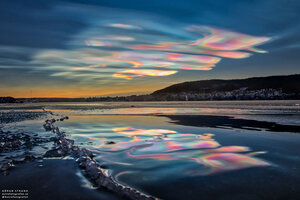
Another gorgeous shot of the ‘Mother of Pearl’ or nacreous cloud formations which occurred late last year over Sweden, in this case, on New Year’s Eve in the skies above Ostersund. To wit:

A relatively rare phenomenon in clouds known as iridescence can bring up unusual colours vividly or even a whole spectrum of colours simultaneously. These polar stratospheric clouds clouds (…) are formed of small water droplets of nearly uniform size. When the Sun is in the right position and, typically, hidden from direct view, these thin clouds can be seen significantly diffracting sunlight in a nearly coherent manner, with different colors being deflected by different amounts. Therefore, different colours will come to the observer from slightly different directions. Many clouds start with uniform regions that could show iridescence but quickly become too thick, too mixed, or too angularly far from the Sun to exhibit striking colours. 

(Image: Goran Strand)
apod

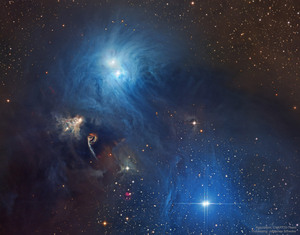
Behold: cosmic dust clouds and young, energetic stars on the northern border of Corona Australis. To wit:

The dust clouds effectively block light from more distant background stars in the Milky Way. But the striking complex of reflection nebulae cataloged as NGC 6726, 6727, and IC 4812 produce a characteristic blue color as light from the region’s young hot stars is reflected by the cosmic dust. The dust also obscures from view stars still in the process of formation. At the left, smaller yellowish nebula NGC 6729 bends around young variable star R Coronae Australis. Just below it, glowing arcs and loops shocked by outflows from embedded newborn stars are identified as Herbig-Haro objects. On the sky this field of view spans about 1 degree. That corresponds to almost 9 light-years at the estimated distance of the nearby star forming region.

(Image: CHART32 Team, Processing – Johannes Schedler)

apod

Behold: NGC 602 – a cluster of stars 200,000 light years away near the outskirts of the Small Magellanic Cloud, captured in a stunning image by the Hubble Space Telescope. To wit:

…augmented by images in the X-ray by Chandra, and in the infrared by Spitzer. Fantastic ridges and swept back shapes strongly suggest that energetic radiation and shock waves from NGC 602’s massive young stars have eroded the dusty material and triggered a progression of star formation moving away from the cluster’s center. At the estimated distance of the Small Magellanic Cloud, the Picture spans about 200 light-years, but a tantalizing assortment of background galaxies are also visible in this sharp multi-colored view. The background galaxies are hundreds of millions of light-years or more beyond NGC 602.

(Image: X-ray: Chandra: NASA/CXC/Univ.Potsdam/L.Oskinova et al; Optical: Hubble: NASA/STScI; Infrared: Spitzer: NASA/JPL-Caltech)

apod

Behold: vivid iridescent nacreous or ‘mother of pearl’ clouds over Tandalen in Sweden late last week. To wit:

 …they are rare. This northern winter season they have been making unforgettable appearances at high latitudes, though. A type of polar stratospheric cloud, they form when unusually cold temperatures in the usually cloudless lower stratosphere form ice crystals. Still sunlit at altitudes of around 15 to 25 kilometers the clouds can diffract sunlight after sunset and before the dawn.

Image: P-M Hedén (Clear Skies, TWAN)

apod

Behold: the face-on spiral of M33, aka the Pinwheel Galaxy, aka The Triangulum Galaxy. To wit:

M33 is over 50,000 light-years in diameter, third largest in the Local Group of galaxies after the Andromeda Galaxy (M31), and our own Milky Way. About 3 million light-years from the Milky Way, M33 is itself thought to be a satellite of the Andromeda Galaxy and astronomers in these two galaxies would likely have spectacular views of each other’s grand spiral star systems. As for the view from planet Earth, this sharp image shows off M33’s blue star clusters and pinkish star forming regions along the galaxy’s loosely wound spiral arms. In fact, the cavernous NGC 604 is the brightest star forming region, seen here at about the 7 o’clock position from the galaxy center. Like M31, M33’s population of well-measured variable stars have helped make this nearby spiral a cosmic yardstick for establishing the distance scale of the Universe.

(Image: Rui Liao)

apod

Behold: the rippling dust and gas lanes of IC405 – the Flaming Star Nebula. To wit:

The orange and purple colours of the nebula are present in different regions and are created by different processes. The bright star AE Aurigae, visible toward the image left, is so hot it is blue, emitting light so energetic it knocks electrons away from surrounding gas. When a proton recaptures an electron, red light is frequently emitted (depicted here in orange). The purple region’s colour is a mix of this red light and blue light emitted by AE Aurigae but reflected to us by surrounding dust. The two regions are referred to as emission nebula and reflection nebula, respectively. Pictured here in the Hubble color palette, the Flaming Star Nebula, officially known as IC 405, lies about 1500 light years distant, spans about 5 light years, and is visible with a small telescope toward the constellation of the Charioteer (Auriga).

(Image: Eric Coles and Mel Helm)

apod

Actually, it’s been a lot less pronounced lately.

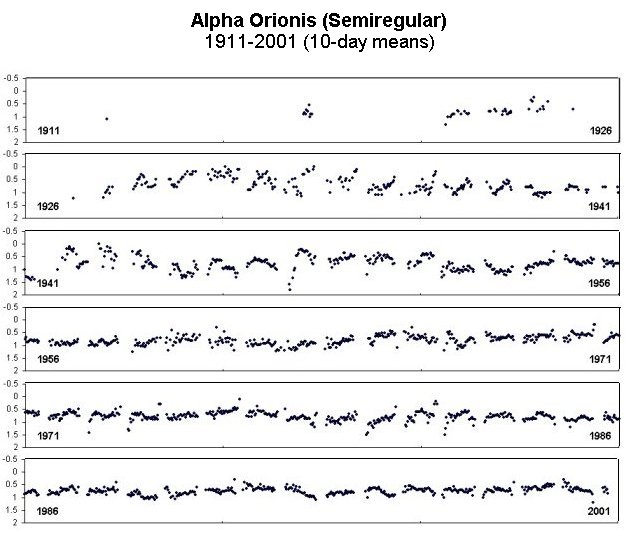
Behold: Betelguese – one of the brightest and most recognised stars in the night sky (it’s that yellowish one off the shoulder of Orion). Only half as bright now as it was five months ago. To wit:

Such variability is likely just normal behavior for this famously variable supergiant, but the recent dimming has rekindled discussion on how long it may be before Betelgeuse does go supernova. Known for its red colour, Betelgeuse is one of the few stars to be resolved by modern telescopes, although only barely. The featured artist’s illustration imagines how Betelgeuse might look up close. Betelgeuse is thought to have a complex and tumultuous surface that frequently throws impressive flares. Were it to replace the Sun (not recommended), its surface would extend out near the orbit of Jupiter, while gas plumes would bubble out past Neptune. Since Betelgeuse is about 700 light years away, its eventual supernova will not endanger life on Earth even though its brightness may rival that of a full Moon. Astronomers — both amateur and professional — will surely continue to monitor Betelgeuse as this new decade unfolds.

(Illustration: ESO, L. Calcada)

apod

Behold: Messier 104, also known as the Sombrero Galaxy – one of the largest galaxies in the nearby Virgo Cluster. To wit:

 The dark band of dust that obscures the mid-section of the Sombrero Galaxy in optical light actually glows brightly in infrared light. The featured image, digitally sharpened, shows the infrared glow, recently recorded by the orbiting Spitzer Space Telescope, superposed in false-color on an existing image taken by NASA’s Hubble Space Telescope in optical light. The Sombrero Galaxy, also known as M104, spans about 50,000 light years across and lies 28 million light years away. M104 can be seen with a small telescope in the direction of the constellation Virgo.

(Image: R. Kennicutt (Steward Obs.) et al., SSC, JPL, Caltech, NASA)

apod