
Category Archives: Science

Like this.

Neutron stars are the collapsed cores of stars which – prior to supernova – had the mass of between 10 and 29 times our own sun. They’re only about 10km in diameter which. In cosmic terms, is very, very small indeed. To wit:

Previously these city-sized stars were too small and too far away to resolve. Recently, however, the first maps of the locations and sizes of hotspots on a neutron star’s surface have been made by carefully modeling how the rapid spin makes the star’s X-ray brightness rise and fall. Based on a leading model, an illustrative map of pulsar J0030+0451‘s hotspots is pictured, with the rest of the star’s surface filled in with a false patchy blue. J0030 spins once every 0.0049 seconds and is located about 1000 light years away. The map was computed from data taken by NASA’s Neutron star Interior Composition ExploreR (NICER) X-ray telescope attached to the International Space Station. The computed locations of these hotspots is surprising and not well understood. Because the gravitational lensing effect of neutron stars is so strong, J0300 displays more than half of its surface toward the Earth. Studying the appearance of pulsars like J0030 allows accurate estimates of the neutron star‘s mass, radius, and the internal physics that keeps the star from imploding into a black hole.


Image: NASA, NICER, GSFC‘s CI Lab

apod

Contrary to previously apocalyptic predictions, the world’s population is actually expected to balance out at around 11 billion by the end of the century. But the big picture hides at last one alarming detail. In another fascinating animated essay, German educational design studio Kurzgesagt, explains:

Sub-Saharan Africa. In 2019 it was home to a billion people living in 46 countries. Although its growth rate has slowed down in the last few decades, it is still much higher than in the rest of the world. While some projections expect around 2.6 billion people others reckon with up to 5 billion by 2100. Such growth would be a huge challenge for any society. But Sub-Saharan Africa is also the poorest region on earth. So is Sub-Saharan Africa doomed? And why do the projections vary by 2.4 billion people? 

Previously: An Antidote To Dissatisfaction

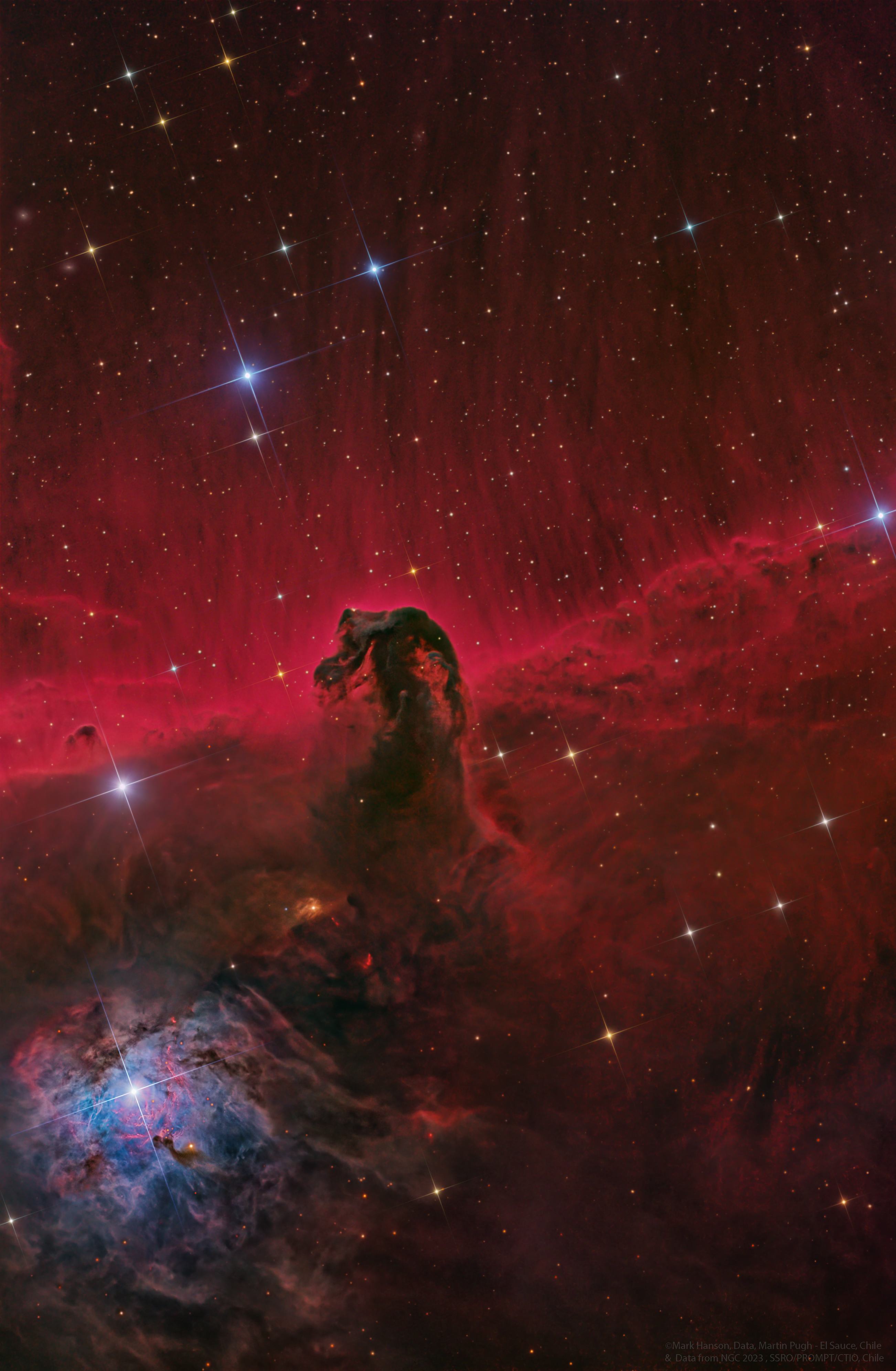
Behold: the Horsehead Nebula, just south of the easternmost star of Orion’s Belt, 1,500 light years distant. To wit:

About five light-years “tall”, the dark cloud is cataloged as Barnard 33 and is visible only because its obscuring dust is silhouetted against the glowing red emission nebula IC 434. Stars are forming within the dark cloud. Contrasting blue reflection nebula NGC 2023, surrounding a hot, young star, is at the lower left of the full image. The featured gorgeous colour image combines both narrowband and broadband images recorded using several different telescopes.

Previously: My Lovely Horse

(Image : Mark Hanson & Martin Pugh, SSRO, PROMPT, CTIO, NSF)

apod

Pendulous mammatus clouds over Hastings, Nebraska in June 2004. To fwoaarr wit:

Normally, cloud bottoms are flat. This is because moist warm air that rises and cools will condense into water droplets at a specific temperature, which usually corresponds to a very specific height. As water droplets grow, an opaque cloud forms. Under some conditions, however, cloud pockets can develop that contain large droplets of water or ice that fall into clear air as they evaporate. Such pockets may occur in turbulent air near a thunderstorm. Resulting mammatus clouds can appear especially dramatic if sunlit from the side.

Side mammatus.

Oh grow up.

RELATED: Boob Clouds Over Michigan.

(Image: Jorn Olsen Photography)

apod

Behold: the 2,000 year-old blast radius of N63A – a supernova remnant, still expanding. To wit:

As little as 2,000 years ago, light from a massive stellar explosion in the Large Magellanic Cloud (LMC) first reached planet Earth. The LMC is a close galactic neighbour of our Milky Way Galaxy and the rampaging explosion front is now seen moving out – destroying or displacing ambient gas clouds while leaving behind relatively dense knots of gas and dust. What remains is one of the largest supernova remnants in the LMC: N63A. Many of the surviving dense knots have been themselves compressed and may further contract to form new stars. Some of the resulting stars may then explode in a supernova, continuing the cycle. Featured here is a combined image of N63A in the X-ray from the Chandra Space Telescope and in visible light by Hubble. The prominent knot of gas and dust on the upper right — informally dubbed the Firefox — is very bright in visible light, while the larger supernova remnant shines most brightly in X-rays. N63A spans over 25 light years and lies about 150,000 light years away toward the southern constellation of Dorado

(Image  NASA, ESA, Hubble, Chandra; Judy Schmidt)

apod

What are these streaks in the sky? They’re more orbiting agents of Elon Musk is what they are. To wit:

SpaceX launched 60 Starlink communication satellites in May and 60 more in November. These satellites and thousands more are planned by communications companies in the next few years that may make streaks like these relatively common. Concern has been voiced by many in the astronomical community about how reflections from these satellites may affect future observations into space. In the pictured composite of 33 exposures, parallel streaks from Starlink satellites are visible over southern Brazil. Sunflowers dot the foreground, while a bright meteor was caught by chance on the upper right. Satellite reflections are not new — the constellation of 66 first-generation Iridium satellites launched starting 20 years ago produced some flares so bright that they could be seen during the day. Most of these old Iridium satellites, however, have been de-orbited over the past few years.

(Image: Egon Filter)

apod

Ever get the feeling that things are not as they should be?

Here’s German educational design studio Kurzgesagt with the cure. To wit:

In this video we want to talk about one of the strongest predictors of how happy people are, how easily they make friends and how good they are at dealing with hardship. An antidote against dissatisfaction so to speak: Gratitude. 

Previously: Space Catapult

What is this? a meteor shower streaming toward us from a point source in the sky? Well, yes – in a way. To wit:

When the Earth crosses a stream of Sun-orbiting meteors, these meteors appear to come from the direction of the stream — with the directional point called the radiant.  An example occurs every mid-December for the Geminids meteor shower, as apparent in the featured image.  Recorded near the shower’s peak in 2013, the featured skyscape captures Gemini’s shooting stars in a four-hour composite from the dark skies of the Las Campanas Observatory in Chile. In the foreground the 2.5-meter du Pont Telescope is visible as well as the 1-meter SWOPE telescope. The skies beyond the meteors are highlighted by Jupiter, seen as the bright spot near the image center, the central band of our Milky Way Galaxy, seen vertically on the image left, and the pinkish Orion Nebula on the far left. Dust swept up from the orbit of active asteroid 3200 Phaethon, Gemini’s meteors enter the atmosphere traveling at about 22 kilometers per second. The 2019 Geminid meteor shower peaks again this coming weekend.

(Image: Yuri Beletsky (Carnegie Las Campanas Observatory, TWAN)

apod