
Category Archives: Science

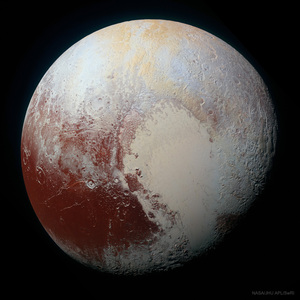
Behold: Pluto, but not as it’s normally seen. To wit:

Colour data and high-resolution images of our Solar System’s most famous dwarf planet, taken by the robotic New Horizons spacecraft during its flyby in 2015 July, have been digitally combined to give an enhanced-colour view of this ancient world sporting an unexpectedly young surface. The featured enhanced color image is not only aesthetically pretty but scientifically useful, making surface regions of differing chemical composition visually distinct. For example, the light-coloured heart-shaped Tombaugh Regio on the lower right is clearly shown here to be divisible into two regions that are geologically different, with the leftmost lobe Sputnik Planitia also appearing unusually smooth. After Pluto, New Horizons continued on, shooting past asteroid Arrokoth in 2019 and has enough speed to escape our Solar System completely.

(Image: NASA, Johns Hopkins Univ./APL, Southwest Research Inst.)

apod

Behold: the Tulip Nebula also known as Sh2-101 – a bright glowing cloud of interstellar gas and dust viewed along the plane of the Milky Way toward the constellation of Cygnus the Swan. To wit:

Nearly 70 light-years across the complex and beautiful Tulip Nebula blossoms about 8,000 light-years away, shown in a Hubble palette image that maps the glow of the nebula’s sulfur, hydrogen, and oxygen ions into red, green, and blue colors. Ultraviolet radiation from young energetic stars at the edge of the Cygnus OB3 association, including O star HDE 227018, ionizes the atoms and powers the emission from the Tulip Nebula. Also in the field of view is microquasar Cygnus X-1, one of the strongest X-ray sources in planet Earth’s sky. Driven by powerful jets from a black hole accretion disk, its fainter bluish curved shock front is only just visible though, directly above the cosmic Tulip’s petals near the top of the frame.

(Image: Carlos Uriarte)

apod

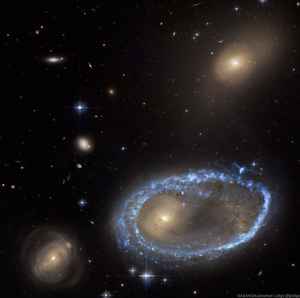
Behold: the immense 150,000 light years wide circumference of newly formed, extremely bright, massive stars forged by the violent birth of AM 0644-741, also known as the Lindsay Sharply Ring. To wit:

AM 0644-741 is known as a ring galaxy and was caused by an immense galaxy collision. When galaxies collide, they pass through each other and their individual stars rarely come into contact. The large galaxy’s ring-like shape is the result of the gravitational disruption caused by a small intruder galaxy passing through it. When this happens, interstellar gas and dust become compressed, causing a wave of star formation to move out from the impact point like a ripple across the surface of a pond. Other galaxies in the field of view are background galaxies, not interacting with AM 0644-741. Foreground spiky stars are within our own Milky Way. But the smaller intruder galaxy is caught above and right, near the top of the frame taken by the Hubble Space Telescope. Ring galaxy AM 0644-741 lies about 300 million light years away toward the southern constellation Volans.

(Image: NASA, ESA, Hubble, HLA; Processing: Jonathan Lodge)

apod

Behold: CG4, aka ‘God’s Hand’ – a ruptured cometary globule, so named because looks like a comet, but isn’t. To wit:

The “claw” of this odd looking “creature” in the featured photo is a gas cloud known as a cometary globule. This globule, however, has ruptured. Cometary globules are typically characterised by dusty heads and elongated tails. These features cause cometary globules to have visual similarities to comets, but in reality they are very much different. Globules are frequently the birthplaces of stars, and many show very young stars in their heads. The reason for the rupture in the head of this object is not yet known. The galaxy to the left of the globule is huge, very far in the distance, and only placed near CG4 by chance superposition.

(Image: Nicolas Rolland & Martin Pugh)

apod

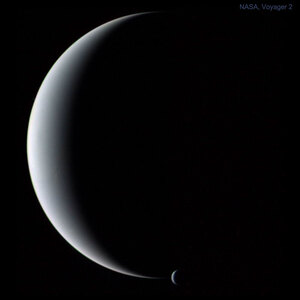
Behold: Neptune and its moon Triton captured together during the planet’s crescent phase by the Voyager 2 spacecraft. To wit:

The elegant picture of the ice-giant planet and its cloudy moon was taken from behind just after closest approach in 1989. It could not have been taken from Earth because Neptune never shows a crescent phase to sunward Earth. The unusual vantage point also robs Neptune of its familiar blue hue, as sunlight seen from here is scattered forward, and so is reddened like the setting Sun. Neptune is smaller but more massive than Uranus, has several dark rings, and emits more light than it receives from the Sun.

(Image: NASA, Voyager 2)

apod

Behold: the cosmic cloud of NGC 2359 also known as Thor’s Hemet. To wit:

Heroically sized even for a Norse god, Thor’s Helmet is about 30 light-years across. In fact, the cosmic head-covering is more like an interstellar bubble, blown with a fast wind from the bright, massive star near the bubble’s center. Known as a Wolf-Rayet star, the central star is an extremely hot giant thought to be in a brief, pre-supernova stage of evolution. NGC 2359 is located about 15,000 light-years away toward the constellation of the Great Overdog. This remarkably sharp image is a mixed cocktail of data from broadband and narrowband filters, capturing not only natural looking stars but details of the nebula’s filamentary structures. The star in the center of Thor’s Helmet is expected to explode in a spectacular supernova sometime within the next few thousand years.

(Image: Bernard Miller)

Previously: Thor’s Helmet

apod

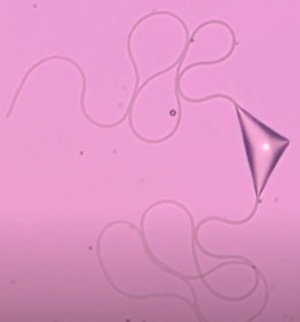
Behold: a truly bizarre recent discovery by a team of scientists in Bulgaria, Poland, the UK and China.

It seems – when ordinary oil droplets floating in soapy water are cooled to around 2-8°C – they change shape, grow tentacles and propel themselves around like sentient marine life. To wit:

Some of the particles’ facets grow while other shrink, producing a variety of geometrical forms such as kites, isosceles triangles and spiked tetrahedra. Then, from some of the sharp corners emerge tentacle-like strands, as if being extruded from a nozzle. As they grow, the strands bend into undulating shapes — and the droplets start to swim, propelled through the fluid by the tentacles’ extension.

kottke

Behold: M31, aka, the Andromeda galaxy – young blue stars circling galactic central point as seen in ultraviolet light.

2.5 million light years from Earth, Andromeda is the nearest major galaxy to our own Milky Way. Right next door, in cosmic terms. To wit:

Spanning about 230,000 light-years, it took 11 different image fields from NASA’s Galaxy Evolution Explorer (GALEX) satellite telescope to produce this gorgeous portrait of the spiral galaxy in ultraviolet light in 2003. While its spiral arms stand out in visible light images, Andromeda’s arms look more like rings in ultraviolet. The rings are sites of intense star formation and have been interpreted as evidence that Andromeda collided with its smaller neighbouring elliptical galaxy M32 more than 200 million years ago. The Andromeda galaxy and our own comparable Milky Way galaxy are the most massive members of the Local Group of galaxies and are projected to collide in several billion years — perhaps around the time that our Sun’s atmosphere will expand to engulf the Earth.

(Image: NASA, JPL-Caltech, GALEX)

apod

Behold: an ominous silhouette against a crowded star field along the tail of the constellation Scorpius, Some cosmic Orthanc or Barad-dûr perhaps? No really. To wit:

In fact, clumps of dust and molecular gas collapsing to form stars may well lurk within the dark nebula, a structure that spans almost 40 light-years across this gorgeous telescopic portrait. Known as a cometary globule, the swept-back cloud, is shaped by intense ultraviolet radiation from the OB association of very hot stars in NGC 6231, off the upper edge of the scene. That energetic ultraviolet light also powers the globule’s bordering reddish glow of hydrogen gas. Hot stars embedded in the dust can be seen as bluish reflection nebulae. This dark tower, NGC 6231, and associated nebulae are about 5,000 light-years away.

(Image: Data – Martin Pugh Processing – Rocco Sung)

apod

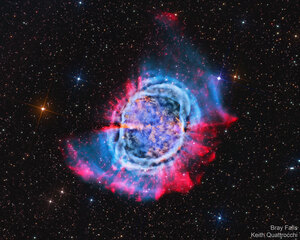
Behold: Messier 27, aka, the Dumbbell Nebula – a possible teaser for the ultimate fate of our own dear Sol. To wit:

The first hint of our Sun‘s future was discovered inadvertently in 1764. At that time, Charles Messier was compiling a list of diffuse objects not to be confused with comets. The 27th object on Messier’s list, now known as M27 or the Dumbbell Nebula, is a planetary nebula, one of the brightest planetary nebulae on the sky — and visible toward the constellation of the Fox (Vulpecula) with binoculars. It takes light about 1000 years to reach us from M27, featured here in colors emitted by hydrogen and oxygen. We now know that in about 6 billion years, our Sun will shed its outer gases into a planetary nebula like M27, while its remaining center will become an X-ray hot white dwarf star. Understanding the physics and significance of M27 was well beyond 18th century science, though. Even today, many things remain mysterious about planetary nebulas, including how their intricate shapes are created.

(Image: Bray Falls & Keith Quattrocchi)

apod