
Category Archives: Science

Behold IC417 and NGC1931, two large emission nebulae toward the constellation of Auriga. Also known as the Spider Nebula (for obvious reasons) and (less obviously, but continuing the theme), ‘The Fly’. To wit:

About 10,000 light-years distant, both nebulae harbour young, open star clusters. For scale, the more compact NGC 1931 (Fly) is about 10 light-years across. The featured picture in scientifically-assigned, infrared colours, combines images from the Spitzer Space Telescope and the Two Micron All Sky Survey (2MASS). Spitzer is celebrating its 16th year orbiting the Sun near the Earth.

(ImageNASAJPL-CaltechSpitzer Space Telescope2MASS)

apod

Behold: M45 aka the ‘Seven Sisters’ aka the Pleiades Star Cluster, looking dustier than most people have ever seen it. To wit:

 Perhaps the most famous star cluster on the sky, the bright stars of the Pleiades can be seen without binoculars from even the depths of a light-polluted city. With a long exposure from a dark location, though, the dust cloud surrounding the Pleiades star cluster becomes very evident. The featured exposure took over 12 hours and covers a sky area several times the size of the full moon. It lies about 400 light years away toward the constellation of the Bull (Taurus). A common legend with a modern twist is that one of the brighter stars faded since the cluster was named, leaving only six stars visible to the unaided eye. The actual number of Pleiades stars visible, however, may be more or less than seven, depending on the darkness of the surrounding sky and the clarity of the observer’s eyesight.

(Image: Marco Lorenzi (Glittering Lights)

apod

Scouring the skies above 18th century France for comets, the astronomer Charles Messier was careful to log all the things he saw that were definitely not comets, and this was the twenty seventh. Messier 27. To wit:

In fact, 21st century astronomers would identify it as a planetary nebula, but it’s not a planet either, even though it may appear round and planet-like in a small telescope. Messier 27 (M27) is an excellent example of a gaseous emission nebula created as a sun-like star runs out of nuclear fuel in its core. The nebula forms as the star’s outer layers are expelled into space, with a visible glow generated by atoms excited by the dying star’s intense but invisible ultraviolet light. Known by the popular name of the Dumbbell Nebula, the beautifully symmetric interstellar gas cloud is over 2.5 light-years across and about 1,200 light-years away in the constellation Vulpecula. This impressive color composite highlights details within the well-studied central region and fainter, seldom imaged features in the nebula’s outer halo. It incorporates broad and narrowband images recorded using filters sensitive to emission from hydrogen and oxygen atoms.

(ImageBob Franke)

apod

Of course you have. But not like this.

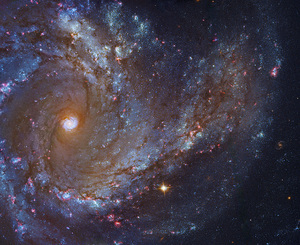
Behold: a spectacular composite ‘close-up’ of the spiral galaxy Messier 61 combining images from the Hubble Space Telescope, he European Southern Observatory and other smaller telescopes on Earth. To wit:

A mere 55 million light-years away in the Virgo Cluster of Galaxies, M61 is also known as NGC 4303. It’s considered to be an example of a barred spiral galaxy similar to our own Milky Way. Like other spiral galaxies, M61 also features sweeping spiral arms, cosmic dust lanes, pinkish star forming regions, and young blue star clusters. The bright galactic core is offset to the left in this 50 thousand light-year wide close-up

Full sized image here.

(ImageNASAESAHubbleESO, Amateur Data; Processing & Copyright: Robert Gendler & Roberto Colombari)

apod

How come the sky near the star Antares and the Rho Ophiuchi cloud complex is so dusty and colourful? Who hasn’t wondered that? No one hasn’t. To wit:

The colours result from a mixture of objects and processes. Fine dust illuminated from the front by starlight produces blue reflection nebulae. Gaseous clouds whose atoms are excited by ultraviolet starlight produce reddish emission nebulae. Backlit dust clouds block starlight and so appear darkAntares, a red supergiant and one of the brighter stars in the night sky, lights up the yellow-red clouds on the lower left of the featured image. Rho Ophiuchi lies at the center of the blue nebula near the top. The distant globular cluster M4 is visible to the right of Antares. These star clouds are even more colorful than humans can see, emitting light across the electromagnetic spectrum.

(ImageDavid McGarvey)

apod

Behold: the Angel Nebula aka NGC 2170. to wit:

Reflecting the light of nearby hot stars, NGC 2170 is joined by other bluish reflection nebulae, a red emission region, many dark absorption nebulae, and a backdrop of colourful stars. Like the common household items that still life painters often choose for their subjects, the clouds of gas, dust, and hot stars featured here are also commonly found in this setting — a massive, star-forming molecular cloud in the constellation of the Unicorn (Monoceros). The giant molecular cloudMon R2, is impressively close, estimated to be only 2,400 light-years or so away. At that distance, this canvas would be over 60 light-years across.

(Image: Juan Lozano de Haro)

apod

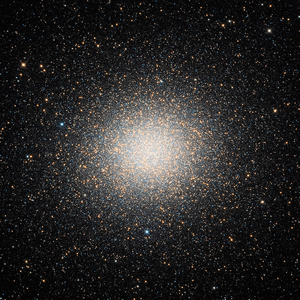
Behold: globular star cluster Omega Centauri, also known as NGC 5139. To wit:

…some 15,000 light-years away, the cluster is packed with about 10 million stars much older than the Sun within a volume about 150 light-years in diameter. It’s the largest and brightest of 200 or so known globular clusters that roam the halo of our Milky Way galaxy. Though most star clusters consist of stars with the same age and composition, the enigmatic Omega Cen exhibits the presence of different stellar populations with a spread of ages and chemical abundances. In fact, Omega Cen may be the remnant core of a small galaxy merging with the Milky Way.

Full sized image here.

(ImageMichael MillerJimmy Walker)

apod

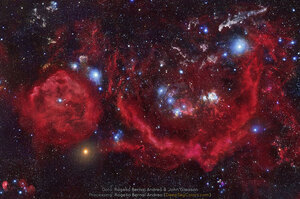
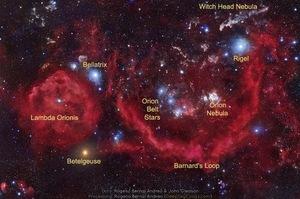
Behold: one of the best known and most recognisable constellations in the night sky: Orion. But shown in considerably more detail than the human eye – or any one telescope – can detect. To wit:

This is a more full Orion than you can see — an Orion only revealed with long exposure digital camera imaging and post-processing. Here the coolred giantBetelgeuse takes on a strong orange tint as the brightest star at the lower left. Orion’s hot blue stars are numerous, with supergiantRigel balancing Betelgeuse on the upper right, and Bellatrix at the upper left. Lined up in Orion’s belt are three stars all about1,500 light-years away, born from the constellation’s well-studied interstellar clouds. To the right of Orion’s belt is a bright but fuzzy patch that might also look familiar — the stellar nursery known as Orion’s Nebula. Finally, just barely visible to the unaided eye but quite striking here is Barnard’s Loop — a huge gaseous emission nebula surrounding Orion’s Belt and Nebula discovered over 100 years ago by the pioneering Orion photographer E. E. Barnard.

Full size image here.

(ImageJohn Gleason & Rogelio Bernal Andreo)

apod

This is how the Orion Nebula appeared to astronomers at the turn of the 20th century when advances in astrophotography opened up new vistas for science. To wit:

… his stunning image of the star-forming Orion Nebula was captured in 1901 by American astronomer and telescope designer George Ritchey. The original glass photographic plate, sensitive to green and blue wavelengths, has been digitised and light-to-dark inverted to produce a positive image. His hand written notes indicate a 50 minute long exposure that ended at dawn and a reflecting telescope aperture of 24 inches masked to 18 inches to improve the sharpness of the recorded image. Ritchey’s plates from over a hundred years ago preserve astronomical data and can still be used for exploring astrophysical processes.

(ImageGeorge Ritchey, Yerkes Observatory – Digitization Project: W. Cerny, R. Kron, Y. Liang, J. Lin, M. Martinez, E. Medina, B. Moss, B. Ogonor, M. Ransom, J. Sanchez (Univ. of Chicago)

apod

Behold: the Elephant’s Trunk Nebula winding its way through the star cluster complex of IC1396, some 3000 light years distant in the constellation of Cepheus. To wit:

Also known as vdB 142, the cosmic elephant’s trunk is over 20 light-years long. This colourful close-up view was recorded through narrow band filters that transmit the light from ionised hydrogen, sulphur, and oxygen atoms in the region. The resulting composite highlights the bright, swept-back ridges that outline pockets of cool interstellar dust and gas. Such embedded, dark, tendril-shaped clouds contain the raw material for star formation and hide protostars within

(Image: Chuck Ayoub)

apod