
Category Archives: Science

Earlier this week, on its monthly trundle around the Earth, our moon passed directly in front of Saturn from the viewpoint of the Southern hemisphere.To wit:

The featured image from SydneyAustralia captured the pair a few minutes before the eclipse. The image was a single shot lasting only 1/500th of a second, later processed to better highlight both the Moon and Saturn. Since Saturn is nearly opposite the Sun, it can be seen nearly the entire night, starting at sunset, toward the south and east. The gibbous Moon was also nearly opposite the Sun, and so also visible nearly the entire night — it will be full tomorrow night. The Moon will occult Saturn again during every lap it makes around the Earth this year.

(ImagePeter Patonai)

apod

Question: what could possibly shoot out a neutron star like a cannonball? Answer: a supernova. But you knew that. To wit:

About 10,000 years ago, the supernova that created the nebular remnant CTB 1 not only destroyed a massive star but blasted its newly formed neutron star core — a pulsar — out into the Milky Way Galaxy. The pulsar, spinning 8.7 times a second, was discovered using downloadable software Einstein@Home searching through data taken by NASA’s orbiting Fermi Gamma-Ray Observatory. Traveling over 1,000 kilometers per second, the pulsar PSR J0002+6216 (J0002 for short) has already left the supernova remnant CTB 1, and is even fast enough to leave our Galaxy. Pictured, the trail of the pulsar is visible extending to the lower left of the supernova remnant. The featured image is a combination of radio images from the VLA and DRAO radio observatories, as well as data archived from NASA’s orbiting IRAS infrared observatory. It is well known that supernovas can act as cannons, and even that pulsars can act as cannonballs — what is not known is how supernovas do it.

(ImageF. Schinzel et al. (NRAONSF), Canadian Galactic Plane Survey (DRAO), NASA (IRAS); Composition: Jayanne English (U. Manitoba)

apod

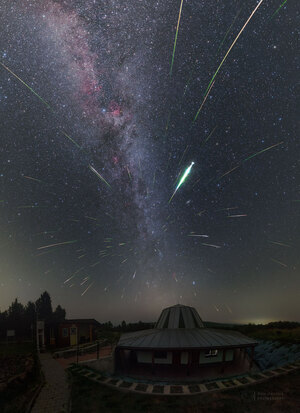
Did you catch the annual Perseid meteor shower last night? Of course you did. But it didn’t look like this. Because this (with a little technical adjustment) is what it looked like last year over Slovakia. To wit:

 The featured composite image was taken during last year’s Perseids from the Poloniny Dark Sky Park in Slovakia. The unusual building in the foreground is a planetarium on the grounds of Kolonica Observatory. Although the comet dust particles travel parallel to each other, the resulting shower meteors clearly seem to radiate from a single point on the sky in the eponymous constellation Perseus. The radiant effect is due to perspective, as the parallel tracks appear to converge at a distance, like train tracks

(ImagePetr Horálek)

apod

Behold: a rather extraordinary image of the star cluster of Messier 16, aka NGC 6611, aka ‘The Eagle Nebula’, surrounded by natal clouds of dust and glowing gas. To wit:

This beautifully detailed image of the region adopts the colourful Hubble palette and includes cosmic sculptures made famous in Hubble Space Telescope close-ups of the star-forming complex. Described as ‘elephant trunks’ or ‘Pillars of Creation’, dense, dusty columns rising near the centre are light years in length but are gravitationally contracting to form stars. Energetic radiation from the cluster stars erodes material near the tips, eventually exposing the embedded new stars. Extending from the ridge of bright emission left of centre is another dusty star-forming column known as the Fairy of Eagle Nebula. M16 lies about 7,000 light-years away, an easy target for binoculars or small telescopes in a nebula rich part of the sky toward the split constellation Serpens Cauda (‘the tail of the snake’).

(ImageIgnacio Diaz Bobillo)

apod

August is a good time of the year to see Jupiter. Just after sunset, it’s the brightest object in its section of the south-eastern sky. So what’s going on here, then?

The featured image was taken about a month ago from the Persian Gulf. The image shows Jupiter just to the right of the nearly vertical band of the central disk of our Milky Way Galaxy. The unnamed rock formations appear in projection like the jaws of a giant monster ready to engulf the Jovian giant. When you see Jupiter, it may be interesting to know that NASA’s robotic Juno spacecraft is simultaneously visiting and studying the giant planet. Saturn is also visible this month, and although it is ‘nearby’ Jupiter, it is not as bright.

(ImageMohammad S. Hayati)

apod

It’s hard to visualise what our little corner of the Universe looks like, what with galaxies being so spread out and our own one blocking quite a lot of the distant sky from us. Well, now there’s a map, of sorts. To wit:

…using large-scale galaxy motions to infer what massive objects must be gravitating in the nearby universe, the featured map, spanning over 600 million light years on a side, shows that our Milky Way Galaxy is on the edge of the Virgo Cluster of Galaxies, which is connected to the Great Attractor — an even larger grouping of galaxies. Also nearby are the massive Coma Cluster and the extensive Perseus-Pisces Supercluster. Conversely, we are also on the edge of huge region nearly empty of galaxies known as the Local Void. The repulsive push by the Local Void combined with the gravitational pull toward the elevated galaxy density on the other side of the sky explains part of the mysteriously high speed our Galaxy has relative to the cosmic microwave background — but not all.

To explore the local universe yourself, as determined by Cosmicflows-3, you are invited to zoom in and spin around this interactive 3D visualization.

(Image: R. Brent Tully (U. Hawaiiet al.)

apod

Behold: two detailed views of Mimas, one of the major moons of Saturn. To wit:

Peering from the shadows, the Saturn-facing hemisphere of Mimas lies in near darkness alongside a dramatic sunlit crescent. The mosaic was captured near the Cassini spacecraft’s final close approach on January 30, 2017. Cassini’s camera was pointed in a nearly sunward direction only 45,000 kilometres from Mimas.

The result is one of the highest resolution views of the icy, crater-pocked, 400 kilometre diameter moon. An enhanced version better reveals the Saturn-facing hemisphere of the synchronously rotating moon lit by sunlight reflected from Saturn itself. Other Cassini images of Mimas include the small moon’s large and ominous Herschel Crater.

(ImageCassini Imaging TeamSSIJPLESANASA)

apod

Behold: G292.0+1.8 – a fine young supernova 20,000 light years away toward the southern constellation Centaurus. So what are we looking at here?

Massive stars spend their brief lives furiously burning nuclear fuel. Through fusion at extreme temperatures and densities surrounding the stellar core, nuclei of light elements like Hydrogen and Helium are combined to heavier elements like Carbon, Oxygen, etc. in a progression which ends with Iron. So a supernova explosion, a massive star’s inevitable and spectacular demise, blasts back into space debris enriched in heavier elements to be incorporated into other stars and planets and people. This detailed false-colour x-ray image from the orbiting Chandra Observatory shows such a hot, expanding stellar debris cloud about 36 light-years across. […] Light from the inital supernova explosion reached Earth an estimated 1,600 years ago. Bluish colors highlight filaments of the mulitmillion degree gas which are exceptionally rich in Oxygen, Neon, and Magnesium. This enriching supernova also produced a pulsar in its aftermath, a rotating neutron star remnant of the collapsed stellar core. The stunning image was released as part of the 20th anniversary celebration of the Chandra X-ray Observatory.

(Image: NASA/CXC/SAO)

apod


Behold: the glowing gases and dust clouds of IC1795, a star forming region 6000 light years from Earth in the constellation of Cassiopeia. To wit:

 The nebula’s colours were created by adopting the Hubble color palette for mapping narrow emission from oxygen, hydrogen, and sulphur atoms to blue, green and red colours, and further blending the data with images of the region recorded through broadband filters. Not far on the sky from the famous Double Star Cluster in Perseus, IC 1795 is itself located next to IC 1805, the Heart Nebula, as part of a complex of star forming regions that lie at the edge of a large molecular cloud. Located just over 6,000 light-years away, the larger star forming complex sprawls along the Perseus spiral arm of our Milky Way Galaxy. At that distance, this picture would span about 70 light-years across IC 1795.

(ImageAlan Pham)

apod

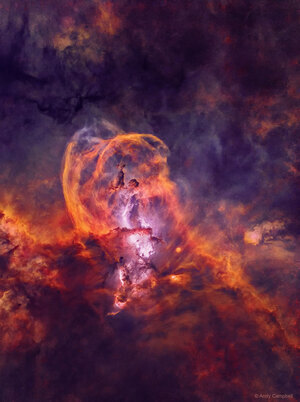
Behold: NGC 3582 a stellar nursery also known as the ‘Statue Of Liberty Nebul’a where bright stars are being formed constantly. But not in this picture. To wit:

The complex nebula resides in the star forming region called RCW 57, and besides the iconic monument, to some looks like a flying superhero or a weeping angel. By digitally removing the stars, this image showcases dense knots of dark interstellar dust, fields of glowing hydrogen gas ionized by these stars, and great loops of gas expelled by dying stars. A detailed study of NGC 3576, also known as NGC 3582 and NGC 3584, uncovered at least 33 massive stars in the end stages of formation, and the clear presence of the complex carbon molecules known as polycyclic aromatic hydrocarbons (PAHs). PAHs are thought to be created in the cooling gas of star forming regions, and their development in the Sun’s formation nebula five billion years ago may have been an important step in the development of life on Earth.

(ImageAndrew Campbell)

apod