
Category Archives: Science

Behold: the Great Seahorse Of Doom western edge of the Veil Nebula, filaments of shocked, glowing gas draped across 1,470 light years of the sky in the direction of the Cygnus Constellation. To wit:

 The Veil Nebula itself is a large supernova remnant, an expanding cloud born of the death explosion of a massive star. Light from the original supernova explosion likely reached Earth over 5,000 years ago. Blasted out in the cataclysmic event, the interstellar shock wave plows through space sweeping up and exciting interstellar material. The glowing filaments are really more like long ripples in a sheet seen almost edge on, remarkably well separated into atomic hydrogen (red) and oxygen (blue-green) gas. Also known as the Cygnus Loop, the Veil Nebula now spans nearly 3 degrees or about 6 times the diameter of the full Moon. While that translates to over 70 light-years at its estimated distance of 1,500 light-years, this telescopic image of the western portion spans about half that distance. Brighter parts of the western Veil are recognised as separate nebulae, including The Witch’s Broom (NGC 6960) along the top of this view and Pickering’s Triangle (NGC 6979) below and left.

apod

What on Earth is going on here? Jet lightning is what. To wit:

While flying from Munich to Singapore earlier this month, an industrious passenger took images of a passing lightning storm and caught something unexpected: gigantic jet lightning. The jet was captured on a single 3.2-second exposure above BhadrakIndia. Although the gigantic jet appears connected to the airplane’s wing, it likely started in a more distant thundercloud, and can be seen extending upwards towards Earth’s ionosphere. The nature of gigantic jets and their possible association with other types of Transient Luminous Events (TLEs) such as blue jets and red sprites remains an active topic of research.

(ImageHung-Hsi Chang)

apod

Bit windy round your way? Count yourself lucky.

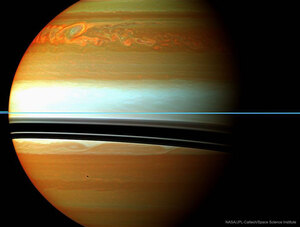
Behold: one of the largest and longest-lived storms ever recorded in our Solar System. To wit:

First seen in late 2010, the above cloud formation in the northern hemisphere of Saturn started larger than the Earth and soon spread completely around the planet. The storm was tracked not only from Earth but from up close by the robotic Cassini spacecraft, then orbiting Saturn. Pictured here in false coloured infrared in February, orange colours indicate clouds deep in the atmosphere, while light colours highlight clouds higher up. The rings of Saturn are seen nearly edge-on as the thin blue horizontal line. The warped dark bands are the shadows of the rings cast onto the cloud tops by the Sun to the upper left. A source of radio noise from lightning, the intense storm was thought to relate to seasonal changes when spring emerges in the north of Saturn. After raging for over six months, the iconic storm circled the entire planet and then tried to absorb its own tail — which surprisingly caused it to fade away.

(ImageCassini Imaging TeamSSIJPLESANASA)

apod

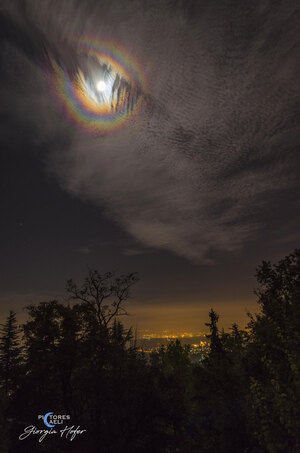
No, it’s an equally strange lunar corona over Turin. To wit:

Rings like this will sometimes appear when the Moon is seen through thin clouds. The effect is created by the quantum mechanical diffraction of light around individual, similarly-sized water droplets in an intervening but mostly-transparent cloud. Since light of different colors has different wavelengths, each color diffracts differently. Lunar Coronae are one of the few quantum mechanical colour effects that can be easily seen with the unaided eye. The featured lunar corona was captured around full Moon above TurinItaly in 2014. Similar coronae that form around the Sun are usually harder to see because of the Sun’s great brightness.

(ImageGiorgia Hofer (Cortina Astronomical Association)

apod

Behold: IC1805 – an emission nebula shaped rather like the human heart (after which it is named) glowing brightly with the red light emitted by its most prominent element: hydrogen. To wit:

The red glow and the larger shape are all powered by a small group of stars near the nebula’s centre. In the centre of the Heart Nebula are young stars from the open star cluster Melotte 15 that are eroding away several picturesque dust pillars with their energetic light and winds. The open cluster of stars contains a few bright stars nearly 50 times the mass of our Sun, many dim stars only a fraction of the mass of our Sun, and an absent microquasar that was expelled millions of years ago. The Heart Nebula is located about 7,500 light years away toward the constellation of Cassiopeia. Coincidentally, a small meteor was captured in the foreground during imaging and is visible above the dust pillars. At the top right is the companion Fishhead Nebula.

(ImageBray Falls)

apod

Behold: the most distant celestial object easily visible to the unaided eye – M31, the great Andromeda Galaxy, over two million light-years away. To wit:

Without a telescope, even this immense spiral galaxy appears as an unremarkable, faint, nebulous cloud in the constellation Andromeda. But a bright yellow nucleus, dark winding dust lanes, luminous blue spiral arms, and bright red emission nebulas are recorded in this stunning six-hour telescopic digital mosaic of our closest major galactic neighbour. While even casual skygazers are now inspired by the knowledge that there are many distant galaxies like M31, astronomers seriously debated this fundamental concept only 100 years ago. Were these “spiral nebulae” simply outlying gas clouds in our own Milky Way Galaxy or were they “island universes” — distant galaxies of stars comparable to the Milky Way itself? This question was central to the famous Shapley-Curtis debate of 1920, which was later resolved by observations favouring Andromeda being just like our Milky Way Galaxy — a conclusion making the rest of the universe much more vast than many had ever imagined.

(ImageAmir H. Abolfath (TWAN))

apod

Wel, as you can see, it’s a little beige in places but it’s taken a long time to find that out.

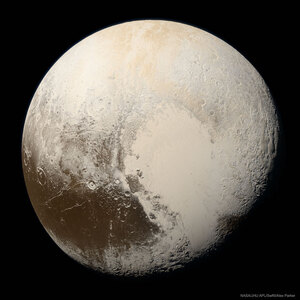
In 2015, multispectral images were sent back to Earth by NASA’s New Horizons spacecraft as it shot by Pluto at 80,000km/h. But processing these (in order to approximate what the human eye might see) took time. To wit:

The result featured here, released three years after the raw data was acquired by New Horizons, is the highest resolution true colour image of Pluto ever taken. Visible in the image is the light-coloured, heart-shaped, Tombaugh Regio, with the unexpectedly smooth Sputnik Planitia, made of frozen nitrogen, filling its western lobe. New Horizons found the dwarf-planet to have a surprisingly complex surface composed of many regions having perceptibly different hues. In total, though, Pluto is mostly brown, with much of its muted colour originating from small amounts of surface methane energised by ultraviolet light from the Sun.

Full sized image here.

(Image: NASAJHU APLSwRIAlex Parker)

apod

Joe Dolan.

Big Tom.

Cassiopeia A.

Yes, big stars shine bright and their legacies abide long after they die. To wit:

 Massive stars in our Milky Way Galaxy live spectacular lives. Collapsing from vast cosmic clouds, their nuclear furnaces ignite and create heavy elements in their cores. After a few million years, the enriched material is blasted back into interstellar space where star formation can begin anew. The expanding debris cloud known as Cassiopeia A is an example of this final phase of the stellar life cycle. Light from the explosion which created this supernova remnant would have been first seen in planet Earth’s sky about 350 years ago, although it took that light about 11,000 years to reach us. This false-colour image, composed of X-ray and optical image data from the Chandra X-ray Observatory and Hubble Space Telescope, shows the still hot filaments and knots in the remnant. It spans about 30 light-years at the estimated distance of Cassiopeia A. High-energy X-ray emission from specific elements has been colour coded, silicon in red, sulphur in yellow, calcium in green and iron in purple, to help astronomers explore the recycling of our galaxy’s star stuff. Still expanding, the outer blast wave is seen in blue hues. The bright speck near the centre is a neutron star, the incredibly dense, collapsed remains of the massive stellar core.

(Image : X-ray – NASACXC, SAO; Optical – NASA,STScI)

apod