
Category Archives: Science

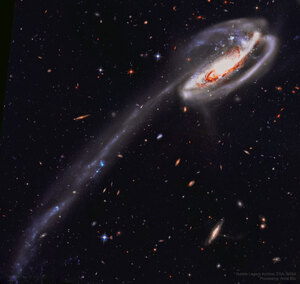
Behold: a stunning image of Arp188, aka the Tadpole Galaxy based on imagery from the Hubble Telescope Archive. To wit:

The cosmic tadpole is a mere 420 million light-years distant toward the northern constellation of the Dragon (Draco). Its eye-catching tail is about 280 thousand light-years long and features massive, bright blue star clusters. One story goes that a more compact intruder galaxy crossed in front of Arp 188 – from right to left in this view – and was slung around behind the Tadpole by their gravitational attraction. During the close encounter, tidal forces drew out the spiral galaxy’s stars, gas, and dust forming the spectacular tail. The intruder galaxy itself, estimated to lie about 300 thousand light-years behind the Tadpole, can be seen through foreground spiral arms at the upper right. Following its terrestrial namesake, the Tadpole Galaxy will likely lose its tail as it grows older, the tail’s star clusters forming smaller satellites of the large spiral galaxy.

(Image: Hubble Legacy Archive, ESA, NASA; Processing: Amal Biju)
apod

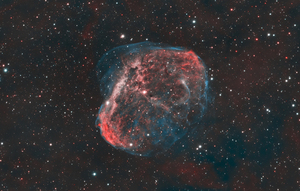
Behold: NGC 6888, aka Sharpless 105, aka the Crescent Nebula – 25 light-years wide and blown by winds from its central, bright, massive star. To wit:

A triumvirate of astro-imagers ( Joe, Glenn, Russell) created this sharp portrait of the cosmic bubble. Their telescopic collaboration collected over 30 hours of narrow band image data isolating light from hydrogen and oxygen atoms. The oxygen atoms produce the blue-green hue that seems to enshroud the detailed folds and filaments. Visible within the nebula, NGC 6888’s central star is classified as a Wolf-Rayet star (WR 136). The star is shedding its outer envelope in a strong stellar wind, ejecting the equivalent of the Sun’s mass every 10,000 years. The nebula’s complex structures are likely the result of this strong wind interacting with material ejected in an earlier phase. Burning fuel at a prodigious rate and near the end of its stellar life this star should ultimately go out with a bang in a spectacular supernova explosion. Found in the nebula rich constellation Cygnus, NGC 6888 is about 5,000 light-years away.

(Image: Joe Navara, Glenn Clouder, Russell Discombe)

apod

Behold: the southern constellation of Scorpius, but not as normally seen by the unaided human eye. To wit:

Scorpius more typically appears as a few bright stars in a well-known but rarely pointed out zodiacal constellation. To get a spectacular image like this, though, one needs a good camera, a dark sky, and some sophisticated image processing. The resulting digitally-enhanced image shows many breathtaking features. Diagonal across the image right is part of the plane of our Milky Way Galaxy. Visible there are vast clouds of bright stars and long filaments of dark and intricate dust. Rising vertically on the image left are dark dust bands known as the Dark River. Several of the bright stars on the left are part of Scorpius’ head and claws, and include the bright star Antares. Numerous red emission nebulas, blue reflection nebulas, and dark filaments became visible as the deep 17-hour expo image developed. Scorpius appears prominently in southern skies after sunset during the middle of the year.

(Image: Stefan Lenz)

apod

Behold: the Zhurong rover – deployed on Mars last month by China’s Tianwen-1 mission. But who’s taking the picture? It’s all staged! Wake up sheeple! Calm down. To wit:

As Mars means Planet of Fire in Chinese, the Zhurong rover’s name means, roughly, God of Fire in Chinese mythology. Zhurong landed in northern Utopia Planitia, the largest known impact basin in the Solar System, and an area reported to have much underground ice. Among many other scientific instruments, Zhurong carries ground-penetrating radar that can detect ice buried even 100-meters deep. Car-sized Zhurong is pictured here next to its landing base. The image was snapped by a remote camera deployed by the rolling rover. Zhurong‘s planned 90-day mission includes studying the geology, soil, and atmosphere of Mars in Utopia Planitia.

(Image: China National Space Administration)

apod

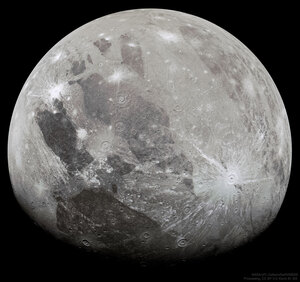
Behold: Ganymede – the largest moon in the solar system. To wit:

Jupiter‘s moon Ganymede, larger than even Mercury and Pluto, has an icy surface speckled with bright young craters overlying a mixture of older, darker, more cratered terrain laced with grooves and ridges. The cause of the grooved terrain remains a topic of research, with a leading hypothesis relating it to shifting ice plates. Ganymede is thought to have an ocean layer that contains more water than Earth — and might contain life. Like Earth’s Moon, Ganymede keeps the same face towards its central planet, in this case Jupiter. The featured image was captured last week by NASA’s robotic Juno spacecraft as it passed only about 1000 kilometers above the immense moon. The close pass reduced Juno’s orbital period around Jupiter from 53 days to 43 days. Juno continues to study the giant planet‘s high gravity, unusual magnetic field, and complex cloud structures.

(Image: NASA/JPL-Caltech/SwRI/MSSS; Processing & License: Kevin M. Gill)

apod

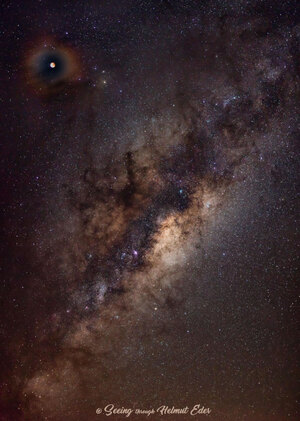
The Moon, yes. But no ordinary Moon. To wit:

This moon was a full moon, specifically called a Flower Moon at this time of the year. But that didn’t make it strange — full moons occur once a month (moon-th). This moon was a supermoon, meaning that it reached its full phase near its closest approach to the Earth in its slightly elliptical orbit. Somewhat strange, a supermoon appears a bit larger and brighter than the average full moon — and enables it to be called a Super Flower Moon.  This moon was undergoing a total lunar eclipse. An eclipsed moon can look quite strange, being dark, unevenly lit, and, frequently, red — sometimes called blood red. Therefore, this moon could be called a Super Flower Blood Moon. This moon was seen through thin clouds. These clouds created a faint corona around the moon, making it look not only strange, but colorful. This moon was imaged so deeply that the heart of the Milky Way galaxy, far in the background, was visible to its lower right. This moon, this shadow, this galaxy and these colors were all captured last month near Cassilis, NSW, Australia — with a single shot. (Merged later with two lower shots that better capture the Milky Way.)

(Image: Helmut Eder)

apod

Hello you.

Behold: pareidolia in the clouds of Jupiter. To wit:

On the largest scale, circling the planet, Jupiter has alternating light zones and reddish-brown belts. Rising zone gas, mostly hydrogen and helium, usually swirls around regions of high pressure. Conversely, falling belt gas usually whirls around regions of low pressure, like cyclones and hurricanes on Earth. Belt storms can form into large and long-lasting white ovals and elongated red spots. NASA’s robotic Juno spacecraft captured most of these cloud features in 2017 during perijove 6, its sixth pass over the giant planet in its looping 2-month orbit. But it is surely not these clouds themselves that draws your attention to the displayed image, but rather their arrangement. The face that stands out, nicknamed Jovey McJupiterFace, lasted perhaps a few weeks before the neighbouring storm clouds rotated away. Juno has now completed 33 orbits around Jupiter and just yesterday made a close pass near Ganymede, our Solar System’s largest moon.

(Image: NASA/JPL-Caltech/SwRI/MSSS/Jason Major)

apod

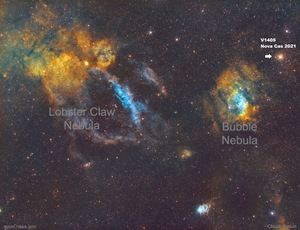
Behold: the northern constellation of Cassiopeia wherein a new spot of light has lately appeared. But what is it? To wit:

A nova. Although novas occur frequently throughout the universe, this nova, known as Nova Cas 2021 or V1405 Cas, became so unusually bright in the skies of Earth last month that it was visible to the unaided eye. Nova Cas 2021 first brightened in mid-March but then, unexpectedly, became even brighter in mid-May and remained quite bright for about a week. The nova then faded back to early-May levels, but now is slightly brightening again and remains visible through binoculars. Identified by the arrow, the nova occurred toward the constellation of Cassiopeia, not far from the Bubble Nebula. A nova is typically caused by a thermonuclear explosion on the surface of a white dwarf star that is accreting matter from a binary-star companion — although details of this outburst are currently unknown. Novas don’t destroy the underlying star, and are sometimes seen to recur. The featured image was created from 14 hours of imaging from Detroit, Michigan, USA. Both professional and amateur astronomers will likely continue to monitor Nova Cas 2021 and hypothesize about details of its cause.

(Image: Chuck Ayoub)

apod

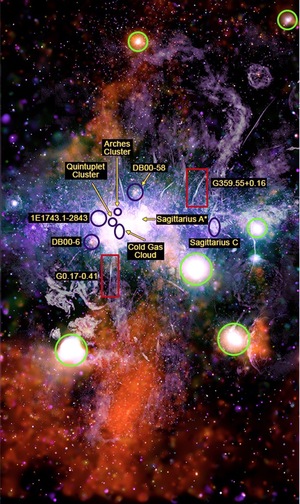
Behold: a newly detailed panorama that explores regions just above and below the galactic plane near the centre of our beloved Milky Way in radio and X-ray light. But what’s going on in there? To wit:

 X-ray light taken by the orbiting Chandra Observatory is shown in orange (hot), green (hotter), and purple (hottest) and superposed with a highly detailed image in radio waves, shown in gray, acquired by the MeerKAT array. Interactions are numerous and complex. Galactic beasts such as expanding supernova remnants, hot winds from newly formed stars, unusually strong and colliding magnetic fields, and a central supermassive black hole are all battling in a space only 1000 light years across. Thin bright stripes appear to result from twisting and newly connecting magnetic fields in colliding regions, creating an energetic type of inner galactic space weather with similarities to that created by our Sun. Continued observations and study hold promise to not only shed more light on the history and evolution of our own galaxy — but all galaxies.

(Image: X-ray: NASA/CXC/UMass/Q.D. Wang; Radio: NRF/SARAO/MeerKAT)

apod