
Category Archives: Science

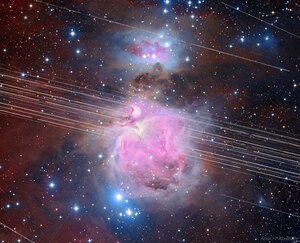
Behold: Orion. But what are those streaks of light crossing through it? To wit:

They are reflections of sunlight from numerous Earth-orbiting satellites. Appearing by eye as a series of successive points floating across a twilight sky, the increasing number of communications satellites, including SpaceX Starlink satellites, are causing concern among many astronomers. On the positive side, Starlink and similar constellations make the post-sunset sky more dynamic, satellite-based global communications faster, and help provide digital services to currently underserved rural areas. On the negative side, though, these low Earth-orbit satellites make some deep astronomical imaging programs more difficult, in particular observing programs that need images taken just after sunset and just before dawn. Planned future satellite arrays that function in higher orbits may impact investigations of the deep universe planned for large ground-based telescopes at any time during the night. The streaks across Orion are not from Starlink but rather satellites in high geosynchronous orbit. The featured picture, taken in 2019 December, is a digital combination of over 65 3-minute exposures, with some images taken to highlight the background Orion Nebula, while others to feature the passing satellites.

(Image: Amir H. Abolfath)
apod

It is.

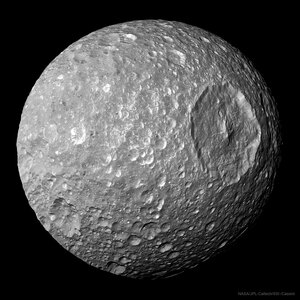
Behold: Mimas – the Death Starriest of all Saturn’s moons.  See that big dent though? That’s no super laser emitter. To wit:

Whatever hit Mimas nearly destroyed it. What remains is one of the largest impact craters on one of Saturn‘s smallest round moons. Analysis indicates that a slightly larger impact would have destroyed Mimas entirely. The huge crater, named Herschel after the 1789 discoverer of Mimas, Sir William Herschel, spans about 130 kilometers and is featured here. Mimas‘ low mass produces a surface gravity just strong enough to create a spherical body but weak enough to allow such relatively large surface features. Mimas is made of mostly water ice with a smattering of rock – so it is accurately described as a big dirty snowball. The featured image was taken during the closest-ever flyby of the robot spacecraft Cassini past Mimas in 2010 while in orbit around Saturn.

(Image: NASA, JPL-Caltech, Space Science Institute, Cassini)

apod

Behold: supergiant star AG Carinae, about 20,000 light-years away in the southern constellation of Carina. But what are those clouds surrounding it? To wit:

The star’s emitted power is over a million times that of the Sun, making AG Carinae one of the most luminous stars in our Milky Way galaxy. AG Carinae and its neighbour Eta Carinae belong to the scarce Luminous Blue Variable (LBV) class of stars, known for their rare but violent eruptions. The nebula that surrounds AG Car is interpreted as a remnant of one or more such outbursts. This nebula measures 5 light-years across, is estimated to contain about 10 solar masses of gas, and to be at least 10,000 years old. This Hubble image, taken to commemorate Hubble’s 31st launch anniversary, is the first to capture the whole nebula, offering a new perspective on its structure and dust content. The LBVs represent a late and short stage in the lives of some supergiant stars, but explaining their restlessness remains a challenge to humanity’s understanding of how massive stars work.

(Image: NASA, ESA, STScI; Processing: Judy Schmidt; Text: Anders Nyholm)

apod

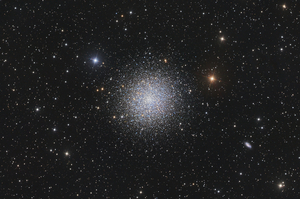
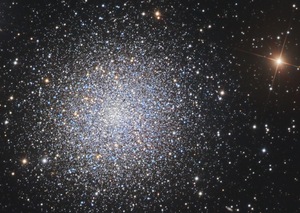
Behold: Messier 13, aka, the Great Globular Cluster in Hercules. To wit:

In 1716, English astronomer Edmond Halley noted, “This is but a little Patch, but it shews itself to the naked Eye, when the Sky is serene and the Moon absent.” Of course, M13 is now less modestly recognised as the Great Globular Cluster in Hercules, one of the brightest globular star clusters in the northern sky. Sharp telescopic views like this one reveal the spectacular cluster’s hundreds of thousands of stars. At a distance of 25,000 light-years, the cluster stars crowd into a region 150 light-years in diameter. Approaching the cluster core upwards of 100 stars could be contained in a cube just 3 light-years on a side. For comparison, the closest star to the Sun is over 4 light-years away. The remarkable range of brightness recorded in this image follows stars into the dense cluster core. Distant background galaxies in the medium-wide field of view include NGC 6207 at the lower right.]

(Image: Martin Dufour)

apod

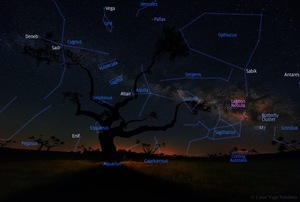
Behold: a recently pruned grove of oak trees in the Spanish town of Salamanca framing a spectacular galactic vista. To wit:

The photographer stayed up until 2 am, waiting until the Milky Way Galaxy rose above the level of a majestic looking oak. From this carefully chosen perspective, dust lanes in the galaxy appear to be natural continuations to branches of the tree. Last came the light. A flashlight was used on the far side of the tree to project a silhouette. By coincidence, other trees also appeared as similar silhouettes across the relatively bright horizon. The featured image was captured as a single 30-second frame in 2015 and processed to digitally enhance the Milky Way.

(Image: César Vega Toledano; Rollover Annotation: Judy Schmidt)

apod

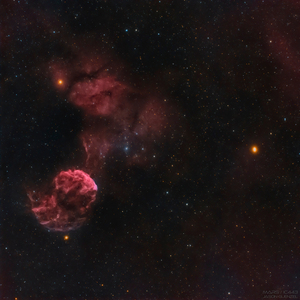
Behold: the normally faint and elusive Jellyfish nebula, aka IC 443, captured in an alluring scene with Mars to the right. To wit:

In the telescopic field of view, two bright yellowish stars, Mu and Eta Geminorum, stand just below and above the Jellyfish Nebula at the left. Cool red giants, they lie at the foot of the celestial twin. The Jellyfish Nebula itself floats below and left of centre, a bright arcing ridge of emission with dangling tentacles. In fact, the cosmic jellyfish is part of bubble-shaped supernova remnant IC 443, the expanding debris cloud from a massive star that exploded. Light from that explosion first reached planet Earth over 30,000 years ago. Like its cousin in astrophysical waters the Crab Nebula supernova remnant, the Jellyfish Nebula is known to harbour a neutron star, the remnant of the collapsed stellar core. Composed on April 30, this telescopic snapshot also captures Mars. Now wandering through early evening skies, the Red Planet also shines with a yellowish glow on the right hand side of the field of view. Of course, the Jellyfish Nebula is about 5,000 light-years away, while Mars is currently almost 18 light-minutes from Earth.

(Image: Jason Guenzel)

apod

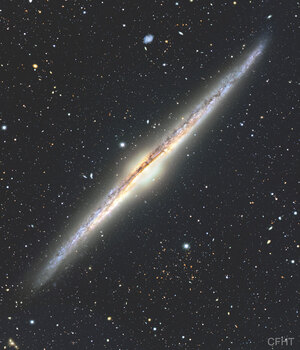
Behold: spiral galaxy NGC 4565, aka, the Needle galaxy on account of its narrow side-on profile (from our perspective). To wit:

…bright NGC 4565 is a stop on many telescopic tours of the northern sky, in the faint but well-groomed constellation Coma Berenices. This sharp, colorful image reveals the spiral galaxy’s boxy, bulging central core cut by obscuring dust lanes that lace NGC 4565’s thin galactic plane. An assortment of other background galaxies is included in the pretty field of view. Thought similar in shape to our own Milky Way Galaxy, NGC 4565 lies about 40 million light-years distant and spans some 100,000 light-years. Easily spotted with small telescopes, sky enthusiasts consider NGC 4565 to be a prominent celestial masterpiece Messier missed.

(Image: CFHT, Coelum, MegaCam, J.-C. Cuillandre (CFHT) & G. A. Anselmi (Coelum)

apod

Behold: what looks like a cosmic oyster filled with pearls but is, in fact, the star cluster NGC 602. To wit:

Near the outskirts of the Small Magellanic Cloud, a satellite galaxy some 200 thousand light-years distant, lies 5 million year young star cluster NGC 602. […] Fantastic ridges and swept back shapes strongly suggest that energetic radiation and shock waves from NGC 602‘s massive young stars have eroded the dusty material and triggered a progression of star formation moving away from the cluster’s center. At the estimated distance of the Small Magellanic Cloud, the featured picture spans about 200 light-years, but a tantalizing assortment of background galaxies are also visible in this sharp multi-colored view. The background galaxies are hundreds of millions of light-years or more beyond NGC 602.

(Image: NASA, ESA, and the Hubble Heritage Team (STScI/AURA) – ESA/Hubble Collaboration)

apod

Behold: the dusty central Milky Way rising over the ancient Andean archaeological site of Yacoraite in northwestern Argentina. To wit:

The denizens of planet Earth reaching skyward are the large Argentine saguaro cactus currently native to the arid region. The unusual yellow-hued reflection nebula above is created by dust scattering starlight around red giant star Antares. Alpha star of the constellation Scorpius, Antares is over 500 light-years distant. Next to it bright blue Rho Ophiuchi is embedded in more typical dusty bluish reflection nebulae though. The deep night skyscape was created from a series of background exposures of the rising stars made while tracking the sky, and a foreground exposure of the landscape made with the camera and lens fixed on the tripod. In combination they produce the single stunning image and reveal a range of brightness and color that your eye can’t quite perceive on its own.

(Image: Franco Meconi)

apod

German educational design studio Kurzgesagt turns to a sobering truth of astrophysics: the fact that 94% of the observable Universe is so far from us that we will never go there, even if we achieve light-speed travel. To wit:

…there is a cosmological horizon around us. Everything beyond it, is traveling faster, relative to us, than the speed of light. So everything that passes the horizon, is irretrievably out of reach forever and we will never be able to interact with it again. In a sense it’s like a black hole’s event horizon, but all around us. 94% of the galaxies we can see today have already passed it and are lost to us forever.

And if that twists your melon, consider this: by the time you’ve watched the video, 22 million more stars will have drifted off beyond our reach.