Category Archives: Science/Tech

petman

Of PETMAN – their frankly terrifying robo-humanoid, developed with funding from the US Defense Department’s Chemical and Biological Defense program, Boston Dynamics sez:

It is used to test the performance of protective clothing designed for hazardous environments. The video shows initial testing in a chemical protection suit and gas mask. PETMAN has sensors embedded in its skin that detect any chemicals leaking through the suit. The skin also maintains a micro-climate inside the clothing by sweating and regulating temperature.

Killing all humans: it’s a sweaty business.

boingboing

mobile

A historical series of nesting phones by UK artist Kyle Bean celebrating four decades of the mobile phone.

In early April 1973, engineer and inventor Marty Cooper made the first mobile call on a Motorola DynaTAC 8000x to rival engineer Joe Engel at Bell Labs.

Just trollin’.

The Verge Interview: Marty Cooper, Father of The Cellphone (The Verge)

dailywhat

stockpicWallace Turbeville, writing earlier this week in The American Prospect, reveals the following chilling but less-than-surprising reduction to near absurdity in the world of stock trading:

For me, the story starts with a book, Dark Pools, written by Wall Street Journal Reporter Scott Patterson. The book, published in the summer of 2012, is an account of the rise of high-frequency trading or “HFT.”That is automated trading of securities and derivatives using powerful computers driven by complex algorithms. It is widely accepted that trading activity in most markets is dominated by HFT. Firms that specialize in this practice trade in enormous volumes but start and end the day with few if any holdings. Their purpose is to profit from intra-day market moves, not from fundamental investment. They buy and sell in the blink of an eye, churning the markets constantly. Mr. Patterson’s book contains the following passage:

At the end of World War II, the average holding period for a stock was four years. By 2000, it was eight months. By 2008, it was two months. And by 2011, it was 22 seconds, at least according to one professor’s estimate.

Gone In 22 Seconds: How Frequent is High Frequency Trading? (The American Prospect)

(Hat tip: Mark Malone)

(Pic: AP)

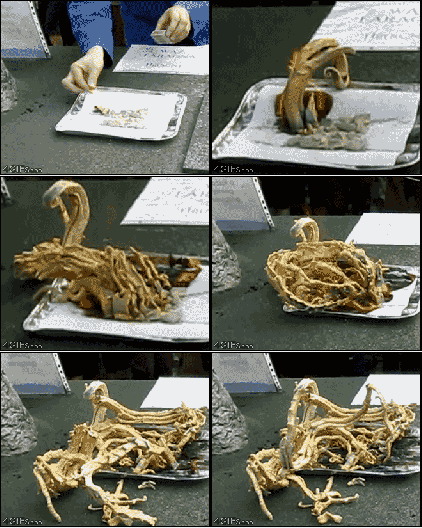
Over the weekend, the above animated gif did the rounds on Twitter billed as being akin to “opening a portal to hell”.

But what exactly is going on?

Enter io9 with the science bit (and a nice long video):

http://www.youtube.com/watch?v=ritaljhhk7s

Igniting mercury(II) thiocyanate causes it to decompose into an insoluble brown mass that is primarily carbon nitride, C3N4. Mercury(II) sulfide and carbon disulfide are also produced.
2Hg(SCN)2 → 2HgS + CS2 + C3N4

Flammable carbon disulfide combusts to carbon(IV) oxide and sulfur(IV) oxide:

CS2 + 3O2 → CO2 + 2SO2

The heated C3N4 partially breaks down to form nitrogen gas and dicyan:

2C3N4 → 3(CN)2 + N2

Mercury(II) sulfide reacts with oxygen to form mercury vapor and sulfur dioxide. If the reaction is performed inside a container, you will be able to observe a gray mercury film coating its interior surface.

HgS + O2 → Hg + SO2

Well that explains that.

Being such a spectacular reaction, it was marketed in Germany as Pharaoschlangen (“Pharaoh’s snakes”). In the tradition of all great fireworks of bygone times, it was incredibly dangerous:

All aspects of the reaction can be hazardous, including handling the mercury thiocyanate, breathing the smoke or touching the ash column, and contact with the remains of the reaction during clean-up.

What in the name of all that is holy is going on in this video? (io9)