

They know roughly where you live.
(Thanks Fergus O’Neill)



You’ll recall how asylum seekers initially apply for protection and refugee status from the Office of the Refugee Applications Commissioner.
If their initial application is turned down they can appeal the decision to the Refugee Appeals Tribunal.
Further to this…
In 2014 the Refugee Appeals Trib. set aside > 46% of decisions by ORAC! 80 out of 173. That is a huge % indicating errors made at 1st stage
— IrishRefugeeCouncil (@IrishRefugeeCo) July 13, 2015
Previously: ‘Out Of 500 Cases, I Let Two People In’


From top: demonstrations outside Leinster House last week; Julien Mercille
The water charges movement has changed the political landscape in Ireland.
With little or no help from the unions.
Dr Juien Mercille, in his first words since the beatdown, writes:
The anti-water charges movement is the biggest popular mobilisation this State has seen since its foundation. Together with Sinn Féin and progressive politicians, it is our Podemos and our Syriza.
And just like Syriza is now under attack by the European establishment because it presents an alternative to the troika’s austerity strategy, the Right2Water movement is once again being demonised by our conservative government and media and ignored by some large trade unions that have chosen to side with the Government.
To be clear, the anti-water charges movement is not about calling for free water provision. Everybody recognises that water services have to be paid for – the issue is about how we pay for it.
We already pay for our water through general taxation, which is the right way to do it because it is more progressive than by paying at the point of use through water charges.
If more money and investment are needed to maintain the water provision infrastructure, then we just need to make general taxation more progressive and raise taxes on the better off or increase our low 12.5% corporation tax and close tax loopholes that allow the rich to get away with paying their just part.
Or even better: stop austerity and stimulate the economy to allow it to grow, which will automatically generate more income and tax revenues.
In any case, the government is now pushing two important bills through parliament which, once enacted into law, will reinforce its ability to force people to pay their water charges.
The first is the Environment (Miscellaneous Provisions) Bill. It will make it impossible to sell your house if you haven’t paid your water charges; will force tenants to pay their water bills while landlords will have to provide Irish Water with the identity of their tenants; and it will establish a database that will include much information about Irish Water customers.
In this process, opposition parties have accused the government of bypassing normal parliamentary procedures to allow enough time for debate by pushing through 37 pages of amendments at very short notice. Clearly, democracy is not a priority in the Dáil.
The second is the Civil Debt (Procedures) Bill. It will allow a court to order deductions from social welfare payments or from wages in order to pay for the water charges.
The demonisation of the water movement has also continued in recent days with two main events that happened just as the above legislation was being pushed in parliament.
First, during a protest against water charges and in support of Greece at the Dail, former minister for justice Alan Shatter remained trapped in his car among the protesters for 15 minutes as he tried to drive through them.
So the media brought back the “kidnapping the minister” story that was used when Joan Burton had also been trapped in her car at Jobstown in a similar situation last year.
Shatter said the protesters were “thugs, intolerant, anti-democratic and fascist”. He even criticised the police for letting the situation get out of hand, when it’s clear that the gardai have consistently protected Government interests against anti-water charges protesters since the emergence of the movement.
Second, in another poor public relations performance by those we elected, Fine Gael TD Catherine Byrne (Dublin South-Central) told the Dail during the debate on the Civil Debt Procedures Bill that many people were “stacking up their trolleys with drink and wine” at the grocery store while they allegedly refused to pay their water charges.
The image was clear: those annoying people on welfare just use the money given to them generously by the State to pay for booze but are still too selfish to pay for water, because they “believe everything should be free”.
The Government strategy is thus obvious.
First, implement austerity that throws the economy in recession and forces people to emigrate in the face of skyrocketing unemployment.
Then, just blame all that on “the poor” and make all sorts of wild claims about them. It must be them, after all, who created an out-of-control banking system, inflated a housing bubble, decided on a bank guarantee, took taxpayers’ money to pay for bondholders in Germany and Britain, and had the brilliant idea of implementing austerity to depress the economy further.
But the attacks on water charges protesters are not only coming from Fine Gael and Labour.
They also originate from some trade unions that have remained quite apathetic toward the movement. Indeed, Right2Water includes only five trade unions, the two biggest ones of which are Unite and Mandate. Why are the others not joining this historical movement?
For example, ICTU (the umbrella group for Irish trade unions) and the unions SIPTU and IMPACT haven’t been very proactive to say the least. Perhaps their mindset is best illustrated by David Begg, who was general secretary of ICTU from 2001 to 2015.
A few months ago, I asked him about the anti-water charges protesters and why the trade union leadership did not support them more strongly.
Hold your breath.
David Begg described the protesters who do more than just marching as “the dark forces in Irish society”… and added that we had to guard against such excesses because “once the toothpaste is out of the tube, you can’t put it back in”. That’s from a trade union leader who is supposed to defend the interests of ordinary people.
And then we wonder why there’s a Syriza government in Greece, a rising Podemos in Spain, but an Enda Kenny in power in Ireland.
The real dark forces in Irish society need to be kicked out of power at the next general election. For this, people will need to get to the streets, and progressive politicians will need, for once, to unite, and to do so now.
@JulienMercille is lecturer at UCD and the author of The Political Economy and Media Coverage of the European Economic Crisis: The Case of Ireland (2015, Routledge) and a member of the Greek Solidarity Committee. His new book, Europe’s Treasure Ireland, is published this month.
(Sam Boal/Photocall Ireland)

This morning.
Henry Warren writes:
Ambling along Fishamble Street [Temple Bar, Dublin] I snapped this shambles of a Batmobile in the rain. What would Handel think?
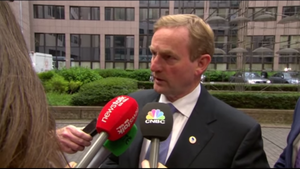
“This has been a pretty bruising experience over the last period but what this allows for is a document that’s agreed now that will be the basis for negotiations for a programme for Greece which will allow the Greek economy to thrive and prosper and to continue to remain a member of the Eurozone.
This was a point I stressed before coming here, that Europe should not do anything to cause a Grexit as it’s referred to. This is a challenging position for Greece, a very challenging position but it’s one that the Prime Minister himself has said that he is up for. The first requirement now is for the document to be voted on by the European Parliament. It then has to be followed through with other parliaments voting on it: Finland, Germany. And there are agreements in respect of pieces of legislation to be put through the Greek parliament this week and for others to follow suit. Clearly, the sticking points were the involvement of the IMF and the €50billion fund. This has been settled and agreed and an arrangement has been made for the use of those funds in respect of Greece in terms of privatisation where 25% of proceeds can be used for investment for and the remainder for debt reduction.
So, the IMF is an accepted point by the Prime Minister and their involvement, in terms of their ability and experience in assessing values and conditions, is accepted.
What’s in this for Greece is the potential to grow their own economy to bring it back to a point of stability where growth, investment and jobs can be created and to remain a member of the Eurozone which was the object of the the exercise from the Prime Minister’s point of view in the first instance.
There were quite a number of periods during the course of the night where bi-lateral discussions and references had to be made to details that were in the document but it does start off, by setting out the critical need and the crucial need for the rebuilding of trust.
So I welcome the fact that agreement has been reached after an all-night session. I welcome the fact that this has been accepted by the, by Prime Minister Tspiras, that it is hoped now that this can go through the Greek parliament with assistance from all sides and that it forms the basis for negotiation for a third programme and the details of that will obviously, you know, be discussed over the coming period.
…There was a great deal of discussion about the €50billion, how that might be used and what the outcome would be. Clearly that’s not something that can happen overnight but I did point out that in our own case in Ireland, on a lesser scale that in involvement with the Troika, we were able to use a significant amount of privatisation funds for investment for job creation, provided that it did not interfere with the deficit targets that had been set by the Troika. So in Greece’s case there’s a 25% opportunity to use for investment as well as for debt reduction
Taoiseach Enda Kenny speaking to journalists this morning after Eurozone leaders talked through the night before reaching a deal with Greece to negotiate a third bailout.
FIGHT!
WATCH: European leaders agree bailout deal with Greece (Newstalk)

Nimble.
In fairness.
Thanks Davy Fallon

What you may need to know
1. Hello Oscar – it’s Saoirse Ronan calling…
2. Based upon the novel by Colm Tóibín. Adapted by Nick Hornby. Directed by John Crowley, who did Intermission (2003).
3. Between this, Star Wars and The Revenant, Domhnall Gleeson’s gonna have a hell of a year.
4. Best YouTube comment: ‘NO NO NO HOLLYWOOD THIS IS NOT HOW YOU MAKE A ROMANCE MOVIE, YOU DO NOT MAKE THE GIRL QUIT A GOOD AND NICE GUY FOR A MANIPULATOR’
5. Broadsheet Prognosis: There will be tears. There will be prizes.
Release Date: November


Further to Conor McGregor’s win in Las Vegas against Chad Mendes…
Brian Manning writes:
A painting I did of the the Notorious recently. It feels like Italia ’90 when I watch him fight!
Conor McGregor crowned UFC interim featherweight champion (RTE)
Update:

Fake fight!

The National Archives of Ireland has uploaded the Dublin Metropolitan Police’s reports on the “Movements of Dublin Extremists” between July 10 and 15 in 1915.
Je suis Bulmer.
Find them here

Richard Troy writes:
“Happily not what it looks like. Dog-owner trying hard to retrieve his retriever from under a lock on Royal Canal.”
More as we get it.
UPDATE: The dog-owner did save the dog, with help from nice man with the rope.
Yay!