



This
at


MORE to folly
Thanks Ronan Casey (The Westmeath Topic); Patrick Conboy (The Longford Leader); Pamela McCarthy (The irish Examiner); Fran Green (The Meath Chronicle); Paul Murphy (The Irish Sun); Mick Crowley (The Irish Times); Meliosa Fitzgibbon (The Irish Daily Mail)
Covers to broadsheet@broadsheet.ie


Oh.
Damn you Cullen syndicate.
Thanks Dan Crawford.


Sam Simon, co-creator of The Simpsons, dead at 59.
Monty Burns, Dr Hibbert, Chief Wiggum, Bleeding Gums Murphy – they were all his.
(Pix: Huffpo, Greg-leon-Guillemin)

This afternoon.
Taoiseach and Fine Gael leader Enda Kenny and Tanaiste and Labour Party Minister for Social Protection Joan Burton speak to the media on the ‘Government Progress Report on Recovery’ at Government Buildings.
The harp podium-filled hoo ha marks the Government’s fourth year in office and outlined report on progress made in relation to the ‘Agreed Programme for Government and the Statement of Government Priorities 2014’,
As well as outlining priorities for the next 12 months.
FIGHT!
(Photocall Ireland)


Does she deserve them?
Read on.
Joanne writes:
We have a box of delicious Lindor chocolate created by Lindt master chocolatier to give every Mum her Lindor ‘moment of bliss’ and a beautiful bouquets of flowers from Flowers by Moira created by Jenny Murphy who won a Gold Medal at the Chelsea Flower Show to giveaway. We are looking for the best confession. To enter just complete this sentence.
I would like to apologise to my mother because______________________________
LINES MUST close at MIdnight
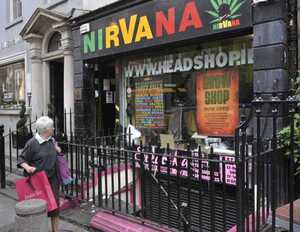
Head shop on South William Street, Dublin in 2010
Today the Court of Appeal in the Bederev case declared Section 2(2) of the Misuse of Drugs Act 1977 unconstitutional.
We asked Legal Coffee Drinker, what’s it all about?
Broadsheet: “Legal Coffee Drinker, what’s it all about?”
Legal Coffee Drinker: “Well, let’s start with Section 2(2). This is a section in the 1977 Act allowing the government to declare ‘any substance, product or preparation’ to be a controlled drug for the purposes of the Act.”
Broadsheet: [shuffles]”Like what substances?
LCD: “The Act simply says ‘any substance, product or preparation’, without defining it further. Judge Hogan, in the Court of Appeal, pointed out that this is so wide that alcohol or tobacco could be made a controlled substance by the government, if it so wishes.”
Broadsheet: “Coffee?”
LCD: [refills cup] “On the face of Section 2(2), yes, coffee could be made a controlled drug. If the government so wished.”
Broadsheet: “Let them try sez you.
LCD: “Yes.”
Broadsheet: [pause] “So…what are the consequences of making something a controlled drug?”
LCD: “Possession, manufacturing, importation or supply of the substance is restricted and may be (indeed, usually is) a criminal offence.”
Broadsheet: “Have many drugs been declared controlled under that section?
LCD: “Yes. Quite a few. You’ll see a list of the government ordersmade under Section 2(2) here. If you click on them, you’ll see the names of the substances declared controlled in each case. They include ecstasy, magic mushrooms, head shop drugs and new psychoactive drugs.”
Broadsheet: “And this has now been held unconstitutional?”
LCD: “Yes. Because giving the Government such an open-ended power to designate controlled substances breached the doctrine of the separation of powers contained in our Constitution. According to this doctrine, judicial power is exercised by the judiciary, executive power by the government and legislative (law making) power by the Oireachtas.
Put another way, laws should be passed by the legislature, not the government. When the legislature passes an Act giving a power to the government to supplement or fill in gaps in an Act, that power cannot be too wide, it must be defined in nature and there must be guidance in terms of principles and policies regarding its exercise.
According to the Court of Appeal, the power given to the Oireachtas to declare substances controlled drugs under Section 2(2) was too wide and not subject to control – it represented an abrogation of law making power to the executive and this was unconstitutional.”
Broadsheet: “And the consequences of Section 2(2) being held unconstitutional?”
LCD: “Well, until amending legislation takes effect, all the substances previously declared controlled substances under Section 2(2) are now legal.
Broadsheet: “All drugs?”
LCD: “All drugs prohibited under Section 2(2), they’re listed in the ministerial orders linked to above.”
Broadsheet: “But not heroin, cocaine, cannabis or LSD?”
LCD: “No, these are controlled drugs listed in the Schedule to the 1977 Act, they come under Section 2(1) which is still constitutional, not Section 2(2).”
Broadsheet: “And what about previous convictions under Section 2(2)?”
LCD: “An extremely interesting question. The courts are still grappling with the question of the retrospective effect of a finding of unconstitutionality on previous convictions.
The traditional view was that a finding that a piece of criminal legislation was unconstitutional did not automatically invalidate previous convictions under the legislation. The leading case is A v Governor of Arbour Hill Prison [2006] 4 I.R. 88; [2006] IESC 45, where an accused was convicted under a statutory provision (section 1(1) of the Criminal Law (Amendment) Act 1935 later found to be unconstitutional. [drains cup]. It was held that he could not rely on the subsequent finding of unconstitutionality as a ground for challenging his conviction, the Court of Criminal Appeal stating as follows:-
“In a criminal prosecution where the State relies in good faith on a statute in force at the time and the accused does not seek to impugn the bringing or conduct of the prosecution, on any grounds that may in law be open to him or her, including the constitutionality of the statute, before the case reaches finality, on appeal or otherwise, then the final decision in the case must be deemed to be and to remain lawful notwithstanding any subsequent ruling that the statute, or a provision of it, is unconstitutional. That is the general principle.”
There have however been some cases which indicate wider retrospective effect for a finding of unconstitutionality, but none dealing with the point exactly. Perhaps we will find out the answer when someone challenges their conviction under Section 2(2) on the basis of this case. In the meantime, there’s a good discussion of the issue by humanrights.ie here.”
Broadsheet: Thank you Legal Coffee Drinker. Extremely helpful. Some of the ‘sheeters were planning a gathering tonight if you fancy. For the legal loophole that’s in it.”
LCD: “No thanks.”
Broadsheet: “There’ll be coffee…constitution permitting.”
LCD: “No really..”
Broadsheet: ” Karl may go down the ‘k-hole’?
LCD: “What? No.”
Broadsheet: “Fair enough. Karl probably won’t go down the hole in anyway. Not entirely sure what it entails meself.”
LCD: *click*
Broadsheet: “Thanks Legal Coffee Drinker.”
Earlier: Everyone Stay Cool
Related: Varadkar: ‘Dozens’ of convictions in question after drug law ruling (Breakingnews)
(James Horan/Photocall Ireland)