

Covers to broadsheet@broadsheet.ie
Via Independent_ie



 The Priory Hall apartment complex, Dublin.
It’s not that Enda Kenny is an unkind man, it’s not that he doesn’t care. He sees the world differently – and unfortunate occurrences such as Priory Hall are not his business. The free market regulates these things, and in the market there are winners and losers.
When the banks collapsed in 2008, this column said that the next few years would see a fight over who picked up the tab. The establishment, here and in the EU bureaucracies, would do its best to bring about economic recovery. But there were conditions. It must be recovery without change. The social and economic hierarchies must be maintained, with all their statuses and privileges.
This corrupt, inefficient, dangerous set-up went to extraordinary lengths to indulge the greed of the few – and, as a result, destroyed itself. The aftermath needed an adversarial approach to the corruption, the recklessness, the ruthlessness. That wasn’t on anyone’s agenda. The same structure, the same people, prevailed. Capable of nothing else, the establishment has for six years now been trying to restore the system as it was. Any notions of justice, fairness or decency are dismissed as an unaffordable luxury.
Previously: Dear Enda
(Sasko Lazarov/Photocall Ireland)
 ‘Sup?
Sorcha writes:
I know you don’t usually do this but my friend Cindy found a passport on the Harolds Cross bridge [Dublin 6] last night. I’m going to drop it in to the Navan road Garda station this afternoon..

http://www.youtube.com/watch?v=bMRylW0H-kM
What you may need to know
1. We’ve said it before, we’ll say it again: movies smoovies, TV is where its at.
2. Cillian Murphy could be cashing in phoning it in as wild-eyed bad guys in Hollywood movies – instead, he’s gone and done a big epic BBC crime drama thing. That said, he’s in the next Chris Nolan flick – they’ve done five together.
3. Peaky Blinders is created by Steven Knight, who wrote Dirty Pretty Things (2002) and Eastern Promises (2007).
4. The great Sam Neill gets to channel his inner Nordy bloke – well, he was born in County Tyrone, hai.
5. Love/Hate legend Tom Vaughan Lawlor is in there somewhere, to boot.
6. Broadsheet Prognosis: Boardwalk Empire meets Brighton Rock (2010). We’re in.
Release Date: Next Thursday, BBC2
 President Higgins arrives for the funeral mass For Seamus Heaney at the Church of the Sacred Heart, Donnybrook, Dublin, within the last 30 minutes.
Via Chris Lindsay


Listowel man Danny Foley (above) awaits release from prison after a five-year sentence for sexually assaulting a young woman in 2008.
You may recall news reports at the time of how up to 50 supporters queued in single file to shake the offender’s hand in Tralee court.
The priest who gave a character witness for the convicted man, Father Sean Sheehy (top) maintains his belief in Foley’s innocence and reckons the jury delivered the wrong verdict.
He is reported as saying of the victim:
“I don’t want to make any judgment on her at all, but obviously the whole situation must have been embarrassing, for the police to happen upon them and what-not. She’s the mother of a young child as well and, you know, that in itself doesn’t look great.”
Fr Sheehy said Foley remains unrepentant and is planning to volunteer for the Samaritans on release having completed a course while in Arbour Hill.
Man in Listowel sex assault case due for release (Catherine Shanahan, Irish Examiner)
Pics: IrishCentral

RUBBISH!
It’s on.
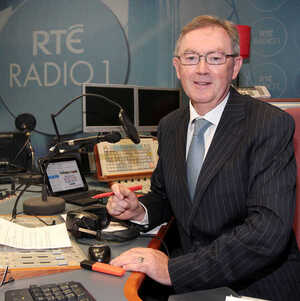
Pat Kenny (top) in the Newstalk radio studio this morning and Sean O’Rourke (above) in the RTÉ R1 studios.
Pics: Jason Clarke (Newstalk)
Photocall Ireland
 Seamus Heaney at an anti apartheid picket outside Dunnes Stores, Moore Street, Dublin, in 1985.
Sean Thomas, aka novelist Tom Knox writes:
…Some of the most over-the-top eulogies have come from Heaney’s native Ireland. The Irish Times, in the person of Fintan O’Toole, devoted two pages to the Nobel prize-winning bard. First the paper soberly assessed the poet’s merits. “Seamus Heaney made us gasp in wonder that, for all its follies and terrors, Irish culture had such a person in it…” “The great maker of such phrases will not be lost, for he is among the immortals now…” Then the Irish Times gave one example of those “immortal” Heaney phrases. Here it is:
Two buckets were easier carried than one.
I grew up in between.OK, I can hear all the protests. I am being unfair. Modern poetry is meant to be like this: awkward, dull, obscure, and forgettable.
But that’s not true. Some postwar poets managed to write lines that were beautiful, memorable and startling. Consider Philip Larkin. I bet you know a few of his phrases. “They f*ck you up your mum and dad, they may not mean to, but they do,” Or “What will survive of us is love.” Consider the searing Larkin poem, Aubade, a meditation about death which is so purely brilliant that it is wrong to pluck out any individual line.
Seamus Heaney simply does not compare to this. He’s not even playing in the same league.
Why, then, did Heaney become more famous than the infinitely superior Larkin? For a start, unlike grumpy Philip Larkin, Heaney was, by all accounts, a charismatic, sociable, and generous man. But the younger Heaney was also Irish, republican, Left-wing and hairy when all this was à la mode.
And once the literary world decided Heaney was the Mandela of Irish Poetry, he became irreproachable.
Literally irreproachable. I once wrote a mildly negative Amazon.com critique of Heaney’s turgid yet prize-winning translation of Beowulf (this was when Amazon paid folding money for proper reviews). The critique was censored; Amazon never ran it.
Too soon, about time or FIGHT?
YOU decide.
(Eamonn Farrell/ Photocall Ireland)
Now I feel stupid. Really really fucking stupid. pic.twitter.com/nrOdIQ1CJp
— The Walking Dread. (@_walkingdread) September 1, 2013
This changes everything.
Be cáis-tious.
