
Tag Archives: Alan Shatter

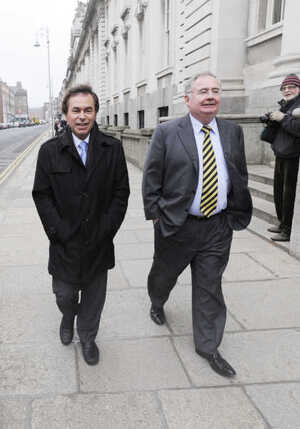
90217023[Alan Shatter and Pat Rabbitte]

“In so far as individuals who raised issues are alleging that the Garda reports published are untrue, let them bring forward chapter and verse and proof of this. I am open to being convinced, but they have not done so. Having engaged with Members of this House and published material, they did not co-operate with the Garda investigations that took place. I do not know why that was the case. There is no question of anyone being victimised”.

Justice Minister Alan Shatter in the dail, October 1, 2013

Meanwhile this morning [on Today with Sean O’Rourke]…

Sean O’Rourke: “The Minister for Communications Energy and Natural Resources Pat Rabbitte is on the line. Good morning to you Minister.”

Pat Rabbitte: “Hello Sean.”

Sean O’Rourke: “Now you are primarily on the programme to talk about these fears that post offices will be subject to wholesale closures round the country but before we come to that can I just get your sense as to what should happen now on the whole whistleblower controversy. Just on a point of clarification, and I heard you speak well of Sergeant Maurice McCabe the whistleblower at the centre of all this, is it your view that he did not co-operate with inquiries say particularly the inquiry into the penalty points controversy by the assistant Garda Commissioner?”

Pat Rabbitte: “Well, I mean I repeat Sean what I said about Maurice McCabe, I know him a little, I haven’t met him in recent years, he came to me a number of years ago about certain matters that Maurice McCabe wanted to put them into the public domain, he’s perfectly free to do so as regards you know what was the content of his exchanges in the present controversy I’m not party to that but it would appear from what has emerged now that the Minister for Justice may have been mistaken when he said he didn’t co-operate and I presume when the opportunity arises he will say whether that’s right or not but judging from media coverage it would appear that Maurice McCabe was available and so on and wasn’t exactly examined on the issue.

Sean O’Rourke:
“But surely if the Minister for Justice was mistaken he’d know that well and know it for a long time now and surely should have clarified it by this stage?”

Pat Rabbitte: “Well I don’t know, I don’t know whether he did know it. Quite clearly, if he said that in the Dail, he was under that impression. This is not a minister who would mislead the Dail, he’s a long-time parliamentarian, he’s a very scrupulous politician and if that wasn’t his genuine understanding of the situation at the time it’s simply unthinkable that he would have said otherwise there may, there may have been a simple mistake here and if there is it should be corrected.”

Sean O’Rourke:
“And isn’t it equally unthinkable that he wouldn’t have known long before now if there was such a mistake?”

Pat Rabbitte: “I don’t, you see, you’re inviting me into an area, Sean, that I haven’t personally been involved in, so, you know, there have been a lot of interactions here with the Official Receiver with the Confidential Recipient and so on and you know for example my memory of the legislation is that the Confidential Recipient is not required and does not report to the Minister for Justice the confidential recipient is an anonymised procedure put in place to take complaints from members of the, serving members of the Garda Siochana and pass them onto the Garda Commissioner*. so you know, you are inviting me into expressing personal knowledge of detail that I couldn’t have and I don’t have…”

Sean O’Rourke: “Well it was more an opinion as to whether the facts should have been known by this stage or not, but to come to the core point, the fact that the Taoiseach has now accepted that the matters brought to his attention by the Fianna Fail leader Mr Martin and subject to files that he’s given him are very serious and very grave matters and that they’re now being studied by both Taoiseach and his officials as well as internally the Department of Justice, is that the kind of scrutiny that in your view is going to satisfy the public?”

Pat Rabbitte: “Well I absolutely agree with you that they are very grave matters and couldn’t in fact be more serious in the manner that they have been presented in the public press in any event. I mean these are hugely serious issues and I presume what is underway is that the Minister is going back over all of the paper trail of this and all of the information in the Department of Justice before he meets with Taoiseach in respect of the file now in the possession of the Taoiseach. I mean like everyone else he didn’t know anything about this file until the day before yesterday, I still don’t know what’s in it but what I’ve seen in the public press can scarcely be more seriously and it’s being taken as such by the Taoiseach and I am sure by the Minister but the Minister has to be given an opportunity, he was out of the country yesterday on business, I don’t know if he’s, if he’s back yet, I haven’t spoken to him but the Minister has to be given an opportunity to explain what exactly happened in respect of the matters in this file that he had knowledge of. I know from personal experience that if a file was passed to the Minister this particular Minister for Justice would take time to find out what’s in it because he’s a diligent and scrupulous minister who works a very long day every day…”

Sean O’Rourke: “That suggests you have total confidence in Alan Shatter as a cabinet colleague?”

Pat Rabbitte: “I do have confidence in Alan Shatter, I do have confidence in him. He’s a reforming, hardworking, insightful minister and, you know, these are serious issues that have now arisen, the actual issues themselves of course far preceding Alan Shatter becoming Justice Minister, but we have to give him the opportunity to say what is in the possession of the Department of Justice and in his own possession and what happened and what we do now.”

Fairly awks, in fairness.

Listen here

* In this instance the complaint was against the Garda Commissioner

Previously: Garda Confidential

(Sasko Lazarov/Photocall Ireland)

00141117

[Charlie Flanagan TD. Knife out of shot]

This isn’t either.

Further to the GSOC/Whistleblower crisis Charlie Flanagan, chairman of the Fine Gael Parliamentary party, appeared on Morning Ireland this morning to give his backing to justice minister Alan Shatter.

Sort of.

Fran McNulty: “I have read this transcript in full and there are a number of details in it and it has been indicated by Micheal Martin that there are a number of crimes detailed, there are sexual assaults, there are murders, there are abductions and kidnappings wouldn’t it be a matter of the most grave political consequences if it is found that these issues having been flagged up by a whistleblower haven’t been dealt with and people have suffered as a result? Wouldn’t the political consequences of this be very grave?”

Charlie Flanagan: “I agree. These are very disturbing and serious allegations of a very grave nature. The Taoiseach yesterday received a copy of the transcript from Micheal Martin, he is considering the matter, he will ensure that the detail is passed on the appropriate authorities, some of this I understand has already been examined by the whistleblower (sic) in any event but I haven’t seen the allegations let’s see what the allegations are first and lest, let’s ensure that we have due process but you can take it from me that no one in government will be sitting on any aspect of this.”

Fran McNulty: “Can I ask you, do you agree with the decision to sack Oliver Connolly?”

Charlie Flanagan: “It was quite clear having regard again to the release of a transcript of a conversation which was highly defamatory of the Minister of Justice that the position of the whistleblower (sic) was untenable and he had to go.”

Fran McNulty: “Was it a knee jerk reaction, because we heard [Garda whistleblower] John Wilson saying earlier that members of the Force now have nowhere to turn?”

Charlie Flanagan: “No, you see, a knee-jerk reaction, I heard criticism earlier that it took too long, so really, really, we are in a situation here where on the one hand the opposition is talking about the delay and on the other hand other commentators are talking about a knee-jerk reaction. The fact of the matter was that there must be an element of process here. Over the past week an investigation has taken place between officials in the Department of Justice and the Office of the Confidential Recipient, the Report was handed to the Taoiseach on Tuesday and the Recipient was relieved of his duties.”

Fran McNulty: “And his office is now vacant and members of the Force have nowhere to turn.”

Charlie Flanagan: “Well the Office was used on 12 occasions in a period of six years. The legislation – and already the Minister for Justice has indicated some time ago that he was not happy with functions and operation of the office, already that legislation, the Protective Disclosures legislation is at an advanced stage in the Dail. The Minister has indicated his amendment and there’s every reason Fran, with all party co-operation, that that legislation can be enacted within a couple of months.”

Fran McNulty: “What do you say in response to the commentary this morning that Mr Connolly was just a fall guy and attempt by the Minister for Justice to kill this story?”

Charlie Flanagan: “No I don’t believe he was, I believe it was clear that Mr Connolly made very, very serious allegations against the Minister for Justice of a highly defamatory nature and, his, his position was untenable.”

Listen here

It may be worth noting that  Alan Shatter has known about the contents of the McCabe/Connolly transcript since May 2013.

Yes.

Most odd.

Meanwhile: Eight Independent TDs call on Shatter to step down (Independent.ie)

ShatterDaill

[Justice Minister Alan Shatter in the Dáil last night]

Last night in the Dáil, Justice Minister Alan Shatter referred again to Section 80(5) the Garda Síochána Act 2005 in relation to the non-reporting of the surveillance sweep undertaken by GSOC to the minister before outlining that other sections provided for GSOC to tell him.

He said:

It is true that section 80(5) of the 2005 Act provides that GSOC may make a report to me in the
circumstances I have described, but this is better described as an enabling provision rather than a purely discretionary one. In other words, it should be used in circumstances contemplated by the provision. In that context, I don’t think that any reasonable person would regard concerns of the nature we are discussing as anything other than grave or exceptional. I am not sure how anyone could sensibly argue the opposite in circumstances where this issue has dominated the TV and radio news for days on end, has been the subject of countless newspaper headlines and articles, was the subject of statements in this House last week, is the subject of a motion in the House this evening, and is being examined as a matter of urgency by a Joint Committee of both Houses.

Even apart from this, however, there is the separate obligation in section 103 of the 2005 Act. Section 103 provides that GSOC, where it launches a section 102 investigation, shall inform the Minister of the progress and results of the investigation. An exception to this strict requirement is allowed in only three circumstances, namely where supplying the information would prejudice a criminal investigation or prosecution; would jeopardise a person’s safety; or for any other reason would not be in the public interest. The first two exceptions are irrelevant. As regards the third, I find it impossible to see how it would not be in the public interest for the Minister to be advised of an investigation in these circumstances.

However,

Vincentpanel


On Tonight with  Vincent Browne with  Former Supreme Court judge Catherine McGuinness, Sunday Times security correspondent John Mooney, Labour Senator Susan O’Keeffe and Fianna Fáil TD Niall Collins addressed the relevancy of the the Garda Síochana Act to the GSOC ‘situation’.

They also discussed how Mr Shatter has refused to confirm whether or not he has signed a warrant to allow for the surveillance of journalists and how Mr Shatter has not been asked if he signed a warrant for the bugging of GSOC’s phone.

Vincent Browne: “First of all, let’s deal with the legal issue. Catherine, a former Supreme Court judge, do you think really there’s any possible reading of Section 80 of the Garda Siochána Act 2005 that requires GSOC to inform the Minister for Justice of what it’s doing.”

Catherine McGuinness: “Well, looking at the text I would have said that there wasn’t an absolute requirement, certainly you could possibly say they might have a discretionary, a discretionary need to make a requirement to talk to the minister about something that was particularly grave. But I do think it’s left to their own discretion. But, in any case, I really do think that too much is being made of this, about whether the minister was told or the minister was not told. Certainly, from the point of view of GSOC when you look at what has happened – when the minister did hear about it, do you wonder that they didn’t tell him in the first place, you know?”

Browne: “That’s a separate issue. I’m just just talking about the legal thing – was there a legal requirement to tell them under Section 80 of the Garda Síocána Act 2005. He went on to say that, under Sections 102 and 103, there was clearly a requirement on them to inform him. And, I, I can’t, I think this is quite amazing. 102 says, it applies to a situation where a Garda Commissioner asks GSOC to enquire about something or when the Minister asks GSOC to enquire about something – then there is a requirement on GSOC to inform the minister, that’s…”

McGuinness: “Yes”

Browne: “That’s what it amounts to.”

McGuinness: “Yes.”

Browne: “Neither…”

McGuinness:These things haven’t happened.”

Browne: “These things hadn’t happened so it’s totally irrelevant.”

McGuinness: “I think that 102 is dealing with particular issues, particular issues that may arise like when the, as you have said, and I don’t think they’re connected with this particular situation. I was puzzled when I, frankly, I was puzzled when the minister said this.”

Browne: “It’s amazing that a solicitor, admittedly he spent most of his time in Family Law, but amazing that a solicitor can’t read and Act and understand it, isn’t it?”

Later

John Mooney: “This all arises out of a public interest inquiry that GSOC ran into collusion between a drug trafficker called Kieran Boylan, from Co. Louth, and members of a now disbanded elite unit of gardaí in Dublin. There were a lot of tensions in that as part of that inquiry. GSOC have been on the record about Garda management withheld documents from them, some documents weren’t furnished at all. That is because this individual was involved in extra-judicial operations, whereby he was trafficking drugs and setting up low-level people. But I think that there’s an issue in that file, in so far as there were weapons and drugs transported at one stage, through European countries.”

Browne: “Was there a remark made by Garda Síochána…”

Talk over each other

Mooney: “If you just let me finish the story. But, during that, we published a number of stories in The Sunday Times about what was happening and, at one point, a senior member of Garda management rang GSOC and threatened to use analysts to find out where we were getting our information from and because it was accurate. If we continue on into a couple of months until last summer, there was, Simon O’Brien, I understand had a meeting, where they decided to take a section of the report, out of the report, prior to publication and, a couple of weeks on, the deletion of that particular section of a report was mentioned to Simon O’Brien.”

Browne: “By whom?”

Mooney: “That was by Martin Callinan. At that point I understand that sent a lot of panic, shockwaves through the Commission, they were very concerned about their own internal security while they may have had fears a couple of weeks prior to that and may have been considering, certainly, bringing in countersurveillance measures. I think when these specific remarks were made they put the cat amongst the pigeons and I think that prompted them into very specific course of action.”

Later

Browne: “Just one further issue I want to pursue with you…and it concerns that if the Garda Síochána believe that a crime had been committed within GSOC to do with release, leaking of confidential information, they would have been justified in undertaking the tapping of phones but in order to do that legally, they would have had to get the authorisation of the Minister for Justice…”

Mooney: “Well I put that question to Alan Shatter last week and he’s refused to comment on whether he signed a warrant, which allowing any sort of surveillance on media organisations or journalists, in particular.”

Browne: “But, GSOC, did he sign an authorisation for the tapping of GSOC’s phones?”

Mooney: “Well I thought it was very noteworthy that Simon O’Brien refused to ask him that particular question.”

Browne: “How do you know that..?”

Mooney: “Because he gave evidence to that..”

Niall Collins: “He said that in the committee last week.”

Browne: “That he didn’t ask if his phone was tapped?”

Mooney: “He didn’t specifically ask Alan Shatter if he’d signed a warrant..”

Collins: “He was asked that question at the committee by Clare Daly…”

Mooney: “And he said he chose not to ask the minister that particular question. I think Simon O’Brien is an English police officer who may be suffering from disbelief at the way these matters are dealt with in this country.”

Watch back here.

UPDATE:

JW1

Justice Minister Alan Shatter will appear before the Oireachtas Joint Committee on Public Service Oversight and Petitions today in relation to the GSOC bugging affair at 4pm.

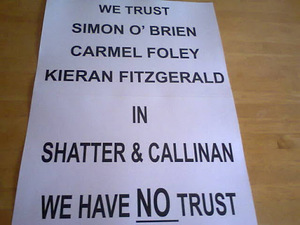
Garda whistleblower John Wilson, who created the placards above, is organising a protest outside the Dáil at this time.

He says:

“It’s to support GSOC’s Simon O’Brien, Kieran Fitzgerald and to express a total lack of confidence and trust in Alan Shatter and Martin Callinan. It’s also to highlight the abuse of numerous people by certain gardaí.”

Earlier: Putting It On Rits

RITSimage
Rits2

Tonight, Justice Minister Alan Shatter told the Dáil:

“I have received a peer review report on the technical matters of relevance from RITS, an IT
security consultancy firm to seek clarification of the technical information contained in the
Verrimus report and an opinion with regard to the risks as identified and presented to GSOC.

“The report mentioned earlier that I received from RITS gives as an opinion, based on the reports
provided to RITS, that “there is no evidence of any technical or electronic surveillance against
GSOC”, that is no evidence at all, not merely no definitive evidence. This report also disputes
other conclusions reached by Verrimus.”

Transcript from his speech in the Dáil, via RTÉ, here.

RITS

00146735

90328579oliver

[From top: Alan Shatter and Garda Commissioner Martin Callinan; Garda Whistleblower Sergeant Maurice McCabe and Garda confidential recipient Oliver Connolly]

Several TDs have read into the record certain sections of a transcript of a conversation between Garda Confidential Recipient, Oliver Connolly and Garda whistleblower Sergeant Maurice McCabe.

We have been provided with a full transcript of that conversation [below].

The confidential recipient’s role is to receive information from whistleblowers in the force and present it to the Justice Minister.

Oliver Connolly was appointed as a confidential Garda liaison by Justice Minister Alan Shatter in 2011. Mr Connolly had donated €1,000 to Mr Shatter’s campaign for the 2011 General Election and Mr Shatter was trained as a mediator by Friary Law, the company owned by Mr Connolly.

Sgt McCabe had given Mr Connolly a report containing a number of allegations of Garda wrongdoing.

The follow-up meeting took place in a Dublin hotel on Thursday, February 9, 2012.

At the meeting Sgt McCabe was told that the Justice Minister had referred his complaints to Garda Commissioner Martin Callinan and that no further action would be taken. We have redacted certain names.

Maurice McCabe:  “Sure it’s a joke really Oliver, when you see it. Like the minister should go to someone independent to look at it. Like what do I do with all the falsification of records and now even the Minister is now saying, now saying that everything was OK.”

Oliver Connolly: “What he’s saying basically is there is no actual evidence against the Commissioner.”

McCabe : “He is believing the Commissioner and not me. So, it’s a joke, isn’t it really Oliver?”

Connolly:  “Look…”

McCabe: “Like almost all the incidents involved were upheld in other words I was right.”

Connolly: “Yes but it’s your allegation of malpractice and corruption against the…”

McCabe:  “No but do you see what he says in the letter it’s he says it was an investigation by [REDACTED] and there is no evidence.”

Connolly: “Well I have to tell you there is nothing in the regulations preventing you, you can make as many confidential reports as you wish and you can actually point out, the only way I can go to the actual minister is if you actually directly implicate the Commissioner.”

McCabe: “But sure I did?”

Connolly: “Only in so far and he made a flawed appointment.”

McCabe: “No I said that he should have been aware.”

Connolly: “You probably exhausted, you probably exhausted the limits of the office.”

McCabe: “I have yeah. So in other words you can go nowhere else except to court.”

Connolly:  “Probably. I mean the minister has given me a three-page letter; it’s more than he gives to most people.”

McCabe : “But I’m sure if the minister read it, he did read it?”

Connolly:  “Shatter would have read your report in detail, I know he did, he communicated with me and he will have read all of your exhibits, which I actually labelled them numbered one to nine in the actual, in the order they were highlighted so he did know. And you know I redacted, the only thing I redacted was your name. Alan studied everything in fact I know he did.”

McCabe: “Yeah but do you see the flaw in the system Oliver he goes back to the commissioner, if anyone complains against the……”

Connolly: “You were guarded in the report I have to say in implicating the Commissioner directly you even gave him a way out, you actually said on page 3 he may not be…”

McCabe: “He may not be…”

Connolly: “Yes but the point is and I know what you are saying . I mean I have to say I am surprised.”

McCabe: “I showed you.”

Connolly: “There are other issues that…”

McCabe: “I showed you the records Oliver.”

Connolly: “There are other issues I am aware of that are not related to you at all, course they’ll go to the Commissioner. But I’m very surprised he pushed the man’s appointment, so he was appointed was he?”

McCabe:- “Yeah, he’s now a Chief Superintendant based on what the commissioner told him.”

[they discuss the appointment]

McCabe: “But Oliver what do you do then with all the falsification of records? What do I do with them? What do I do with the hundreds of cases that haven’t been investigated? What do I do with innocent people being set up.

Connolly: “I tell you Maurice, the only thing I’ll say to you is….”

McCabe: “What?”

Connolly: “Use the public forum of the courts.”

McCabe: “Yeah.”

Connolly: “What I would say to you is I still think you should go for mediation, I don’t think they want all this in the broadcast media. I think you should, you should have your submissions in. I give you some advice, your solicitor and [Michael] McDowell are now aware of it. If you can get them in  the court would be happy to accept mediation. And you go in there looking for the numbers and whatever else you want you’ll get it. If stuff was to get out into the public, the print media, it must only come from what happens in the courtroom. I’ll tell you something Maurice and this is just personal advice to you. If Shatter thinks your screwing him, you’re finished.

McCabe: “Right.”

Connolly: “Forget about it, I mean he is dealing with a lot of shit at the moment, and what I’m saying to you is if stuff is to get into print or broadcasting media, it comes public before the court not any other way. If Shatter thinks it’s you, if he thinks or is told by the Commissioner or the Gardaí here’s this guy again trying another route trying to put pressure on, he’ll go after you.

McCabe: “Alan Shatter?”

Connolly: “Yeah I mean he will.”

McCabe:-“Alan Shatter will go after me?”

Connolly: “Yes, if he thinks, if he thinks, if he thinks and this is a conclusive finding you don’t know it, you don’t know if it’s Gardaí, it’s none of my business,. What I’m saying to you, if you’re going to kill a king, if you’re going to strike, and I mean in the public forum of the courts with the former AG [McDowell], they’ll be all terribly interested. The broadcasting media will get a field day on your case, it’s actually the only forum to speak to them. Then what will happen with the minister, all’s fair in love and war, if he’s told you see I gave it personally on the day and I’d be very careful. No intermediaries.”

McCabe: “No, no and I’ll give you my word.”

Connolly: “…but what I’m saying to you, you have to that day what you will have to do if Shatter if this turns, he’ll turn with you , he’s scaremongering with the Commissioner, but he’s too close [to the Commissioner].”

McCabe: “But how is that?’

Connolly: “That’s a relationship they [Callinan and and Shatter] forged [during the] Obama [visit]. He [Shatter] was only in the job a month and he had the Queen of England and the President of the United States [visiting] and he’s Minister of Justice and Defence and he has to work very closely [With Callinan] because both their careers, everything is on the line, both of them, Shatter and the Commissioner. He’s his new best friend for about two or three months…”

McCabe:  “The Commissioner?”

Connolly: “Had to be had to be and I would say I’m only speculating.”

McCabe: “No problem.”

Connolly: “I would say he forged a reasonably good relationship with Martin [Callinan] now however I know Alan and what I can tell you that I’m lucky…Listen the Commissioner is taking a view to embarrass you.. What I’ll say to you is, [your report] went to the Department of Justice and that annoyed the Commissioner greatly. I’m sure it’s going to be an embarrassment for the Gardaí, a disaster for them and listen if your complaints are exposed to the print media it will make him an angry man.

Continue reading →

ShatterGSOC

Mooneyy

Hmmm.

Last night Justice Minister Alan Shatter’s appeared on Prime Time in relation to the alleged bugging of the Garda Síochána Ombudsman Commission.

During his appearance, presenter Claire Byrne asked Mr Shatter about the different versions of events told by him in the Dáil on Tuesday, compared with that of the GSOC chairman Simon O’Brien, told at an oireachtas committee meeting on Wednesday, and indeed what GSOC commissioner Kieran Fitzgerald said on Prime Time on Tuesday.

Mr Shatter put it down to general confusion while also insisting what he said in the Dáil was exactly what GSOC told him.

Claire Byrne: “Just to clear what you said in the Dáil was based exactly on what Simon O’Brien told you during your meeting on Monday. So did he have a different story then? When he went to the committee. I mean, let’s admit it, he gave an incredibly different account of what had happened?”

Alan Shatter: “I’m very conscious that Mr O’Brien and the other members of GSOC were at a committee meeting for up to four hours and a series of questions were put to them. And I think, in the course of that event, there were different answers given, with regard to particular issues and these, some of what was said during the course of that seemed to me to be a little confused or contradictory.”

Byrne: “So you were surprised by at least some of what was said during that committee hearing by the chairman of GSOC?”

Shatter: “At no stage during his oral briefing of me, in the context of a written brief, or indeed the press release that GSOC issued, was it stated that he or members of GSOC believed they were under surveillance. What was stated was that, in the context of a security sweep that had been undertaken, vulnerabilities, or potential threats or abnormalities had been identified. And I acted, I acted on foot of that.”

Byrne: “Ok. But this is very important. Do you believe that you were given information that led you to mislead the Dáil?”

Shatter: “No, I was given information that I brought to the Dáil…”

Byrne: “But it was wrong, it was contradicted afterwards..”

Shatter:…”the brief…well no, it was, the brief that I received from GSOC, which was very important, I forwarded this evening to Joint Oireachtas Petitions Committee, before whom the GSOC members were yesterday [Wednesday]. I’ve been asked to present at the committee next Wednesday, I’m very happy to do so. I do think that it’s important that there’s absolute clarity in regard to these issues.”

Byrne: “So you weren’t told the full story?”

Shatter: “No I was told a, the story…”

Byrne: “A story but not the whole story.”

Shatter: “I was told the story that I told the Dáil and I do think there’s now some confusion arising from the four hours of hearings that took place.”

Later

Byrne: “Quite aside from the hearings, Kieran Fitzgerald was in here, the Garda Ombudsman Commissioner the other night and he said that the first security sweep was done because there was a credible threat they believed, now that wasn’t what you said in the Dáil? You said it was routine.”

Shatter: “Kieran Fitzgerald, I think I recollect correctly, said that he agreed with my account in the Dáil..”

Byrne: “But he did say there was a credible threat.”

Shatter: “I repeat: my objective, and my only objective, was to tell the Dáil the truth of what I knew about these matters. What I knew about these matters was based on the briefing I got from the chairman of GSOC and also from the written submission that they made to me. It was absolutely clear and the written submission they furnished sets it out. They referenced the importance of confidentiality and security and that because, for some considerable time, going all the way back to 2007 apparently, there hadn’t been a general security sweep, they determined what should be undertaken. No threat was ever identified to me as stimulating the need for that sweep.

Watch Alan Shatter’s interview in full here

Previously: Contradictions In Terms

John Mooney

UPDATE: Read the briefing note given from GSOC to Alan Shatter here

ShatterDail

Justice Minister Alan Shatter spoke in the Dáil yesterday evening about the reported bugging of the Garda Síochána Ombudsman Commission’s offices during a 5.30pm debate on the matter, saying:

“It is important to say at the outset that the Garda Síochána Ombudsman Commission has informed me that, after an investigation, they concluded that no definitive evidence of unauthorised technical or electronic surveillance of their offices was found. Moreover, they have informed me that their databases have not been compromised. In other words, it has not been established that the offices of the Ombudsman Commission were subject to surveillance. Some public comment has proceeded on the basis that it is an established fact that the offices of the Commission were bugged when clearly it is not.”

“The issue in question arose following a security sweep, in September 2013, of GSOC’s offices in Dublin. I am informed that there was no specific concern which caused GSOC to organise the security sweep, which was carried out by a security firm based in Britain. It was a routine sweep of a nature which had occurred previously. I do not think anyone could argue that it is unreasonable for a body which, of its nature, holds sensitive information to take measures to ensure the security of its communications.”

“I am advised by GSOC that the sweep identified what they refer to as two technical anomalies which raised a concern of a surveillance threat to GSOC. I should emphasise that my understanding is that what was at issue were potential threats or vulnerabilities, not evidence that surveillance had, in fact, taken place. A subsequent sweep identified a third potential issue. There was no suggestion that there was any risk of unauthorised access to the GSOC databases and the documentation on them.”

Kennybug

Taoiseach Enda Kenny, above, also addressed the Dáil, saying:

“So, if you’re asking me ‘was the office bugged, what I’m saying to you, in the words of GSOC that they found, following the investigation, no evidence of sophisticated evidence of unauthorised technical or electronic surveillance of their offices found, I think that’s pretty clear.”

RTE9

RTÉ’s political correspondent David Davin-Power on the 9pm news last night, speaking to Eileen Dunne, from Leinster House.

Eileen Dunne: “David, the focus of this story seems to be changing all the time, where are we tonight?”

David Davin Power: “That’s right Eileen, the focus of this controversy has weaved about a bit but I think tonight it’s settled on the Garda Ombudsman Commission and its handling of events. The original newspaper story that sparked this controversy was pretty accurate in its detail, in that it mentioned wi-fi networks, conference phonecalls and so on but it also went on to cite unnamed sources, saying that there was ‘government-level technology involved’. Well, obviously, there doesn’t appear to have been and that raises the question of who leaked the information and, to borrow a phrase from a couple of years ago, who sexed up this particular dossier? And then there’s the question of not telling the minister, understandable perhaps at the time but scarcely credible now that the whole controversy seems to have been nothing more than something of a bottle of smoke. And then, finally, there’s last night’s statement, which infuriated ministers, aswell as the Garda Commissioner, in mentioning the gardaí specifically. Now the Ombudsman chairman [Simon O’Brien] wanted, in his comments, just to put the gardaí out of the frame completely, saying they weren’t involved in anyway but it had the effect of providing ammunition to people who have always been sceptical and suspicion, suspicious of the Ombudsman Commission. So, plenty of questions, serious questions for the chairman of the Ombudsman Commission to ponder, along with his colleagues. They appear before a Dáil committee tomorrow. They’d want to put in a pretty credible performance and present a united front, if the whole process of rebuilding trust and credibility is to have any chance of success.”

Fitzgerald

Garda Ombudsman Commissioner Kieran Fitzgerald then went on Prime Time with Miriam O’Callaghan, following the news, last night.

Miriam O’Callaghan: “So, Kieran Fitzgerald, the minister today seems pretty clear, there’s no evidence at all that you were bugged. So were you bugged?”

Kieran Fitzgerald: “Miriam, it would be very, very good if we were able to say definitively yes, or definitively no. Unfortunately, the reality of modern surveillance and intrusive surveillance mechanisms, is that it’s very often an inconclusive result. So what we got were credible threats to our own security, we hired consultants, experts, international experts to consider those for us, examine those and test them. At the conclusion of their testing and their sweeps, their security sweeps, they were able to tell us that certain things did not look likely and other things, they could not be definitively sure.”

O’Callaghan: “What were the credible threats?”

Fitzgerald: “The credible threats were three-fold. One was a piece of equipment which was connecting to an external network, a wi-fi device. Now it should have been activated by a password, in actual fact it was activated, seemingly, without the need for a password and transmitting. It did not compromise our data, it did not connect with out internal security. But, having found it, we certainly needed to take it very, very seriously. That was one. The second was more worrying, it was a conference call telephone, a conference call facility that we use, not infrequently,  and that was tested, and the test showed up what we called, in our first report, an anomaly, but it showed up something that gave them cause for concern and their judgement was that the strange behaviour of this device, in response to their test, was such that, it could have been coincidental, it could be accidental, it could be explained away but they rated in their report the possibility of it being coincidental as close to zero.”

O’Callaghan: “And the third one?”

Fitzgerald: “And the third one was a sophisticated piece of equipment that does sweeps of buildings, from an external, it doesn’t have to be in a building, just in the vicinity and that can, if you like, attack mobile phones and mobile devices.”

O’Callaghan: “It sounds like, still, like your statement last night from GSOC which more or less confirms what you’re saying now: you still believe that there could have been bugging of your building and your equipment. And that is not what the minister is saying today.”

Fitzgerald: “Well, we’ve no disagreement at all with the minister and we…”

O’Callaghan: “Well you clearly have…because he came out today saying there was none.”

Fitzgerald: “Well, what the minster actually said was that he had received a thorough briefing from us yesterday and further again today, with his officials and what he said was that we said that there was no definitive evidence of…”

O’Callaghan: “He said actually, just to quote him, he said that what was identified was ‘potential threats and vulnerabilities but there was no evidence that any surveillance had, in fact, taken place’.”

Fitzgerald: “There is no evidence to sugge-to confirm that surveillance has taken place. The minister is absolutely right and we have no, as a result of our briefing to him, we have no disagreement on that topic.”

O’Callaghan: “But on the balance of probability, Kieran Fitzgerald, do you believe you were bugged?”

Fitzgerald: “It is very difficult to say, I mean…”

O’Callaghan: “But what do you believe?”

Fitzgerald: “Well, hold on, Miriam, it would be lovely to be able to say we could be certain one way or another. What we are faced with, at the conclusion of this, is that we could more or less dismiss some of these threats and if you like, on a balance of probabilities, on others, we just do not know. What we have learned though, are the threats to our building and ensure that they no longer exist.”

O’Callaghan: “OK but on one of the anomalies you just mentioned, you said the likelihood, you know, that it’s an innocent thing was remote to zero, the possibility?”

Fitzgerald: “Well that’s what was reported to us, exactly.

O’Callaghan: “So you can’t still believe, or say to me tonight that that would make you believe that there was some form of surveillance.”

Fitzgerald: “Well we cannot definitively, as the minister said and as I’m saying now,  we cannot definitively say that we were bugged, certainly we cannot say that.”

Later

O’Callaghan: “But was it routine, Kieran Fitzgerald? To go to a British firm? To do it in the middle of the night, to do it at weekends, or did something make you do it?”

Fitzgerald: “Can I just say, there aren’t an awful lot of people engaged in this work so the pool of people…”

O’Callaghan: “Ok. But was there something that sparked you to do this?”

Fitzgerald: “If you recall, throughout 2012, we were involved in some serious investigations and we…”

O’Callaghan: “The Kieran Boylan case?”

Fitzgerald: “And we submitted a special report to the Oireachtas, something we very rarely do, something we do only in grave and exceptional circumstances. We were obviously in a state of heightened awareness of our security at that point. And some things appeared in the public discourse that gave us rise to concern, nothing terribly specific but things that worried us and we thought this is a good time to do this.”

Watch back in full here

00087eb8-642


Justice Minister Alan Shatter addressing the Dáil within the past hour.

A clean sweep, as they say in G2.

Earlier: “The Politicisation Of Policing In Ireland”

‘Certain Events Prompted This Security Sweep’