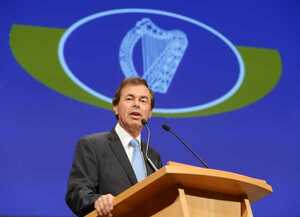
[Justice Minister Alan Shatter and Garda Commissioner Martin Callinan]
Justice Minister Alan Shatter has decided to call in the Garda Ombudsman Commission in the public interest. The decision has been welcomed by the Garda authorities…
The minister’s move seems likely to end the impasse between the committee and Garda Commissioner Martin Callinan over the possible appearance of one of the whistleblowers, who is a serving member of the force, before the PAC on Thursday….
Yesterday’s Dail debate on the report by the Comptroller & Auditor General concerning Garda management of the fixed charge notice system…
And the sacking of Irish Independent journalist Gemma O’Doherty.
Pádraig Mac Lochlainn: “Minister, as you know the Comptroller & Auditor General reported on his findings in relation to the fixed charge notice system and the outcome is absolutely shocking. What he has revealed is that because of clearly widespread maladministration and very poor procedures, 1 in 5 motorists facing fixed charge notices are getting off. 1 in 5.
“We’re talking here about 42,000 a year. Half of the summonses that were issued by the Courts in relation to these, half of them were not served. Now this is an absolute crisis. Minister, it’s not good enough to issue circulars, we need to see how the hell this happened.
“And Minister, you know that two Garda whistleblowers brought this wider issue into the public domain last year. You and the Garda Commissioner, I believe sought to undermine their credibility, talked down the numbers that were involved and now we see very clearly that they have been vindicated.
“So Minister, what are you going to do about this? This is a massive crisis of confidence for the public. The 71% of people who pay their fine, who take it on the chin, accept that they did break the speed limits or whatever they had done to break traffic laws. They need to know that the system applies to everybody.
“And Minister, will you now apologise to the two Garda whistleblowers for the attempts by yourself and the Garda Commissioner at that time to discredit them, to undermine the scope of what they were bringing into the public domain and acknowledge that they were right? There was a widespread problem with the system of penalty points in this State and it’s gonna be sorted out.”
Olivia Mitchell: “Deputy Higgins, two minutes.”
Joe Higgins:”Go raibh maith agat, a Cathaoirleach. Minister, the problem is is that there’s a huge contradiction between the report of the Comptroller & Auditor General and the report of the Gardai into the penalty points issue. The Comptroller found 600 repeat offenders with 3 or 4 terminations, the Garda report found a few. The Comptroller found 3,000 statute barred point cases, there was no mention in the Garda report.
“Thousands of fixed penalty notices went missing and were unaccounted for according to the Comptroller, there is no mention in the Garda report.
The Comptroller said that large volumes of notices were terminated by Gardai from outside their areas, the Garda report said three. The Comptroller said the thousands of notices cancelling contravened the rules and regulations and the Garda report said 600. And finally, the Comptroller said €1.2 million lost, the Garda report said a few thousand. Can you explain?
“Isn’t it the case that the whistleblowers are exonerated as truthful and honest in the light of this revelation and another member has left, another subject to sanctions. Will you see that justice now prevails here?
“Finally, another victim of the penalty points debacle, Gemma O’Doherty, a leading investigative journalist with Independent Newspapers was sacked because she uncovered a story that the Garda Commissioner was the beneficiary of cancellation of penalty points and according to the Irish Post, the editor of the Independent who sacked her was also a beneficiary of cancellation. Isn’t that outrageous and doesn’t it smack Minister of a grotesque abuse of power? Will you speak out against this also?”
Olivia Mitchell: “Thanks deputy. The Minister to respond. Four minutes, Minister.”
Minister Alan Shatter: “Let me respond to both deputies but on the last issue that the deputy who spoke raised, the last issue the deputy raised. I’m not privy to the background circumstances to anyone terminating their employment with Independent Newspapers and I’m certainly not going to comment in any way on that.
“I’m glad of the opportunity to comment on the findings of the Comptroller & Auditor General’s report on the Garda fixed charge processing system. I welcome these findings because they confirm what went wrong with the system and what needed to be fixed.
“Broadly speaking, the findings in fact, echo the findings of the examination of the same allegations which was carried out by Assistant Commissioner John O’Mahoney. I published Assistant Commissioner O’Mahoney’s report and also a related report by the Garda Professional Standards Unit earlier this year and referrred them to the Joint Oireachtas Committee on Justice, Defence and Equality.
“Perhaps the key point is that the O’Mahoney report broadly identified the same key issues of concern relating to the operation of the fixed charge processing system identified with the C&AG namely a failure to follow cancellation procedures in a significant number of cases, a lack of adequate record keeping and inconsistency, and in many cases a laxity in accepting justifications in speeding and other road traffic offences.
“Indeed, I previously have made reference to some of the explanations accepted as exotic. There’s absolutely no doubt the findings of the C&AG reinforce both the concerns identified by the O’Mahoney report about weaknesses in the fixed charge notice system and the case for corrective action and action has been taken. Disciplinary proceedings were taken against a number of members of An Garda Síochána.
“A number of others were advised of the absolute necessity to follow correct procedures. A new garda directive, cancellation of fixed charge notices was issued to the entire force on the 30th of August 2013 aimed at significantly tightening up on procedures for cancellation.
“The Garda Commissioner has accepted and will implement significant recommendations by the C&AG on improving the fixed charge notice system and how it interacts with the Courts Service and the driver licencing system. In addition as I previously indicate, I refer the two Garda reports to the Independent Garda Inspectorate for its advice on any further measures which may be required and expect to see a report from the Inspectorate in the near future.
“I welcome the action taken by the Commissioner and his committment to implement the further recommendations we’re addressing this evening. The result will be a fixed charge notice system which is more open and transparent and more robustly operated. This is essential in public confidence in the system in enforcement of road traffic laws being maintained.
“The Garda Siochana along with the Road Safety Authority and other stakeholders have done so much in recent years to improve road safety and reduce fatalities. Everything must be done to maintain that progress. The Garda Commissioner has my full support in the strong action he has taken.
“It is only fair to acknowledge that these reports and their findings and recommendations are a response to allegations of improper cancellation of fixed charge notices. Any fair assessment must conclude on the evidence available that a great many of the most serious allegations have been found to have been utterly without basis including allegations of avoidable road fatalities linked to speeding drivers being improperly let off fixed charge notices and allegations of hundreds of PULSE records being destroyed.
“Perhaps most significantly the members of An Garda Siochana making the allegations rejects all of the findings of the O’Mahoney report and continues to claim that there has been widespread corruption and criminality on the part of senior members of the Garda Siochana. These are exceptionally serious allegations which the O’Mahony report found no basis in fact. my department has written to the member concerned, urging him to come forward with any evidence that he may have to justify these allegations.
“And indeed, it’s open to the member concerned to make an appropriate presentation if he chooses to do so before the Joint Oireachtas Justice Committee but in fact that has not yet occurred. In conclusion, I welcome the finding of the Comptroller & Auditor General. The findings are in line with the findings of the report by Assistant Commissioner O’Mahoney published earlier this year.
“I fully support the Garda Commissioner and the decisive action he has taken on foot of them and I will do my best to ensure that any further co-ordination required between An Garda Siochana and the Courts Services to ensure the efficient enforcement of summonses in the area of traffic offences does take place and that issues should be promptly addressed when they come before the courts but of course that they become available to them, documentation that they require.
“It of course is not available to me, it would be highly inappropriate of me to in anyway interfere with the independent approach taken by the courts, or by particular District Judges in any individual cases that come before them with regard to any charges brought in relation to road traffic offences.”
Pádraig Mac Lochlainn: “Minister, I’m sure you will accept that the 71% of citizens who accepted the fine and took the penalty points on the chin will be appalled to know that you know that up to one in five managed to get away with this. And that is clearly down to the scale of it ye know you did talk down at one stage. the massive scale of it is clearly maladministration. But there are cases which will cause serious concern.
“There are allegations as ye know about judges repeatedly having points written off, serving Gardai, State Solicitors and recently we’ve been informed that senior journalists have had penalty points written off who work to hold Gardai to account. We have the allegation that the journalist Gemma O’Doherty and it is an allegation that she lost her job because of the work she was doing around all of this area. Are you concerned, Minister?
“Will you investigate the reason why at least two senior journalists in the publication mentioned in The Guardian newspaper, covered in the Irish Post newspaper that senior journalists in that newspaper, INM had penalty points written off, will you investigate those circumstances to see were they genuine and they may well have been genuine reasons but the public have a right to know because in the interests of democracy we need to know the answers.
“I’ll wrap up with this. Thank you, Chairman. Thank you for your appreciation of this. It is critical for public confidence to be restored that overall there was huge maladministration but clearly there were cases that people that were very powerful and connected had points written off because of who they knew, that is totally wrong. And you should undertake to investigate the circumstances where people would not hold Gardai to account by getting points written off. Examine that.”
Olivia Mitchell: “Deputy Higgins, you have a minute.”
Joe Higgins: “Minister, all is that demanded is that any of us who have incurred penalty points are treated in the same way whether you’re a public figure or a private citizen or anybody else. Now Minister you said that the conclusions of the Comptroller are in line with the findings of the report by the Assistant Commissioner O’Mahoney.
“Clearly that is not the case, Minister and that is easily documented. So I invite you to get your department to go through it with a fine toothcomb to revise your view on that.
“You do say it is only fair to acknowledge that these reports and the findings and recommendations are in response to allegations by whistleblowers, my word. Minister, I want you to go the extra mile. Be generous here. Okay, maybe they didn’t get everything absolutely right but the vast substance of what they said has proved to be absolutely honest and true and they have been victimised.
“And you have to stand up and champion the right of people in vulnerable positions to come out for the public good. So I’m asking you to do that today and to apologise for wrong comments you made yourself castigating these people.”
Olivia Mitchell: “Thanks Deputy. Minster to respond.”
Alan Shatter: “Can I firstly say to Deputy Higgins, no one has been victimised, no one has been victimised, Deputy. And there is no basis for alleging that anybody has been victimised. The allegations that were made were taken very seriously.
“The allegations that were made included allegations that a number of road fatalities in which people lost their lives were a consequence of fixed notice charges being cancelled. That was clearly, on a very detailed basis, established to be untrue.
“Such allegations could have caused a great deal of stress to families, already distressed, as a consequence of losing a loved one. Despite the very detailed addressing of those matters, in a report that’s before the Joint Oireachtas Justice committee, that Deputy Mac Lochlainn has access to, and others have access to this information, because I published it.
“Despite that, the individuals who raised these issues are adamantly insisting that they disagree with the contents of that report. The allegations alleged widespread corruption and conspiracy in An Garda Síochána. There’s absolutely no doubt there’s been administrative and bureaucratic failings.
“I’ve also no doubt that there’s been a number of fixed notice charges cancelled which based on the background circumstances, as detailed in the reports, were absolutely justified. And most of us, I think everyone would stand by them. And certainly there were some decisions that I, deliberately, described as exotic, that I would question.
“And indeed that is one of the reasons why the Garda Commissioner has changed the procedures and provided for oversight. And he made an initial statement on this when the original reports were published and a very detailed new guidelines were published which do amend the previous guidelines.
“As people, it was suggested earlier today in this house, that they’re just reproducing the same, the same guidelines all over again. They’re not. They address matters in a way to ensure there’s proper oversight and only decisions are made where appropriate and that there’s transparency and to ensure that everyone is treated equally.
“Because it is my view: It doesn’t matter who you are, you must be treated equally. And, in the context, indeed it could be said that people who are in prominent positions or members of this house, there’s, they’re going to be treated less than equally because there’s an additional level of, of..there’s a particular layer in the new guidelines which ensures that any applications made by them for cancellation are dealt at a higher level with An Garda Síochána. And there’s complete transparency, everything is monitored. And I’m very happy with that.
“So let me just say, that in conclusion, in so far as individuals who raised issues, are alleging that the Garda reports published are untrue, let them bring forward the chapter and verse and proof of that. I’m open to being convinced, but they haven’t done so. Indeed, having engaged with members of this House, and published material, they didn’t cooperate with the Garda investigations that took place.
“Now I don’t know why that is and there’s no question deputy, of anyone, of anyone being victimised. And could I conclude by saying, it is important to keep, and I’m saying this particularly to Deputy Mac Lochlainn, who raised the issue, to keep cancellations in perspective because both the Garda and C&AG reports are consistent in showing the level of cancellation of Fixed Charge Notices to be around 5%, meaning that 95% of Fixed Charge Notices have been processed correctly.
“And, indeed, within that 5%, 50% of those, there was absolutely irrefutable evidence, regarding 50% of those, there were indisputable reasons to cancel them: wrong people received Fixed Charge Notices; the registration number, for example, photographed, turned out to be different to the car owned by an individual.
“So whereas it’s true the C&AG report did identify some weaknesses in the process, particularly in enforcement notices, I’m glad that the Garda Commissioner is taking action in this area.
“And you can assume that I will continue to monitor, to ensure that matters are dealt with appropriately and I have no doubt, and I’m concluding finally Cathaoirleach, and thank you for your patience, I’ve no doubt that the Garda Inspectorate will keep oversight over this area so that everyone in this house is now satisfied the system is fair, is operating efficiently and appropriately.”
The Chief Justice Susan Denham and Minister for Justice, Alan Shatter at the presentation of The annual report of the Courts Service for 2012 in Phoenix House, Dublin
Which reveals:
Murder cases down by 20%,
drink-driving down by 32%,
drug offences down by 10%,
public order offences down 22%
juvenile crime case down 30%.
Repossession orders down 30%.
Judgments for the recovery of debts down 30%
However
There was an 82% increase in committal orders to jail people for the non-payment of debts, from 1,051 in 2011 to 1,921 last year.
Domestic violence cases were up by almost 20% last year, mostly in relation to safety and protection orders.
(Alan Shatter at a Citizenship Ceremony in the Convention centre, Dublin, last year)
In January 1999, the High Court ruled that Section five (1) (e) of the 1935 Aliens Act, under which the State deported 60 people in 1998, was unconstitutional.
In May of the same year, the Supreme Court upheld this rule.
And in early July, when Fianna Fáil and the PDs were in coalition, the Dáil passed an Immigration Bill before summer recess, with 74 Government and Opposition amendments taken in one vote, which passed 73-64.
The overriding purpose of the bill was to give the Government statutory powers to resume deporting asylum seekers.
However, much of the discussion in the Dáil in relation to the Bill centered on debating one of the amendments regarding whether asylum seekers should be allowed to work or not.
[Then Justice Minister} John O’Donoghue said this was an amendment that the Government was still considering).
In one of the exchanges, Labour’s Jan O’Sullivan called for asylum seekers, who had been in the country for three months, to be allowed to work.
The Irish Times reported at the time:
“Mr Ivor Callely (FF, Dublin North Central) opposed the amendment because “it would give an asylum seeker false hope if, after going through due process, his or her application was unsuccessful. It would create a lot of difficulties and would be unfair.”
He pointed out that 80 per cent of people with disabilities were unable to find employment. “I do not hear people shouting on their behalf or saying they should be given an opportunity to work.”
However
“Mr Alan Shatter (FG, Dublin South) said Mr Callely’s suggestion of false hope for asylum-seekers was “an extraordinarily asinine argument. Allowing them to work allows them the dignity of earning a living while awaiting a decision about their future, no more and no less than that.”
In late July, 1999, the FF/PD coalition decided to allow any asylum seeker who had entered Ireland and applied for asylum before July 26, 1999, to work – on the basis that the asylum seeker had been waiting for a decision on their application for refugee status for 12 months or more.
The Department of Justice estimated that this would allow between 2,000 and 3,000 asylum seekers work.
At the time, there reportedly were up to 6,000 asylum seekers awaiting a decision, while the average waiting time for a new application was 12 months.
The move followed public disagreement between Minister O’Donoghue, who was opposed to allowing asylum seekers work, and the then Tánaiste Mary Harney, who supported the campaign to allow people in that category to work.
As Mr O’Donoghue put it:
“Giving a right to work would simply create another ‘pull’ factor which would put further pressure on the asylum-processing system and continue to delay recognition for genuine refugees in need of protection.”
So, how did the work permit scheme go?
Not very well.
The right to work was on a restricted, non-transferable basis, meaning the asylum seeker was not allowed to work independently of a job specified by a prospective employer, essentially leaving the asylum seeker open to being exploited.
The employer also had to pay a monthly fee of £25 or a one-off annual fee of £125 to the Department of Enterprise, Trade and Employment.
Also, prospective employers had to prove that the vacancy could not have been filled by an Irish or other EU national – both deterring measures by all accounts.
A study by the Irish Refugee Council, in 2000, found that DoETE figures showed just 67 work permits were issued between July 27, 1999 and December 15, 1999.
The non-transferable work permit system ended in December 1999, to be replaced with a system whereby the Department of Justice would provide a letter confirming their right to work. The letter would be shown by the asylum seeker to the prospective employer.
The IRC found that, by the end of June 2000, 1,032 out of 3,241 asylum seekers entitled to work had either found a job or had stopped claiming social welfare – meaning two thirds of those eligible had still to find a job, a year after the scheme was devised.
Earlier this year, in March, as part of Ireland’s EU Presidency, Justice Minister Alan Shatter announced revised EU laws on the processing of asylum claims.
This is part of the Common European Asylum System which has been designed to maintain consistent and equitable treatment of asylum seekers across Europe.
But Ireland has opted out of this.
Why?
Explaining Ireland’s decision in the Dáil, Minister Shatter said:
“The principal reason for Ireland’s position is the provisions of Article 11 of the 2003 Directive which deals with access to the labour market for asylum seekers. Article 11 provides that if a decision at first instance has not been taken within one year of the presentation of an application for asylum, and this delay cannot be attributed to the applicant, Member States shall decide the conditions for granting access to the labour market for the applicant.”
“This is contrary to the existing statutory position in Ireland which provides that an asylum seeker shall not seek or enter employment. This prohibition in Irish law is maintained in the Immigration, Residence and Protection Bill, which I intend to republish.“
“Extending the right to work to asylum seekers would almost certainly have a profoundly negative impact on application numbers.”
Mr Shatter said his mentioning of the incident involving the Independent TD Mick Wallace was a mistake.
He apologised and said he would not do it again.
Minister Alan Shatter told the Dáil the motion was particularly galling given that one of his biggest jobs on entering office was to reverse Fianna Fáil’s cuts to justice and defence funding.
Addressing claims made by Mattie McGrath TD last Thursday he told the Dáil, “While I can be accused of being a workaholic, I can not be accused of abusing alcohol.”
The Garda report filed on the 2008/9 incident in which Justice Minister Alan Shatter was stopped at a drink-drive checkpoint “has gone missing”.
Don’t worry.
A concerned and informed garda whistleblower has been found..
An informed source has revealed the garda who stopped Mr Shatter felt he was not fully co-operative. She was also asked by the then Fine Gael frontbench spokesman: “Don’t you know who I am?
Information made available to the Irish Independent about the incident about five years ago appears to contradict Mr Shatter’s version of events.
Informed sources familiar with the case say that the now Justice Minister:
* Said nothing about being asthmatic, preventing him completing the test.
* Intimated to the garda that it was unconstitutional to stop him as he was coming from the Dail and said: “Check your law book.”
* Appeared not to make a sufficient effort to complete the breath test.
* Drove off without being waved on by the officer.
And we know what happens to people such as Clare Daly, in similar circumstances.
She winds up handcuffed by the side of the road, taken to a police station and put in a cell. When she gives a urine sample she’s released with the remark: “Come back when you’re sober.”
The details of her alleged “offence” are then leaked and end up in the media. The fact she subsequently passed the drink-driving test with flying colours is beside the point.
Two whistleblowers started this. They misinterpreted and got wrong significant details, but they did us a service in disclosing what’s going on. Four TDs sought to clean up what has become a very, very rotten system.
Clare Daly ended up in handcuffs. Interaction between the Garda Commissioner and the Minister for Justice led to the release of private information about Mick Wallace. Ming Flanagan was publicly skewered for his bad behaviour.
The names of the VIPs and celebrities on whose behalf senior gardai quashed penalty points remain unknown. That’s confidential.