Tag Archives: Anglo

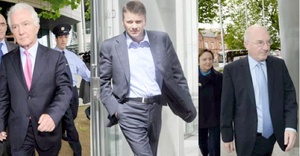
The High Court has extended for another year the investigation by the Director of Corporate Enforcement into the 2008 collapse of Anglo Irish Bank.

Criminal trials arising from the inquiry to date also appear unlikely to open until late this year and may not start until next year.

The director had sought a three-year extension of orders allowing retention of documents seized from the bank for the investigation, which began four years ago.

The extension was sought to complete the probe and facilitate what the Director of Public Prosecutions anticipates will be lengthy criminal trials arising from some of the matters being investigated.

It’ll run and run.

Just like they wish they could.

High Court judge extends Anglo inquiry by year (Mary Carolan, Irish Times)

(Laura Hutton/Photocall Ireland)

Worth listening to.

Nessa Ní Chasaide, of the Debt and Development Coalition Ireland, writes;

Thank you for your post ‘Notes on a scandal’ (Dec 12th), which highlighted campaign group Debt Justice Action’s concerns about government misinformation on the payment of this years Anglo Promissory Note worth €3.06 billion.

Since then, Debt Justice Action have launched a World Record attempt to have Ireland recognised for achieving the World’s Most Expensive Bondholder Bailout through applying to the Guinness Book of Records. Your readers might enjoy this video and petition to our World Record application:

This World Record attempt has elicited some identical responses from TDs.

The Government continues to create the impression that the March 2012 Promissory Note was not paid. By arguing that payment was ‘deferred’, through the issuing of a bond, the government appears to be claiming that the bond is in some way not an asset carrying value.

The bond used to pay the Anglo Promissory Note is an asset just as cash and bricks and mortar are assets. It is just a different type of payment to cash.

The government initially funded the payment to the IBRC using cash from NAMA (which we own) and we are currently scheduled to repay Bank of Ireland in 2013. It is like paying off credit card debt you hold with one bank with a short-term loan taken out from another bank.

Although the money comes from a second source, the debt is still paid – and the ‘promise made’ to the first bank is fulfilled – the money ‘was’ deleted from the system as scheduled.

It appears the Government is being deliberately disingenuous. The Government must clearly and unambiguously state that this year’s Anglo Promissory Note WAS paid.

 World Record Attempt (NotOurDebt)


Nessa Ní Chasaide writes:

Could you have a look at the letter below and put these questions to someone in government? The government is telling us that they did not pay the Promissory Note last March, but they did – they got a loan from NAMA, and they paid it (see the full explanation below). It is critical that the government is challenged on this as otherwise they may continue to provide false information to the public about the next payment.


Debt Action Group

Dear Sir  / Madam,

In the past few days, Minister Pat Rabbitte said:

“We didn’t pay the promissory note this year and as far as I’m concerned we’re not going to pay it next year. It’s as simple as that.”

It is entirely untrue that the Promissory Note was not paid this year. The Promissory Note was paid in full. The government borrowed €3.06bn from NAMA. Following this, NAMA passed this debt to Bank of Ireland (BoI), so now, instead of owing €3.06bn as a Promissory Note, which might easily be written off, the State owes the same amount to BoI, where it is much less likely to be written off.

Here is the Department of Finance confirmation of this fact:

“The April SPU Exchequer deficit estimate of €18.7 billion included, as part of non-voted capital expenditure, a €3.06 billion payment in respect of the IBRC Promissory Note. However this €3.06 billion payment was settled with a Government bond and the transaction is not included in Note 6 of the end-October Exchequer Statement (non-voted capital expenditure) due to the statutory payments basis of the Finance Accounts (with which the Exchequer Statement aligns) and the exceptional nature of the transaction in that regard. Therefore it is not accounted for as part of the Exchequer deficit in 2012 as the 2011 payment in respect of the IBRC Promissory Note was last year.” (Medium-Term Fiscal Statement – November 2012 – Incorporating the Department of Finance’s Autumn, Forecasts, Page 10, footnote #1)

Here it is again on page 32 as a footnote to Table 4.1:

The 2012 IBRC Promissory Note payment was settled with a Government bond and as such is not reflected as part of the Exchequer deficit (or EBR) in the end-October 2012 Exchequer Returns. For simplicity however it is counted as part of the 2012 EBR in table 4.1.”

And finally on Table 2 of Page 89, it is listed as a payment under point (b):

“(b) Non-cash payment in 2012 of IBRC promissory note”

The government did not raise €3.06bn this year against the Promissory Note through taxes, cuts or market borrowings, but this does not change the undeniable fact that the Promissory Note was paid with a NAMA loan.

If the Promissory Note had not been paid as scheduled, the Irish Central Bank would have been obliged to withdraw the IBRC’s access to Exceptional Liquidity Assistance (ELA) as the promissory notes would no longer have been acceptable as collateral – and it is this ELA funding which constitutes the billions in loans that is keeping the IBRC alive. Without access to this ELA, the IBRC will cease to exist. That this didn’t happen is proof that the Promissory Note was paid this year.

The media plays a vital role in society by bringing government and other powerful interest groups to account. It is startling that this government has been allowed to consistently make this claim without contradiction when it is so patently untrue and misleading. The Department of Finance’s document confirms this. The continued operation of IBRC confirms this.

At the very least, can the people of Ireland expect our own media to publicly clarify this point with the government with all possible speed?

Yours sincerely,

Ken Rogan, Irishtown, Dublin
Marie Moran, School of Social justice, UCD
Nessa Ní Chasaide, Debt and Development Coalition Ireland
Andy Storey, School of Politics and International Relations, UCD
Niamh McCrea, Institute of Technology, Carlow
On Behalf of Debt justice Action

(Barry Cronin/Photocall Ireland)

Representatives of IBRC (ex-Anglo), including chairman and former Fine Gael leader Alan Dukes and CEO Mike Aynsley are before the Public Accounts Committee Joint Committee on Public Expenditure and Reform this morning.

Fianna Fail’s finance spokesman Michael McGrath asked Mr Aynsley (above) about those texts.

Later Aynsley moved to rubbish ‘anonymous notes’ alleging some carry-on between banking officials, IBRC clients and private jets.

That’ll be Denis O’Brien’s private jet so

What rumours are these?

Michael McGrath: “I think you need to understand why I’m asking this question because we’re trying to be absolutely reassured that what’s left of the former Anglo and Irish Nationwide has moved away with entirely, from the culture that prevailed in those institutions where there were very close relationships between the people running those institutions and their largest clients and borrowers. And I want that reassurance from you because you are involved in making commercial decisions involving tens of billions and hundreds of billions of euro. And you can go through all the governance process that you have referred to Mr Dukes, but it does come down to judgement calls ultimately. Now it’s not my job to say whether or not you’re making the correct judgement calls but it is my job to be reassured that you’re going about it the right way. And that there is nothing else involved, much in anyway, influencing your decisions. So I’d be interested in your comments on that.”

Mike Aynsley: “Look there’s nothing untoward in anyway about the approach to Mr McKillen to advise him of the decision put forward. The reality was that we were going through a process that Mr McKillen and the Barclay brothers’ representatives were well and truly aware of, which culminated in a submission to the board and approval of the board to maintain a process of consensual restructuring with Mr McKillen around his loans, rather than selling a portion of those to the Barclay brothers. Now we came out of those meetings and my colleague Mr Woodhouse was given the authority to contact the Barclay brothers and inform them of the decision. I intended to call Mr McKillen but of course, couldn’t get hold of him. He doesn’t do email. So I sent him a text and it was as simple as that. And the reminder to him, following it up, was simply that this was a board decision and it’s a bank-client relationship that shouldn’t be divulged. Of course, being aware at the time that he was acutely in litigation with the Barclay brothers it was inappropriate, we felt, that he should admittedly go to the press with that. Of course it ultimately came out during the discovery process in that litigation. That’s all that there was to it. Now I would like to just go on a minute because it is a very important aspect in you being confident that this bank is operating in a total other way than the old management of the bank, pre-nationalisation. I think that the key point here is that there is no one individual in the organisation who has the capacity to influence and make decisions around any of these loans. We have a very well structured governance process…”

And then later

McGrath: “There’s one answer that you could give, which would be the departure from the practices of the past in the institutions you inherited, would be on the issue of hospitality. And I know the bank has a very clear policy in that regard that, in general, directors and employees must not accept gifts or the conveyance of anything of value, including entertainment from current and prospective banking customers or suppliers, is that fully adhered to in the respect of IBRC?”

Aynsley: “We have a full entertainment and travel policy in place. We still maintain a situation where we will have entertainment, client entertainment in certain circumstances, that’s controlled under the policy. It’s specified under the policy, what is appropriate, what is not appropriate. There is, and I’ve seen some of the anonymous notes that have been sent to various members and press, that have been sent on to me, I can assure you that, as far as I know in the organisation, there is no participation by any member of the bank’s management team or staff in any of the allegations that have been made around, flying in jets and staying in people’s personal homes and all these sorts of things”

Hmmm.

Yesterday the Sunday Independent ran an explanatory piece on the events leading up to last week’s arrest and subsequent charging of former Anglo chairman Sean Fitzpatrick.

The headline was: ‘Scapegoat for politicians and regulators knew trial was always on the cards’. The paper listed other influential groups or people at that time, entitled ‘The remaining pieces of the Anglo jigsaw’.

One was on Brian Cowen and the civil service:

Brian Cowen, the Taoiseach, knew from at least March 2008 of Quinn’s giant gamble on Anglo after Sean FitzPatrick rang him on his mobile. In April 2008 he attended a dinner where he was introduced to Anglo’s board and executives by his college friends Fintan Drury, then an Anglo director. On Monday, July 28, 14 days after the Maple transaction, Cowen played golf and had dinner with Fitzpatrick, spending all day with him. According to both, Quinn was never discussed. Cowen, who spent all summer studying in Stanford University in the United States, has never been publicly questioned in detail about what he knew or didn’t know about the Maple affair”.

This recalled last Tuesday’s Tonight With Vincent Browne on TV3 where supporters of the Quinn family, Patricia Gilheaney and Mairin Martin (below), from the Concerned Irish Citizens’ Group, appeared with Irish Times finance correspondent and author of Anglo Republic, Simon Carswell and Tom Lyons, Of The Sunday Independent, who is also co-author of the Fitzpatrick Tapes.

To summarise, Patricia Gilheaney (second left) said there was “political pressure” in relation to Sean Quinn accepting the €2.3billion loan from Anglo – that was used to prop up Anglo’s shares. Anglo is chasing the Quinns for €2.8 billion but the Quinns claim the €2.3 billion loan was illegal.

Vincent Browne: “In 2007 and 2008, in 2007, it was discovered that Sean Quinn, through a device known as contracts for difference had effectively acquired a shareholding in Anglo Irish Bank to the tune of I think initially 23 per cent and eventually 28 per cent. He then didn’t have the money to finance the purchase of those shares even though he’d contracted to purchase them. And had those shares gone on the market at the time it would have effectively collapsed the Anglo Irish Bank at that stage and therefore that shareprice fixing was undertaken which partly involved this €2.3billion loans given to Sean Quinn to pay for shares that really he had already contracted to buy. That’s essentially it. Do you go along with that, Tom?”

Tom Lyons: “Yeah, that’s essentially it, Vincent. I mean Sean Quinn took the most outrageous punt on a banking stock in the history of the world. He built up a 28 and a half per cent stake in secret. Then when things begin to go wrong, he raids the insurance company. That wasn’t his money. That money was there to pay out for people who broke their legs or who got in car accidents. Then, when that, when he gets found out on that, he turns to the bank and he’s very eager to take the loans from the bank in order to fund his position.”

Patricia Gilheany: “How do you know that Simon, or Tom?”

Lyons: “He took them over, and over, and over.”

Gilheany: “How do you know he was very eager to take them? In fact it was the other way around. He wasn’t eager at all.”

Lyons: “Well he’d taken from the insurance company, from ordinary people to meet the margin calls. When that was shown to be illegal, he’d no other option but to go to the bank and he took them.”

Gilheaney: No my, excuse me now, my understanding is that he went to the bank in September 2007, effectively told, or he met Sean Fitzpatrick and David Drumm. (Turns to Simon) A meeting incidentally that has been recorded in books which I think is inappropriate given that all these things are before the courts. But anyway, he effectively told them he didn’t have the money to meet the margin calls and he was prepared to get out at that stage. Now the interesting thing is he was then rang, he was told in fact. There was.

Browne: “There was no getting out.”

Lyons: “He couldn’t get out.”

Browne: “He had already contracted to buy these shares. There was no getting out. He had entered into a contract to buy the shares at a certain price. And then, when the share price collapsed, he would have had to pay a huge amount of money to get the shares even though they were worth a fraction of what he would have been paying for them. That was the difficulty.”

Gilheaney: “Well he was prepared to take that hit at that stage. And I would disagree totally with Tom on this, suggesting, he nearly infers that Sean Quinn went asking for the money, nothing could have been further than the truth.”

Browne: “Sure he couldn’t have supported the purchase of the shares, or what’s called the margin call,  without getting money from Anglo Irish Bank. He couldn’t have done so.

Mairin Martin: “Vincent, Tom said he did all these things in secret. Was there nobody watching the Stock Exchanges or not watching..are there no regulators?”

Browne: “There is no-one watching the Stock Exchange with regards to contracts for difference, that’s the point. People can build up a shareholding in a company through contracts for difference which essentially means that they make a deposit and then agree to buy the shares at a particular price at some future time and it’s not disclosed. That’s one of the difficulties.”

Gilheany: “Well I resent the word, the inference there that there was something untoward about. It’s absolutely…”

Simon Carswell: But it wasn’t disclosed to the market.

Gilheany: “Yeah but that’s the nature of CFDs.”

Carswell: “Yeah but by their nature he wasn’t coming out and disclosing to the market.”

Gilheany: “Which he was perfectly entitled not to do.”

Carswell: “The point that I’m making is though that when he got to the point that he owned 28 per cent of the bank, he controlled 28 per cent of the bank, it was such a great shareholding, a large shareholding that at that point he was jeopardising not only the bank but also his own financial position if the bank got into trouble. He didn’t even realise that. That’s the scary thing about the gamble that he took.”

Gilheaney: “Well, look it, I object to the word ‘gamble’. Who’s gambling with citizens’ money now? Sorry now, with all due respect, we’ve heard this side of the story for two years now, it’s time to hear the other side. It’s not Sean Quinn or the Quinn family who are gambling with citizens’ money. It’s the current board of Anglo who’s spending in the region of €2 million a week on ridiculous cases that we’ll not recoup one cent.”

Browne: That might be true but we’re not talking about Anglo in general now. We’re talking about Sean Quinn and the issue is he couldn’t have financed the contracts that he entered into without getting money from Anglo. That’s why they got the €2.3billion.”

Gilheany: “But he didn’t ask for that?”

Carswell: “Can I just put it in another way? If Sean Quinn then, as you put it, through 2008 as the share price was falling and he was deeply, in a heavily loss-making position in the margin calls why didn’t he say ‘no I don’t want you loans then, Anglo Irish Bank?'”

Gilheaney: “Because he was told to put on the green jersey.”

Martin: “Yes.”

Gilheaney:And that came from political pressure aswell and that will come out, Simon. And I think you know that.”

Carswell: “Well, perhaps you can explain that because there’s a reference in the Mail on Sunday at the weekend in an interview he gave where he had a conversation with Brian Cowen. I mean do you know anything about that?”

Gilheany: “I believe that Brian Cowen rang him in the days after, when Quinn Insurance went into administration.”

Carswell: “How do you know this? Has he told you this? Sean Quinn?

Gilheany: “No, he hasn’t told me. I’ve met Sean Quinn very few times but, as I’ve said, I’ve asked the hard questions.”

Carswell: “How do you know that specific fact though, there in relation to Brian Cowen?” How do you that?

Gilheaney: “Yeah because I heard that interview.”
Carswell: “With the interview that he gave to the Mail on Sunday. But I’m wondering how…?”

Gilheany: We were observers actually because we were preparing for this interview tonight. So we sat in, we just sat in as observers, Mairin and myself.

Carswell: “In the interview with Sean Quinn?”

Gilheaney: “Yeah there were a number of people in the room, yes. Yes just to prepare for tonight. So I don’t think you need…”

Carswell: “Sorry I just want to clarify. You were sitting in the room and Sean Quinn was interviewed by the Mail on Sunday?”

Gilheaney: “Yes, yes.”

Martin: “Yes, yes.”

And any doubts that Gilheaney and Martin were not speaking for Sean Quinn were dispelled last night in Ballyconnell, Co Cavan: