Tag Archives: Promissory Notes

MEP Luke ‘Ming’ Flanagan, along with his parliamentary assistant Diarmuid O’Flynn – who appeared before the Joint Committee on Finance, Public Expenditure and Reform, and Taoiseach in June –  reminds people of the Anglo Irish Bank promissory note deal.

In June, Mr O’Flynn, of the newly titled Ballyhea Says Know group, told the committee that Ireland’s Central Bank took out of circulation €500million in 2014; €2billion in 2015, €3billion in 2016; €4billion in 2017; and, as of June this year, €1billion.

Mr Flanagan, in the clip above, calls on members of the public to ask their local TDs, regardless of party, to stop this practice.

Previously: There’s A Touch Of That About It

bill1bill 2bill3

We. Are. Great.

Significant alterations suggested by Fianna Fail deputies to last night’s attempt by the Technical Group to rescind the promissory notes.

Mark Malone writes:

Just one long pat on the back for themselves

Meanwhile…
cropped_twitter

(Diarmuid O’Flynn, centre)

The Motion was defeated, we were not – in fact we have gained in strength and in conviction;

The searing truth in speech after speech by the members of the Technical Group, the honesty, the conviction, was in stark contrast to the sneering arrogance by a succession of government speakers;

We ended with over 40 TDs opposing the government’s amendment to our Motion – that’s nearly 25% of the current Dáil, so we’re getting closer and closer!

We have been on a long journey in Ballyhea and in Charleville, a sometimes rocky road, but this week we turned a corner, and we reinforced as we now are with new friends, new alliances, we aren’t in the least intimidated by what now lies in front of us.

Diarmuid O’Flynn, Ballyhea Says No

Pic via Diarmuid O’Flynn

Responding to reports that the ECB had rejected Ireland’s proposal for a longer repayment schedule, Mr Varakdar disputed this was the case.

“There was no rejection. There was no breakdown. There are issues that need to be changed. And issues that need to be agreed on,” he said on RTÉ’s The Week in Politics.

Setting out the nature of the talks, he said: “There is agreement in a lot of areas, but there are a number of issues outstanding and some of those issues are very difficult . . . We need to work on them but we are still very hopeful of getting a resolution.”

The ECB told The Irish Times yesterday that it was “premature” to refer to any outcome and that talks on this issue were ongoing.

All righty, then. Or not.

Ministers concede difficulties with ECB over deal on promissory notes (Harry McGee, Suzanne Lynch, Tom Hennigan, Irish Times)

(Sam Boal/Photocall Ireland)

Worth listening to.

Nessa Ní Chasaide, of the Debt and Development Coalition Ireland, writes;

Thank you for your post ‘Notes on a scandal’ (Dec 12th), which highlighted campaign group Debt Justice Action’s concerns about government misinformation on the payment of this years Anglo Promissory Note worth €3.06 billion.

Since then, Debt Justice Action have launched a World Record attempt to have Ireland recognised for achieving the World’s Most Expensive Bondholder Bailout through applying to the Guinness Book of Records. Your readers might enjoy this video and petition to our World Record application:

This World Record attempt has elicited some identical responses from TDs.

The Government continues to create the impression that the March 2012 Promissory Note was not paid. By arguing that payment was ‘deferred’, through the issuing of a bond, the government appears to be claiming that the bond is in some way not an asset carrying value.

The bond used to pay the Anglo Promissory Note is an asset just as cash and bricks and mortar are assets. It is just a different type of payment to cash.

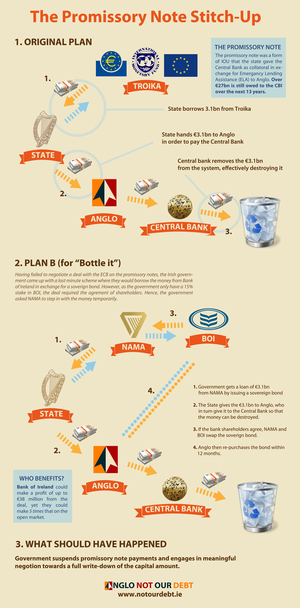
The government initially funded the payment to the IBRC using cash from NAMA (which we own) and we are currently scheduled to repay Bank of Ireland in 2013. It is like paying off credit card debt you hold with one bank with a short-term loan taken out from another bank.

Although the money comes from a second source, the debt is still paid – and the ‘promise made’ to the first bank is fulfilled – the money ‘was’ deleted from the system as scheduled.

It appears the Government is being deliberately disingenuous. The Government must clearly and unambiguously state that this year’s Anglo Promissory Note WAS paid.

 World Record Attempt (NotOurDebt)


Nessa Ní Chasaide writes:

Could you have a look at the letter below and put these questions to someone in government? The government is telling us that they did not pay the Promissory Note last March, but they did – they got a loan from NAMA, and they paid it (see the full explanation below). It is critical that the government is challenged on this as otherwise they may continue to provide false information to the public about the next payment.


Debt Action Group

Dear Sir  / Madam,

In the past few days, Minister Pat Rabbitte said:

“We didn’t pay the promissory note this year and as far as I’m concerned we’re not going to pay it next year. It’s as simple as that.”

It is entirely untrue that the Promissory Note was not paid this year. The Promissory Note was paid in full. The government borrowed €3.06bn from NAMA. Following this, NAMA passed this debt to Bank of Ireland (BoI), so now, instead of owing €3.06bn as a Promissory Note, which might easily be written off, the State owes the same amount to BoI, where it is much less likely to be written off.

Here is the Department of Finance confirmation of this fact:

“The April SPU Exchequer deficit estimate of €18.7 billion included, as part of non-voted capital expenditure, a €3.06 billion payment in respect of the IBRC Promissory Note. However this €3.06 billion payment was settled with a Government bond and the transaction is not included in Note 6 of the end-October Exchequer Statement (non-voted capital expenditure) due to the statutory payments basis of the Finance Accounts (with which the Exchequer Statement aligns) and the exceptional nature of the transaction in that regard. Therefore it is not accounted for as part of the Exchequer deficit in 2012 as the 2011 payment in respect of the IBRC Promissory Note was last year.” (Medium-Term Fiscal Statement – November 2012 – Incorporating the Department of Finance’s Autumn, Forecasts, Page 10, footnote #1)

Here it is again on page 32 as a footnote to Table 4.1:

The 2012 IBRC Promissory Note payment was settled with a Government bond and as such is not reflected as part of the Exchequer deficit (or EBR) in the end-October 2012 Exchequer Returns. For simplicity however it is counted as part of the 2012 EBR in table 4.1.”

And finally on Table 2 of Page 89, it is listed as a payment under point (b):

“(b) Non-cash payment in 2012 of IBRC promissory note”

The government did not raise €3.06bn this year against the Promissory Note through taxes, cuts or market borrowings, but this does not change the undeniable fact that the Promissory Note was paid with a NAMA loan.

If the Promissory Note had not been paid as scheduled, the Irish Central Bank would have been obliged to withdraw the IBRC’s access to Exceptional Liquidity Assistance (ELA) as the promissory notes would no longer have been acceptable as collateral – and it is this ELA funding which constitutes the billions in loans that is keeping the IBRC alive. Without access to this ELA, the IBRC will cease to exist. That this didn’t happen is proof that the Promissory Note was paid this year.

The media plays a vital role in society by bringing government and other powerful interest groups to account. It is startling that this government has been allowed to consistently make this claim without contradiction when it is so patently untrue and misleading. The Department of Finance’s document confirms this. The continued operation of IBRC confirms this.

At the very least, can the people of Ireland expect our own media to publicly clarify this point with the government with all possible speed?

Yours sincerely,

Ken Rogan, Irishtown, Dublin
Marie Moran, School of Social justice, UCD
Nessa Ní Chasaide, Debt and Development Coalition Ireland
Andy Storey, School of Politics and International Relations, UCD
Niamh McCrea, Institute of Technology, Carlow
On Behalf of Debt justice Action

(Barry Cronin/Photocall Ireland)

The Anglo Not Our Debt Campagin deliver a petition of 7,000 signatures protesting against honouring the zombie bank’s promissory notes at government buildings within the last hour. Top pic: Cathleen O’Neill. Bottom pic, from left, Garda officer, John Bissett, Cathleen O’Neill and Mark Malone.

(Sam Boal/Photocall Ireland)

.

Guess we know who that “unnamed Irish official” official is now.

CENTRAL BANK governor Patrick Honohan is expected to raise the possibility of delaying a cash payment of €3.1 billion to the former Anglo Irish Bank on March 31st and suggest alternatives at the meeting of European Central Bank decision-makers today.

Options being considered to delay the cash payment include a payment-in-kind by way of a Government bond or another promissory note until a long-term restructuring of the notes is concluded.

Notes for notes. Totes not notes for votes.

We’ll get our cotes.

State to seek delay on €3.1bn cash payment due over Anglo (Simon Carswell and Stephen Collins, Irish Times)

pic

In an interview with Dow Jones Newswires, a senior Irish official said there was “cautious optimism” that a complex deal to free the government from paying the next, EUR3.1 billion installment on the promissory notes will be struck by the end of this month.

The promissory notes were pledged to Anglo Irish Bank Corp., and Irish Nationwide Building Society–now jointly renamed the Irish Bank Resolution Corp–over three years ago. Based on those pledges, both banks qualified for emergency loans from the Central Bank of Ireland.

Rescheduling the notes would lengthen the time over which the central bank is repaid, and therefore needs the approval of the European Central Bank. Since last September, the Irish government has been talking to its bailout lenders–the European Union, the International Monetary Fund and the ECB–on ways to delay or reschedule repayment of the notes.

“The technical discussions are well advanced,” the official said. “But there still needs to be a decision at the principal level [among the bailout lenders] whether this thing is going to work or not. Between now and the end of the month, when the next promissory note payment is due, will bring that to a head.”

Rescheduling payments on the notes would improve the government’s prospects of returning to the bond markets in 2013, when its EUR67.5 billion loan agreement with the EU and IMF ends.

But the senior official revealed that the government is seeking a wider deal to reduce the burden it incurred in bailing out its banks and ensuring they didn’t default on their debts, which could have toppled the already fragile European banking system.


INTERVIEW: Senior Irish Official Sees Wider Refinancing Of Bank Burden (Dow Jonesn