



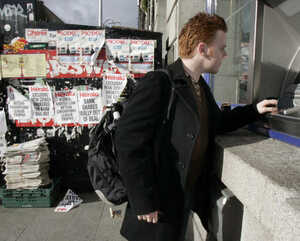

From top: O’Connell Street, Dublin on the morning after the night of the bank guarantee, 2008; Julien Mercille
Between 2008 and 2014, the State paid a net amount of €60 billion to stabilise the banking system with €9 billion spent on interest alone.
Dr Julien Mercille writes:
Do you wonder at night how much has the banking crisis cost us? If so, you should read chapter 3 of the excellent report on the subject by the Comptroller and Auditor General (C&AG).
It provides details on the costs incurred by the State between 2008 and the end of 2014 in order to stabilise the banking system. If that money had not gone up in smoke, the Government could have invested in a number of public services and strategic economic sectors.
The report’s main points are as follows.
(1) The net cost to the State of saving the banks is €43 billion. This is composed of two main numbers. First, it cost €60 billion to bail out the banks. However, the government still owns shares in the banks it rescued.
Eventually, those shares will be sold back and the banks re-privatised (for example, AIB is still 99.8% State-owned). The value of the shares owned by the State in AIB, Bank of Ireland and Permanent TSB is valued at about €17 billion today. Therefore, if these shares were all sold back now, the net cost of the bank bailout would be €43 billion. But the shares will be sold later, and by that time their value may have moved up or down, in which case the €43 billion will be adjusted accordingly.
(2) In addition to that, we have NAMA, the bad bank that the Government created to buy the banks’ toxic loans. NAMA paid for those loans at a discount, and has been selling them back together with the properties to which they are tied, making money in the process. We don’t know yet if NAMA will break even, make a profit or losses, but NAMA estimates that it will make a profit of about €1 billion. This would thus reduce the €43 billion by that amount, but it’s hypothetical for now.
(3) Among the costs incurred above, one interesting fact is that we have paid no less than €9 billion in interest. (Bailing out the banks required the Government to borrow, and therefore to pay back that debt with interest). This is a significant sum. Between 2008 and 2014, the State paid a total of €32 billion on the national debt as a whole. This means that the interest associated with the bank bailout is nearly 28% of that sum.
(4) Another interesting component of the above costs is the total of €152 million the State spent on “consultancy services”. The report gives a detailed list of who got what. Four firms accounted for 60% of the total: Arthur Cox (€33 million), Blackrock Financial Management (€23.5 million), Ernst and Young (€21 million) and KPMG (€13 million).
Now you know why one negative consequence of the Government getting deeply involved in bailing out the banks and creating NAMA has been a sprawling bureaucracy of highly-paid “experts” fed by the public purse.
(5) The State also made money by bailing out the banks, about €10 billion (which is already factored in the €43 billion above). This comes from two main sources: from fees paid by the banks to the State in exchange for the Government protecting them with the now infamous bank guarantee; and from the fact that the Central Bank returns to the State some money it made from operations during the bank bailout.
(6) In the next few years, we will keep paying interest on the debt accumulated to save the banks, which will come on top of the €43 billion. This interest is estimated at about €1 billion annually. (However, some of this will be offset by fees we will receive from the rescue — see point 5).
It is thus clear that the bank bailout cost us dearly. And it was not even necessary, or at least certainly not to the extent that it was implemented. Many people agree, for example, that Anglo Irish should have been left to die on its own, without any Government involvement. That would have saved us the bulk of the total cost of the bailout.
In any case, one can certainly blame reckless policymakers for inflating a housing bubble whose collapse triggered the crisis.
We can imagine what we could do with €43 billion.
A few suggestions:
– Solve the homelessness crisis.
– End the trolley crisis, and much more, in the health care system.
– Reverse the drastic cuts made to a range of community and public services.
– No water charges.
– Raise the minimum wage.
– Give more student grants and reduce/abolish tuition fees.
– Start a range of infrastructure development projects.
But you get the point. We paid once to save the banks. Now we’re paying a second time by living in a country where there’s a lot of services lacking and where quality of life is definitely not as high as it could be.
Julien Mercille is a lecturer at UCD. His book Deepening Neoliberalism, Austerity, and Crisis: Europe’s Treasure Ireland is out. Follow Julien on Twitter: @JulienMercille

