
Tag Archives: C&AG report

screen-shot-2016-09-14-at-16-20-45

screen-shot-2016-09-14-at-17-56-07 screen-shot-2016-09-14-at-17-56-18

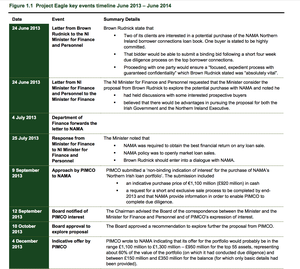
The Comptroller & Auditor General’s report into Nama’s Project Eagle sale and a timeline of the sale, as set out in the report

The Comptroller & Auditor General’s report into Nama’s sale of its Northern Ireland property portfolio, Project Eagle, to Cerberus has been published.

From page 10 of the 158-page report:

The sales of Northern Ireland debtor assets outside Project Eagle involved disposals of 125 properties – mainly in Germany and Great Britain – and represented about one eighth of the carrying value (after impairment) of the Northern Ireland debtor portfolio.

On average, NAMA incurred losses of around 1% on those sales. The corresponding loss rate on Project Eagle was 13%.

From page 11:

In a paper submitted to the Board for the December 2013 meeting (reproduced in Appendix C), the NAMA executive sought the Board’s approval for the sale of the loans.

The paper indicated that the total NAMA debt for the loans at end November 2013 was £1.98 billion – equivalent to 43% of the par debt.

Cash flow projections indicated that NAMA would realise net receipts totalling £1.68 billion over the period 2014 to 2020, if it worked out the loans through the sale of the underlying assets in line with its formal strategy. The paper recommended a minimum price of £1.3 billion be set for a loan sale.

…In June 2013, the NAMA Board endorsed the use of a standard discount rate of 5.5% to evaluate the viability of potential transactions or commercial decisions, including decisions whether to hold or sell an asset.

The examination team applied that standard rate of 5.5% to the projected cash flows in NAMA’s December 2013 paper, and estimated the loans had a NPV of £1.49 billion. This amount represents the probable value to NAMA, as at the end of 2013, of working out the Northern Ireland debtor loans.

As a result, the decision to sell the loans at a minimum price of £1.3 billion involved a significant probable loss of value to the State of up to £190 million in NPV terms.

…The paper presented [by the NAMA executive] to the [NAMA] Board projected the end-December 2013 carrying value of the loans at £1.48 billion. This was a forecast of the value of the loans that would be reported in NAMA’s 2013 annual financial statements.

However, the paper proposed a downward adjustment of £85 million in the carrying value to reflect additional expected impairment, resulting in an ‘adjusted carrying value’ of £1.39 billion. This examination found that the records supporting the December 2013 paper did not provide evidence justifying the adjustment.

Other evidence presented by NAMA during this examination supports a downward adjustment of, at most, around £8 million in cash terms. Consequently, the adjusted carrying value of £1.39 billion presented in the paper to the Board underestimated the value of the Project Eagle loans.

From page 12:

The NAMA paper for the Board recommended that the minimum price for the sale of the loans should be £1.3 billion, but did not state that this would represent the best achievable return, or what the recommended minimum price was based on.

From pages 12 and 13:

…the Board has stated that its decision on setting a minimum price was based on the portfolio’s adjusted carrying value (i.e. £1.39 billion) and on the Board’s acceptance that a purchaser’s discount of at least 10% would apply if the loan sale were to proceed. The Board also stated that the minimum reserve price was the best price deemed achievable through a loan sale.

The argument that a discount rate of 10% would have been appropriate in calculating NAMA’s workout value for the loans is not persuasive.

From page 13:

The minutes of the meeting on 12 December 2013 record that: “The Board agreed that the paper and analysis presented therein presented a compelling commercial case to sell the portfolio, and that in addition such a portfolio sale would release NAMA from what had been a disproportionate burden of effort in light of the relative size of the portfolio.”

From pages 17 and 18:

During NIAC meetings and in annual statements of interests, one external NIAC member, Mr Frank Cushnahan, declared his involvement as an advisor, mainly on a non-fee basis, to six NAMA debtors and to a third party engaged in a joint venture with a seventh debtor.

The examination team estimated that the loans of the six debtors represented about half the value of the Northern Ireland loan book.

The NAMA Board should have formally considered whether Mr Cushnahan’s engagement in discussion of the strategy – including the PIMCO/Brown Rudnick approach – was consistent with his ongoing involvement as financial advisor to a significant proportion of NAMA’s Northern Ireland debtor connections.

NAMA sought and relied on an assurance from Cerberus that no fee or payment was payable to anyone connected with NAMA “in connection with any aspect of our (Cerberus) participation in the Project Eagle sales process”.

NAMA only learned of Brown Rudnick’s engagement with Cerberus on 2 April 2014, and do not appear to have asked Cerberus when it engaged Brown Rudnick, or what was the precise nature of the services Brown Rudnick and Tughans were providing to Cerberus.

The allegations of Mr Cushnahan’s involvement in an arrangement to share fees with Brown Rudnick and Tughans (or the managing partner of Tughans) warranted more action by NAMA when the matter came to light, such as seeking advice from the unit within the National Treasury Management Agency that was responsible for providing compliance support to NAMA, or writing to Mr Cushnahan to seek confirmation or an explanation.

Lazard was not briefed on the disclosures, and was not asked for its assessment of the potential implications for the integrity of the sales process. NAMA appears to have taken a narrow approach, focusing on what were its legal obligations, rather than on what were the options for action that should be considered.

Meanwhile…

UPDATE:

More as Namawinelake we reads it.

Read the report in full here
screen-shot-2016-06-29-at-16-45-50

https://www.youtube.com/watch?time_continue=7&v=lKNDnrZ5vtU

Later today.

The C&AG report into Nama’s sale of it’s northern Ireland property portfolio, known as Project Eagle, to US investment firm Cerberus, is expected to be published.

Ahead of this…

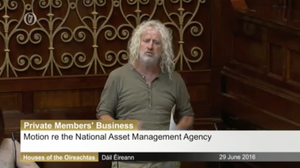
A look-back at what some politicians said in the Dáil on June 29, 2016 during a debate on a motion put forward by Independents 4 Change TD Mick Wallace, in which he called for a Commission of Investigation into the Project Eagle sale (above):

Michael Noonan, Minister for Finance and Fine Gael TD:

The NAMA Act rightly established a high degree of public accountability for NAMA and established an independent board to implement NAMA’s commercial mandate.

Indeed, a number of NAMA board members first appointed in late 2009, including the chairman and CEO, continue to progress diligently NAMA’s commercial mandate to this day.

In addition, long-serving members of the House will recall that the then Minister, Mr. Brian Lenihan, agreed to the establishment of NAMA’s Northern Ireland advisory committee under section 33 of the NAMA Act following discussions with his counterpart in Northern Ireland, Mr. Sammy Wilson.

The board of NAMA appointed a person from Northern Ireland to the advisory committee who had been recommended by Mr. Wilson to Mr. Lenihan.

It should be remembered, however, that the Northern Ireland advisory committee had no decision-making powers and no access to confidential information.

…We had a repeat of the allegations today by Deputy Wallace. If he is so sure of the veracity of these allegations, he does not need the cover of privilege to make them. If he is so sure of his grounds, he should make them outside the House.

Deputy Clare Daly has a peculiar attitude to commissions of investigation, seeing them as trawling instruments which may come up with something after which proceedings would follow.

I remember reading “Alice’s Adventures in Wonderland” and it was either the Mad Hatter or the Dormouse who said “Verdict first, trial afterwards”.

That is the sort of due process being advocated in the House by people who make allegations under privilege which they do not substantiate or make in public without the cloak of privilege to protect them.

… taking into account the investigations that are under way, it is my view that there is no specific line of inquiry that could be usefully pursued by a commission of investigation.

The appropriate investigations are already taking place in the appropriate jurisdictions.

It is unwise to launch a costly commission of investigation on claims that are under investigation by the appropriate authorities.


Michael McGrath, Fianna Fáil TD:

Fianna Fáil has been consistent in asking that all aspects of the Project Eagle sale be thoroughly examined and investigated”.

Last October, I moved a motion, on behalf of Fianna Fáil, calling for a Commission of Investigation under the terms of the 2004 Act. We called for this on the basis that the allegations were of such a serious nature, the public would demand nothing less than a comprehensive inquiry which would get to the truth and be able to make clear findings in relation to any wrongdoing on the part of individuals…”

“…In its evidence before the committee of public accounts, and in its public commentary on Project Eagle, Nama has argued consistently that no issue has arisen regarding the sale side of this transaction but, as I said last October, that is not an adequate answer.”

“Ultimately, the decision to proceed with the sale of Project Eagle was made by Nama in Dublin and Nama must account for the entirety of that transaction.”

“Based on information and allegations currently in the public domain, surrounding Project Eagle, a Commission of Investigation is warranted. That remains the Fianna Fáil view. The question is whether a Commission would stand any chance of success, running in parallel with a criminal investigation that is clearly gathering pace.”

Our honest assessment is that a Commission of Investigation, established in the Republic now, in the heat of an accelerating criminal investigation in the North would most likely run into the sand very quickly. This would serve no purpose. Do we really think that key people involved in this transaction, living in Northern Ireland, would voluntarily cooperate with a Commission of Investigation in the Republic while arrests are being made in the North?”


Gerry Adams, leader of Sinn Féin:

“I understand Mr John Miskelly began legal proceedings over the deal against Cerberus and Anglo Irish Bank on 21 June in the Belfast High Court.”

“Members will recall that Mr Miskelly appeared in the BBC “Spotlight” programme which brought some of the details of this case to light. He is alleging the Project Eagle process was fraudulent from the start.”

It is high time that the Minister for Finance made a full statement on all of these matters and I am disappointed he did not take the opportunity to do so today.”

“The National Asset Management Agency has been handling billions of euro of the people’s money and it should be accountable.”

“The Fianna Fáil Party agreed with our position on this matter. In October, the party’s finance spokesperson, Deputy Michael McGrath, stated: “There is simply no room whatsoever for any question marks when we talk about the sale of a State asset with a face value of over €5 billion”.”

“He went on to say: “It is also essential for the integrity of the House that a commission of investigation is established to find out the truth about the entirety of Project Eagle”. What has changed?”

Just two weeks ago, the Fianna Fáil leader, Deputy Micheál Martin, described the Government’s position on Project Eagle as untenable, yet despite a number of requests directly from me, his party will not now support the establishment of an investigation.

“The reason it gives for its position on this issue is entirely spurious and can only be explained by a desire to keep the Fine Gael Party in power.”


Pearse Doherty, Sinn Fein TD:

Fianna Fáil’s latest attempt at two-faced politics is utterly transparent and typical of its approach to politics.

Literally 15 days ago, Deputy Micheál Martin stood up in the Chamber and said that the Government’s position on the sale of Project Eagle by NAMA was becoming more untenable by the day.

He said that the sales process, whether we liked it and whether NAMA liked it, was not robust or competitive and did not secure the best outcome. He went on to say there were major ethical questions over the entire sale of the asset.

He asked whether it ever occurred to the Taoiseach that we should set up a commission of investigation given that the UK National Crime Agency, the US Securities and Exchange Commission and others were pursuing it.

That was the position of Fianna Fáil 15 days ago. The position of Fianna Fáil in October was to call for a commission of investigation to be established.

However, when push comes to shove, Fianna Fáil retreats into the establishment. It is afraid to look into issues but happy to look angry about them for a few cheap headlines.

Deputy Michael McGrath referred to how we had to ensure the criminal investigation was not affected. That is a great line from the spin doctors of Fianna Fáil.

The line is that we now have criminal investigations and that a commission of investigation is not warranted but Fianna Fáil is not doing a U-turn.

The reason none of that adds up is the UK National Crime Agency, the agency conducting the criminal investigation, announced in a press release to the world on 9 July 2015 that after receiving requests from the Police Service of Northern Ireland it was instigating a criminal investigation into the issues surrounding the sale of Project Eagle. That was on 9 July 2015.

In October 2015 Deputy Michael McGrath said it was imperative that the Dáil [launch a Commission of Investigation]…

Transcript via Oireachtas.ie

Previously: Screech

That Nama Vote In Full

screen-shot-2016-09-12-at-15-12-58

[soundcloud url=”https://api.soundcloud.com/tracks/282537894″ params=”auto_play=false&hide_related=false&show_comments=true&show_user=true&show_reposts=false&visual=true” width=”100%” height=”450″ iframe=”true” /]

Taoiseach Enda Kenny, and Martin Hayden, chairman of the Fine Gael parliamentary party, at the party’s think-in in Newbridge, Co Kildare this morning, and the audio of an interview Mr Kenny gave to KFM Kildare this morning

On Saturday, Pat Leahy, in the Irish Times, reported that the C&AG found that hundreds of millions may have been lost in the sale of Nama’s Northern Ireland property portfolio, Project Eagle, to US investment firm Cerebrus.

It was reported that this loss may have been due to what the C&AG found to be “shortcomings” and “irregularities” in the sale.

The C&AG report is due to be published on Wednesday.

The report about the C&AG study followed a BBC Northern Ireland Spotlight programme into Project Eagle broadcast last week, which followed an earlier Spotlight programme in March – both of which made serious allegations about the Project Eagle sale.

Readers may recall how, on June 1, Taoiseach Enda Kenny told the Dáil:

There has not been any allegation of wrongdoing against NAMA”.

In addition, on June 8, Mr Kenny told the Dáil:

“Nobody has presented me with evidence of wrongdoing by Nama”.

Further to this.

Taoiseach Enda Kenny spoke to Shane Beatty, of KFM Kildare, this morning, ahead of the Fine Gael’s knees-up think-in starting today in Keadeen Hotel, Newbridge, Co Kildare.

The C&AG report into NAMA was discussed.

From the interview…

Enda Kenny: “If I find… if I find, and our colleguess in Government, find that there is a case to be examined well then I won’t be opposed to that.”

Shane Beatty: “But viewers of BBC’s Spotlight will say we’ve already seen a case that I think we need to have an inquiry, why do we have to wait until Thursday?”

Enda Kenny: “There are two criminal investigations going on in a different jurisdiction.”

Shane Beatty: “None here.”

Enda Kenny: “None here, and the National Crime Agency in the UK have confirmed that there is no case that they have, or are in pursuit of, in repsect of NAMA down here. So, the C&AG’s report is about a ‘value for money’ audit and you, as was pointed out on many occasions… depending on the process you follow for valuations, you might get different results.

“If you, for instance, were to dispose of the properties now with the devaluation of Sterling you’d get a different result also. But I think this is an extensive report, we do need to read it, everybody needs to reflect on it. And if there are questions arising from the Public Accounts Committee’s engagment with NAMA, they are due in before them very shorty [September 22], I’m not adverse [sic] to taking action, but I need to know what is we are taking action on.

Shane Beatty: “Did you watch the Spotlight programme?”

Enda Kenny: “Yes I did, and I saw that, and I found it quiet incredible, but you know, Shane…”

Shane Beatty: “Incredible, how?”

Enda Kenny:Nothing suprises me at the kind of activites that take place in politics. And in that sense I found it extraordinary to hear the audio report of engagements and meetings of certain personnel.”

KFM Radio

‘Hundreds of millions lost by Nama’ in sale of Northern properties, report finds (Irish Times, Saturday, September 10, 2016)

Previously: Screech

That Nama Vote In Full

Meanwhile, yesterday….

Labour TD and vice chairman of the Public Accounts Committee (PAC) Alan Kelly was interviewed on This Week by Colm Ó Mongáin following the reported findings of the C&AG report.

During the interview Mr Kelly said, in recent days, he was approached by a senior member of Nama ahead of Nama’s appearance before PAC on September 22.

From the interview…

Alan Kelly: The [C&AG] report on this should be released, and obviously then, Nama will come before the PAC. It’s a matter for Nama whether they want to make public statement on it, I believe they should, I believe they’ve been quite naive to a point in relation to this.

Even this week, a senior member of Nama contacted me to brief me before they met before the PAC. I redirected him to the chair of the PAC. I was not comfortable that selective briefings was the way to go to be appropriate given the situation we find ourselves in. But that just shows another level of naivety, I believe, in relation to Nama.

Colm Ó Mongáin: These briefings that were offered by Nama, how was that approach made and by whom?

Kelly: “Ah well, I won’t, eh, get into individual, but, ah, just a call during the week to meet up. Look, I just explained the Public Accounts Committee is a different committee to every other committee, you know, it has different powers. And it wouldn’t be abnormal for other organisations to brief committee members of other committees but, in relation to this scenario, I think selective briefings wouldn’t be the way to go. And, obviously, I referred to the chairman in relation to this. But, for me, I didn’t think it was appropriately the way to deal with things.

Ó Mongáin: Is it your understanding that all members of the committee were offered these briefings?

Kelly: “I have no idea, I was going to raise it with my committee colleagues when we meet. I doubt it, but I don’t know so I wouldn’t like to say indefinitely. But I will say this, I don’t think there was necessarily anything malicious or intentional in that way in relation to that contact… It’s another sense of naivety, I feel on the part of Nama in relation to how they do things. It gave me some concerns.”

Ó Mongáin: “Well, what did they want to tell you?

Kelly: “Well that’s a matter for Nama. I understand that they’re in front of us in the coming weeks and I suppose they wanted to brief us on various different actions, but that would be a matter for Nama to state because obviously I don’t know because I didn’t meet them.”

Listen back to interview in full here

Transcript via Namawinelake

Earlier: ‘I Didn’t Enjoy The Election… But I’ve Got My Mojo Back’

‘Nama Has Done Nothing Wrong’

‘Nobody Has Presented Me With Wrongdoing By Nama’

Eamonn Farrell/Rollingnews

90122157Julien-Mercille-hi-res-233x300

From top: O’Connell Street, Dublin on the morning after the night of the bank guarantee, 2008; Julien Mercille

Between 2008 and 2014, the State paid a net amount of €60 billion to stabilise the banking system with €9 billion spent on interest alone.

Dr Julien Mercille writes:

Do you wonder at night how much has the banking crisis cost us? If so, you should read chapter 3 of the excellent report on the subject by the Comptroller and Auditor General (C&AG).

It provides details on the costs incurred by the State between 2008 and the end of 2014 in order to stabilise the banking system. If that money had not gone up in smoke, the Government could have invested in a number of public services and strategic economic sectors.

The report’s main points are as follows.

(1) The net cost to the State of saving the banks is €43 billion. This is composed of two main numbers. First, it cost €60 billion to bail out the banks. However, the government still owns shares in the banks it rescued.
Eventually, those shares will be sold back and the banks re-privatised (for example, AIB is still 99.8% State-owned). The value of the shares owned by the State in AIB, Bank of Ireland and Permanent TSB is valued at about €17 billion today. Therefore, if these shares were all sold back now, the net cost of the bank bailout would be €43 billion. But the shares will be sold later, and by that time their value may have moved up or down, in which case the €43 billion will be adjusted accordingly.

(2) In addition to that, we have NAMA, the bad bank that the Government created to buy the banks’ toxic loans. NAMA paid for those loans at a discount, and has been selling them back together with the properties to which they are tied, making money in the process. We don’t know yet if NAMA will break even, make a profit or losses, but NAMA estimates that it will make a profit of about €1 billion. This would thus reduce the €43 billion by that amount, but it’s hypothetical for now.

(3) Among the costs incurred above, one interesting fact is that we have paid no less than €9 billion in interest. (Bailing out the banks required the Government to borrow, and therefore to pay back that debt with interest). This is a significant sum. Between 2008 and 2014, the State paid a total of €32 billion on the national debt as a whole. This means that the interest associated with the bank bailout is nearly 28% of that sum.

(4) Another interesting component of the above costs is the total of €152 million the State spent on “consultancy services”. The report gives a detailed list of who got what. Four firms accounted for 60% of the total: Arthur Cox (€33 million), Blackrock Financial Management (€23.5 million), Ernst and Young (€21 million) and KPMG (€13 million).
Now you know why one negative consequence of the Government getting deeply involved in bailing out the banks and creating NAMA has been a sprawling bureaucracy of highly-paid “experts” fed by the public purse.

(5) The State also made money by bailing out the banks, about €10 billion (which is already factored in the €43 billion above). This comes from two main sources: from fees paid by the banks to the State in exchange for the Government protecting them with the now infamous bank guarantee; and from the fact that the Central Bank returns to the State some money it made from operations during the bank bailout.

(6) In the next few years, we will keep paying interest on the debt accumulated to save the banks, which will come on top of the €43 billion. This interest is estimated at about €1 billion annually. (However, some of this will be offset by fees we will receive from the rescue — see point 5).

It is thus clear that the bank bailout cost us dearly. And it was not even necessary, or at least certainly not to the extent that it was implemented. Many people agree, for example, that Anglo Irish should have been left to die on its own, without any Government involvement. That would have saved us the bulk of the total cost of the bailout.

In any case, one can certainly blame reckless policymakers for inflating a housing bubble whose collapse triggered the crisis.

We can imagine what we could do with €43 billion.

A few suggestions:

– Solve the homelessness crisis.

– End the trolley crisis, and much more, in the health care system.

– Reverse the drastic cuts made to a range of community and public services.

– No water charges.

– Raise the minimum wage.

– Give more student grants and reduce/abolish tuition fees.

– Start a range of infrastructure development projects.

But you get the point. We paid once to save the banks. Now we’re paying a second time by living in a country where there’s a lot of services lacking and where quality of life is definitely not as high as it could be.

Julien Mercille is a lecturer at UCD. His book Deepening Neoliberalism, Austerity, and Crisis: Europe’s Treasure Ireland is out. Follow Julien on Twitter: @JulienMercille

90232752FCNS
Yesterday the Office of the Comptroller and Auditor General released its Report on the Accounts of the Public Services 2012.

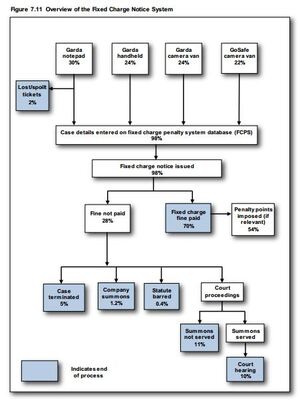
Chapter seven of the report deals with the Management of the Fixed Charge Notice System in 2011 and 2012, above.

The C&AG became interested in this area after a garda, unnamed in the report, contacted the C&AG seeking a meeting to discuss their concerns about the operation of the fixed charge notice system.

The garda gave the C&AG a file of information relating to around 4,000 cases where it appeared fixed charge notices were cancelled, resulting in drivers avoiding penalty points and a loss to the Exchequer. The file showed that multiple fixed charge notices were cancelled for some individuals.

The garda, who gave the C&AG the file, alleged that, in many cases, the notices were cancelled corruptly and illegally.

The garda also alleged a number of people who benefited from (one or more) cancellations of notices went on to commit further offences.

Some of these offences, it was alleged, resulted in deaths and/or injury to themselves and/or third parties.Continue reading →