Tag Archives: black hole

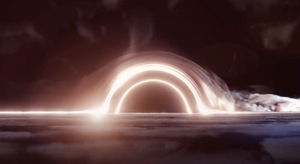
Behold: a spectacular animated representation of what happens when a star gets too close to a black hole. Cosmic dismemberment. To wit:

The black hole can rip it apart — but how? It’s not the high gravitational attraction itself that’s the problem — it’s the difference in gravitational pull across the star that creates the destruction. In the featured animated video illustrating this disintegration, you first see a star approaching the black hole. Increasing in orbital speed, the star’s outer atmosphere is ripped away during closest approach. Much of the star’s atmosphere disperses into deep space, but some continues to orbit the black hole and forms an accretion disk. The animation then takes you into the accretion disk while looking toward the black hole. Including the strange visual effects of gravitational lensing, you can even see the far side of the disk. Finally, you look along one of the jets being expelled along the spin axis. Theoretical models indicate that these jets not only expel energetic gas, but create energetic neutrinos — one of which may have been seen recently on Earth.

(Video: DESY, Science Communication Lab)

apod

Behold: the bright elliptical galaxy Messier 87 (M87) – home to the supermassive black hole whose spectacular image was captured in 2019 by the Event Horizon Telescope – the first ever visual of its kind. To wit:

 Giant of the Virgo galaxy cluster about 55 million light-years away, M87 is the large galaxy rendered in blue hues in this infrared image from the Spitzer Space telescope. Though M87 appears mostly featureless and cloud-like, the Spitzer image does record details of relativistic jets blasting from the galaxy’s central region. Shown in the inset at top right, the jets themselves span thousands of light-years. The brighter jet seen on the right is approaching and close to our line of sight. Opposite, the shock created by the otherwise unseen receding jet lights up a fainter arc of material. Inset at bottom right, the historic black hole image is shown in context, at the center of giant galaxy and relativistic jets. Completely unresolved in the Spitzer image, the supermassive black hole surrounded by infalling material is the source of enormous energy driving the relativistic jets from the center of active galaxy M87.

(Image: NASA, JPL-Caltech, Event Horizon Telescope Collaboration)

apod


Two gigantic superbubbles – each one thousands of light years across – near the centre of spiral galaxy NGC 3079.

Hot? They’re so hot they emit X-rays that can be detected by NASA’s earth-orbiting Chandra X-ray Observatory. To wit:

Since the bubbles straddle the center of NGC 3079, a leading hypothesis is that they were somehow created by the interaction of the central supermassive black hole with surrounding gas. Alternatively, the superbubbles might have been created primarily by the energetic winds from many young and hot stars near that galaxy’s center. The only similar known phenomenon is the gamma-ray emitting Fermi bubbles emanating from the center of our Milky Way Galaxy, discovered 10 years ago in images taken by NASA’s Fermi satellite. Research into the nature of the NGC 3079 superbubbles will surely continue, as well as searches for high-energy superbubbles in other galaxies.

apod